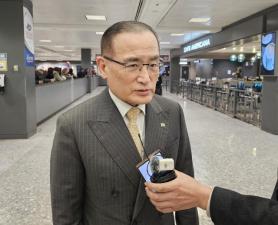
![Wi Sung-lac, South Korea’s national security adviser, briefs reporters on Dec. 24 at the presidential office press center about his trip to the United States, Canada and Japan. [Photo: Yonhap]](https://image.ajunews.com/content/image/2025/12/24/20251224131541105523.jpg)
SEOUL, December 24 (AJP) -South Korea and the United States will start working-level talks early next to write out a separate bilateral agreement on cooperation on nuclear-powered submarines, said Seoul’s national security adviser said Wednesday.
In a televised briefing on his back-to-back visits to the United States, Canada, and Japan, Wi Sung-lac specified the reasons for the need for a separate pact on the submarine program, which is linked to broader security commitments outlined in a joint fact sheet released last month.
“We shared the view that a stand-alone agreement on cooperation over nuclear-powered submarines is necessary, and agreed to move forward with discussions,” Wi said.
Wi traveled from Dec. 16 to 22 to the United States, Canada and Japan, holding meetings with senior officials including U.S. Secretary of State and national security adviser Marco Rubio and U.S. Energy Secretary Chris Wright. He described the talks in Washington as “practical and in-depth,” focused on implementing security commitments agreed at the leaders’ level.
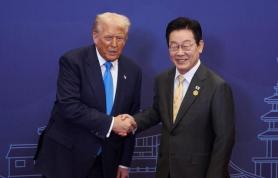
The submarine issue is part of follow-up measures stemming from a joint fact sheet issued after President Lee Jae Myung met U.S. President Donald Trump on the sidelines of the Asia-Pacific Economic Cooperation summit in Gyeongju in late October.
Under current U.S. law, transfers of nuclear material for military use are generally prohibited. However, exemptions may be granted through specific provisions or presidential authority, making a separate bilateral agreement a key procedural hurdle. Wi noted that Australia secured similar exceptions through its own arrangements with Washington.
On uranium enrichment and spent nuclear fuel reprocessing, Wi reiterated South Korea’s commitment to nuclear non-proliferation, stressing that Seoul plans to use low-enriched uranium below 20 percent for any nuclear-powered submarines and is not considering highly enriched uranium.
He said Seoul emphasized to Washington that stable access to low-enriched uranium is becoming a strategic issue amid volatility in global uranium markets, framing the matter as one of shared energy and security interests rather than a departure from non-proliferation norms.
A U.S. working-level delegation is expected to visit South Korea early next year to begin issue-by-issue consultations on security matters listed in the joint fact sheet. The two sides also agreed to set interim milestones — potentially around mid-2026 or the second half of the year — to review progress.
“Based on the results of this visit, we will actively operate consultation channels with the United States and make every effort to implement the agreements quickly and faithfully,” Wi said.
Beyond the submarine talks, Wi said discussions with U.S. officials also covered the stalled state of dialogue with North Korea, U.S.-China relations, Russia-North Korea military cooperation and broader regional security dynamics in Northeast Asia.
During stops in New York, Ottawa and Tokyo, Wi also met with U.N. Secretary-General Antonio Guterres, Canadian national security and defense officials, and senior Japanese policymakers. In Canada, he highlighted South Korea’s capabilities in submarine construction as Seoul seeks to participate in Ottawa’s next-generation submarine procurement program, while talks in Japan focused on maintaining stable bilateral relations and expanding regional coordination.
Wi acknowledged that differences can emerge among South Korean ministries on North Korea policy, but stressed that coordination through the National Security Council is essential to avoid mixed signals to allies.
“What matters is coordination,” he said.
Copyright ⓒ Aju Press All rights reserved.