
Journalist

Lee Hugh
=
-
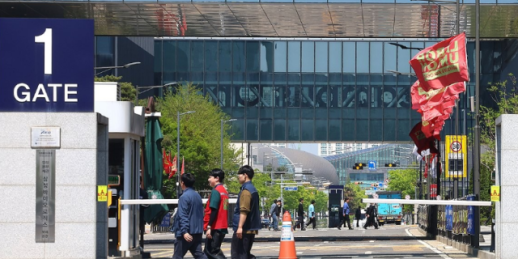 Samsung Biologics union launches first full strike as labor dispute escalates Samsung Biologics’ labor union began its first full strike since the company’s founding, intensifying a standoff in which both sides are trading blame. The union says management is responsible and is urging talks, while the company is calling for restraint and warning of heavy losses. Yonhap reported May 1 that the Samsung Biologics branch union will hold a five-day full strike from May 1 through May 5. Rather than a traditional walkout, members are participating by using annual leave. The union said about 2,800 of its roughly 4,000 members have indicated they will take part. The Songdo plant area in Incheon appeared quieter than usual, with only some employees seen entering and leaving. Banners and flags reading “ONE TEAM ON STRIKE” were posted inside the facility. While essential staffing is being maintained due to the nature of biopharmaceutical production, overall operations appeared subdued. The union said the dispute is rooted not in wages but in what it called management failures. It cited decisions that did not reflect conditions on the ground, chronic understaffing and excessive cost-cutting as factors that hurt competitiveness. The union said it sought negotiations for more than a month after mediation broke down, but the company focused on legal action and pressure instead of substantive talks. “If the company is concerned about losses and damage to customer trust, it should not shift responsibility to employees but come to the negotiating table,” the union said, calling for an immediate resumption of bargaining. The company has said a prolonged strike could result in losses of up to 6.4 trillion won. A previous partial strike in the material aliquoting unit disrupted production of 23 products, including anticancer drugs and HIV treatments, and was expected to cause about 1.5 trillion won in losses, according to the report. Chief Executive John Rim issued an apology message to employees the previous day, saying a strike is an individual choice but could have impacts that would be difficult for both the company and its members to recover from. He urged careful judgment and said the company would continue dialogue with the union to rebuild trust. The two sides have held more than 10 rounds of talks since late last year without reaching an agreement. The company sought a court injunction to ban strike action over concerns about production disruptions, and the court limited strikes only in some core processes. Labor and management are scheduled to meet again May 4 to discuss the direction of negotiations, but with positions far apart, a quick compromise remains uncertain.* This article has been translated by AI. 2026-05-01 14:06:00
 -
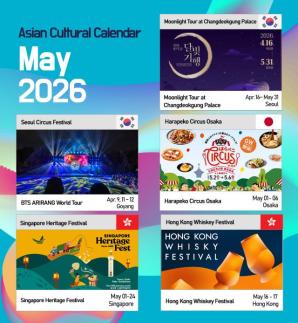 Asian Culture Calendar SEOUL, April 30 (AJP) - South Korea Apr. 8 - May 27 Gyeongbokgung Saenggwabang Apr. 16 - May 31 Moonlight Tour at Changdeokgung Palace May. 2 - 3 Ajou Motor College Festival May. 4 - 5 Seoul Circus Festival May. 5 - 10 Hangang River Festival May. 13 - 24 Suragan Sisik Gonggam May. 16 - 17 Yeon Deung Hoe May. 22 - 25 Hwaseong Boating Festival Japan May. 1 - 6 Harapeko Circus Osaka May. 2 - 3 Nyanko Expo May. 2 - 5 Saku Hot-Air Balloon Festival May. 3 - 4 Hakata Dontaku Festival May Hong Kong May. 16 - 17 Hong Kong Whiskey Festival May. 24 Cheung Chau Bun Festival Singapore May. 1 Mayday SG Festival 2026 May. 1 - 24 Singapore Heritage Festival May. 15 - 30 Singapore International Festival of Arts (SIFA) 2026-05-01 13:33:03
 -
 South Korea's exports top $80 billion for second straight month SEOUL, May 01 (AJP) - South Korea's exports surged 48 percent year-on-year in April to $85.89 billion, breaching the $80 billion threshold for a second consecutive month as a semiconductor supercycle powered by global artificial intelligence investment continued to underpin the trade-dependent economy. The Ministry of Trade, Industry and Energy reported Friday that the April figure trailed only the all-time high of $86.6 billion set in March, making it the second-largest monthly tally on record. Imports rose 16.7 percent to $62.11 billion, yielding a trade surplus of $23.77 billion and extending the country's streak of monthly surpluses to 15. Chip shipments drove the bulk of the gains. Semiconductor exports soared 173.5 percent to $31.9 billion, eclipsing the $30 billion mark for a second month in a row on surging demand for high-bandwidth memory, DDR5 and NAND flash used in AI server infrastructure. Computer exports also rocketed 515.8 percent to $4.08 billion, propelled by brisk enterprise demand for solid-state drives. Rising crude oil prices stemming from the prolonged Middle East conflict lifted petroleum product exports by 39.9 percent to $5.11 billion, though analysts noted the increase was driven largely by unit-price gains rather than higher volumes. Automobile shipments, by contrast, slipped 5.5 percent amid logistics disruptions in the Middle East and the overhang of U.S. tariff measures. By destination, exports to China jumped 62.5 percent on robust appetite for semiconductors and IT products, while shipments to the United States climbed 54 percent on the strength of chips and computers. Exports to the Middle East, however, tumbled 25.1 percent as the war disrupted trade routes. "South Korea saw its monthly exports surpass the $80 billion mark, along with a trade surplus of over $20 billion, for the second straight month for the first time in history in April even amid the persisting conflict in the Middle East," said Kim Jung-kwan, Minister of Trade, Industry and Resources. Analysts cautioned that the export boom remains heavily tethered to semiconductors and elevated oil prices, leaving it vulnerable to additional U.S. tariffs, a protracted Middle East war and a broader global slowdown in the second half of the year. 2026-05-01 12:59:59
 -
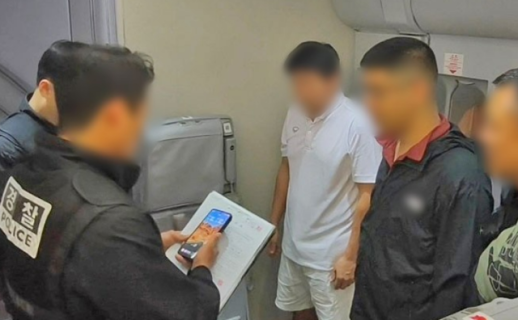 Alleged Supplier to ‘Drug Kingpin’ Park Wang-yeol Deported From Thailand to South Korea A man in his 50s accused of supplying drugs to Park Wang-yeol, described by police as a “drug kingpin,” has been arrested in Thailand and sent back to South Korea, authorities said. Investigators said securing the alleged key supplier will help expand the probe into the broader distribution network. The National Police Agency said Choi, 51, arrived at Incheon International Airport on May 1. Wearing a hat and mask, he was escorted by officers and did not answer reporters’ questions before being taken to investigators. Police said Choi used the Telegram names “Cheongdam” and “Cheongdam Boss” and is suspected of bringing into South Korea, or taking part in distributing, about 22 kilograms of methamphetamine and other drugs since around 2019. The drugs were valued at 10 billion won, police said, an amount they believe could support hundreds of thousands of doses. Police said they identified Choi as a major supply line while questioning Park after Park was deported from the Philippines. The Gyeonggi Nambu Provincial Police Agency consolidated related cases and tracked Choi after obtaining information that he was in Thailand. Authorities are also investigating how he stayed overseas without an official record of leaving South Korea. South Korean and Thai investigators narrowed the search to the Samut Prakan area near Bangkok and arrested Choi after surveillance in an upscale residential neighborhood, police said. He was detained on allegations of illegal stay, and deportation procedures moved quickly. Police said an arrest warrant was served as he returned on a Korean airline. At the time of his arrest, police said they seized a passport in another person’s name and 13 mobile phones. Investigators plan digital forensic analysis to check for additional crimes and possible accomplices, and to examine how the passport was used and the actual travel process. Police said they will focus on clarifying the supply structure and the scale of transactions centered on the alleged link between Choi and Park, including whether there were overseas production or distribution bases. Authorities said they are also tracing money flows with relevant agencies and will move to recover confirmed illegal proceeds. Police said they are considering seeking a warrant to detain Choi. “We are continuing the investigation under the principle that we will track and arrest suspects to the end even if they are overseas,” a police official said. “We will concentrate our investigative resources on identifying the entire drug distribution organization.”* This article has been translated by AI. 2026-05-01 12:00:12
 -
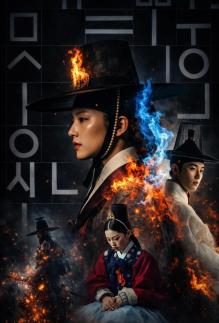 Novelist Ye Sun-young Reimagines Queen Soheon in the 1426 Great Hanseong Fire Ye Sun-young is a writer who moved from the front lines of record-keeping to the work of fiction. As a reporter, he spent years chasing events and verifying facts, documenting the surface of history. In that process, he says, he found another truth: Records are never complete, and many people disappear without ever being written down. His fiction begins in that gap. Between the lines of the Annals, beneath the numbers in statistics, and in the margins of history books are people who existed but were not preserved. His novel, 『Hanseong Great Fire, Queen Soheon』, is an attempt to call them back. Blending a reporter’s cool eye with a novelist’s imagination, Ye’s prose goes beyond reenactment to restore the dignity of those left unrecorded. He also reflects on how human presence expands and is marginalized in today’s digital civilization, reading the past’s revolution in writing and the present’s technological revolution as part of a single continuum. History can leave only numbers and erase people. In 1426, the eighth year of King Sejong’s reign, flames that began in central Hanseong burned for three days and nights and engulfed the city. About 2,000 homes were destroyed and hundreds of lives were lost, recorded as the largest urban disaster of the early Joseon period. The record is blunt: “Thousands of homes destroyed, hundreds dead.” No names. No faces. Only figures. The lives and suffering inside those numbers vanish from history, in part because most commoners at the time could not read or write and had no way to record themselves. The novel also frames the fire against a “power vacuum.” Sejong and Crown Prince Munjong were away from Hanseong on a hunt in the Hoengseong area of Gangwon Province. With the top rulers absent, the disaster became not only a fire but a crisis of governance. In a capital without the king and crown prince, the chain of command wavered, the flames spread faster, and the response was delayed. The Hanseong fire is presented as a case in which physical conditions and political conditions combined to magnify destruction. In that vacuum, authority shifts. In Joseon’s system, the queen was not meant to step to the political forefront. But in a crisis, boundaries can break, and power concentrates in whoever can direct events. Ye places Queen Soheon at the center. Pregnant, she is portrayed not as someone to be evacuated but as a decision-maker. As ministers panic, she asks, “Are we putting out the fire now, or are we protecting the country?” She decides: “The people’s homes can be rebuilt, but if the royal ancestral shrine and the altars of state fall, the country has nowhere to stand.” The choice is harsh, but the novel presents it as the language of statecraft. Ye then turns to what she confronts beyond the flames: a procession of unnamed deaths. Many people vanish in the fire, and none are recorded. He reconstructs the scene with restraint and sympathy. “Under the burning roof tiles, the crying stopped, and no one remembered who the crying belonged to,” he writes. Elsewhere: “If you live without a name, and die without a name left behind, where does that life remain?” The lines are not only description but a question about existence. After the fire subsides, the queen is left alone. “I never once called their names,” she says. The confession underscores the limits of power: Before lives that cannot be protected and people who cannot be recorded, authority becomes helpless. Only then, the novel suggests, does she face the tragedy of a “society without letters.” The experience does not end as an incident; it accumulates. The story jumps ahead 18 years after the fire, following what builds in palace archives, the Hall of Worthies, and Sejong’s thinking. At the center of that accumulation is the queen’s silence — a question that does not disappear: “Why can the people not leave even a single name behind?” Ye restores that question as dialogue. “Your Majesty, people without writing are like the wind. Even if they pass by, there is no trace, and even if they disappear, they are not remembered,” the queen says. In another scene: “A death that cannot leave a name is like dying twice.” The novel acknowledges these lines are not in the official record, but presents them as language that most honestly reveals the era’s reality. Hunminjeongeum is reread through that lens. It is not reduced to the king’s achievement alone, but framed as an answer to those who could not be recorded — a civilizational decision to bring nameless people into history. The 18 years between the 1426 fire and the 1446 promulgation are not treated as mere time. They are years in which questions accumulate, pain turns into reflection, and reflection condenses into resolve. Writing is power, but also a tool of liberation. Hangul is described as the first tool that allowed commoners to record themselves — to write their names, appeal injustices and leave traces of their lives. In that sense, Hangul becomes not only a system of knowledge but a means of existence. Ye’s interpretation is bold, the article says, but persuasive, building a consistent narrative by adding literary imagination atop the facts of the Annals and historical sources. The Hanseong Great Fire is not only an event of flames, the article argues, but an event that asks what it means to exist. 『Hanseong Great Fire, Queen Soheon』 is presented as a literary response: The fire burned the city, but left a question. That question led to letters, and letters made people exist again. A society without writing cannot record people. People who are not recorded are, in effect, treated as if they did not exist. In that view, Hangul is not merely characters but a civilization that allowed people to be born again in the record. The article ends by posing a present-day question: Who is being recorded, and who is still not? ■ Who was Queen Soheon Queen Soheon was the primary queen consort of King Sejong, the fourth king of Joseon. She was from the Cheongsong Sim clan and is known as the daughter of Sim On. The article describes her as more than the highest-ranking figure of the inner court, portraying her as a key person who helped lay the foundation for Joseon’s peak alongside Sejong. It says she showed calm restraint but firm judgment in national crises, and that her decisions and sense of responsibility in emergencies such as the Hanseong Great Fire are viewed as a model of political leadership. It also says she understood and supported Sejong’s scholarship and policies, and is interpreted as providing an important spiritual foundation behind the civilizational achievement of creating Hangul. She gave birth to eight princes and two princesses, stabilizing royal succession, and is remembered as a queen with deep compassion for the people and a strong sense of moral responsibility. * This article has been translated by AI. 2026-05-01 11:18:29
 -
 Lee calls for end to 'pro-labor vs. pro-business' divide SEOUL, May 01 (AJP) - South Korean President Lee Jae Myung called for an end to the long-standing dichotomy that pits workers against employers, vowing to deliver "real growth" through cooperation between labor and management. Speaking at a Labor Day ceremony at the Blue House on Friday — the first such event ever held at the former presidential compound — Lee said the country could only move forward by abandoning the "outdated binary" of pro-labor versus pro-business politics. About 120 figures from labor, business, government and civil society attended the gathering. "A society that respects labor and a country that is good for doing business are not mutually exclusive. There are no workers without companies, and no companies without workers," Lee said. The event marked the first time the country's two rival umbrella unions, the Federation of Korean Trade Unions and the more militant Korean Confederation of Trade Unions, jointly attended a government Labor Day ceremony, an unprecedented show of unity that the Blue House described as a response to the administration's labor-respecting agenda. Lee, a former teenage factory worker, pledged to expand basic labor rights to non-regular employees, subcontractors, platform workers and freelancers, and said workplace safety would not be compromised. He framed safety as "a fundamental duty of the state and corporations, not a cost or a choice," cautioning against forcing workers to bear one-sided sacrifices in the name of productivity gains driven by artificial intelligence. The remarks come amid heightened labor tensions in South Korea, including a planned large-scale walkout by the Samsung Electronics union as well as Samsung Biologics, and follow legislation that restored the holiday's original Korean name, Nodongjeol, and elevated it to a statutory public holiday for the first time in 63 years. Lee, who said he was proud to have once been a "boy laborer" himself, vowed to answer workers' voices with "a heavy sense of duty" as the country navigates the twin pressures of the AI transition and the climate crisis. 2026-05-01 10:45:15
 -
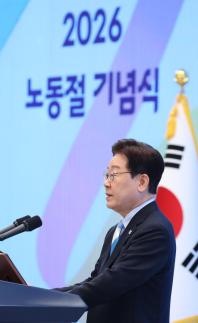 Lee Jae-myung urges end to 'pro-labor vs. pro-business' divide in Labor Day speech President Lee Jae-myung said Thursday that South Korea can move toward a better future only by breaking what he called an outdated binary that “pro-labor is anti-business” and “pro-business is anti-labor.” Speaking at a Labor Day ceremony at the Blue House, Lee said he would “open a path of shared growth where labor and business move forward together.” Lee said growth that leaves no future for workers — who make up most of the public — “cannot be called real growth.” He described workers as the key economic actors, supporting the economy through production at work and driving development as consumers outside the workplace. The following is the full text of President Lee’s Labor Day address. Dear fellow citizens, And workers — the proud name that moves the world, Today, we gather to honor the sweat, dedication and value of labor as we mark Labor Day, which has “reclaimed its name” for the first time in 63 years. With us are senior figures from the labor community and representatives of economic organizations. Workers from many fields — including civil servants and teachers — and those engaged in new forms of work are also here. Because workers across the country quietly fulfilled their responsibilities and kept workplaces running, today’s Republic of Korea was possible. I extend my respect and gratitude to all workers in this land — the drivers of production, the core engine of economic growth and the leading force behind our nation’s development. Most people in Korea work for a living. The forms of work vary, but people provide their labor and sustain their lives in return. Yet labor is not only a means of making a living. Through work, we realize ourselves, change our lives and bring change to the world. Labor supports an individual’s daily life, protects a family’s present and is the source of strength that carries our community into tomorrow. I, too, worked in a factory as a child laborer. I would head to work early in the morning and end the day late at night — sometimes at dawn — with hands stained with grease. It would be a lie to say it was not exhausting. But being able to protect my family with the sweat I shed at work was a great comfort and the strength that made me who I am today. I was a child “worker,” and I am still proud of that name. That is why today, when we use the name “Labor Day” rather than “Workers’ Day,” feels especially meaningful to me. A moment ago, we heard the voices of many workers. Though their jobs, generations and genders differ, their voices carried the same dream — a dream no different from what I felt as a child factory worker. The desire to work safely and have one’s labor respected does not change, no matter the era or circumstances. As a president who once was a child factory worker, I will answer your voices with a deep sense of duty. Dear workers, We stand in the middle of enormous change. Artificial intelligence is reshaping industries and the way we work. The climate crisis is also redefining the standards of national competitiveness. Rapid change may be an opportunity for some, but a major threat to survival for others. Many forecasts say machines and AI will replace much of human labor as technology advances. But we must not demand one-sided sacrifice from workers in the name of productivity alone. Growth without a future for workers — who make up most of the public — cannot be real growth. Workers are the most important economic actors, sustaining our economy through production and driving development as consumers. Even if this wave of change is unavoidable, finding a path of shared growth is the way to a sustainable tomorrow for all of us. In this great transition, the government will take special care so that each working citizen can build a life that is safer, fairer and more dignified. On this Labor Day, I make three promises to the public and to workers. First, we will never compromise on workplace safety. We will build a normal country where workers do not have to risk death to do their jobs. At any worksite in Korea, life and safety must never be placed behind profit and performance. I will make clear that protecting safety is not a cost or an option, but the minimum basic duty that the state and companies must uphold. Second, we will ensure that all workers can enjoy basic labor rights. Rights must not vary because employment types or ways of working differ. Whether regular or nonregular, prime contractor or subcontractor, platform worker or freelancer, anyone who works should be treated fairly. We will pay close attention so that no one falls into blind spots of protection. Third, we will open a path of shared growth where labor and business move forward together. A society that respects labor and a country where it is good to do business are not incompatible. There are no workers without companies, and no companies without workers. Only by breaking the outdated binary of “pro-labor is anti-business” and “pro-business is anti-labor” can we move toward a better future. Respect for labor is not a matter of charity or favor. Growth without labor is only half a growth and cannot be sustainable. Growth with labor is growth with a future. We will build an ecosystem of shared growth where labor and management can respect each other and talk. We will realize “real growth” in which labor and business, fairness and innovation, and growth and distribution reinforce one another in a virtuous cycle. Dear fellow citizens, Today, along with this Labor Day ceremony, various events are being held nationwide, including a street festival at Cheonggye Plaza. These events were prepared over a long period with labor, management, government and civil society working together. I believe that the fact that labor and management are together here today shows the efforts made so far for respect and shared growth. People with different positions cannot always think the same way. But we must not turn away from one another or become hostile because of differences. The first step toward dialogue already began in the preparation process. The fact that everyone has started drawing a blueprint for shared growth together is, in itself, one of the greatest meanings of today’s Labor Day. Today’s dialogue must continue. We will turn what we discussed here into changes in workplaces and into policies that improve people’s lives. We will, together with the public and with workers, build a normal country where people can return safely to their families after the workday ends — a Korea where labor is respected, workers are treated with dignity, and everyone who works hard can shine. Thank you.* This article has been translated by AI. 2026-05-01 10:33:20
 -
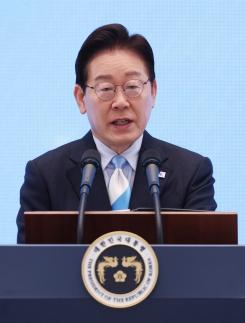 Lee Jae-myung Says Growth Without Labor Is ‘Only Half’ as He Marks Labor Day President Lee Jae-myung said May 1 that “growth with labor is growth with a future,” calling for a sustainable economy built on respect between workers and companies. Speaking at a Labor Day ceremony at the Cheong Wa Dae State Guest House, Lee said respect for labor “is not simply a matter of consideration or charity.” “Growth without labor is only half, and it is not sustainable,” he said, pledging to build “a cooperative ecosystem” in which labor and management respect each other and can hold dialogue. Lee stressed that a society that respects labor and a country that is good for doing business are not mutually exclusive. “There are no workers without companies, and no companies without workers,” he said. He said he would pursue “real growth” in which labor and business, fairness and innovation, and growth and distribution reinforce one another. Lee also pointed to Labor Day events being held nationwide, calling them the result of long preparation by labor, management, government and civil society. He said the joint presence of labor and business at the ceremony itself reflected efforts toward respect and coexistence. On the era of artificial intelligence, Lee said many expect machines and AI to replace most human labor, but warned that workers should not be forced into “one-sided sacrifice” solely for productivity gains. “Growth without a future for workers, who make up the majority of the public, cannot be called real growth,” he said, adding that even amid unavoidable change, finding a path of coexistence is key to a sustainable tomorrow. Lee, who noted he once worked as a factory boy, recalled starting early for work and ending late at night, sometimes at dawn, with oil-stained hands. He said being able to protect his family through the sweat of labor was a comfort and a source of strength that helped shape who he is today. Lee made three pledges. First, he said he would “never compromise” on workplace safety. Second, he promised to ensure all workers can enjoy basic labor rights, including regular and nonregular workers, prime contractors and subcontractors, platform workers and freelancers. Third, he pledged to open a path of coexistence in which labor and business move forward together, again saying a labor-respecting society and a business-friendly country can coexist. The ceremony was the first Labor Day event since “Workers’ Day” was renamed “Labor Day” after 63 years. It was also Lee’s first Labor Day since taking office, and the first time Cheong Wa Dae has hosted the ceremony. The day had been called “Workers’ Day” since a 1963 law established it. The official name changed after a legal revision in October last year. About 120 workers from various occupations and generations attended. For the first time, both major umbrella labor groups — the Federation of Korean Trade Unions and the Korean Confederation of Trade Unions — took part, the report said.* This article has been translated by AI. 2026-05-01 10:24:17
 -
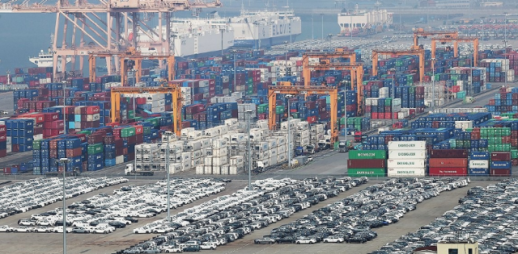 South Korea Exports Top $80B for Second Straight Month on AI Chip Surge South Korea’s exports stayed above $80 billion for a second straight month in April, extending the momentum after first crossing the threshold in March, led by a sharp rise in semiconductor shipments tied to the global boom in artificial intelligence. With the Middle East war sending shock waves across industries, exports are being seen as a key support for the economy. According to Yonhap, the Ministry of Trade, Industry and Energy released April trade figures on Thursday. Exports rose 48.0% from a year earlier to $85.89 billion despite the war in the Middle East. After never having posted a $70 billion month, South Korea exceeded $80 billion in March for the first time and remained above that level in April. April’s total was the second-highest monthly export figure on record, following March’s $86.6 billion. Average daily exports, adjusted for working days, also rose 48.0% to $3.58 billion, topping $3 billion for a third consecutive month. Semiconductors drove the gains. Chip exports surged 173.5% to $31.9 billion, the second-highest monthly total on record after $32.8 billion in March. Semiconductors exceeded $30 billion for a second straight month and posted a record for the month for the 13th consecutive month. Auto exports fell 5.5% to $6.17 billion, as logistics disruptions from the Middle East war and increased local production in the United States following U.S. tariffs weighed on shipments. Exports of eco-friendly vehicles, including electric and hybrid models, increased. Petroleum product exports rose 39.9% to $5.11 billion on higher oil prices, but export volumes fell 36.0%. The ministry said exports of gasoline (down 43.0%), diesel (down 23.2%) and kerosene (down 99.9%) dropped sharply from a year earlier after export control measures were introduced for petroleum products. Petrochemical exports increased 7.8% to $4.09 billion, though export volumes fell 20.9% as domestic supply rose. Among 15 major export items, eight posted gains, including computers ($4.08 billion, up 515.8%) and wireless communications equipment ($1.62 billion, up 11.6%). Exports to China climbed 62.5% to $17.7 billion, extending gains for a sixth straight month on stronger shipments of semiconductors and other IT products such as computers and wireless communications equipment. Exports to the United States rose 54.0% to $16.33 billion, led by items such as semiconductors and computers that were described as exempt from tariffs. Shipments to ASEAN rose 64.0% to $15.41 billion, and exports to the European Union increased 8.5% to $7.19 billion, also supported by semiconductors. Exports to the Middle East, however, fell 25.1% to $1.27 billion due to factors including logistics disruptions. Imports increased 16.7% to $62.11 billion. Energy imports rose 7.5% to $10.61 billion, while non-energy imports climbed 18.8% to $51.51 billion. The trade balance posted a $23.77 billion surplus in April, extending the surplus streak to 15 months. Industry Minister Kim Jeong-gwan said April marked the first time the country recorded exports of more than $80 billion and a trade surplus of more than $20 billion for two consecutive months while the Middle East war continued for more than two months. He attributed the results to expanding global AI investment, higher unit prices for petroleum products amid rising oil prices, and companies securing supply chains in advance. Kim warned that export volatility could increase due to intensifying competition in key products and difficulties in securing raw materials linked to the Middle East war. He said the government would seek to reduce burdens on companies through marketing, financing and insurance support and policies to diversify export markets, while actively using trade networks to secure additional alternative supplies of crude oil and naphtha. * This article has been translated by AI. 2026-05-01 10:18:18
 -
 Apple's incoming CEO signals new products as quarterly revenue hits record SEOUL, May 01 (AJP) - Apple's incoming chief executive John Ternus voiced strong confidence in the company's product pipeline, hinting at new categories on the horizon as the iPhone maker posted record fiscal second-quarter revenue. Speaking on a conference call on Thursday (local time) after Apple reported results for the January-March quarter, Ternus, who takes the helm in September from Tim Cook, said the company had "an incredible roadmap" ahead and was preparing fresh offerings, though he declined to disclose details. "Suffice it to say, this is the most exciting time in my 25-year career at Apple to be building products and services.," Ternus said, suggesting work was under way on new product forms. He pledged to carry on the financial discipline that defined Cook's 15-year tenure. Apple posted revenue of $111.18 billion for the quarter, up 17 percent from a year earlier and surpassing the LSEG consensus estimate of $109.66 billion for an all-time high in the period. Earnings per share came in at $2.01, beating Wall Street's $1.95 forecast. iPhone sales jumped 21.7 percent to a record $56.99 billion but fell just shy of the $57.21 billion analysts had projected, while the iPad, Mac, wearables and services divisions all topped expectations. Services revenue reached $30.98 billion, and research and development spending climbed 33.6 percent to $11.42 billion as the company widened its artificial intelligence push. Cook flagged supply constraints during the quarter, particularly for the iPhone, tied to limited capacity at advanced chip nodes operated by Taiwan's TSMC, and warned that the squeeze would tighten in the April-June quarter. 2026-05-01 10:02:18