
Journalist

Lee Hugh
=
-
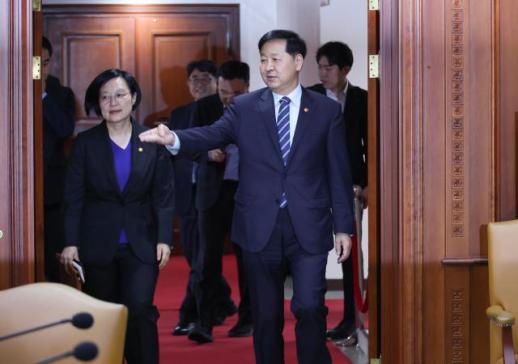 South Korea’s Koo Yun-cheol to Travel to Uzbekistan for Trilateral, ADB Meetings Deputy Prime Minister and Minister of Finance and Economy Koo Yun-cheol will depart for Uzbekistan to attend a series of major international meetings, including a trilateral meeting of finance ministers from South Korea, China and Japan and the annual meeting of the Asian Development Bank (ADB). The Ministry of Finance and Economy said Thursday that Koo will leave on May 2 for Samarkand, where he will chair the South Korea-China-Japan meeting of finance ministers and central bank governors and attend the ASEAN+3 meeting of finance ministers and central bank governors, as well as the 59th ADB annual meeting. Koo is scheduled to chair the trilateral meeting on May 3. Participants will share their countries’ economic conditions and policy responses in light of developments in the Middle East war and exchange views on regional financial cooperation. He will then attend the ASEAN+3 meeting, which brings together ASEAN members and South Korea, China and Japan. Officials from the International Monetary Fund, the ADB and the ASEAN+3 Macroeconomic Research Office are also expected to take part in discussions on global and regional economic trends and ways to strengthen the financial safety net. Strengthening the Chiang Mai Initiative Multilateralization (CMIM) is expected to be a key agenda item. The CMIM is a multilateral currency-swap arrangement designed to provide liquidity support to ASEAN+3 members in times of crisis, with a total size of about $240 billion. Koo will also attend the ADB annual meeting from May 4-5 and present South Korea’s views on sustainable and inclusive growth in the region and on cooperation among member countries. On the sidelines, he plans bilateral talks with the ADB president, Uzbekistan’s deputy prime minister and Singapore’s finance minister to discuss ways to expand economic cooperation. * This article has been translated by AI. 2026-04-30 17:03:19
 -
 Ambassador Roh Jae-heon Urges Korea-China Youth to Serve as Bridge Between Peoples Ambassador Roh Jae-heon to China visited Shanghai on a one-night, two-day trip starting April 29, carrying out public diplomacy centered on Korea-China exchanges in youth, culture and history. The Korean Embassy in China said Roh delivered a lecture at NYU Shanghai on April 29 titled "A New Era in Korea-China Relations" and met with students for an open discussion. He said young people in both countries should pursue global cooperation in areas including innovation, culture and peace, and urged them to serve as a bridge connecting the two peoples, especially among future generations. Roh later visited a mixed-use shopping complex in central Shanghai, attended an opening ceremony for a Korean company store and toured the Korea SMEs and Startups Agency's Global Business Center. He also held a public-private meeting with officials and businesspeople to review the status of the government's "K-Initiative" and exchange views on ways to implement it more effectively. On April 30, Roh visited the grave of Korean film figure Kim Yeom, known as the "emperor of film" for his work in China in the 1930s, and laid flowers. He also visited the Shanghai site of the Korean Provisional Government, underscoring historical ties between the two countries. In a meeting with an official from the Shanghai Foreign Affairs Office, Roh praised Chinese authorities for their efforts to preserve the site as the 107th anniversary of the establishment of the Korean Provisional Government approaches. He called for continued cooperation so more visitors can commemorate the shared history of Korea and China. The embassy said the trip strengthened public diplomacy, including youth exchanges, supported Korean businesspeople, and provided an opportunity to discuss and review the spread of the government's cross-agency K-Initiative and ways to improve its implementation. * This article has been translated by AI. 2026-04-30 16:58:43
 -
 South Korea seeks discipline for 12 officials over mishandled recovery in 12·29 Jeju Air crash The Office for Government Policy Coordination said it will seek disciplinary action against 12 public officials over what it called a poor recovery effort that left victims’ remains inadequately collected and stored for an extended period after the 12·29 Jeju Air passenger plane disaster. The office’s joint government inspection team on Wednesday released results of an intensive review conducted for about a month starting March 23, covering the Aviation and Railway Accident Investigation Board, the Ministry of Land, Infrastructure and Transport, and related agencies including police, fire authorities and the military. The team said early search and recovery operations were incomplete because there were no detailed guidelines for aircraft-accident recovery and because on-scene command and oversight by fire and police officials were insufficient. It also said the investigation board violated relevant rules and manuals while storing and managing debris that included unrecovered remains, leaving it piled up and unattended for a long period. The team said it will notify the relevant ministries of its findings and request disciplinary measures for 12 officials: six from the investigation board, four from the transport ministry, and one each from police and fire authorities. According to the team, the initial recovery led by fire and police authorities was carried out without a manual, and many inexperienced personnel were deployed, contributing to a flawed operation. It found the South Jeolla Fire Headquarters, which oversaw the first search, ended that initial operation on Jan. 7 last year even though remains continued to be found at the site. A second search led by the South Jeolla Provincial Police Agency ended, and the team said police did not review whether additional searches were needed even after learning that remains were found the next day. The team said the investigation board failed to properly check debris mixed with remains, placed it in large sacks and left it for 14 months, and did not respond promptly to bereaved families’ requests for a renewed search. Kim Young-soo, first vice minister at the Office for Government Policy Coordination, said the inspection was carried out quickly to ease, even slightly, the pain of bereaved families who have suffered additional distress due to the delayed recovery. He said he hoped the findings would help address suspicions raised about inadequate early recovery and the long-term neglect of remains.* This article has been translated by AI. 2026-04-30 16:57:18
 -
 Court Halts FIU Sanction, Allowing Bithumb to Keep Operating for Now Bithumb, a South Korean virtual asset exchange, has avoided a financial regulator’s business suspension for now. According to the legal community on Wednesday, the Seoul Administrative Court’s Administrative Division 2, presided over by Chief Judge Gong Hyeon-jin, granted Bithumb’s request to suspend the Financial Intelligence Unit’s (FIU) sanction of a “six-month partial business suspension.” The measure will remain suspended until the court rules on the main case. The FIU had said Bithumb violated obligations under the Act on Reporting and Using Specified Financial Transaction Information — including bans on dealing with unreported virtual asset businesses, customer identification (KYC) requirements and transaction restriction duties — a total of 6.65 million times. Last month, the FIU imposed a six-month partial suspension and a 36.8 billion won fine. The partial suspension restricts new customers from transferring virtual assets to and from external wallets. It is the toughest sanction imposed on a domestic exchange operating a won-based market. The sanction had been set to take effect March 27, but Bithumb sought an injunction, leaving the measure temporarily on hold through Wednesday. With the court’s decision, Bithumb can continue operating under its current business model until the lawsuit is resolved. A Bithumb official said the company “plans to faithfully explain its position in the remaining procedures.”* This article has been translated by AI. 2026-04-30 16:54:16
 -
 Shinhan Financial to Launch $100 Million Venture Fund, Targeting $1 Billion in Startup Investment Shinhan Financial Group said it will launch a private venture fund-of-funds and provide investment support totaling 1 trillion won for youth-led and regional startups. Shinhan said it signed a memorandum of understanding on Thursday with the Financial Services Commission and the Ministry of SMEs and Startups to boost venture investment and will launch a 100 billion won fund-of-funds. The fund is the first project to be carried out under a public-private cooperation framework built with the FSC and the SMEs ministry to expand venture investment. Shinhan said the aim is to help close early-stage funding gaps for youth and regional startups and increase the supply of private risk capital. The Shinhan Venture Innovation Fund of Funds, which is targeting formation in June, will be managed by Shinhan Venture Investment. Key affiliates including Shinhan Bank, Shinhan Card, Shinhan Investment Corp. and Shinhan Capital will participate as investors. Shinhan said it will use 100 billion won of its own money as seed capital to draw private participation and expects leverage from forming sub-funds to expand total assets under management to about 1 trillion won. Investment targets include promising startups and growth-stage companies in advanced industries such as artificial intelligence and semiconductors. Shinhan said it will also invest in early-stage youth startups by participating in Korea Venture Investment Corp.'s LP Growth Fund program. Jin Ok-dong, chairman of Shinhan Financial Group, said the fund is "a starting point for the entire group to help remove the early funding hurdle, the biggest barrier for young founders." He said Shinhan will be "a reliable partner at every stage, from the start to global growth."* This article has been translated by AI. 2026-04-30 16:52:23
 -
 Survey: 82.2% of South Korean women-owned firms say Middle East crisis is hurting business As fallout from the Middle East crisis spreads across South Korea’s small-business sector, a new survey found that more than 8 in 10 women-owned companies say their operations are already being hit. Many reported a double squeeze from higher input costs and weaker domestic consumption. According to a survey released Thursday by the Women’s Economic Research Institute under the Women’s Enterprise Comprehensive Support Center, 82.2% of women-owned firms said their business activities are currently being affected. Including those expecting an impact (12.3%), 94.5% said they are feeling risks tied to the Middle East situation. Among firms reporting an impact, 97.2% said the severity was “moderate or higher,” underscoring heightened concern in the field. On the cost and supply side, the most-cited factor was rising raw material prices (49.4%), followed by raw material supply disruptions (12.7%) and higher oil prices (11.8%). On the market and demand side, firms pointed to weaker domestic demand due to subdued consumer sentiment (30.1%) and fewer or canceled orders from clients (28.5%). Profitability indicators also worsened, with 89.5% of women-owned firms expecting sales to decline. For direct support, respondents most often requested emergency management stabilization funds (45.3%) and broader financial support (42.6%). For indirect support, they sought help easing difficulties related to laws, institutions and regulations (38.9%) and consulting on business strategy and crisis response (38.5%). Separately, the number of small and medium-sized enterprises reporting damage linked to the Middle East war has been rising weekly. As of April 29, the Ministry of SMEs and Startups said it had received 733 reports. Of those, 547 were classified as “damage and difficulties,” up 51 from the previous week; 116 were “concerns,” up 3; and 70 were “not applicable,” up 2. Park Chang-sook, chair of the Women’s Enterprise Comprehensive Support Center, said the survey shows how external risks tied to the Middle East are destabilizing the business environment for women-owned firms. She urged the government to move quickly with emergency stabilization funding and easing of financial regulations to build an effective safety net.* This article has been translated by AI. 2026-04-30 16:51:21
 -
 Socar to Launch 150 Billion Won Self-Driving Unit; Krafton to Invest 65 Billion Won Socar said it is pushing to set up a self-driving-focused subsidiary with planned investment of 150 billion won, a level it described as among the largest in South Korea’s autonomous driving services sector. Video game company Krafton will join the project as a strategic investor. Socar said Thursday the new company is expected to be established in May. Socar CEO Park Jae-wook, who has led the company’s autonomous driving initiatives, will also serve as CEO of the new unit and oversee the business directly, it said. As part of the partnership, Krafton will make a 65 billion won strategic investment in Socar through a third-party allotment paid-in capital increase, Socar said. Krafton will become a major shareholder of Socar and will also make a separate investment in the new subsidiary as a core investor, the company said. Socar said it plans to participate in forming the new unit by contributing cash and data assets, pending board approval. Socar said the project is being viewed as an unprecedented private-sector collaboration aimed at accelerating commercialization of autonomous driving services in South Korea, as well as one of the largest investments of its kind. The company said it will concentrate 15 years of accumulated autonomous driving data and mobility platform operating capabilities into the new unit. It said that through its “Future Mobility TF,” launched earlier this year, it built a centralized data pipeline that collects real-time driving data based on its car-sharing fleet of about 25,000 vehicles, totaling about 1.1 million kilometers of real-world driving per day. Socar said it has also secured a range of edge-case data, including about 220,000 accident records, and processed the data — including anonymization, time synchronization and tag labeling — into a format that can be used immediately for AI training. It said the work is helping speed efforts to commercialize autonomous driving services. Socar said the new unit will pursue a phased commercialization strategy, starting with Level 2 car-sharing services and later expanding into fully autonomous, consumer-facing services such as Level 4 ride-hailing. It said it will work to internalize technology while validating it in real-world services, build independent technical and operational capabilities, and pursue partnerships to compete in both domestic and global markets. “Our goal goes beyond simply developing autonomous driving technology — it is to commercialize it successfully and fundamentally change how users move and their quality of life,” Park said. “Based on the data and operational know-how Socar has built over 15 years, we will create a new standard for the future mobility market.” An industry official said Socar is effectively the only company with large-scale real-world driving data accumulated by everyday users. “This kind of data is a unique competitive advantage that cannot be built in a short period of time,” the official said. * This article has been translated by AI. 2026-04-30 16:49:52
 -
 Prosecutors Add Charges in Gangbuk Motel Serial Killing Case, Citing More Victims Prosecutors have filed additional charges against Kim So-young, 20, the suspect in the so-called Gangbuk motel serial killings, after confirming signs of more alleged attacks. Authorities said similar drugging cases involving other men were uncovered beyond the incidents already indicted. According to Yonhap News Agency on the 30th, the Seoul Northern District Prosecutors Office’s Criminal Division 2, led by Chief Prosecutor Kim Ga-ram, additionally indicted Kim on charges of aggravated injury and violating the Narcotics Control Act. Kim was previously arrested and indicted on March 10 on allegations that from mid-December last year through February this year she gave drug-laced drinks to three men in their 20s, killing two and leaving one unconscious. During the investigation, police said they found indications that Kim used the same method — offering a “drugged drink” — to injure three other men. The additional cases were sent to prosecutors on March 19, and prosecutors decided to bring the new indictment after further investigation. At the first trial on April 9 before the Seoul Northern District Court’s Criminal Division 14, presided over by Judge Oh Byeong-hee, Kim’s side said, “She admits giving the victims drinks, but denies the charges of aggravated injury and murder.” The defense argued the purpose was to make the victims fall asleep, not to kill them. The court said intent must be judged from the circumstances and demanded a detailed explanation of how Kim met the victims and how the alleged crimes unfolded. The court also told prosecutors to prove, based on the charges for each victim, how intent to kill was formed. The hearing ended in about 10 minutes after confirming both sides’ basic positions. Kim appeared in a green detention uniform and a white mask and said she did not want a jury trial. The gallery filled before proceedings began, and some bereaved family members strongly objected, calling for the maximum sentence. The next hearing is scheduled for May 7 at 3:30 p.m. 2026-04-30 16:48:18
 -
 Hanon Systems Q1 Operating Profit Jumps 361% to 97.2 Billion Won Hanon Systems, an automotive thermal energy management solutions company under the Hankook & Company Group, posted sharply improved results. In a regulatory filing on the 30th, Hanon Systems said its first-quarter operating profit on a consolidated basis was 97.2 billion won, up 361.1% from a year earlier on a preliminary tally. Revenue rose 5% to 2.7482 trillion won. Net profit was 67.5 billion won, returning to the black. The company said the performance reflects companywide restructuring efforts pursued since its acquisition by the Hankook & Company Group. Hanon Systems has maintained an operating margin in the 3% range since the second half of last year and posted a 3.5% margin in the first quarter, citing improved cost ratios and greater operating efficiency. Electrification, a key growth area, accounted for 29% of revenue, putting it close to surpassing 30% of total sales. The company said it responded flexibly to demand for internal-combustion and hybrid models, as well as the impact of new electric-vehicle launches. It said further revenue growth is expected this year, driven by European customers expanding electrification and rising demand for hybrids. Based on a full-line portfolio spanning internal-combustion vehicles to hydrogen fuel-cell electric vehicles, the company said it plans to introduce intelligent solutions that apply artificial intelligence to maximize energy efficiency. Vice Chairman and CEO Lee Soo-il said, "Based on our accumulated thermal management capabilities, we will accelerate qualitative growth by pursuing future new businesses such as AI-based integrated thermal management solutions, secure long-term financial soundness, and strengthen our technology leadership in the global market."* This article has been translated by AI. 2026-04-30 16:45:19
 -
 CNN: U.S. Iran War Costs Could Reach $50 Billion, Double Pentagon Figure The cost of the U.S. war with Iran could reach $50 billion, CNN reported, about double the $25 billion the Pentagon has publicly cited. CNN and Reuters reported on the 30th that the Defense Department told Congress the previous day that the war had cost $25 billion so far. CNN, citing multiple sources, said the actual total could be $40 billion to $50 billion. Reuters said most of the Pentagon’s $25 billion estimate was for munitions, and it was not specifically confirmed whether the figure included rebuilding and repair costs for U.S. bases in the Middle East. Officials cited by CNN said the higher estimate reflects restoration costs for U.S. facilities in Bahrain, Kuwait, Iraq, the United Arab Emirates and Qatar. Reuters reported that Jules Hurst, the acting Pentagon comptroller, told Congress that most of the $25 billion was for munitions. Reuters previously reported that in the first six days after the war began, U.S. costs alone were estimated at at least $11.3 billion. CNN’s latest report again highlights that the financial burden could exceed the official figure.* This article has been translated by AI. 2026-04-30 16:33:55