
Journalist

Lee Hugh
=
-
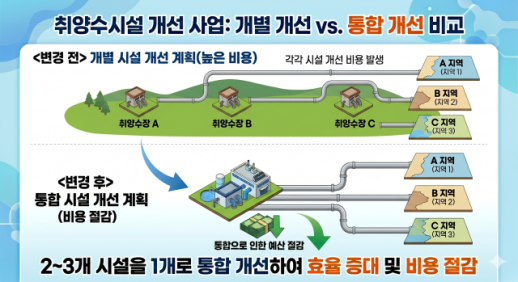 South Korea weighs combined intake, pumping stations to cut river work and costs The government is considering building a single integrated facility when two or more water intake stations and pumping stations are located close together, aiming to reduce costs by minimizing river construction work. The Ministry of Climate, Energy and Environment and the Ministry of Agriculture, Food and Rural Affairs announced the plan after holding a regular meeting of their 2026 working-level consultative body on intake and pumping station upgrades on Wednesday at the Government Complex Sejong. The upgrade program is designed to ensure stable water intake even as climate change increases swings in river water levels due to drought and algal blooms. The two ministries plan to invest a total of 88.6 billion won this year to improve facilities through 2028, including relocating intake points and reinforcing equipment. The climate ministry is upgrading intake and pumping stations managed by local governments and K-water. Of 70 sites, upgrades have been completed at four. Of the remaining 66, construction is underway at eight, while designs are being prepared for 56. The agriculture ministry is upgrading pumping stations managed by the Korea Rural Community Corp. Of 101 sites, 11 have been upgraded, and supplemental design work is underway for the remaining 90. Construction will begin as designs are completed, the ministry said. The two ministries reviewed progress and future plans and agreed to coordinate to speed implementation. The climate ministry said it will provide administrative support so permitting steps, including river-occupation permits and small-scale environmental impact assessments, can be processed quickly. The ministries also plan to hold seminars to share upgrade experience and new technologies. Song Ho-seok, the climate ministry’s director general for water resources policy, called the upgrades “a key project to secure stable water use even amid the climate crisis,” and said the government will work with relevant agencies to accelerate the work and actively consider ways to cut costs. Jeong Hye-ryeon, the agriculture ministry’s director general for food policy, said pumping station upgrades are an important foundation for a stable supply of agricultural water and pledged close coordination and technical support to keep the project on track.* This article has been translated by AI. 2026-04-30 14:45:17
 -
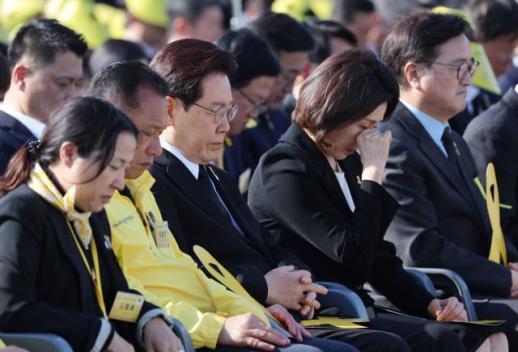 South Korea releases list of 28 designated presidential records from Sewol ferry disaster day after dropping appeal The Presidential Archives under the Ministry of the Interior and Safety said Wednesday it has provided requesters with a list of presidentially designated records related to rescue efforts on the day of the Sewol ferry disaster. The disclosure followed an April 10 Seoul High Court ruling that overturned the government’s decision to withhold the list. The government decided not to file a further appeal, making the ruling final. The case began with a June 2017 information request seeking disclosure of the list of designated presidential records tied to passenger rescue efforts on the day of the disaster. The archives had denied the request, citing Article 17 of the Presidential Records Act and the protected status of the materials. But the court, in a remand trial, said it was difficult to conclude the legal requirements for designation had been properly met and found the nondisclosure unlawful. The released information is a list of 28 designated presidential records produced or received on April 16, 2014, by the presidential secretariat and the National Security Office, among others. The contents of the individual records were not included in the disclosure. Han Seong-won, head of the Presidential Archives, said the agency respected the court’s decision, quickly completed administrative steps related to dropping the appeal and delivered the list to the requesters. Han said the archives also plans to provide the list soon to the 4.16 Sewol Ferry Disaster Family Association, which requested the same information, adding that the disclosure is expected to help protect the public’s right to know and improve administrative transparency. * This article has been translated by AI. 2026-04-30 14:43:37
 -
 Iran Soccer Federation Leaders Turned Back at Canadian Airport, Miss FIFA Congress Iran’s soccer federation leadership was blocked during the entry process in Canada and was unable to attend the FIFA Congress. Reuters and The Associated Press reported on April 29 (local time) that a delegation including Iran Football Federation President Mehdi Taj, Secretary-General Hedayat Mombeni and Vice President Hamed Momeni arrived in Toronto with valid visas but ran into problems at the airport and returned on the first available flight. Iran said the delegation turned back because of “unacceptable conduct” by Canadian immigration authorities. The Canadian government declined to discuss individual cases but said its policy barring entry to senior officials of Iran’s Islamic Revolutionary Guard Corps, or IRGC, remains in place. AP said Canadian Foreign Minister Anita Anand effectively confirmed the refusal. As a result, the Iranian delegation missed both the Asian Football Confederation Congress in Vancouver and the FIFA Congress. The incident renewed debate over Iran’s participation and travel issues ahead of the 2026 World Cup in North America. FIFA has not issued an official statement.* This article has been translated by AI. 2026-04-30 14:39:47
 -
 POSCO E&C to Open Model Home for Daejeon’s The Sharp Gwanjeo Arte, 951 Units POSCO E&C said Wednesday it will open a model home on May 1 for The Sharp Gwanjeo Arte, a new apartment complex in the Gwanjeo-dong area of Seo-gu, Daejeon, and begin sales. The project, planned for 1988 Gwanjeo-dong, will have nine buildings ranging from three basement levels to up to 25 stories, with a total of 951 units. By size, it will include 143 units of 59 square meters, 450 units of 84 square meters, 287 units of 104 square meters and 71 units of 119 square meters. Applications will be accepted through the Korea Real Estate Board’s Cheongyak Home system, starting with special supply on May 6, followed by first-round applications on May 7 and second-round applications on May 8. Winners will be announced May 14. Contracts are scheduled for May 28-30. For first-round applications, applicants must be at least 19 years old and meet requirements including at least six months of subscription-savings account membership and the required deposit amount by region and unit size. Applications are open regardless of whether the applicant is the head of household, and homeowners may apply. There is no restriction on re-winning, allowing those with prior wins to participate. Eligibility is limited to residents of Daejeon, Sejong and South Chungcheong Province as of the date of the subscription notice, with priority given to those who have lived in Daejeon for at least one year. As a private housing project in a nonregulated area, the resale restriction is six months and there is no mandatory occupancy period. POSCO E&C said the complex will feature a curtain-wall look and specialized side-wall design using its premium steel product PosMAC. It also cited wider spacing between buildings and landscaping-focused site planning. Inside units, the company said about 90% will use a four-bay, flat layout to improve daylight and ventilation, with some types offering three-sided openness. It also highlighted storage-focused features such as an alpha room and pantry. Paid options will include a premium kitchen, a styling bath with a dry vanity area, an all-in-one dressing room and a dry utility room. Community facilities are planned to include an indoor multipurpose gym, fitness center, GX room, golf practice range, table tennis room, sauna, multipurpose room, a small library and an education and business lounge. Family-oriented facilities will include a daycare center, a shared childcare center, a kids station and a tea house. The company also said it will operate an AI-based health care lounge with an on-site care manager. Parking is planned at about 1.67 spaces per household. The Sharp Gwanjeo Arte will be the third The Sharp-branded project supplied in the area, following Gwanjeo The Sharp and Gwanjeo The Sharp Phase 2, POSCO E&C said. The company said the site is in the center of the Gwanjeo district, with access on foot to the planned Jinjamnegeori Station on Daejeon Metro Line 2’s tram. It also cited access via Seodaejeon Interchange and Doan-daero, and said elementary, middle and high schools are nearby, along with a planned Third Municipal Library. “Gwanjeo is an area where living infrastructure is already in place, and demand for new housing supply has continued steadily,” a POSCO E&C sales official said. “The Sharp Gwanjeo Arte is expected to complete the Gwanjeo The Sharp brand town and become a representative residential complex for the area.” The model home will be located in the 1747 Gwanjeo-dong area of Seo-gu, Daejeon. Move-in is scheduled for June 2029. * This article has been translated by AI. 2026-04-30 14:38:29
 -
 HMM Reaches Labor-Management Deal on Headquarters Move to Busan; Oceans Minister Pledges Support HMM’s labor-management dispute over relocating its headquarters to Busan ended with an agreement, prompting the Ministry of Oceans and Fisheries to pledge full support for the move. Oceans Minister Hwang Jong-woo attended the signing ceremony for the labor-management agreement on HMM’s headquarters relocation, held April 30 at the Kensington Hotel in Seoul’s Yeouido district. HMM and its union had been in talks since the second half of last year but failed to reach a deal, and tensions recently escalated as the union warned of a possible strike. The sides ultimately produced an agreement after weighing concerns that a war in the Middle East could disrupt global logistics. Under the agreement, HMM plans to hold an extraordinary shareholders meeting on May 8 and seek to amend its articles of incorporation to change the company’s registered headquarters location. It also agreed to proceed step by step with related procedures, including relocation registration. “I deeply appreciate the decision by labor and management,” Hwang said, calling the agreement “a symbolic and hopeful message” for developing a maritime hub in the country’s southeast. He added that the ministry “will provide maximum support” to ensure the relocation proceeds smoothly.* This article has been translated by AI. 2026-04-30 14:37:31
 -
 HMM Reaches Labor Deal to Move Headquarters to Busan, Plans North Port Office Tower HMM and its labor union, which had been locked in a sharp standoff that included talk of a possible general strike over the planned move of the company’s headquarters to Busan, reached a broad agreement after weighing concerns about potential disruptions to logistics at home and abroad and wider social impact. With union opposition — the last major obstacle — now removed, the relocation of the headquarters of South Korea’s largest container shipping line is expected to be confirmed at a special shareholders meeting on May 8. The company is expected to begin full-scale practical preparations for the move in the second half of this year. According to the shipping industry on the 30th, HMM and the union finalized the agreement and held a signing ceremony that day at the Kensington Hotel in Seoul’s Yeouido district. Attendees included Hwang Jong-woo, minister of oceans and fisheries; Choi Won-hyeok, HMM CEO; and Jung Sung-cheol, head of HMM’s onshore labor union. Under the agreement, HMM will revise its articles of incorporation at the May 8 meeting to designate Busan, not Seoul, as its headquarters, and the change will take effect immediately after the revision. Legal procedures, including relocation registration, will be completed within May. Because the company’s top two shareholders are state-run Korea Development Bank (35.42%) and Korea Ocean Business Corp. (35.08%), the articles change is expected to pass without major variables at the meeting. As it moves its headquarters to Busan, HMM also plans to build a landmark office building at Busan North Port (the former Busan Port). The decision was made with expected synergy in mind with government ministries and affiliated agencies based in Busan, including the Ministry of Oceans and Fisheries and the Korea Ocean Business Corp., the report said. Choi said the company intends to “properly build a symbolic headquarters building that represents Busan,” taking into account the roughly 300 HMM employees already working in Busan and the number of staff who will relocate from Seoul. Hwang said the ministry would “actively support” HMM’s swift construction of the new North Port headquarters, working with the Busan Port Authority and others. The scale and timing of relocations for employees currently working in Seoul will be decided through labor-management talks after the legal procedures for the headquarters move are completed. Staff handling sales and ship financing — functions that require communication with domestic and overseas shippers — are likely to remain in Seoul in a branch format, while other departments move to the Busan headquarters. HMM and the union have also begun discussions on support measures for relocating employees. To back the move, government ministries and the Busan city government have formed a consultative body and are working to detail support measures for the company and its workers. Hwang said that following last year’s relocation of the Ministry of Oceans and Fisheries to Busan and now HMM’s move, Busan is “beginning in earnest to take on the form of a maritime capital.” He added that the ministry would support HMM’s relocation and efforts to strengthen its global competitiveness “in various ways.” Choi said labor and management faced “many differences and hurdles” in talks but reached an agreement “in the broader interest” of balanced national development. He added that with a “deterioration in performance becoming visible” due to the war in the Middle East, labor and management would work together to overcome the crisis and further strengthen capabilities as the world’s eighth-largest global shipping company. 2026-04-30 14:36:24
 -
 Army Chief Kim Gyu-ha Calls for Korea-Specific Drone Doctrine, Expanded Force The Army said it will actively bring in attack drones, including loitering munitions, and sharply expand education and training so all service members can operate drones with ease. Army Chief of Staff Kim Gyu-ha said at a policy meeting with reporters at Gyeryongdae on April 29 that he wants to define drones “as the same concept as personal weapons,” adding that troops should be able to use them “freely,” like the individual weapons every combatant carries. Kim said drone operations seen in Russia and Ukraine and in Iran differ greatly from conditions on the Korean Peninsula, particularly in terrain, and stressed the need to develop drone doctrine and a force structure suited to South Korea. He said drones will evolve beyond surveillance and reconnaissance to include strike missions and sustained support operations. He added the Army is working to field drones by echelon — from company level to operational command level — based on functions that match strategic and tactical objectives. As part of its “training 500,000 drone warriors” policy, the Army plans to introduce about 11,000 commercial drones for training this year and about 50,000 by 2029, aiming to enable each squad to operate one training drone. The Army is also reported to be pursuing the introduction of “battalion-level loitering munitions.” Kim said the Army has developed its “dronebot” combat system since 2018 under the “Army Tiger” policy, but acknowledged progress has partly stalled because it has not kept pace with recent technological advances. He said the Army will accelerate efforts to field drone capabilities. 2026-04-30 14:32:42
 -
 At War 60 Days: Korea learns to wean off Gulf crude and naphtha SEOUL, April 30 (AJP) - A return to unfettered access through the Strait of Hormuz — and to the cartel-defined Gulf order that once governed energy flows — is increasingly unlikely, even if Middle East tensions ease. For South Korea and other import-dependent economies, the emerging reality is one where security premiums outweigh the old calculus of cost and efficiency. Seoul is already adapting. South Korea has secured 74.62 million barrels of crude for May, roughly 87 percent of last year's monthly average. Naphtha — largely derived from Middle Eastern crude — is stocked at 85 to 90 percent of pre-war levels, according to presidential chief of staff Kang Hoon-sik. "We are increasing imports from the United States, Brazil and other non-Gulf suppliers to stabilize domestic supply," Kang said. In a development that could reshape supply dynamics, the United Arab Emirates announced it will withdraw from OPEC and the broader OPEC+ alliance effective Friday, removing the cartel's fourth-largest producer at a time when the U.S.-Iran standoff has thrust Gulf supply routes into the center of global energy security concerns. For Seoul, the timing is critical. During a March visit to the Middle East, Kang secured an additional 18 million barrels of UAE crude, bringing Korea's emergency intake from the Emirates to 24 million barrels. With OPEC quotas no longer binding from May, the UAE's production capacity of 4.8 million barrels per day — well above its previous 3.2 million barrel quota — creates room for supply expansion, particularly for buyers seeking alternatives to Hormuz-dependent shipments. That diversification is underpinned by infrastructure. The UAE's Habshan-Fujairah pipeline, which bypasses the Strait of Hormuz and terminates on the Gulf of Oman, has emerged as one of only two viable alternatives, alongside Saudi Arabia's East-West pipeline. Domestically, Korea has moved quickly to stabilize operations. Utilization rates at naphtha crackers, which slumped in late March, are recovering. Yeochun NCC has raised its rate to 65 percent from 55 percent, Korea Petrochemical Industries to 72 percent from 62 percent, and Lotte Chemical to 83 percent from 73 percent at its Daesan complex. "Support measures for naphtha import cost differentials are taking effect, and contracted volumes are rising. If the current trend continues, supply will largely return to pre-war levels in May, easing concerns over petrochemical shortages," Trade Minister Kim Jung-kwan said at a Cabinet meeting. Beyond Korea, however, the picture remains far less stable. Brent crude surged past $113 per barrel as daily transits through the Strait of Hormuz plunged to around eight vessels, down from a pre-war average of 135 — underscoring how fragile supply remains despite diversification efforts. Last year, about 63 percent of Korea's crude imports and 54 percent of its naphtha shipments passed through Hormuz. The first non-Hormuz Saudi cargo, loaded from Yanbu on the Red Sea, only arrived in Korea on April 17. The costs of these workarounds are already filtering through the economy. Gasoline prices have climbed above 2,000 won per liter, prompting a 6.1 trillion won relief package that began disbursing on April 27 to around 32.56 million citizens. Industrial users are also under pressure. Prices for delivery films, tapes and cushioning materials have surged 20 to 30 percent, with some products nearly doubling, accelerating a shift toward alternatives such as pulp-mold packaging. Seoul's policy response has broadened accordingly. The Financial Services Commission has expanded emergency financing support to 26.8 trillion won, targeting petrochemicals, refining and five other strategic sectors. At the same time, the government is using the crisis to accelerate structural change. The Ministry of Climate, Energy and Environment has unveiled a roadmap to cut virgin naphtha-based material use by 30 percent by 2030. Yet analysts caution that the recovery remains conditional. The UAE's departure from OPEC+, combined with a potential slowdown in U.S. shale output, could narrow the long-standing cost disadvantage faced by Asian refiners, positioning Korean producers as swing suppliers in global markets. "The UAE's exit strengthens Asian producers' bargaining power and supports longer-term price moderation, but it is not an immediate catalyst for lower prices," said Yoon Jae-sung, an analyst at Hana Securities. "If Hormuz normalizes, it becomes a tailwind — but for now, it remains neutral." That uncertainty deepens if the conflict persists. Competition for heavy crude outside the Middle East is intensifying, while the risk of retaliatory production cuts by Saudi Arabia in response to the UAE's exit adds another layer of volatility. "Unless the conflict ends on terms that restore confidence among shipowners and insurers, it will be extremely difficult for oil prices to return to pre-war levels, even over the longer term," said Chung Tae-hun of the Korea Energy Economics Institute. "We are already seeing intensified competition from China and Japan for alternative crude. And if Saudi Arabia responds with production cuts, downward pressure on prices may remain limited, even in the near term." 2026-04-30 14:32:19
 -
 Yen Breaks Past 160 per Dollar as Japan Holds Rates and Bond Yields Hit 29-Year High “You must not say that.” After an economic and fiscal advisory meeting at the prime minister’s office on the 13th, Prime Minister Sanae Takaichi summoned Economy, Trade and Industry Minister Ryosei Akazawa for a private reprimand. The day before, Akazawa told NHK that “a rate hike is also an option” to respond to the yen’s weakness. While the stated reason was the principle that monetary policy is the BOJ’s domain, markets took it as a signal that the government does not want higher rates. The Nikkei business daily reported that this mood was clearly felt inside the prime minister’s office. A little more than two weeks later, on the 29th in New York trading, the yen slid into the mid-160s per dollar, breaking the widely watched “160 line.” On the 30th in Tokyo, it failed to rebound from the low 160s, as a level long seen as a likely trigger for Japanese intervention gave way with little resistance. At the same time, Japan’s bond market delivered its own warning: the 10-year government bond yield, a benchmark for long-term rates, rose as high as 2.52% intraday on the 30th, the highest since 1997. With the BOJ holding its policy rate at 0.75%, market rates surged, underscoring a widening gap between policy and markets. The immediate catalyst was the BOJ’s pause. At its policy meeting on the 28th, the BOJ kept rates unchanged. The number of members arguing for the need to raise rates increased to three, and the bank raised its inflation outlook, but it did not move to hike. Analysts cited the government’s cautious stance and instability in the Middle East as factors making it difficult for the BOJ to act quickly. Political scrutiny also weighed on decision-making. Nikkei reported that Economic and Fiscal Policy Minister Minoru Kiuchi, seen as a cautious voice, attends BOJ meetings “in principle every time” to monitor deliberations. The BOJ’s restraint was also linked to frustration within the government after Ueda’s advance signaling ahead of a rate increase last December was priced in by markets, narrowing policymakers’ room to maneuver, the report said. Meanwhile, external pressures intensified. With Middle East tensions persisting, concerns grew that a closure of the Strait of Hormuz could drag on, and oil prices became entrenched above $100 a barrel. For Japan, which relies heavily on energy imports, that translated quickly into inflation pressure. In the bond market, selling spread as investors priced in higher inflation, pushing yields up. U.S. developments added to the strain. The Federal Reserve held rates steady at its April 29 Federal Open Market Committee meeting, but three regional Fed bank presidents opposed keeping dovish language in the statement, signaling continued tightening. As U.S. long-term yields rose, upward pressure spilled into Japan, and expectations that the U.S. would not pivot easily toward easing supported a stronger dollar. In currency markets, those forces converged. Keiko Ninomiya, a senior analyst at SMBC Trust Bank, said expectations of a worsening trade balance from higher oil prices and a widening U.S.-Japan rate gap were working at the same time, adding that the yen could weaken further into the 161 range in the short term. Tsuyoshi Ueno, chief economist at NLI Research Institute, said current volatility alone was not enough to justify intervention, and that authorities would be more likely to respond if the yen moved quickly toward 162 per dollar. Speculative money also piled in. According to U.S. Commodity Futures Trading Commission data, as of the 21st speculators’ net short yen position expanded to about 94,460 contracts, worth roughly 1.18 trillion yen, the largest in about 1 year and 9 months and the biggest since Japan’s government and the BOJ intervened in July 2024. Rinto Maruyama, a strategist at SMBC Nikko Securities, said hedge funds and others were increasing yen-selling positions as they judged that fundamentals were strengthening pressure for a weaker yen. Bond investors voiced a more direct concern. Tadashi Matsukawa, a portfolio manager at PineBridge Investments, said that even as more BOJ members favored rate hikes and the inflation outlook was raised, policy was not following through. The remark was seen as reflecting worries that the central bank is “behind the curve.” Shotaro Gugo, a researcher at the International Monetary Institute, said a July rate hike was most likely at this point, but added that a June hike could not be ruled out if uncertainty clears. Nikkei said Japan’s market dynamics are increasingly reinforcing each other: high oil prices lift inflation expectations and spur bond selling, while also deepening yen weakness through expectations of a deteriorating trade balance. The longer policy responses are delayed, the paper warned, the greater the risk of market volatility. The paper also contrasted the BOJ’s response during the first oil shock, when it focused on stimulating the economy and fell behind on inflation control, with the second oil shock, when pre-emptive tightening reduced the impact. It warned that delaying hikes could raise the risk of stagflation, with surging prices and an economic downturn arriving together. Authorities’ room to act is narrowing. Finance Minister Satsuki Katayama has repeatedly said Japan can take “firm and strong measures” against speculative moves, but skepticism about the effectiveness of intervention remains. Toru Sasaki, chief strategist at Fukuoka Financial Group, said the recent yen weakness reflects fundamentals as well as speculation, which could limit the impact of intervention. Yujiro Goto, a strategist at Nomura Securities, said that even if intervention occurs, its effect would likely last only a few weeks, at most until the next BOJ meeting in June. Officials also face the risk that further yen weakness could fuel import-driven inflation and provide grounds for trade pressure from the Trump administration. The break below 160 yen per dollar and the move above 2.5% in long-term yields have become twin markers of Japan’s shifting financial landscape — a sign that markets and money are moving ahead while policy hesitates.* This article has been translated by AI. 2026-04-30 14:31:03
 -
 Google Signals Possible Ads for Gemini, but No Immediate Plans Google has left open the possibility of adding advertising to its AI assistant, Gemini, though it has not confirmed any immediate rollout. On April 29 (local time), Google Senior Vice President and Chief Business Officer Philipp Schindler said in a post-earnings Q&A that the company is currently focused on the Gemini app’s free tier and subscriptions. “Advertising can be a way to expand a product to a broader user base, and if designed appropriately it can be useful commercial information,” Schindler said. He added that Google is “not rushing,” and said the company would share plans “at the right time” if it has them. Business Insider reported that Google is already running advertising and commerce experiments centered on AI Mode and AI Overviews, the AI-generated summaries shown at the top of search results, and said Gemini could also become part of longer-term monetization discussions. Alphabet, Google’s parent company, reported first-quarter revenue of $109.9 billion, up 22% from a year earlier. CEO Sundar Pichai said the Gemini app delivered “the biggest quarter ever” for a consumer AI product. Alphabet’s total paid subscribers reached 350 million, including YouTube and Google One. AI spending is also rising quickly. Alphabet’s first-quarter capital expenditures topped $35 billion, and its full-year capital spending outlook is as high as $190 billion. As AI infrastructure investment grows, market pressure may increase for clearer monetization plans for services such as Gemini. 2026-04-30 14:29:47