
Journalist

Lee Hugh
=
-
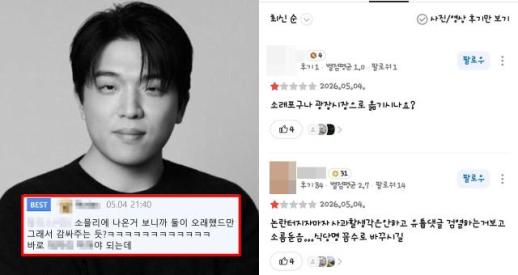 Wine Switch Allegation at Michelin 3-Star Mosu Rekindles Scrutiny of Sommelier Ethics A wine-switching incident at Michelin three-star fine-dining restaurant Mosu, run by chef Ahn Sung-jae, has revived attention on past controversies in South Korea’s fine-dining scene. In recent days, online communities and social media have circulated a post criticizing what it called ongoing ethical lapses among sommeliers, while listing earlier disputes involving restaurants and wine service. The post cited complaints tied to the handling of expensive wines and what it described as weak ethics inside some establishments. It said that at the then two-star Kwon Sook-soo, a sommelier was found guilty in a first trial and fined 7 million won for allegedly taking 106 bottles of the restaurant’s wine, with the case emerging after the person left to open a wine bar. It also claimed that at Vampire Weekend, a sommelier was caught drinking customers’ high-priced corkage wines out of sight, posting about it on social media, and that the business later changed its name. The post also alleged that at the two-star Jungsikdang, a sommelier poured about 100 milliliters from a customer’s corkage wine worth about 900,000 won, saying it was “to taste later.” It added that Mosu, described as previously three-star and now two-star, was exposed for deceiving customers. The writer said it was embarrassing that the level of Seoul fine dining was being revealed repeatedly at a time when global attention is on Korea’s food boom. The writer questioned whether a new direction could begin if Mosu closes after the latest incident, and criticized sommeliers who, the post said, focus on wine books rather than customers and end up causing problems. After the post spread, commenters criticized what they saw as a breakdown of basic trust even at high-end restaurants. Comments included comparisons to delivery workers accused of taking food, jokes that people would call them “corkscrews,” and remarks that hardworking professionals are being tarnished by a few bad actors, leading to insults ranging from neighborhood karaoke bars to “bottle openers.” Meanwhile, Mosu’s Kakao Map page drew a wave of hostile comments. Reviews included remarks such as, “Are you moving to Sogeopogu or Gwangjang Market?” and criticism that the restaurant did not apologize immediately and instead was “moderating” YouTube comments. Other posts said comments were being deleted, criticized “switching,” and questioned how long it had been happening. One commenter said the issue could end quickly if an apology video were posted properly or if a penalty were imposed on the sommelier, adding frustration that the matter was being dragged out. 2026-05-06 09:48:16
 -
 Stella Artois Launches 'Taste Worth More' Campaign Highlighting Perfect Serve Belgian beer brand Stella Artois is rolling out a marketing push that puts taste and quality front and center. OB Beer, which distributes Stella Artois in South Korea, said Tuesday the brand has launched a new campaign, “Taste Worth More,” aimed at highlighting a top-tier beer-drinking experience. The campaign expands the brand experience to the full process of completing a single pour. The ads focus on the brand’s signature “chalice” glass and visually lay out a “five-step serving ritual,” including how the beer is poured, the height of the foam and the order in which the glass is handled. Stella Artois is also expanding on-site quality control. It plans to increase the number of locations using “Perfect Serve,” its global draft-beer quality management program, from about 1,500 to about 2,500 this year. The company will also hold the “Stella Artois Perfect Serve Awards Korea” competition for venues that complete the training program. Using an AI-powered “Perfect Serve Scanner” app, the brand will select the top 20 venues based on scores submitted by consumers. Those venues will then compete on the accuracy and consistency of the five-step serving ritual. The brand is also updating packaging and running a limited-time promotion. It has changed the logo on its cans from a horizontal to a vertical layout, a design intended to keep the logo upright when the can is tilted to pour into the chalice. For May, it will also sell a limited-edition package that includes a temperature-sensitive chalice through major supermarkets nationwide and convenience-store smart orders online. When cold beer at the optimal temperature touches the glass, the logo on the outside turns red, allowing drinkers to confirm the beer is chilled. “S Stella Artois believes the brand should be responsible not only for how the beer is made, but also for the moment consumers experience it,” said Park Sang-young, an OB Beer marketing executive director. “We will continue to set standards for delivering the best possible beer experience.” Stella Artois also participated as the official beer partner at the Michelin Guide Seoul & Busan 2026 publication event held in March at Signiel Busan. The brand has partnered with the Michelin Guide Seoul & Busan for a second consecutive year.* This article has been translated by AI. 2026-05-06 09:45:26
 -
 SK Square shares jump 11% to top 1 million won as chip rally lifts outlook SK Square surged in early trading after joining the so-called “emperor stock” club, a term for shares priced at 1 million won or more. According to the Korea Exchange, SK Square was trading at 1.10 million won as of 9:24 a.m. on Tuesday, up 109,000 won, or 11.00%, from the previous session. It briefly climbed to 1.149 million won, setting a new intraday record high. Its market capitalization rose to about 145 trillion won, ranking it roughly third on the benchmark KOSPI behind Samsung Electronics and SK hynix. Its market-cap weighting expanded to the mid-2% range. The rally has been attributed to a sharp rise in the value of key subsidiary SK hynix, as an AI-driven boom in memory semiconductors has highlighted the value of SK Square’s stake. Investor sentiment has also been supported by an aggressive shareholder-return policy. SK Square has continued share buybacks and cancellations in recent years and is also planning a 200 billion won cash dividend this year, raising expectations for improved shareholder value. Analysts are watching whether structural changes in the semiconductor cycle could further lift SK Square’s valuation. “A trend toward ‘layering of computing’ driven by the spread of AI is expanding overall memory demand, not only for HBM but also for server DRAM and eSSD,” said Ahn Jaemin, an analyst at NH Investment & Securities. “If this trend continues, SK Square’s value is likely to rise alongside improved results at SK hynix.” He added that a stronger virtuous cycle could take hold, with cash inflows from higher subsidiary dividends feeding back into shareholder returns and semiconductor-related investment. * This article has been translated by AI. 2026-05-06 09:43:20
 -
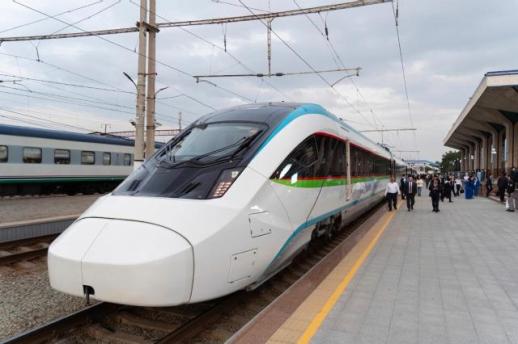 Hyundai Rotem’s Korean-Built High-Speed Train Begins Commercial Service in Uzbekistan Korean-built high-speed trains have entered service on a major rail route in Uzbekistan, marking their first commercial operation overseas. Hyundai Rotem said May 6 that it began revenue service for the new high-speed rolling stock on May 5 local time. The trains will run on the country’s longest rail line, about 1,020 kilometers (634 miles), linking the capital, Tashkent, with Khiva, a Silk Road city in the west. The fleet consists of 42 cars, with seven cars per trainset, designed based on the KTX-Eum (EMU-260). The trains have a top speed of 250 kph (155 mph) and can carry up to 389 passengers. Hyundai Rotem said the distributed-power design offers better acceleration and deceleration efficiency than the locomotive-style high-speed trains previously used locally. Seating is divided into three classes: VIP, business and economy. Hyundai Rotem said the trains were tailored for local conditions, including dust-resistant design for extreme heat and desert environments, to provide safe and comfortable long-distance travel. The company signed a supply contract in 2024 with Uzbekistan Railways (UTY), which it described as the first overseas export of a domestically developed Korean high-speed train. Hyundai Rotem said more than 600 South Korean parts suppliers involved in the project will be able to demonstrate to global markets a stable production, delivery and handover supply chain built with the company. The company said it expects the launch to help improve Uzbekistan’s transportation infrastructure and left open the possibility of entering Vietnam’s high-speed rail market. On April 23, Hyundai Rotem signed a 491 billion won contract with Vietnam’s THACO Group for the Ho Chi Minh City Metro Line 2 project. A Hyundai Rotem official said the company is moving into commercial operations after holding a launch ceremony in November and starting test runs this year. The official said the company will work to expand additional export bases, including Vietnam, where it has already entered the market.* This article has been translated by AI. 2026-05-06 09:39:16
 -
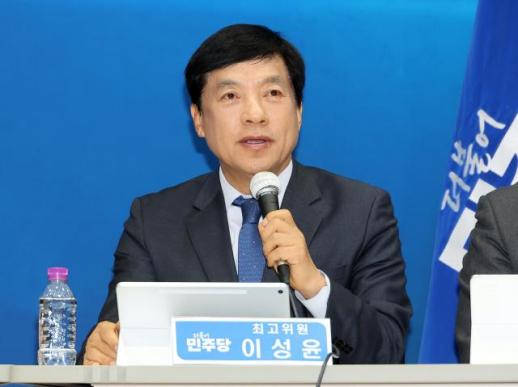 Lee Seong-yoon to Receive 7.63 Million Won in Compensation After Acquittal in Kim Hak-ui Case Lee Seong-yoon, a lawmaker from the Democratic Party who was indicted on allegations of improperly pressuring investigators in the so-called “Kim Hak-ui travel ban case” but was ultimately acquitted by the Supreme Court, will receive criminal compensation. According to the government gazette published on the 6th, the Seoul Central District Court’s Criminal Division 51, chaired by Senior Judge Jeon Bo-seong, ordered the government to pay Lee 7,631,000 won in cost compensation. Under the criminal compensation system, the state compensates defendants whose acquittals are finalized for losses tied to detention or trial. Payments are divided into detention compensation and cost compensation, which covers expenses such as attorney fees and transportation. Lee was indicted by prosecutors in May 2021 on charges that, while serving as head of the Supreme Prosecutors’ Office’s Anti-Corruption and Strong Force Department in June 2019, he pressured the Anyang branch of the Suwon District Prosecutors Office to halt its investigation into the travel ban imposed on former Justice Ministry Vice Minister Kim Hak-ui. Trial courts in the first and second instances found Lee not guilty, and the Supreme Court finalized the acquittal in June last year. The court said it could not rule out the possibility that the investigative team ended the probe on its own, rather than because Lee exerted improper pressure. The gazette also said criminal compensation was approved for others whose acquittals were finalized. Kim Tae-han, former CEO of Samsung Biologics, and Kim Shin, former head of Samsung C&T, who were tried alongside Samsung Electronics Chairman Lee Jae-yong over allegations of an improper merger and accounting fraud, will receive 13.77 million won and 5.65 million won, respectively. Park Hyeong-cheol, former Blue House senior secretary for anti-corruption, who was tried over allegations of covering up an internal inspection involving former Busan Vice Mayor for Economic Affairs Yoo Jae-soo, will receive 7,448,000 won. Jang Hwan-seok, former senior administrative officer in the Blue House’s Balanced Development Secretariat, who was acquitted in a case tied to alleged interference in the Ulsan mayoral election during the Moon Jae-in government, will receive 8,851,000 won in cost compensation.* This article has been translated by AI. 2026-05-06 09:37:16
 -
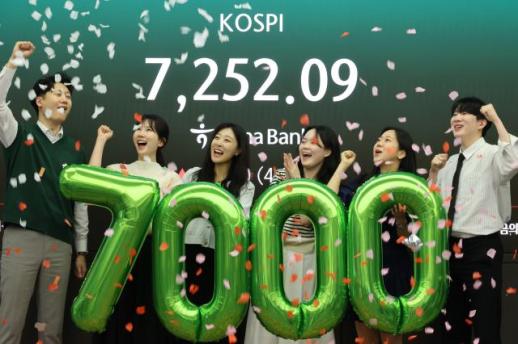 KOSPI Tops 7,000 as Middle East Tensions Ease; Won Gains Early South Korea’s won strengthened early Tuesday as local stocks rallied, with the KOSPI breaking above 7,000 amid expectations of easing geopolitical risks in the Middle East. In Seoul’s foreign exchange market, the won was trading at 1,461.4 per U.S. dollar as of 9:23 a.m., according to the market. The exchange rate opened at 1,465.8 won, up 3.0 won from the previous session, then moved lower. Clashes have continued in the Strait of Hormuz, but the U.S. confirmed that a cease-fire agreement with Iran remains in place, feeding hopes that tensions may ease. Overnight, U.S. stocks rose as Middle East risk concerns eased and expectations for artificial intelligence-driven demand lifted semiconductor shares. In New York on May 5 (local time), the S&P 500 and the Nasdaq both set record highs. The S&P 500 gained 0.81% to 7,259.22, and the Nasdaq rose 1.03% to 25,326.13. The KOSPI moved above 7,000 immediately after the open. With foreign funds flowing into local shares, led by semiconductors, the market is expected to support the won’s strength. Min Kyeong-won, an economist at Woori Bank, said the exchange rate is expected to fall during the session, tracking Monday’s closing level, as risk appetite improves on reduced fears of a renewed full-scale U.S.-Iran conflict. He added that the stock-market rally is a factor that can tilt supply and demand toward net selling, led by offshore selling.* This article has been translated by AI. 2026-05-06 09:36:05
 -
 Celltrion posts record Q1 as new biosimilars drive earnings surge SEOUL, May 06 (AJP) - South Korean biopharmaceutical firm Celltrion reported its strongest first-quarter results on record, as a wave of newly launched biosimilars accelerated overseas sales and pushed operating profit more than twofold higher. According to regulatory filings released Wednesday, the company logged consolidated revenue of 1.14 trillion won ($779.43 million) and operating profit of 321.9 billion won for the three months ended March 31, up 36 percent and 115.5 percent, respectively, from a year earlier. The operating margin widened to about 28.1 percent. Sales of five high-margin biosimilars launched last year jumped 67 percent on year to 581.2 billion won, accounting for 60 percent of total product revenue for the first time. Omlyclo, rolled out across Europe in September, has captured market shares of 98 percent in Denmark, 80 percent in Spain and 70 percent in the Netherlands within roughly four months of launch. Momentum has carried into the United States, where Zymfentra, the world's only subcutaneous infliximab, is logging its highest-ever monthly prescription volumes, more than triple year-earlier levels. SteQeyma held an IQVIA-tracked share above 10 percent as of March, supported by reimbursement coverage secured through major pharmacy benefit managers. "Achieving sharp growth in the seasonally weak first quarter reflects the full-fledged market entry of our high-margin product lineup," said a Celltrion spokesperson, adding that the results mark a successful start toward exceeding annual targets of 5.3 trillion won in revenue and 1.8 trillion won in operating profit. Celltrion's board on Wednesday also approved cancelling about 100 billion won of recently bought treasury shares, following last month's retirement of 9.11 million shares worth roughly 1.8 trillion won. The company plans to expand its biosimilar portfolio to 18 products by 2030 and 41 by 2038, while broadening its novel drug pipeline to 20 candidates by 2027. Shares of Celltrion traded at 197,000 won per stock on 9:30 a.m., 0.4 percent lower than the previous session. 2026-05-06 09:35:41
 -
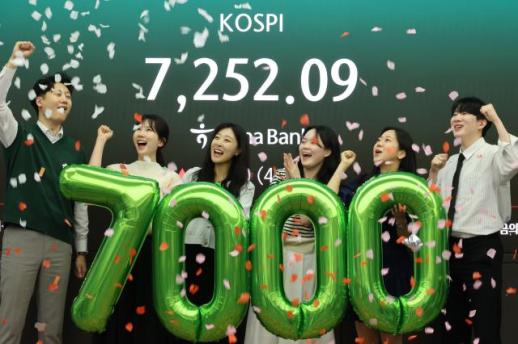 South Korea’s Kospi Surges Past 7,000 for First Time, Up More Than 3% Early South Korea’s benchmark Kospi opened higher on the 6th and climbed above 7,000 for the first time in early trading. According to the Korea Exchange, the Kospi stood at 7,195.92 as of 9:07 a.m., up 258.93 points, or 3.73%, from the previous session. It opened at 7,093.01, up 156.02 points, or 2.25%, and extended gains. Han Ji-young, a researcher at Kiwoom Securities, said the market could face “a pause for breath” for the rest of the week or short-term profit-taking by foreign investors. Still, Han said the Kospi’s earnings momentum has continued to strengthen after the first-quarter earnings season, while the absolute profit level and valuation burden are lower than on earlier net-buying days. The early surge also triggered a “sidecar” curb for program buying for the first time in about a month. At 9:06:02 a.m., the Kospi 200 futures index jumped 66.05 points, or 6.28%, to 1,116.55, prompting a five-minute halt in the effectiveness of program buy orders. In the main market, individuals and foreign investors were net buyers of 560.7 billion won and 314.2 billion won, respectively, helping lift the index. Institutions were net sellers of 707.9 billion won, appearing to take profits. Among top market-cap stocks, Samsung Electronics rose 10.32%, SK hynix gained 9.19%, SK Square climbed 13.22%, Hyundai Motor added 3.53%, LG Energy Solution rose 0.64%, Doosan Enerbility gained 0.79% and Samsung Electro-Mechanics advanced 1.85%. Hanwha Aerospace fell 2.46% and HD Hyundai Heavy Industries slipped 3.24%. Samsung Electronics and SK hynix jumped about 9% to 10% early, reaching 250,000 won and 1.6 million won, respectively. At the same time, the Kosdaq index turned lower, down 12.25 points, or 1.01%, at 1,206.22. It opened up 7.16 points, or 0.59%, at 1,220.90, but gave up gains and moved into negative territory. In the Kosdaq market, individuals were net buyers of 329.8 billion won, while foreign investors and institutions were net sellers of 164.7 billion won and 138.3 billion won, respectively. Among top Kosdaq stocks, EcoPro BM rose 2.78%, EcoPro gained 1.28% and HLB added 0.66%. Alteogen fell 2.28%, Rainbow Robotics slipped 1.75%, Samchundang Pharm dropped 2.20%, Lino Industrial declined 2.48%, Kolon TissueGene fell 1.05%, ABL Bio slid 3.32% and LigaChem Bio dropped 2.64%.* This article has been translated by AI. 2026-05-06 09:34:11
 -
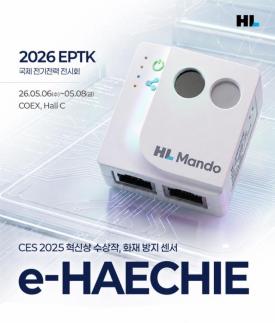 HL Mando to Supply AI Electrical Fire-Prevention System to Hyundai Motor’s U.S. Plant Software-defined vehicle (SDV) company HL Mando is pushing a new business line as it seeks to extend its earnings growth. HL Mando said Tuesday it is moving ahead with commercialization of e-HAECHIE, an artificial intelligence-based solution designed to prevent electrical fires. The company said it secured stability and reliability through proof-of-concept tests at 17 plants in South Korea. Mass production is set to begin next month. The first customer will be Hyundai Motor Group, which plans to apply the system at its key North American production base, Hyundai Motor Group Metaplant America (HMGMA). HL Mando said the production version has evolved into a “smart disaster-prevention consultant.” While the initial model focused on detecting arc events, the production model analyzes arc characteristics and patterns and assesses risk, reflecting the use of AI. Depending on the risk level, the system is designed to prompt preventive steps such as inspections, equipment replacement and changes in operating conditions. It also adds infrared sensors and thermal imaging cameras to detect subtle temperature changes, aiming to block scenarios that could lead to a fire. The company said it expects the new business to support continued strong results. HL Mando posted first-quarter revenue of 2.3117 trillion won and operating profit of 93.6 billion won, up 1.8% and 18.2% from a year earlier. Despite softer demand, it also set record quarterly revenue in some regions, including India. The production version of e-HAECHIE will be unveiled publicly for the first time at the 2026 International Electric Power Industry Expo, running for three days starting Tuesday at COEX in Seoul.* This article has been translated by AI. 2026-05-06 09:33:15
 -
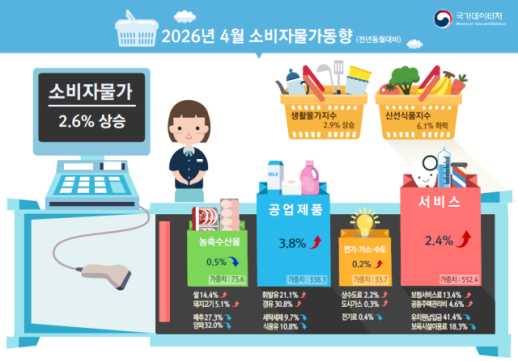 South Korea’s April Consumer Inflation Hits 2.6%, Highest in 21 Months on Fuel Surge Global oil prices kept climbing, driving a sharp jump in fuel costs and pushing consumer inflation to its fastest pace in 21 months. A government cap on fuel prices, in place since March, helped cushion the rise but did not prevent inflation from staying in the 2% range. Officials also warned that price pressures that have been concentrated in energy could spread to non-energy items starting in May. According to the National Data Center’s “April 2026 Consumer Price Trends” released Tuesday, the consumer price index stood at 119.37 (2020=100) in April, up 2.6% from a year earlier. Prices for agricultural, livestock and fisheries products fell, but the steep rise in petroleum products lifted overall inflation to its biggest increase in 21 months. Processed food prices, which had posted high gains since last year, rose 1.0% in April. The slower increase appeared to reflect cuts in factory-gate prices, the agency said. Petroleum product prices jumped 21.9% from a year earlier, the biggest increase since July 2022 during the Russia-Ukraine war, when the rise reached 35.25, marking the largest gain in three years and nine months. Over the same period, gasoline rose 21.1% and diesel climbed 30.8%. Kerosene increased 18.7%, the strongest rise in three years and two months since February 2023, when it gained 27.1%. The agency said the fuel price cap introduced in March acted as a buffer against inflation. The Korea Development Institute has also reported that the cap lowered March consumer inflation by 0.8%, according to its research findings. “Rising global oil prices pushed up petroleum products and international airfares in particular,” said Lee Du-won, the agency’s director for economic trends and statistical review. “However, compared with the OECD, the increase in petroleum products is smaller. The fuel price cap had some effect in easing the overall rise in consumer prices,” he said. Price pressures also extended into services. Public service prices rose 1.4% from a year earlier and personal services increased 3.2%. International airfares jumped 15.9% as fuel surcharges rose, leading the increase in public service prices, the agency said. Domestic airfares have not shown a marked rise so far, but increases are expected from May. The April fuel surcharge for domestic flights was calculated based on February levels, while May pricing is expected to reflect the impact of the Middle East war in late February, the agency said. Prices for rice and livestock products also continued to rise. Rice, including glutinous rice, posted larger increases due to reduced cultivation area. Livestock prices rose sharply for items such as imported beef and chicken, driven by higher import prices and avian influenza, the agency said. Still, the agency said higher oil prices had not yet spread broadly into non-energy categories. “So far, we are not seeing an overall rise in dining out or processed foods,” Lee said. He added that prices for paper diapers and sanitary pads have not fluctuated much, and that garbage bags fell 0.3% due to price adjustments by some local governments. The core inflation index excluding food and energy rose 2.2% from a year earlier. The index excluding agricultural products and petroleum products also increased 2.2% over the year. Among 458 items, the cost-of-living index covering 144 frequently purchased goods rose 2.9% from April last year. The fresh food index, however, fell 6.1% from a year earlier. An index excluding owners’ equivalent rent, which reflects the cost of housing services consumed by homeowners, rose 2.3% from a year earlier. * This article has been translated by AI. 2026-05-06 09:28:39