SEOUL, May 06 (AJP) - South Korea’s stock benchmark powered through energy shocks and inflation fears to race past one four-digit milestone after another and outperform the S&P 500, though the rally is increasingly raising concerns over overheating and heavy dependence on a single engine: semiconductors.
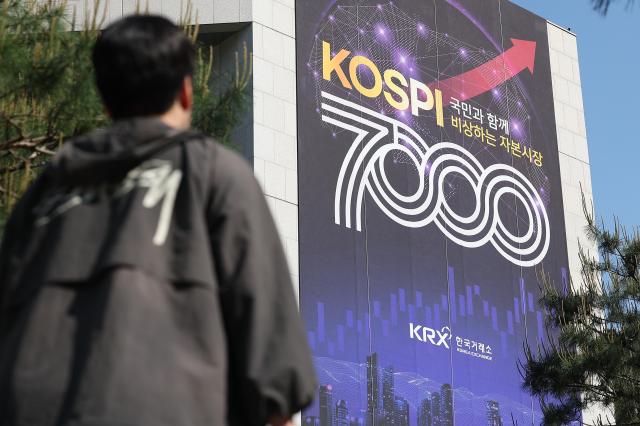
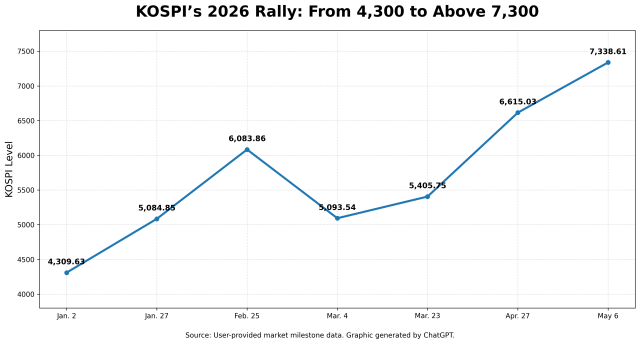
The KOSPI closed at 7,384.56 on Wednesday, up 6.45 percent, blasting through another psychological threshold without the usual consolidation period. The rally remained highly selective, with declining stocks overwhelming gainers 679 to 200.
Momentum again rested disproportionately on chip giants Samsung Electronics and SK hynix, which now account for more than 43 percent of the KOSPI’s total weighting.
Samsung Electronics closed at 266,000 won, up nearly 390 percent from a year earlier and joining the exclusive $1 trillion market-cap club. SK hynix has soared 761 percent to 1,601,000 won from 186,000 won on May 2 last year.
“AI ecosystems need balanced development across infrastructure, models and services, but South Korea remains heavily concentrated on the hardware side,” said Lee Seong-yeob, a professor at Korea University’s Graduate School of Technology Management.
Lee said decades of industrial policy helped cement South Korea’s global semiconductor competitiveness, but the heavy concentration has left other sectors lagging behind, complicating efforts to build a sustainable AI ecosystem.
The rally has been underpinned by explosive earnings from a prolonged semiconductor supercycle.
Samsung Electronics’ semiconductor division posted a nearly 48-fold jump in operating profit to 53.7 trillion won from a year earlier. SK hynix also reported a 405.5 percent jump in first-quarter operating profit from a year earlier.
According to the Korea Exchange, foreign investors purchased a net 3.134 trillion won worth of shares on the main bourse Wednesday, surpassing the previous daily record of 3.126 trillion won set on Oct. 2 last year.
The KOSPI has surged 188.5 percent since May last year, marking a sharp turnaround from early 2025, when political turmoil and U.S. reciprocal tariffs triggered nine consecutive months of foreign selling. Government efforts to narrow the so-called “Korea discount” later helped restore investor confidence.
Despite the blistering rally and a surge in retail trading accounts, the KOSPI’s price-to-book ratio of 2.12 remains well below the S&P 500’s 5.44, even after the Korean benchmark closed above the U.S. index’s 7,259.22 finish Tuesday.
Sustainability questions linger. Samsung Electronics faces pressure from rising material costs and the prospect of a labor union strike over profit-sharing disputes.
Data flag deeper vulnerability. Outstanding margin loans on the benchmark KOSPI and the tech-heavy KOSDAQ reached 35.84 trillion won ($25.8 billion) as of Monday, after briefly surpassing the 36 trillion-won mark for the first time on April 29.
The sharp rebound in retail leverage suggests that so-called “FOMO” money — investors fearful of missing out on the market’s relentless surge — is flooding back into equities through borrowed funds after briefly retreating during the U.S.-Israel-Iran conflict shock.
Cash waiting on the sidelines has also ballooned. Investor deposit balances stood at 124.84 trillion won as of Monday, after nearing 130 trillion won late last month, underscoring the scale of speculative liquidity chasing the rally.
At the same time, shorting bets are climbing to unprecedented levels, reflecting simmering unease over whether the rally can sustain its pace.
Outstanding short-selling positions on the KOSPI reached a record 20.1 trillion won on April 29, the first time the figure has crossed the 20 trillion-won threshold. Short selling involves borrowing and selling shares in anticipation of buying them back later at lower prices.
Stock lending balances — often viewed as ammunition for future short-selling — also surged to 174.8 trillion won as of Monday, up roughly 25 trillion won from a month earlier, all pointing to a momentum-driven gold rush vulnerable to a sharp unwind once sentiment reverses.

Copyright ⓒ Aju Press All rights reserved.