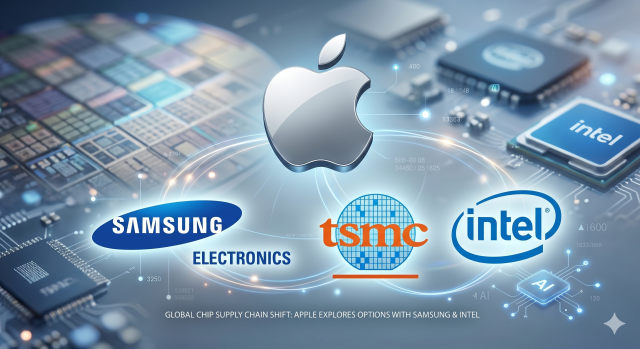
SEOUL, May 06 (AJP) - Apple Inc. is reportedly exploring partnerships with Samsung Electronics and Intel to reduce its heavy reliance on Taiwan Semiconductor Manufacturing Co. (TSMC) for processor production, a shift that coincides with Samsung securing a new 4-nanometer artificial intelligence (AI) chip order from a U.S. firm.
According to a recent report by Bloomberg, Apple is in early-stage discussions with Samsung and Intel to manufacture its core processors. The move is widely interpreted as an effort to restructure its critical component supply chain as the explosive growth of AI tightens global advanced chip capacity and geopolitical risks surrounding Taiwan persist.
When asked about a new order, a Samsung Electronics spokesperson stated, "Nothing has been confirmed yet regarding this matter."
Despite the lack of official confirmation, industry observers note that Apple has pressing reasons to seek alternatives.
For over a decade, Apple has exclusively contracted TSMC to manufacture its custom-designed System-on-Chips (SoCs) for iPhones and Macs, utilizing TSMC's cutting-edge 3nm process for its latest devices.
However, soaring demand for AI data centers and on-device AI has strained the supply of advanced nodes. Apple CEO Tim Cook recently acknowledged during an earnings call that the company's supply chain flexibility has diminished, highlighting chip shortages as a constraint on product growth.
While the Apple partnership remains in the exploratory phase, Samsung's foundry division is actively capitalizing on the overflow demand in the AI sector.
On Sunday, South Korean semiconductor design house ADTechnology (ADT) announced it had signed a turnkey contract worth approximately 40 billion won ($29.4 million) with a U.S.-based AI fabless company. Under the three-way collaboration model, the U.S. firm will lead the chip design, while ADT will manage development and production utilizing Samsung Foundry’s 4nm process. The project centers on high-performance computing (HPC) system-on-chip (SoC) chiplets for AI data centers.
Although the contract size is relatively small, industry experts view it as a crucial testbed for Samsung to prove itself as a viable alternative to TSMC. With Samsung's 4nm production yields reportedly stabilizing near 80 percent, the company is targeting niche markets and fabless firms unable to secure production slots at TSMC.
The global foundry market remains fiercely competitive as the AI boom drives an unprecedented need for manufacturing capacity.
TSMC, which commands roughly 70 percent of the global market share compared to Samsung's 7 percent to 8 percent, is aggressively expanding its footprint. The Taiwanese giant recently resumed its Longtan Science Park expansion project for next-generation angstrom-level facilities and plans to increase its 2nm and 3nm wafer capacity by 20 percent by the end of the year.
Meanwhile, Samsung Electronics indicated during its first-quarter earnings call that its advanced node facilities have reached maximum utilization. The tech giant noted it is in active discussions with multiple large AI and HPC clients regarding 2nm cooperation, signaling a continued push to close the gap with its Taiwanese rival.
Shares of Samsung Electronics surged on Wednesday, closing at 267,000 won, up 14.84 percent, sending its market value to $1.075 trillion to make the company second Asian name after TSMC to be worth more than $1 trillion. On Wednesday's closing, Samsung Electronics ranks 11th in market cap.

Copyright ⓒ Aju Press All rights reserved.