SEOUL, May 6 (AJP) — The rationale for higher interest rates gained ground in South Korea as inflation, long subdued by lethargic demand, accelerated at the fastest pace in 21 months in April after the blockade of the Strait of Hormuz triggered a surge in imported prices, while the benchmark stock index nearly tripled from a year earlier to touch a new four-digit milestone.
According to data released by the Ministry of Data and Statistics (MDAS) on Wednesday, consumer prices rose 2.6 percent year-on-year in April, breaking out of the months-long range around 2 percent.
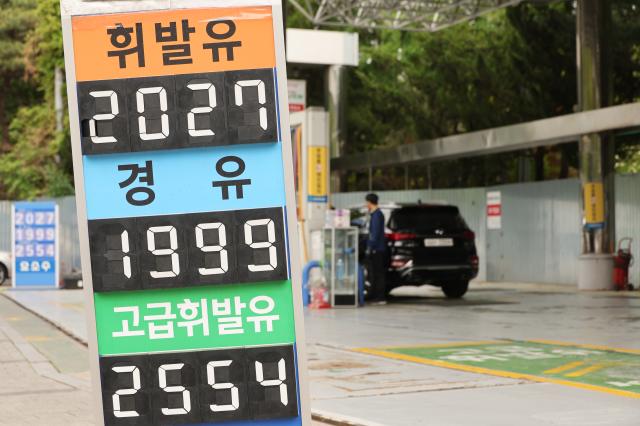
Fuel was the primary driver, as South Korea relies heavily on Middle Eastern crude and gas for energy and manufacturing. Petroleum prices alone soared 21.9 percent from a year earlier and 7.9 percent from the previous month, contributing nearly 1 percentage point to headline inflation. Gasoline prices jumped 21.1 percent year-on-year, while diesel prices surged 30.8 percent. Kerosene prices also climbed 18.7 percent.
As fuel prices rose, transportation costs followed suit. International airfares climbed 15.9 percent from a year earlier.
The Baltic Dry Index (BDI), a benchmark for global shipping rates, surged more than 27 percent from 2,140 on Feb. 27 — before the conflict escalated — to 2,730 as of May 1.
Economic authorities say the impact of the blockade reached the domestic market with a time lag. While vessels that cleared the Strait of Hormuz in February arrived at Korean ports by late March, supply chains began rupturing in April as shipments were cut off.
And the pain may only be beginning.
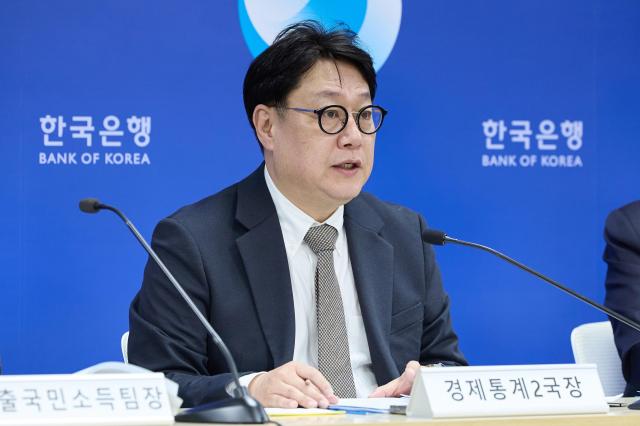
“The squeeze from the blockade will be reflected in second-quarter data,” Lee Dong-won, director general of economic statistics at the Bank of Korea (BOK), said during a press briefing on first-quarter GDP growth on April 23.
At the time, Lee said the modest 2.2 percent rise in March inflation was temporary. “The impact remained minimal through the first quarter as vessels that passed through the strait before the closure arrived in Korea by late March,” he warned. That warning has now become reality.
International oil prices have continued to climb steadily. As of Wednesday afternoon, the three major oil benchmarks — West Texas Intermediate (WTI), Brent and Dubai crude — were all trading above $100 per barrel.
Dubai crude, which accounts for about 70 percent of South Korea’s crude imports, has maintained its upward trend even after the United Arab Emirates (UAE) withdrew from OPEC and other members announced production increases.
Given the tense tug-of-war between the United States and Iran over control of the strategic chokepoint, oil prices are unlikely to normalize anytime soon.
The National Assembly Budget Office (NABO) estimated that South Korea’s economic growth could slow to 1.2 percent from its initial estimate of 2 percent if international oil prices remain above an annual average of $100 per barrel. It also projected inflation to average 2.9 percent, well above the central bank’s 2 percent target.
Following stronger-than-expected 1.7 percent GDP growth in the first quarter and a red-hot streak in chip earnings and stocks, major investment banks have sharply raised their forecasts for Korea this year.
JPMorgan Chase lifted its growth estimate to 3.0 percent from 2.2 percent, BNP Paribas raised its forecast to 2.7 percent from 2.0 percent and Citigroup increased its projection to 2.9 percent from 2.2 percent.
Higher growth and inflation forecasts could further fuel inflation expectations at a time when price pressures are already becoming entrenched.
Bond prices hit fresh annual lows on expectations that rates may move higher.
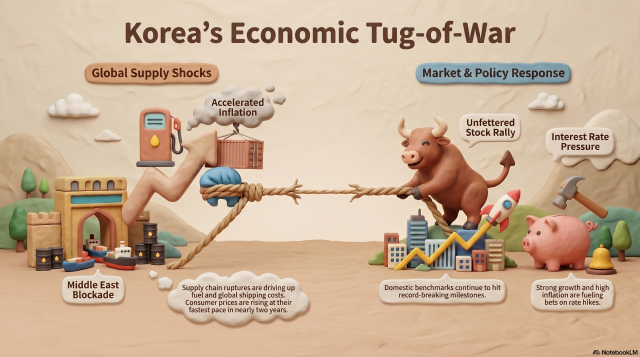
The yield on the three-year government bonds retreated to 3.595 percent after hitting annual high of 3.641 percent in the morning while the ten-year yield ended at 3.932 percent after flirting close at 4.00 percent in earlier session, building pressure around the benchmark interest rate, which has stayed unchanged at 2.5 percent since May last year.
Pessimists warn that the chip and stock frenzy may be overheating, particularly as leveraged investment accelerates.
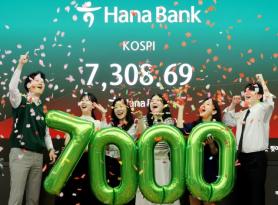
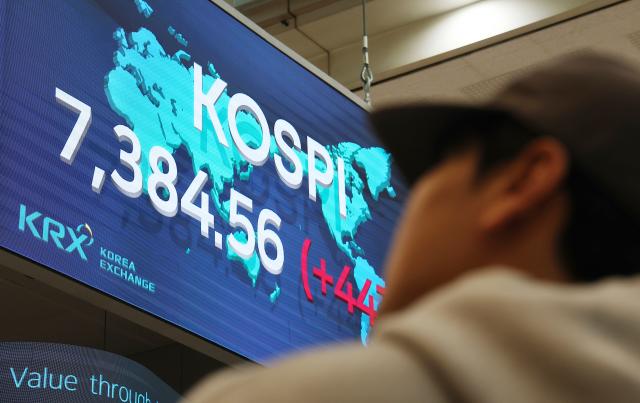
The KOSPI continued to stun markets, ending Wednesday up 6.45 percent at 7,384.56, outpacing the S&P 500 index’s Tuesday close of 7,259.22.
“The prolonged Middle East war could lower South Korea’s economic growth rate by 0.9 percentage point,” Albert Park, chief economist of the Asian Development Bank (ADB), said during a press conference at the ADB annual meeting in Samarkand, Uzbekistan. The ADB nevertheless raised its growth forecast for South Korea to 1.9 percent from 1.7 percent earlier in April.

Copyright ⓒ Aju Press All rights reserved.