
Journalist

Lee Hugh
=
-
 HD Hyundai Electric Q1 2026 Operating Profit Rises 18.4% to 258.3 Billion Won HD Hyundai Electric said in a regulatory filing on the 28th that it posted first-quarter 2026 revenue of 1.0365 trillion won and operating profit of 258.3 billion won. Revenue rose 2.1% from a year earlier and operating profit climbed 18.4%. The operating margin was 24.9%. By product, growth was led by the power equipment segment. Power equipment revenue rose 21.6% from a year earlier, supported by expanded performance in North American power transformers. Revenue from rotating machinery increased 10.8% on strong demand for marine products. Revenue from distribution equipment fell 24.2%, the company said, citing a base effect from large distribution-transformer deliveries a year earlier and delayed shipments of low-voltage circuit breakers due to geopolitical risks in the Middle East. By market, North America revenue increased 26.6% from a year earlier, driving overall growth. In Europe, revenue fell from the previous quarter due to a high base but rose 17.0% from a year earlier. First-quarter orders totaled $1.797 billion, up 34.6% from a year earlier, meeting 42.6% of its annual order target of $4.222 billion. The order backlog stood at $7.888 billion, up 17.2% from the end of last year. An HD Hyundai Electric official said the company is maintaining a selective order strategy focused on profitability, while orders continue to rise on demand tied to the spread of AI data centers and replacement needs for aging power grids. The official said the company will complete expansions at its Ulsan plant and its North American production subsidiary without disruption to sustain solid growth. Separately, the company said it will pay a quarterly cash dividend of 1,300 won per common share. The total dividend is 46.8 billion won. The record date is May 13 and the payment is scheduled for May 27.* This article has been translated by AI. 2026-04-28 13:55:09
 -
 Kim Yong Accepts Democratic Party’s Decision to Drop Strategic Nomination Bid Kim Yong, former deputy director of the Democratic Research Institute, said on the 28th that he “accepts the party’s decision with a heavy heart” after the Democratic Party’s strategic nomination for the upcoming by-election was scrapped, but urged supporters to back the party and “declare a firm resolve to end the aftermath of an insurrection” through the vote. Speaking at a news conference at the National Assembly that afternoon, Kim said he would respect the party’s deliberations and “strategic judgment” and would “serve without rank.” “If my sacrifice becomes a foundation for the success of the Lee Jae-myung government and the Democratic Party’s victory, I will step aside gladly,” he said. Kim again claimed prosecutors had brought a fabricated case against him and said he would fight it to the end. “The indictment against me is clearly a fabrication by political prosecutors and a petty political retaliation,” Kim said. “If I collapse here, it will set a precedent that a manipulated investigation can win.” He added, “I will not stop, and I will prove it to the end. I will break the prosecution’s fabricated indictment and devote myself from the lowest place for the success of the Lee Jae-myung government.” Kim also thanked his supporters and asked for backing for the June 3 local elections and the by-elections. “Because there are party members who believe in my innocence, I am not alone,” he said. “As a comrade standing by your side, I will start again.” He again called on voters to “declare a firm resolve to end the aftermath of an insurrection” and to “declare a great leap forward for South Korea.” Kim had signaled his intention to run in the Gyeonggi Province area starting with a media briefing on the 13th. About 60 lawmakers within the party were reported to have urged Kim’s nomination, and the leadership was said to be weighing whether to nominate him. But on the 27th, the party’s strategic nomination committee decided not to nominate him, citing concerns it could affect the by-election, leaving Kim unable to run.* This article has been translated by AI. 2026-04-28 13:50:38
 -
 Korea Venture Investment CEO Lee Dae-hee Pledges Bigger Role for Fund of Funds, More Private Capital "Korea Venture Investment will continue to support the growth of ventures and startups as a single investment platform," CEO Lee Dae-hee said on the 28th. Speaking at a briefing to mark one year in the job, Lee reviewed the past year and outlined operating strategy and a longer-term vision for the government-backed fund of funds, known as the Motae Fund. He said the organization will expand its role beyond serving contributing institutions, aiming to connect capital with markets and link regions with global opportunities, building on the fund’s 20-year track record. Lee said he moved quickly to address what he had highlighted upon taking office: the issue of the Motae Fund’s duration. Launched in 2005, the fund of funds has been formed at a cumulative 43.9 trillion won over 20 years, and a law revision passed by the National Assembly last year made it possible to extend the fund in 10-year increments. "It must play a practical role in supporting the growth of ventures and startups, beyond supplying money to the venture investment market," he said. Lee said the centerpiece of the strategy is expanding private investment. To raise the share of private pensions and overseas capital, he proposed upgrading the framework for an "LP (limited partner) growth fund." He said the goal is a virtuous cycle in which private capital becomes a core driver of the venture market. Korea Venture Investment has also set up incentive structures to encourage industrial capital, including large companies, to participate in the venture market, widening channels for private money. It has regularized a policy forum for the Motae Fund and, through a venture investment research center, strengthened the management of market indicators and related data to better explain policy to the National Assembly and the government. Based on those efforts, it committed 2.2195 trillion won last year, helping form venture funds totaling 4.4751 trillion won, and a total of 3.0995 trillion won was invested, the company said. As of February, the number of global funds had expanded to 84. The company said it is also broadening the foundation for Korean ventures and startups to expand overseas through efforts including the Jeju Startup Fund, formed with Korean and Japanese contributors including overseas Koreans, and the opening of a Silicon Valley Startup Venture Campus (SVC). On regional investment, it said it formed four regional parent funds totaling 400 billion won in 2025. For 2026, it plans five regional growth funds totaling 450 billion won, as it accelerates efforts to expand investment outside the Seoul metropolitan area. "If the past year was a time to set the direction, the next year will be a time to prove that direction with real results," Lee said. "Korea Venture Investment will strengthen its role as a venture investment platform that connects capital, connects markets, and connects regions with the world."* This article has been translated by AI. 2026-04-28 13:45:19
 -
 FSS chief urges outside directors to step up oversight at regional financial groups Lee Chan-jin, head of South Korea’s Financial Supervisory Service, told newly appointed outside directors in the financial sector that they should “fairly and objectively represent shareholders’ interests” and actively check and monitor management. Lee spoke on April 28 at the Korea Banking Institute in central Seoul, appearing as the first lecturer in a new outside-director training program run by the Korea Banking Institute. He said the role of outside directors is “more important than ever” if financial companies are to carry out their core functions. “Transparent governance helps minimize principal-agent problems between shareholders and management, raising shareholder value and ultimately building trust in the financial industry,” Lee said, calling outside directors central to transparent and fair governance. He also cited repeated cases of consumer harm, including misselling, and the concentration of financial resources in real estate, saying the low-growth trend underscores the need to shift toward more productive finance. Lee said the FSS would provide institutional support, including reflecting board-level feedback on sound governance in its supervision and inspections. After the lecture, the FSS signed a memorandum of understanding with three regional financial holding companies — iM, BNK and JB — to train and strengthen outside directors. The move follows a February agreement last year with five major financial holding companies: KB, Shinhan, Hana, Woori and NH NongHyup. Attendees included BNK Financial Group Chairman Bin Dae-in, who won a second term last month, along with iM Financial Group Chairman Hwang Byung-woo and JB Financial Group Chairman Kim Ki-hong. Under the agreement, the Korea Banking Institute will add topics tailored to regional holding companies to its outside-director curriculum and introduce remote learning to improve access for directors living outside Seoul. The FSS and the Korea Federation of Banks said they plan to encourage active participation across the financial sector. 2026-04-28 13:43:12
 -
 Chey Tae-won urges Korea-Japan economic bloc to compete in U.S.-China AI race Chey Tae-won, chairman of the Korea Chamber of Commerce and Industry and chairman of SK Group, on April 28 urged South Korea to pursue cooperation with Japan at a level approaching economic integration as a response to U.S.-China competition for dominance in artificial intelligence. Speaking at the Korea-China Parliamentary Association’s first 2026 policy seminar at the National Assembly Members’ Office Building, Chey said South Korea “must no longer remain a country that simply follows rules between the United States and China.” He argued that keeping influence in the rivalry will require strengthening technological competitiveness while also expanding the country’s economic reach. Chey described U.S.-China tensions as structural and unlikely to end quickly. “The U.S.-China hegemonic competition is highly likely to continue for decades,” he said, adding that South Korea should “coolly” assess whether it has enough strength to defend itself. As a practical alternative, he proposed strategic cooperation with Japan. “Japan has an industrial structure similar to ours and is a country with which we can share interests,” he said. “Beyond simple cooperation, we need solidarity at a level that is recognized from the outside as a single economic bloc.” He said combining the gross domestic product of South Korea and Japan would total about $6 trillion, or roughly one-third of China’s economy. At that scale, he said, the United States and China “would have no choice but to take it seriously.” Chey said stronger Korea-Japan ties could reshape the broader Asian order. He said that if the partnership deepens, Asian countries excluding China could be drawn toward joining an economic bloc centered on the two nations. Over the long term, he said, an “Asian-style community model” similar to the European Union could also be considered. Chey also listed key competitive factors in the AI era as capital, electricity, GPUs (graphics processing units) and memory, and stressed the need for investment to secure large-scale data centers and energy infrastructure. “To do AI well, you need the ability to produce AI, but South Korea currently does not have a great AI data center,” he said. To overcome that, he said, building 1 gigawatt would require about $50 billion in investment. As a strategy for success in the AI technology supremacy era, Chey cited “speed, scale and security.” He said products should be built quickly even if imperfect to attract users, and that a minimum scale must be secured. To do that, he said, it is necessary to follow the strategy of Nvidia, which currently leads the AI industry ecosystem. The Korea-China Parliamentary Association is a bipartisan parliamentary diplomacy platform made up of 145 lawmakers from both the ruling and opposition parties. It has continued policy discussions through seminars and parliamentary diplomacy across areas including foreign affairs, the economy, advanced industries and culture.* This article has been translated by AI. 2026-04-28 13:42:18
 -
 Daewoo E&C hits 52-week high as surprise Q1 profit jump lifts shares 17% Daewoo Engineering & Construction shares surged after the company reported a surprise earnings beat. According to the Korea Exchange, Daewoo E&C was trading at 39,000 won as of 1:25 p.m. on the 28th, up 17.47% (5,800 won) from the previous session. The stock earlier climbed to 39,850 won, setting a new 52-week high. Daewoo E&C said its first-quarter operating profit rose 68.9% from a year earlier to 255.6 billion won. Revenue fell 6% to 1.9514 trillion won, while net profit jumped 237.6% to 195.8 billion won. The operating profit topped market expectations, marking the first time in 14 quarters the company posted operating profit in the 200 billion-won range. The company said profitability in its building construction business improved as projects launched during a period of rising construction costs were completed in sequence. Daewoo E&C said it plans to expand orders centered on energy infrastructure such as nuclear power plants and liquefied natural gas (LNG), as well as overseas urban development, data centers and urban renewal projects. Lee Eun-sang, an analyst at NH Investment & Securities, said Daewoo E&C is the most likely to participate as a construction partner in Team Korea. He added that with additional construction cooperation in the United States and Vietnam in mind, cost negotiations in the Czech Republic will be important, and Daewoo E&C has leverage because few domestic builders have lead-underwriter construction experience.* This article has been translated by AI. 2026-04-28 13:36:16
 -
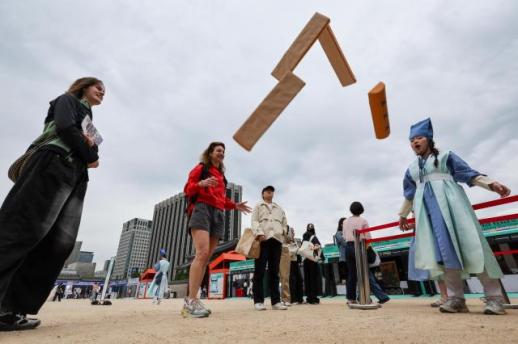 From stillness to spectacle: spring festivals at palaces in Seoul SEOUL, April 27 (AJP) -Once defined by stillness, Seoul’s royal palaces are learning how to absorb noise and hordes of outsiders. At Gyeongbokgung Palace, the gravel crunches not under a lone guard’s step but beneath waves of visitors — cameras raised, hanbok skirts sweeping past sneakers, languages overlapping in the spring air. What was once a space of restraint now pulses with movement. The 2026 Spring Royal Culture Festival has made that shift unmistakable. Across the palaces and Jongmyo Shrine, heritage is no longer observed at a distance. It is entered, performed, photographed — and shared. At Changgyeonggung Palace and Gyeonghuigung Palace, performances unfold where court life once followed rigid protocol. At Jongmyo, the solemn strains of ancestral ritual music now meet the gaze of an audience, not just the spirits they were meant to honor. The question is not whether the palaces have changed — they have — but what they are becoming. They are no longer sanctuaries of quiet history. Nor are they merely tourist sites. They sit somewhere in between: cultural stages, memory factories, shared spaces where history is continuously reinterpreted. In a city moving at relentless speed, the palaces have not resisted change. They have absorbed it — trading solitude for relevance, and silence for life. 2026-04-28 13:31:41
 -
 South Korea’s Q1 CD Exports Top $100 Million for First Time; U.S. Shipments Surge 506% This year’s first-quarter exports of music albums (CDs) topped $100 million for the first time, setting a record high for any quarter. The Korea Customs Service said April 28 that CD exports in the first quarter totaled $120 million, up 159.0% from a year earlier. Annual CD exports totaled $300 million last year, but this was the first time quarterly exports exceeded $100 million. With quarterly results continuing to set new highs since the third quarter of last year, the agency said the annual record could also be broken. The surge is being attributed to the global popularity of K-pop, including BTS, and to fandom culture in which fans buy physical albums to own them and support artists. Demand is also rising among listeners who bypass major streaming-service algorithms and seek out physical CDs. By destination, the United States accounted for $36 million, or 28.8% of the total, followed by Japan at $31 million (25.3%), the European Union at $21 million (16.5%), China at $18 million (14.4%) and Taiwan at $9 million (6.9%). Exports to the United States jumped 506.4% from the first quarter of last year, the fastest growth rate. Shipments to the EU rose 461.9%, while Japan increased 157.4% and China 38.2%. Growth was strongest outside Asia. First-quarter exports to non-Asian markets rose 408.3%, far outpacing the 71.9% increase to Asian markets. North America climbed 449.2% and Europe 397.7%. Exports went to 131 countries, and 94 of them — 72% — posted their best first-quarter results.* This article has been translated by AI. 2026-04-28 13:31:12
 -
 Seoul’s Low-Sugar ‘Seoul Bread’ Tops 10,000 Sold in 10 Days SEOUL — Seoul’s new “Seoul Bread,” developed with a private bakery company, has sold more than 10,000 units in just 10 days, the city government said. Officials credited the strong response to a “less sweet, clean-tasting” health concept that aligns with growing consumer interest in low-sugar foods. Seoul said on the 28th that “Seoul Sweet Red Bean Bread” and “Seoul Whole-Wheat Bread,” jointly planned with Koryodang, an 80-year-old bakery company, recorded cumulative sales of 10,339 as of the 25th after going on sale on the 15th. Average daily sales topped 1,000, with some stores selling out early and customers waiting to buy. The products have been sold at Koryodang stores inside Lotte Department Store’s main branch and Shinsegae Department Store’s Gangnam branch. With sellouts continuing since launch, the city said the items are emerging as another Seoul-branded food souvenir following “Seoul Ramen.” Seoul pointed to the recipes as a key driver. The sweet red bean bread uses a fermentation process to boost flavor while cutting the sweetness of the filling by 36% compared with existing products. The whole-wheat bread uses no sugar or butter. Consumers have responded with comments such as, “It’s less sweet, so it’s not heavy,” and “It’s filling enough for a meal.” Packaging also helped, the city said, featuring major Seoul landmarks including Gwanghwamun, Dongdaemun Design Plaza and Namsan Tower, drawing souvenir demand among foreign tourists. Based on the early results, Seoul plans to expand the lineup. Starting in late May, it will roll out castella, madeleines, rice twisted doughnuts, and cookie-and-yanggaeng sets. In the second half of the year, it plans to broaden distribution to convenience stores and duty-free shops. The city will also run a pop-up store May 1-5 at the Seoul Gallery inside Seoul City Hall to sell the products to visitors during the Children’s Day holiday period. “Seoul Bread is drawing strong interest from both residents and tourists and is becoming a new Seoul food content,” said Min Su-hong, Seoul’s director general for public relations planning. “Through private-sector partnerships, we will continue to expand the Seoul brand experience,” he said. * This article has been translated by AI. 2026-04-28 13:27:18
 -
 NgeneBio shares plunge 25% on capital reduction and $224 million stock offering plan Shares of NgeneBio tumbled after the company announced it will pursue a capital reduction and a stock offering at the same time. According to the Korea Exchange, NgeneBio was trading at 1,226 won on the KOSDAQ as of 1:18 p.m. on the 28th, down 419 won, or 25.47%, from the previous session. The drop was widely attributed to concerns that a large capital reduction and a new share sale would dilute shareholder value and weigh on sentiment. NgeneBio said it decided at a board meeting the previous day to issue 7.15 million common shares in a paid-in capital increase. The company aims to raise about 22.4 billion won, allocating about 17.3 billion won for working capital and 5.1 billion won to repay debt. The deal will be structured as a rights offering to existing shareholders, with any unsubscribed shares sold in a public offering. The company will also carry out a free capital reduction to cover accumulated losses. The reduction ratio is 66.67%, consolidating three existing common shares into one. As a result, the number of shares outstanding will fall to 8,936,583 from 26,809,750. The record date for the capital reduction is June 24, and the listing of new shares is scheduled for July 13. Market participants said the capital reduction is intended to improve the company’s financial structure, but the follow-on stock offering makes dilution of existing stakes unavoidable, adding pressure to the share price. They also noted that the heavy allocation to working capital and debt repayment suggests a focus on financial stability rather than growth investment.* This article has been translated by AI. 2026-04-28 13:25:13