
Journalist

Lee Hugh
=
-
 Daehan Petrochemical to Raise NCC Operating Rate to 72% From 62% Daehan Petrochemical said April 28 it will proactively raise the operating rate of its naphtha cracking center (NCC) to 72% from 62%, in line with the government’s supply-chain stabilization policy. The company said it diversified supply lines to the United States and other sources immediately after the outbreak of war, minimizing disruptions in naphtha procurement. It also used a workaround strategy, buying basic petrochemical feedstocks such as ethylene and propylene to replace short naphtha supplies and using them to produce polyethylene (PE) and polypropylene (PP). Daehan Petrochemical said it expanded supplies of battery separator materials — where it holds the world’s top market share — by more than 60% from the previous month to support the competitiveness of South Korea’s battery industry. It also said it increased supplies of ethylene used to cut shipbuilding steel at shipyards, supporting stable operations in the shipbuilding sector. A company official said Daehan Petrochemical plans to actively expand procurement of raw materials such as naphtha and lift the NCC operating rate to 72% “even amid an unprecedented crisis in raw material supply.” The official added the company will continue to fulfill its responsibilities as a key national industry so there are no disruptions to downstream industries and daily life.* This article has been translated by AI. 2026-04-28 09:25:04
 -
 U.S., Iran Keep Back-Channel Talks After Second Meeting Falls Through, CNN Says U.S.-Iran talks aimed at ending the war have stalled publicly, but the gap between the two sides may be smaller than it appears, according to an analysis. CNN reported on April 27, citing multiple sources familiar with the mediation, that the sides did not hold a second face-to-face meeting in Pakistan but have continued back-channel negotiations. The discussions are focused on a step-by-step approach. In an initial phase, the main items include returning to prewar conditions and reopening the Strait of Hormuz without transit restrictions or fees. Iran’s nuclear program — cited by the United States and Israel as a justification for the war — would be taken up in a later stage, the report said. Uncertainty over the outlook remains. The Wall Street Journal reported the same day that President Donald Trump and his national security team are skeptical of an Iranian proposal that would reopen the strait while postponing nuclear talks. From the early days of the war, Trump has said any deal must require Iran to give up its stockpile of near weapons-grade uranium and halt uranium enrichment, but Iran has not accepted those terms. Sources said mediators are pressing both sides to reach an agreement and view the next few days as a key turning point. They added that the possibility the United States could walk away and military clashes could resume cannot be ruled out.* This article has been translated by AI. 2026-04-28 09:24:25
 -
 Trump WHCA Dinner Shooting Renews Scrutiny of Secret Service Response The shooting incident at the White House Correspondents' Association dinner attended by President Donald Trump has renewed scrutiny of the U.S. Secret Service after an armed suspect moved through the hotel and reached an area near the event. Former Secret Service agents, however, said the core protective layers worked. According to CBS News and Reuters, the suspect, Cole Thomas Allen, left a 10th-floor room at the Washington Hilton on April 25 (local time). Carrying a shotgun, a handgun and three knives, he used an internal stairwell toward the event area, then charged toward a hotel security screening point with metal detectors. Allen was subdued by uniformed Secret Service officers one floor above the ballroom where Trump was. Reuters reported Allen was charged with attempted assassination of President Trump and could face life in prison if convicted. Former agents largely framed the outcome as damage prevention rather than a breakdown. Timothy LeBoeuf, who took part in WHCA dinner security during the George W. Bush and Barack Obama administrations, told CBS News that “everyone did their job,” calling it a “textbook response” in which a multilayered defense worked. He said the Secret Service uses outer, middle and inner perimeters, and the suspect did not reach the ballroom. Paul Eckloff, a former senior official in the presidential protection detail, told CBS News the incident should be seen as preventing mass casualties. “Dozens could have been shot, but everyone walked out,” he said. Former agent Mike Matranga also said the agency’s concentric security model held. He said the suspect ran at full speed toward the screening area, leaving officers only seconds to react. But he added that “you can’t completely secure an entire hotel,” and that public-venue events carry inherent risk. The venue remains a central issue. The Washington Hilton is where former President Ronald Reagan was shot in 1981. Security upgrades later included an enclosed garage allowing a presidential vehicle to enter without outside exposure. Still, the building’s scale poses limits because guests, staff, delivery workers and other visitors share the same space. LeBoeuf said that without defining where a venue begins and ends, “it becomes infinite.” A.T. Smith, a former deputy director of the Secret Service, told CBS News it is possible to fully lock down an open hotel, but that is not typically done in the United States. Instead, he said, the agency sets its protective footprint around the event area where the president is and the access routes. Some former agents said additional steps should be considered. The Independent quoted former agent Bobby McDonald as saying the system worked but could improve, calling it less a “successful outcome” than a “positive outcome.” Former agent Bill Gage said the defense model worked but that strengthening screening points and expanding protected zones could be reviewed. The Secret Service also left room for changes. The Independent quoted spokesman Anthony Guglielmi as saying the WHCA dinner protection model proved effective, but improvements are expected “at every level” for future events.* This article has been translated by AI. 2026-04-28 09:22:07
 -
 Taihan Cable Wins Offshore Cable Contract for Sinan Solar Power Project Taihan Cable said April 28 it has won a project to supply extra-high-voltage submarine cables for a solar power development in Sinan County, South Jeolla Province. The project will transmit electricity generated at the Sinan Bigeum solar power plant and the Dogo floating solar power plant to the Anjwado substation. Taihan Cable will supply Top Solar Group, the engineering, procurement and construction contractor for the overall plants, with 154kV-class extra-high-voltage submarine cables, joints and related materials, and will also carry out installation. It is the company’s first project carried out in cooperation with its submarine cable installation subsidiary, Daehan Ocean Works. Taihan Cable will manufacture the cables at its Dangjin Submarine Cable Plant 1, while Daehan Ocean Works will transport and lay them. The company said it aims to integrate the full value chain from production to transport and installation to demonstrate its total-solution capabilities and accelerate synergy with the subsidiary. Daehan Ocean Works is a specialized offshore installation firm that Taihan Cable acquired in July last year to strengthen its subsea construction competitiveness. Taihan Cable said it has been securing major projects, including Yeonggwang Nakwol, and is expanding both production and installation capacity. It is building a second submarine cable plant capable of producing 640kV high-voltage direct current (HVDC) submarine cables and is reviewing additional cable-laying vessels. “As this is our first project carried out in cooperation with a subsidiary, we will focus our capabilities to ensure its success,” a company official said. “We will continue to strengthen our position as a total-solution provider in the global submarine cable market.”* This article has been translated by AI. 2026-04-28 09:21:17
 -
 Naver Pay to Cover Fees for Small Merchants for Family Month Promotion Naver Pay (Npay) will cover payment fees for small online and offline merchants as part of a promotion tied to May, widely observed in South Korea as “Family Month.” Naver Pay said April 28 that it will support Npay fees incurred from May 4 to May 10 by eligible small merchants using its online and in-store payment services, as well as Naver’s reservation and ordering services. The company said the program is intended to help small business owners benefit from increased spending during a period when payments typically concentrate around Children’s Day and Parents’ Day through online shopping, in-store payments and transactions made via Naver reservations and orders. Merchants classified as “small sellers” under National Tax Service criteria — including Npay online and in-store payment merchants and Naver reservation and order merchants — will be included automatically, without a separate application. For online and reservation/order merchants, the company will cover fees across all payment methods. For in-store payment merchants, support applies to transactions paid with Npay Money and points. The total eligible Npay fees accrued during the support period will be paid in full in a lump sum in June. This is the seventh time Naver Pay has introduced a plan to support or lower fees for merchants. It previously covered in-store payment fees in full for small and midsize merchants during the Lunar New Year holiday period in February. A Naver Pay official said the company will continue efforts to practice “mutual growth finance” by providing services and support measures that help small business owners who use Npay grow their businesses.* This article has been translated by AI. 2026-04-28 09:18:17
 -
 Coinone Files Lawsuit, Seeks Injunction Against FIU Partial Business Suspension South Korean cryptocurrency exchange Coinone has filed an administrative lawsuit and sought a court injunction to block a partial business suspension ordered by the Financial Intelligence Unit under the Financial Services Commission, the virtual asset industry said. According to the industry on the 28th, Coinone retained law firm Lee & Ko on the afternoon of the 27th and filed a suit with the Seoul Administrative Court seeking to overturn the FIU’s three-month partial suspension. It also submitted a request to stay enforcement, the industry said. The FIU held a sanctions review meeting on the 13th and penalized Coinone for violations including a duty to block prohibited transactions and customer identification requirements. The agency ordered a three-month partial suspension from April 29 to July 28 and imposed an administrative fine of 5.2 billion won. If the court grants the stay, the suspension scheduled to begin on the 29th would be halted until a ruling on the merits. The move mirrors steps taken by Upbit and Bithumb, which have also gone to court over FIU sanctions. Separately, a court decision is also expected on the 29th on whether to grant Bithumb’s request to suspend enforcement of its partial business suspension. The court is expected to weigh, among other factors, whether Bithumb’s ongoing transaction-blocking measures sufficiently address concerns about harm to the public interest, according to industry officials.* This article has been translated by AI. 2026-04-28 09:15:15
 -
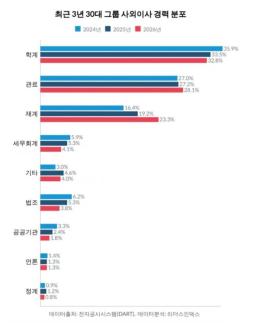 Outside Directors With Big-Business Backgrounds Top 20% at Top 30 Groups, Study Finds The share of outside directors at South Korea’s top 30 conglomerate groups who come from the business community has topped 20% for the first time, while the share of newly appointed female outside directors hit a record high. Leaders Index, a corporate analysis firm, said April 28 it reviewed 847 outside directors at 229 companies that filed business reports among the country’s top 30 groups by assets. It found the business-community share rose the most. Outside directors with business backgrounds increased to 23.3% (197) this year, up from 16.4% (141) in 2024 and 19.2% (163) in 2025. It was the first time the figure exceeded 20% since the survey began. By prior employer, the largest number had careers at Samsung and SK, with 11 each. They were followed by Hana Financial Group and Shinhan Financial Group with 10 each, and Hyundai Motor and LG with seven each. By group, Lotte had the highest share of business-community outside directors: 29 of 59, or 47.5%. At SK, 31 of 80 outside directors, or 38.8%, were from the business community, the largest share within the group. By contrast, Samsung, CJ and Shinsegae groups had high shares of former government officials. At CJ, 21 of 28 outside directors (75%) were from government; at Shinsegae, 13 of 20 (65%); and at Samsung, 33 of 60 (55%). Of the 67 government-background outside directors across the three groups, 20 previously worked at the prosecution, the judiciary or the Fair Trade Commission. Hyundai Motor Group and LG Group had a majority from academia. At Hyundai Motor, 36 of 78 (46.2%) were from academia; at LG, 31 of 42 (73.8%). By specialty, legal and policy was the largest category this year at 28.2% (239). The share in technology and tax has also risen steadily, from 14.8% (127) in 2024 to 15.1% (128) in 2025 and 16.5% (140) in 2026. Women also reached a record share among new outside directors. Of 122 newly appointed outside directors this year, 42 (25.0%) were women. Women accounted for 197 of all 847 outside directors, or 23.2%. Among female outside directors, 42.1% had academic backgrounds, followed by business (26.4%) and government (16.2%).* This article has been translated by AI. 2026-04-28 09:11:55
 -
 Samsung SDI posts 1Q 2026 operating loss of 155.6 billion won, narrows deficit 64.2% Samsung SDI posted a sixth straight quarterly operating loss in the first quarter, but sharply narrowed the deficit as demand improved in key end markets. The company said in a regulatory filing on 28 that first-quarter 2026 revenue rose 12.6% from a year earlier to 3.5764 trillion won. It reported an operating loss of 155.6 billion won, narrowing the loss 64.2% year over year. Net profit totaled 56.1 billion won, returning to the black. By business, the battery division posted revenue of 3.3544 trillion won and an operating loss of 176.6 billion won. The electronic materials division reported revenue of 222.0 billion won and operating profit of 21.0 billion won. In batteries, demand recovered for power energy storage systems, uninterruptible power supplies, battery backup units, power tools and other applications. Revenue rose 12.5% from a year earlier and the operating loss narrowed 61.0%. Samsung SDI said profitability improved on higher benefits from the Advanced Manufacturing Production Credit, supported by expanded U.S. production and sales of ESS batteries, and strong sales of higher-value cylindrical batteries. In electronic materials, semiconductor-material sales remained steady, while display-material sales rebounded on higher flagship smartphone sales by major mobile customers, improving results from a year earlier. Samsung SDI cited expanded ESS orders, diversification of customers and products in its electric-vehicle battery business, and efforts to strengthen future technology competitiveness as key drivers of the first-quarter improvement. In ESS, it said it won new projects for prismatic LFP batteries and signed a supply contract for high-output batteries for BBUs. It also said it built a materials supply chain in advance to respond to the U.S. "prohibited foreign entity" rules. In EV batteries, Samsung SDI said it signed a multiyear supply contract with Mercedes-Benz, securing all three of Germany’s major premium automakers as customers. It also said it won a project for tabless cylindrical batteries for hybrid electric vehicles, further diversifying its customer and product portfolio. The company said it expects results to improve gradually from the second quarter as demand recovery continues, though it warned uncertainty in the global business environment is likely to persist. For EV batteries, it expects demand to recover as subsidies expand in major European countries and total cost of ownership for internal-combustion vehicles rises. It said it will proceed with planned mass production for new projects without disruption and focus on restoring profitability by improving utilization rates. For ESS batteries, Samsung SDI said it will expand local mass production and sales in the United States to meet rising demand tied to the growth of AI data centers. It also plans to participate actively in South Korea’s centralized ESS contract market and next-generation grid-linked ESS projects. In small batteries, it said it will expand sales of differentiated products, including tabless and high-output batteries, reflecting continued growth in BBU and power-tool markets tied to increased AI data center construction and a recovery in micromobility demand. In electronic materials, it expects demand for semiconductor and OLED materials to continue on favorable industry conditions, and said it will pursue revenue growth by expanding sales of new semiconductor patterning materials and OLED materials. A company official said, "Uncertainty in the global business environment is expected to continue in the second quarter as well," but added, "We will execute response strategies by business segment without disruption and achieve a return to quarterly profit in the second half."* This article has been translated by AI. 2026-04-28 09:11:03
 -
 Hyundai Motor Group Starts Pilot Battery Subscription Service to Cut EV Costs Hyundai Motor Group is launching a pilot program for an electric-vehicle battery subscription service that separates battery ownership from the vehicle body. The group said April 28 that Hyundai Motor and Hyundai Capital will run the pilot in the first half of this year with corporate taxis whose warranty coverage has expired. The project is based on a regulatory exemption approved in November through the Ministry of Land, Infrastructure and Transport’s mobility regulatory sandbox, allowing separate registration of EV body and battery ownership. Under the current Automobile Management Act, EV batteries are not registered and managed separately from the vehicle. That has been cited as a major hurdle to EV purchases because buyers face depreciation tied to battery performance decline and the cost of replacement. Hyundai Motor plans to operate a subscription service for five Ioniq 5 corporate taxis in the Seoul metropolitan area to assess how separating battery ownership affects operating costs and vehicle utilization life in real-world driving. During the subscription period, participating taxis will pay a monthly fee to Hyundai Capital. If a battery needs to be replaced, the taxi will return the used battery to Hyundai Capital and receive a Hyundai Capital-owned battery. The service is offered through a subscription model without a separate battery purchase. Because corporate taxis typically rack up high mileage in a short time, battery performance can deteriorate faster and replacement demand can arise sooner. Hyundai Motor Group said it will use the pilot to broadly verify whether the model can reduce operating-cost burdens and extend vehicle operating periods. Hyundai Motor Group also said it plans another pilot in the second half of this year for general customers, offering EV sales and battery subscriptions based on separate body-battery ownership registration. A Hyundai Motor Group official said the pilot will show what impact separating battery ownership has in actual driving conditions. The official said the group plans to later offer “innovative finance and subscription products” built around separate battery ownership to reduce consumers’ burden of buying and operating EVs and to support the government’s policy to expand EV adoption. 2026-04-28 09:09:55
 -
 T map Launches ‘Open Profile’ to Let Users Share Reviews and Saved Places T map Mobility has introduced an “Open Profile” feature that lets users share information with one another. The company said April 28 that the new tool in the T map app allows users to bundle their reviews and saved places into a single profile and share it with other users. Open Profile can be set up in the app’s “MY” tab. Users can add a profile photo and nickname and link external social media accounts to build a personal profile. Saved places are managed as “saved groups,” allowing users to create and share themed lists. Each group can be set to public, limited, or private. Public lists can be viewed by other users, while limited lists are accessible via a link. Other users’ Open Profiles can be viewed through a review writer’s profile, and public saved groups can be added to a user’s own lists. T map Mobility said it aims to broaden user-to-user sharing and increase the amount of data people can reference when searching for places. To mark the launch, the company is running an event through next month’s 6, awarding T map points to users who create a new profile or set a saved group to public. Jeon Chang-geun, T map Mobility’s chief product officer, said the core of Open Profile is that “users’ preferences and travel experiences are naturally shared, creating new discovery and connections,” adding that the company will “continue to strengthen social features based on user participation.” * This article has been translated by AI. 2026-04-28 09:09:24