
Journalist

Lee Hugh
=
-
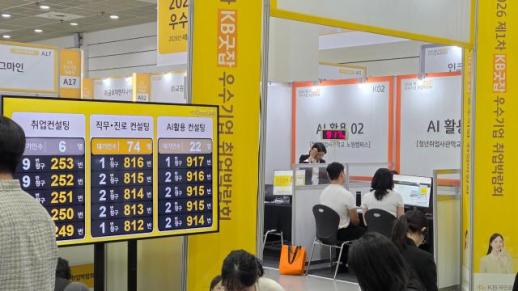 KB Goodjob Job Fair Draws Crowds as Young Koreans Face AI-Era Hiring Squeeze “Even when job postings go up these days, most are for experienced hires. Companies don’t hire many entry-level workers, so I’m trying anything I can. AI makes me uneasy, but I have to work to become someone who can keep up with it.” Jeong Mi-ju, 26, said that Monday at the “2026 First KB Goodjob Excellent Companies Job Fair” at COEX in Seoul’s Gangnam district. Dressed for an interview, she carried a backpack filled with resumes and a portfolio. Preparing since January for an IT job, Jeong said she was ready to interview if she got the chance at the fair. Now in its 29th year, the KB Goodjob fair has drawn about 6,200 companies over time and provided jobs to 45,000 job seekers, organizers said. About 250 companies participated this year. The venue was packed from the 10 a.m. opening, with attendees ranging from vocational high school students to college students, soon-to-be graduates and troops nearing discharge. Many young visitors said they felt hiring had become tougher as AI spreads, and that they came to secure any opportunity they could. Na In-chae, 29, who worked two years on a contract in public relations and marketing and is now seeking a new job, said, “You can definitely feel there are fewer openings and the competition is higher.” She added, “At work, it feels like AI is required, so I’m trying to earn at least one more certificate. Still, I’m relieved I’ll be interviewing with two companies here today.” Kim Ye-rin, 28, preparing for a job in electronics and IT, said, “As AI’s role grows, I think every day about what I can do.” She said she visited the booth of a company that had rejected her application to ask what she lacked and to get feedback. “Even if I don’t get a good opportunity, I hope they see this kind of initiative in a positive way,” she said. Programs aimed at helping job seekers use AI drew especially heavy interest. A recruiting briefing titled “Job-hunting strategies in the AI era” was crowded even before it began. When speakers explained prompts for writing cover letters with generative AI, some attendees held up phones to record the screen. As seats filled, others stood outside on tiptoe to listen. The AI-based “Career Solution Zone,” which offers customized job counseling, was also crowded. The program provides comprehensive consulting tailored to each job seeker’s readiness and supports training to strengthen job-search literacy using AI. Organizers said that 1 hour and 50 minutes after opening, 99 people had taken waiting tickets. A 19-year-old identified by the surname Kim said after a session, “I’m very interested in robotics, and it helped to get detailed, personalized advice on whether to work right away or go to college.” Kim said they planned to look around more, using the counseling as a guide, noting that many related companies had booths at the fair. KB Kookmin Bank said it plans to continue supporting participating companies after the fair, including by offering specialized talent-matching services linked to KB Goodjob partner institutions. If participating companies hire full-time employees, the bank will provide hiring support funds of 1 million won per person, up to 10 million won per year. KB Kookmin Bank CEO Lee Hwan-joo said he hopes the event will be “a place of challenge and opportunity” where young job seekers can fully demonstrate their abilities. He said the bank will continue a range of social contribution activities alongside KB Goodjob to “do our best to establish ourselves as a lifelong financial partner for the public.”* This article has been translated by AI. 2026-04-27 15:54:16
 -
 Analyst: OpenAI may develop an 'AI agent phone,' with mass production eyed for 2028 OpenAI may be moving toward developing its own smartphone, as the competition around ChatGPT and other artificial intelligence tools spreads from apps and services into hardware. The key question is whether it can build a new device architecture centered on an AI agent, rather than simply adding AI features to existing phones. According to China’s Kechuangban Daily on Sunday, TF International Securities IT analyst Ming-Chi Kuo, known for tracking Apple’s supply chain, said OpenAI is pursuing development of its own smartphone. In a post on X, Kuo said OpenAI is developing smartphone processors with MediaTek and Qualcomm, and he forecast that Luxshare would serve as the exclusive partner for joint system design and manufacturing. He projected mass production in 2028. Kuo described the concept as an “AI agent phone,” differing from the current model in which users open and operate apps themselves. In his view, the phone would understand a user’s situation and context, and an AI agent would carry out needed tasks on the user’s behalf. He said OpenAI’s motivation is to gain control over the operating system and hardware, arguing that offering a comprehensive AI agent service would be limited if it relied only on a ChatGPT app running on existing smartphones. Smartphones also hold large amounts of real-time user information, including location, schedules, conversations and usage habits. OpenAI’s hardware push has already taken shape. The company acquired io, a hardware startup co-founded by Jony Ive, who led iPhone design. After the acquisition, the io team joined OpenAI, and Ive’s side has continued to take part in OpenAI product design work. If Kuo’s forecast is correct, OpenAI’s aim would be to make the smartphone a primary gateway for its AI models and agent services. That could introduce a new variable for ecosystems dominated by Apple and Samsung Electronics, which are built around iOS and Android and the App Store and Google Play. If OpenAI releases an AI agent device, it could accelerate a shift toward AI calling apps and services in the background to deliver results, rather than users selecting and launching apps themselves. Still, the report remains an analyst’s projection, and uncertainty is high. OpenAI, Qualcomm, MediaTek and Luxshare have not officially confirmed the details. Challenges before any mass production include technical readiness, handling personal data, and securing an operating system and app ecosystem. 2026-04-27 15:52:07
 -
 Defense Vice Minister Lee Doo-hee Pledges Major Upgrades to Navy Shipboard Living Conditions “To ensure sustained operational capability in wartime and peacetime, it is important to quickly relieve crews’ operational fatigue. We will make major improvements to shipboard living conditions,” Defense Vice Minister Lee Doo-hee said. Lee visited the Navy’s 2nd Fleet Command on April 27 to inspect shipboard living conditions and barracks facilities for sailors and to encourage service members, the Ministry of National Defense said. The on-site inspection was arranged to push ahead with tasks recommended by a joint civilian-government-military special advisory panel to improve living conditions for troops’ physical and mental recovery, and with defense reform efforts to improve barracks conditions, the ministry said. Lee toured crew sleeping quarters aboard the destroyer Eulji Mundeok (DDH-I), which was docked at the 2nd Fleet naval base, and reviewed areas needing improvement. He also checked conditions at an onshore dormitory used by enlisted sailors assigned to fast patrol craft and other vessels. “We will continue improving conditions so that, while ship crews are waiting on shore, the onshore dormitory is a place for adequate rest and recovery,” Lee said. * This article has been translated by AI. 2026-04-27 15:51:17
 -
 Korea’s consumer relief policies add profit pressure on insurers and card firms Financial regulators in South Korea are rolling out a series of measures aimed at easing household costs, but the burden is increasingly being absorbed by financial companies. Insurers and card issuers say they support the policy goals, yet warn that added obligations are squeezing profitability at a time when their core businesses are already under strain. The Financial Services Commission on the 27th introduced a new auto insurance rider offering discounts for drivers who follow a vehicle-use restriction scheme. The measure is intended to respond to volatile global oil prices and encourage energy conservation. Industry officials, however, said it will effectively function as pressure to cut premiums, because insurers are expected to participate and premium revenue falls as enrollment rises. Under the rider, auto insurance premiums are discounted by 2% a year. Regulators estimate about 17 million vehicles could qualify. By simple calculation, that would shift roughly 240 billion won in costs to insurers. The added discount is likely to weigh on earnings, as auto insurance loss ratios are already above break-even levels. Major nonlife insurers have seen underwriting results drop sharply due to weak performance in indemnity health insurance and rising auto loss ratios. The combined insurance profit of four major nonlife insurers — Samsung Fire & Marine Insurance, Hyundai Marine & Fire Insurance, DB Insurance and KB Insurance — totaled 3.5782 trillion won last year, down 34.8% from the previous year’s 5.4892 trillion won. Card issuers are also facing heavier pressure. As regulators urge companies to expand benefits such as fuel discounts to ease oil-related costs, some products are being pushed into a loss-making structure, industry officials said. Performance has been weakening: the combined net profit of eight dedicated card companies — Samsung, Shinhan, Hyundai, KB Kookmin, Lotte, Hana, Woori and BC — fell 8.9%, or 230.8 billion won, to 2.3602 trillion won last year from 2.5910 trillion won a year earlier. “Each time there is a crisis, financial companies have been mobilized as tools to carry out policy,” an industry official said. “We want to participate, but conditions are not easy.” The official added that the burden is growing as volatility in interest rates and exchange rates increases. 2026-04-27 15:48:21
 -
 BYD Korea Opens Pohang Service Center to Expand Access on South Korea’s East Coast BYD Korea said Sunday it has officially opened the “BYD Auto Pohang Service Center” in Pohang, North Gyeongsang Province. The Pohang facility is BYD Korea’s 18th service center for its passenger-car business and will operate as an integrated hub combined with the BYD Auto Pohang showroom that opened late last year. The center offers one-stop service covering vehicle consultation and test experiences, contracts, maintenance and accident repairs. It includes service lines that can handle up to two vehicles at the same time, parking for six vehicles and a customer waiting area, the company said. Located in a central part of Pohang, the service center has convenient access to major arterial roads and the East Coast transportation network, and is expected to be easily reachable from nearby areas including Gyeongju, Yeongcheon and Yeongdeok. BYD Korea said it expects the site to serve as a key base for strengthening service for customers along the East Coast by meeting demand from both nearby industrial complexes and local residents. GNB Mobility, BYD Korea’s official dealer, said the opening is part of a plan to improve both product and service access across the East Coast region. Lee Min-uk, CEO of GNB Mobility, said, “Following the Pohang showroom in one of Korea’s leading industrial cities, we have now built a service center as well, improving the BYD electric-vehicle ownership environment that customers along the East Coast can feel.” He added, “We will continue strengthening our capabilities so customers can drive BYD vehicles with confidence by offering good products and good service in good locations.” BYD Korea said it aims to expand its service network from 18 locations to 26 by the end of the year. A BYD Korea official said the company will work to ensure customers can receive a high level of service nationwide, adding that it plans to focus not only on expanding the number of sites but also on quality improvements, including strengthening the development of technicians who have completed BYD technical training. * This article has been translated by AI. 2026-04-27 15:42:48
 -
 Korea Exchange to Hold Regional Briefings on Corporate Governance Report Disclosures The Korea Exchange said it will hold a relay series of regional briefings this month in four cities — Busan, Daegu, Gwangju and Daejeon — for disclosure officers and others at KOSPI-listed companies on how to file corporate governance reports. The exchange said on the 27th the program was planned to help regional listed firms make smooth disclosures after the corporate governance report filing requirement was expanded this year to all KOSPI-listed companies. The sessions will explain the core purpose of the governance disclosure system and focus on how to prepare the reports, including examples of strong disclosures. A briefing for KOSPI-listed companies in Busan, Ulsan and South Gyeongsang Province was held at the Busan International Finance Center on the 27th. Additional sessions are scheduled in Daegu (28), Gwangju (29) and Daejeon (30). The exchange said it expects the briefings to raise understanding and interest in corporate governance among regional listed companies and to support the stable settlement of the governance disclosure system. It also said it plans to actively support companies’ governance improvements and smooth filings through one-on-one consulting and distribution of guidance materials for newly covered governance disclosure companies next year.* This article has been translated by AI. 2026-04-27 15:42:15
 -
 Fifth-Generation Private Health Insurance to Launch May 6, Cutting Premiums and Narrowing Some Noncovered Benefits Fifth-generation indemnity health insurance will launch May 6, marking a broader overhaul of South Korea’s private health insurance system as insurers introduce redesigned coverage. The new plans are expected to lower premium burdens for consumers while insurers look to improve loss ratios. A key challenge, however, will be creating incentives for existing policyholders to switch. According to reporting by Aju Business Daily on the 27th, major nonlife insurers including Samsung Fire & Marine Insurance, Hyundai Marine & Fire Insurance, KB Insurance and DB Insurance will roll out fifth-generation plans on May 6. The launch had been set for May 1 but was adjusted in consideration of a holiday break. The fifth-generation product shifts benefits toward severe conditions. Unlike the fourth-generation plans, which broadly covered noncovered services, the new plans keep coverage for severe noncovered care but reduce limits and reimbursement rates for nonsevere noncovered services. Manual therapy and some new medical technologies are excluded, and the out-of-pocket share for nonsevere noncovered care rises to as much as 50%. Premiums are also expected to drop sharply, offering an alternative for people who do not frequently use noncovered medical services. For a man in his 40s enrolled in second-generation plans—where insurers have the largest number of policyholders—the average monthly premium as of the end of last year was about 45,000 won, compared with an estimated 17,000 won for the fifth-generation plan. Insurers expect the changes to curb excessive use of noncovered care and improve a loss-ratio structure that has been described as chronically unprofitable. Indemnity health insurance has posted high loss ratios for years, weighing on insurers’ profitability. According to the Korea Insurance Research Institute, the combined risk loss ratio for first- through fourth-generation plans reached 119.3% as of the third quarter of last year. Still, industry officials say broader adoption will depend on moving first- and second-generation policyholders into the new plans. Those older products can be maintained long term with coverage lasting to age 80 or 100 and typically offer broader benefits, raising concerns that customers will see little reason to switch. “First- and second-generation indemnity plans, unlike the third and fourth generations, are structured so policyholders can keep their existing coverage,” an industry official said. “If there are not sufficient incentives to encourage switching, the impact of the market overhaul could be limited.” Financial authorities plan to announce measures soon, including a contract buyback option to encourage conversions of first- and second-generation policies, as well as guidance related to optional riders. Financial Supervisory Service Gov. Lee Chan-jin said at a press briefing late last month that even after the fifth-generation plans launch, incentives would remain an issue for continued discussion. 2026-04-27 15:40:49
 -
 Taiwan court sentences ex-Tokyo Electron engineer to 10 years for TSMC trade secret theft Taiwan’s court specializing in intellectual property and commercial cases has sentenced a former employee of Japanese chip-equipment maker Tokyo Electron (TEL) to 10 years in prison for stealing confidential data from Taiwan Semiconductor Manufacturing Co., the world’s largest contract chipmaker. Bloomberg News and other outlets reported on the 27th that the Taiwan Intellectual Property and Commercial Court sentenced engineer Chen Li-ming, who previously worked at Tokyo Electron, to 10 years. Four other defendants in the case received sentences of up to six years, and one woman was sentenced to 10 months in prison, suspended for three years. Applying a dual-liability provision, the court also fined Tokyo Electron’s Taiwan unit 150 million New Taiwan dollars (about 7 billion won). Prosecutors said Chen recruited two TSMC employees and obtained confidential drawings related to the company’s next-generation 2-nanometer process technology. The employees accessed the company’s internal network while working from home, photographed the materials with mobile phones and passed them along. Authorities said the leaked materials totaled about 1,000 pages. The ruling was seen as reflecting Taiwan authorities’ push to strengthen protection of semiconductor technology, a core foundation of the global artificial intelligence industry. Taiwan has maintained a high level of vigilance over intellectual property leaks, stepping up monitoring not only of activity linked to China, which is seeking to build up its own semiconductor industry, but also of existing partners. In early 2025, Taiwan authorities began investigating whether China’s largest foundry, SMIC, illegally recruited local engineers to obtain advanced technology. Last year, prosecutors also searched the home of a former TSMC executive after allegations of a technology leak surfaced following the executive’s move to Intel.* This article has been translated by AI. 2026-04-27 15:40:04
 -
 Non-Apartment Housing Supply Shrinks as Korea’s Market Tilts to Apartments Apartment-focused supply policy and market preferences are rapidly squeezing non-apartment housing on both the supply and demand sides. According to the Ministry of Land, Infrastructure and Transport on the 27th, nationwide housing permits totaled 379,000 units last year. Of those, non-apartment homes accounted for just 8.7%, or 33,061 units. Seoul had the highest non-apartment share at 15.5%, but of its 6,442 permitted units, multi-family homes made up 5,108, or 79%. The decline reflects a long-running structure in which both the private sector and the government favor apartments for efficiency, infrastructure and liquidity. As that preference has hardened, supply of non-apartment types such as detached, multi-household and row houses has effectively stalled. Broader supply indicators are also weakening. Total housing permits fell from 740,000 households in 2016 to about 410,000 recently, and Seoul’s permit volume has also dropped by about half. Because permits typically translate into move-ins three to five years later, analysts say a medium- to long-term supply decline is likely. Starts and presales have also fallen, tightening the pipeline across multiple stages. For builders, non-apartment projects offer thinner margins. Surging construction costs have raised burdens, and small-scale projects make it difficult to achieve economies of scale. With financing conditions worsening and tax burdens such as acquisition and comprehensive real estate taxes adding pressure, demand has also concentrated on owning a single apartment rather than multiple homes. Falling demand is reshaping the rental market. As more tenants avoid jeonse, preference has shifted toward monthly rent, putting upward pressure on monthly rents for non-apartment homes. Combined with a weakening apartment jeonse market, tenants’ housing costs are rising. The shift is also eroding the role non-apartment housing has played as a “housing ladder.” In the past, tenants often used jeonse in non-apartment homes to build savings before moving to an apartment. With the market moving toward monthly rent, asset-building has become harder, and housing burdens for vulnerable groups are increasing, critics say. Byun Chang-heum, a professor of public administration at Sejong University, said current rules on parking and sunlight rights mean “places where you can build have already been built out.” He added that “prices fall as demand declines, but regulations stay the same and construction costs rise, so the business case doesn’t work.” Byun said rising building costs have created a mismatch in which both supply and demand fail to align. He also said policies that convert non-apartment areas into apartments take a long time and face limits because alternatives for existing residents are insufficient. As an alternative, Byun proposed mid-rise, high-density housing. “In a structure split between low-rise neighborhoods and high-rise apartments, mid-rise high-density complexes can be a realistic option,” he said, calling for eased building, urban planning and parking rules and incentives to improve feasibility. He said the floor area ratio for redevelopment projects, now around 250%, should be raised to about 400%, along with institutional changes such as easing consent requirements. Park Won-gap, senior real estate specialist at KB Kookmin Bank, cited rising construction costs, financing difficulties and the fallout from so-called “underwater jeonse” as key factors behind the supply contraction. “To revive the non-apartment market, policy design should separate apartments and non-apartments,” he said. “Overall housing stability is possible only if the non-apartment market survives.” He added that expanding tax benefits for non-apartment housing could also be considered.* This article has been translated by AI. 2026-04-27 15:39:19
 -
 Korail to Add Train Service for Buddha’s Birthday Holiday in May Korea Railroad Corp., known as Korail, said Monday it will expand train service by adding special trains for the Buddha’s Birthday holiday period in May. Korail will operate 38 additional KTX and conventional train services on four routes nationwide, including the Gyeongbu and Honam lines, from May 23 through the substitute holiday on May 25. The added runs will increase capacity by about 19,000 seats. Korail will also add three early-morning KTX services on May 26, the day after the holiday period, to improve commuting convenience. Tickets for the additional trains will go on sale at 10 a.m. on April 28 through Korail’s ticketing website, its mobile app KorailTalk, and station ticket counters nationwide. Lee Min-seong, head of Korail’s customer marketing division, said the operator is increasing service to meet higher travel demand during the holiday and will do its best to provide safe and comfortable service.* This article has been translated by AI. 2026-04-27 15:36:23