
Journalist

Lee Hugh
=
-
 Samsung SDS, LG CNS Sign Reseller Deals for OpenAI’s ChatGPT Edu in Korea Samsung SDS and LG CNS have each signed reseller partner agreements for OpenAI’s education-focused service, ChatGPT Edu, stepping up competition to secure an early lead in the education AI transformation market. The two companies said on the 27th that they secured the right to supply ChatGPT Edu on the same day and will ramp up sales to South Korean universities and other educational institutions. ChatGPT Edu is designed for educational institutions, supporting tasks such as generating lecture materials, organizing research and reports, and providing personalized tutoring. It applies a “non-training” policy under which user conversations and responses are not used as AI training data, strengthening data privacy. Built on the latest GPT-5 language model, it supports text generation, coding, data analysis, document summarization and custom chatbot creation. The service offers the same security environment as ChatGPT Enterprise, allowing use without concerns about sensitive information leaks, and it is also positioned at a more affordable price for schools, the companies said. Arizona State University, the California State University system, Harvard University, the University of Oxford, the University of London, the Wharton School and the National University of Singapore are using ChatGPT Edu, and Estonia has introduced it across its secondary education system to expand AI use by students and teachers. Samsung SDS is conducting a proof of concept with Korea National Open University, which has about 90,000 students, and plans to discuss a formal rollout. The company said it will provide end-to-end AI transformation services through a “One-Team” setup spanning AI consulting, development, operations, cloud and security, supported by its own cloud and GPU-based AI infrastructure. LG CNS said it will run a series of introductory tours and AI education seminars for major universities in the Seoul metropolitan area. It is also reviewing plans to work with universities and OpenAI on developing AI education curricula and operating hackathons. LG CNS said its dedicated ChatGPT organization, the “OpenAI Launch Center,” will handle full-stack services from adoption consulting to technical support, with participation by AI engineers, architects and consultants alongside OpenAI specialists. Both companies pointed to progress in the corporate market. Samsung SDS said it has signed supply contracts with major companies across the public, finance, manufacturing, distribution and service sectors, including Nexen Tire. LG CNS said it began supplying ChatGPT Enterprise in February and has secured about 10 corporate customers in manufacturing, chemicals, finance and biotech. Lee Jeong-heon, vice president and head of strategic marketing at Samsung SDS, said the company will “strengthen our role as an AX partner that designs and scales corporate AI operating systems, beyond being a simple reseller.” Kim Tae-hoon, vice president and head of the AI Cloud Business Division at LG CNS, said, “As we have rapidly expanded customer use cases through our ChatGPT Enterprise business, this Edu reseller agreement expands our business into the education AX field.” * This article has been translated by AI. 2026-04-27 15:34:09
 -
 Jipyeong to Hold Seminar on Building Sales Act Risks After Supreme Court Ruling Jipyeong LLC said Sunday it will hold a seminar at 2 p.m. on May 11 titled “Building Sales Act A to Z Every Developer Must Know.” The firm said the event will examine the practical impact of a Supreme Court ruling issued Dec. 24, 2025 (2025Da215248) and outline ways to identify and respond to legal risks that can arise throughout the sales process. The ruling clarified that when a corrective order is issued under the Act on the Sale of Buildings, buyers are entitled to cancel their contracts regardless of how serious the violation is. The decision is viewed as a precedent that could significantly affect industry practice, as even relatively minor violations — such as missing information in sales advertising — may lead to contract cancellation and refunds. As a result, developers face increased pressure to strictly comply with legal obligations at every stage, before and after contracts are signed. Jipyeong said the seminar will cover key issues and response strategies from the pre-sale stage through contract signing and post-sale management. It also plans to introduce recent issues, including the main points of a proposed enforcement decree revision and the potential use of constitutional complaints. The seminar will open with remarks by partner attorney Song Han-sa and feature three presentations. Partner attorney Kang Min-je will speak on the pre-sale stage, focusing on the Act’s regulatory framework and practical precautions. Attorney Kim Min-ju will address legal duties and risk management at the contract-signing stage. Partner attorney Baek Jong-hyeon will discuss major post-sale issues and response strategies. Song, head of Jipyeong’s Construction and Real Estate Group, said the ruling made clear that even minor procedural flaws can lead to contract cancellations, requiring close legal review across the entire project. He said he hopes the seminar will help developers assess risks in advance and prepare response plans. * This article has been translated by AI. 2026-04-27 15:33:16
 -
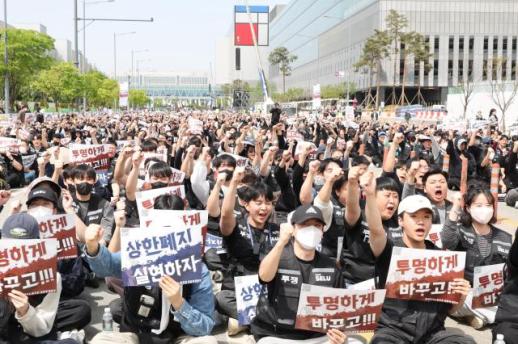 Samsung union flags 18% output hit, raises stakes with 18-day strike threat SEOUL, April 27 (AJP) - Unionized workers at Samsung Electronics said last week’s rally cut memory output by nearly 20 percent, signaling the scale of disruption a looming 18-day strike could unleash on global chip supply. In a statement Monday, Choi Seung-ho, head of the company’s Enterprise Union branch, said a hours-long rally on April 23 led to a 58 percent drop in foundry production and an 18 percent decline in memory chip output, based on overnight wafer transfer data. According to the union, wafer movement — a key production indicator — fell sharply during the night shift following the rally. Foundry output dropped about 58.1 percent, with the Giheung S1 line plunging 74.3 percent. Memory production fell 18.4 percent overall, with a steeper decline in DRAM processes. “A union of 40,000 members is a reality management cannot ignore and a powerful driving force for change,” Choi said, warning that an 18-day general strike would create a “30 trillion won ($21.7 billion) vacuum.” An estimated 40,000 workers — about 30 to 40 percent of union members — joined the rally at the Pyeongtaek campus on April 23. The union plans to proceed with an 18-day strike from May 21, beginning protests at Chairman Lee Jae-yong’s residence. The scale marks a sharp escalation from Samsung’s first-ever strike in 2024, which drew about 5,000 workers, or roughly 15 percent of union members. Semiconductor cleanrooms must operate continuously, as chipmaking involves hundreds of tightly sequenced processes building microscopic circuit layers on silicon wafers. Even brief disruptions risk yield losses and equipment instability. The union is demanding the removal of caps on performance bonuses and greater transparency in the compensation system, accusing management of abandoning Samsung’s “people first” philosophy and reducing employee contributions to market-driven metrics. Samsung maintained a neutral stance on the union’s claims. “It is not for us to confirm or deny the figures; they should be understood as the union’s position,” a company official said, adding that efforts to reach a settlement would continue. Analysts warn that any disruption at the world’s largest memory chipmaker could tighten an already constrained market. “If the May strike materializes, supply shortages could deepen due to production disruptions, adding upward pressure on prices,” said Kim Dong-won, head of research at KB Securities. Kim added that even in a worst-case scenario where the strike lasts 18 days, it could take an additional two to three weeks to fully restart and stabilize automated production lines. Given Samsung’s global market share — about 36 percent in DRAM and 32 percent in NAND — and the production weight of its Pyeongtaek and Hwaseong campuses, KB Securities estimates the strike could reduce global supply by 3 to 4 percent for DRAM and 2 to 3 percent for NAND. “In a tight supply-demand environment, this strike could become a key variable reinforcing upward price pressure,” Kim said. The union has said it will proceed with the strike from May 21 to June 7 unless an agreement is reached on its demands, which include scrapping the performance bonus cap and implementing a more transparent compensation system. Shares of Samsung Electronics continued to rally, regardless of the strike risk. They ended Monday 2.3 percent up at 224,500 won, a tad off the record-high closing of 229,500 won. 2026-04-27 15:32:54
 -
 Moon Jae-in urges dialogue for Korean Peninsula peace; Lee Jae-myung vows no hostile acts Former President Moon Jae-in on April 27 voiced concern over strained inter-Korean ties and said the Lee Jae-myung government should help ensure the Korean Peninsula becomes “a land of sustainable peaceful coexistence and prosperity,” not confrontation. President Lee also reaffirmed his intention to pursue a policy of peaceful coexistence without hostile acts. Moon made the remarks at the National Assembly during a ceremony marking the eighth anniversary of the April 27 Panmunjom Declaration, saying, “Protecting and building peace on the Korean Peninsula ultimately depends on our own capabilities.” It was his second visit to the Assembly since leaving office in May 2022, following his attendance at the same event last year. Moon called the Panmunjom Declaration “a historic declaration” that included improving inter-Korean relations, easing military tensions, substantially reducing the risk of war and building a peace regime on the peninsula. “The spring of peace on the Korean Peninsula in 2018 did not come on its own,” he said. “Even though North Korea’s response remains cold and hostile, this is precisely the time to be patient and stay the course. If we do, opportunities for dialogue will surely return.” Lee did not attend due to scheduling conflicts, but Senior Presidential Secretary for Political Affairs Hong Ik-pyo read his message. Lee said, “Eight years ago today, the Korean Peninsula was filled with the feeling of spring,” and that the two leaders had shown the world “a hopeful path forward.” “Unfortunately, that promise was not kept,” Lee said, adding that peace must still be made to take root amid “severance and hostility.” He said the “people’s sovereignty government” would not pursue absorption-based unification and, under the principle of “no hostile acts of any kind,” would steadily push a coexistence policy in which the two Koreas live peacefully and grow together. The Panmunjom Declaration was issued after a summit on April 27, 2018, at Panmunjom between Moon and North Korean leader Kim Jong Un. It included goals such as a nuclear-free Korean Peninsula, a declaration ending the war and the establishment of a joint inter-Korean liaison office. This year’s event was co-hosted by the Council for the Inheritance and Development of Democratic Governments’ Korean Peninsula Peace and the Ministry of Unification, and sponsored by the Democratic Party, the Rebuilding Korea Party and the Friedrich Ebert Foundation. The council is a group formed last year by the Korean Peninsula Peace Forum, with participants including the Kim Dae-jung Foundation, the Roh Moo-hyun Foundation and Forum Sasae. Attendees included Moon and his wife; Hong; National Assembly Speaker Woo Won-shik; Democratic Party leader Jung Cheong-rae; Unification Minister Chung Dong-young; Kim Dae-jung Foundation Chairman Kwon Noh-kap; Roh Moo-hyun Foundation Chairman Cha Sung-soo; and Korean Peninsula Peace Forum Chairman Lim Dong-won.* This article has been translated by AI. 2026-04-27 15:27:20
 -
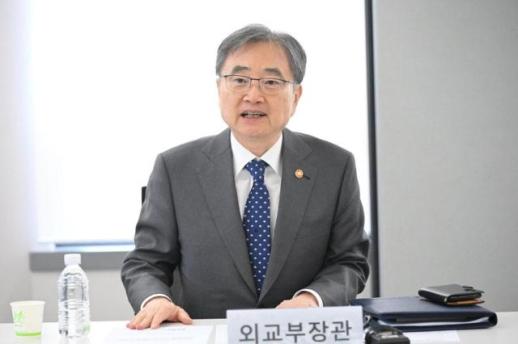 South Korea, Australia to hold foreign ministers' meeting in Seoul this week SEOUL, April 27 (AJP) - Foreign Minister Cho Hyun is scheduled to meet his Australian counterpart in Seoul later this week, the Ministry of Foreign Affairs said on Monday. Cho is expected to discuss cooperation in various areas including the defense and energy sectors, during his meeting with Australian Foreign Minister Penny Wong on Thursday. According to the ministry, the two sides will reaffirm their commitment to working together on shared challenges including the ongoing conflict in the Middle East and supply chain disruptions, while also exploring ways to deepen broader cooperation. Their meeting comes about a month after they spoke by phone and follows their meeting in October last year, when Wong visited South Korea to attend the Asia-Pacific Economic Cooperation (APEC) summit in the southeastern city of Gyeongju. Wong's trip to Seoul is part of her three-nation Asian tour, which will take her to China and Japan. With a "strong bilateral relationship underpinned by shared strategic interests, complementary economies and generational ties between our people," South Korea is "one of Australia's most important sources of refined fuels, including diesel, automotive gasoline and aviation fuel," she said in a press release. 2026-04-27 15:27:08
 -
 Seoul Mayor Oh Se-hoon Launches Local Election Bid, Vows to Check Lee Jae-myung Government People Power Party Seoul mayoral candidate Oh Se-hoon stepped down from the mayor’s post on April 27 and began full-scale campaigning, seeking to close the polling gap with Democratic Party candidate Jung Won-oh. Oh carried out mayoral duties in the morning, then around lunchtime completed his preliminary candidate registration with the election commission. He then walked from Seoul City Hall to Bosingak in Gwancheol-dong, Jongno District, greeting residents along the way, and held a news conference in front of the bell pavilion to announce his candidacy. “I will protect Seoul and help get the country back on its feet,” Oh said. Referring to what he called moves by the government and ruling party to cancel the prosecution in the Daejang-dong case, he added that he would “set right this runaway behavior by the Lee Jae-myung government.” Oh also criticized the period under former Mayor Park Won-soon, saying housing supply stalled while support for government-aligned civic groups surged. He called Park’s tenure “10 years of darkness” and “a period of Seoul’s decline,” and said that during his past five years in office he laid the groundwork to supply 310,000 homes in Seoul by 2031. He also criticized what he described as “no-questions-asked” support totaling 1.0222 trillion won for such groups at the time, and said he would prevent Seoul from again becoming “prey” for organizations that present themselves as civic groups. Oh also addressed his decision to register about two weeks earlier than expected. The National Election Commission’s official candidate registration period is May 14-15. Oh said he decided to work harder because polls showed him “slightly behind” Jung, and said the early move reflected his determination to “protect Seoul” and stop what he called the Lee administration’s “runaway” actions. Asked about his strategy as he seeks a third consecutive term and a fifth term overall, Oh said elections are “not about strategy but about sincerity.” He said he would reach out to residents, communicate more and turn candid advice into policy. Oh said he would make the Lee government, which he said had begun to “run wild,” feel uneasy as it watches Seoul voters’ choice. He also appealed for support, saying Seoul residents had “raised” him into a “public asset of the Republic of Korea” through four elections. Oh opened his campaign office, called the “Jumping Up Camp,” in the Daewang Building near Bosingak. He said the name reflects his goal of helping Seoul “jump” into a “special city for quality of life.” In a Facebook post, Oh said “Jumping Up” carries a promise that if the past five years were about restoring the foundation, the next step is to “jump higher” with residents and unlock Seoul’s potential.* This article has been translated by AI. 2026-04-27 15:16:54
 -
 Woori Bank Adds Mobile Transit Card Top-Ups to Samsung Wallet Money Woori Bank said on the 27th it has added a mobile transit card top-up feature to Samsung Wallet Money. Samsung Wallet Money is a simple payment service that lets users pay with a Samsung Galaxy smartphone without a physical card by linking a bank account or adding funds. With the update, Samsung Wallet Money users can top up the balance of a T-money mobile transit card in the Samsung Wallet app using Samsung Wallet Money. The related app update has been rolling out since the 23rd and is expected to be completed by the end of April. Woori Bank said it also plans to launch top-ups for the EZL (formerly Cashbee) mobile transit card in the third quarter of this year. To mark the launch, Woori Bank will run a special promotion through the end of June. Customers who link a Woori Bank account as the funding account and use Samsung Wallet Money to top up a T-money mobile transit card for the first time will receive 2,000 Samsung Wallet Money points immediately. “This service is meaningful not only as an expansion of payment options, but also because it further strengthens everyday financial convenience through Samsung Wallet Money,” said Heo Min-woo, a deputy manager in Woori Bank’s platform business division. “We will continue to introduce services that are convenient to use at a reasonable cost.”* This article has been translated by AI. 2026-04-27 15:16:11
 -
 Appeals court sentences Unification Church official to 18 months over gifts to Kim Keon Hee, Rep. Kwon An appeals court on Sunday sentenced Yoon Young-ho, former head of the Family Federation for World Peace and Unification’s global headquarters, to prison for using church funds to provide money and valuables to first lady Kim Keon Hee and ruling party lawmaker Kwon Seong-dong. The Seoul High Court’s Criminal Division 6-1 sentenced Yoon to 18 months in prison for violating the anti-graft law, the Political Funds Act and for occupational embezzlement. The term was increased from the 14 months ordered at trial. Prosecutors said Yoon gave Kwon 100 million won in illegal political funds. They also said that from April to August 2022, Yoon used Jeon Seong-bae — known as “Geonjin Beopsa” — to deliver about 60 million won worth of items to Kim, including a Graff necklace, a Chanel bag and a concentrated ginseng product. Investigators said the money and items came from Unification Church funds. The court said Yoon’s provision of valuables to Kim constituted occupational embezzlement. “Providing valuables to the spouse of a president-elect to seek favors cannot be tolerated under the overall legal order,” the panel said, adding that because church funds were used, an intent to unlawfully appropriate was recognized. The court said the special prosecutor’s appeal had merit and rejected the defense’s arguments. The panel said it applied a mandatory reduction provision under the special counsel law related to Kim. It cited Yoon’s cooperation during the investigation, including statements that helped open leads into the probe involving Jeon, and his admissions about providing funds to Kwon and delivering the bag and necklace to Kim. The court called them “key statements that contributed to identifying other people’s crimes” and treated them as grounds for a reduced sentence. As in the first trial, the court dismissed the indictment on an evidence-destruction charge. It said the alleged act was difficult to view as falling within the special counsel law’s investigative scope and rejected the special prosecutor’s appeal on that point. In explaining the sentence, the court described the crimes as an effort by the Unification Church to expand political influence. It said the acts were carried out to support a presidential candidate and to broaden policy influence after the launch of a new administration, undermining the purposes of the Political Funds Act and the anti-graft law and violating the constitutional principle of separating religion and politics. The panel said the case was serious because it damaged public trust in the fair execution of national policy. The court said it also considered Yoon’s cooperation, his general acceptance of key facts, his contribution to clarifying other suspects’ crimes and his lack of a criminal record. It imposed six months for the Political Funds Act violation and one year for the anti-graft and embezzlement charges, and denied his request for bail, citing a risk of flight. After the ruling, Yoon left the courtroom with a tense expression and a flushed face.* This article has been translated by AI. 2026-04-27 15:11:48
 -
 Seoul’s Gangnam Home Prices Show Signs of Rebound as Lease Crunch Grows, Tax Overhaul Looms Seoul home prices in the Gangnam area, which had been sliding, are showing signs of a rebound as bargain listings dry up and rising jeonse (lump-sum lease) prices push buyers back into the market. The shift has been led by Songpa-gu, where a string of record-high deals in smaller units and outlying neighborhoods has helped halt a decline that had lasted nearly two months. Songpa leads a broader Gangnam-area rebound as buyer sentiment turns positive According to the Korea Real Estate Board, Seoul’s average apartment sale price rose 0.15% from a week earlier in the third week of April (as of the 20th). Songpa-gu, which had fallen for eight straight weeks along with Gangnam and Seocho, switched to gains for the first time in nine weeks, ending a downturn that began in February as listings from multi-home owners hit the market. The Ministry of Land, Infrastructure and Transport’s transaction disclosure system shows a 27-square-meter unit at Ricenz in Jamsil-dong sold on April 4 for 1.83 billion won, topping 100 million won per 3.3 square meters. A 49-square-meter unit at Helio City in Garak-dong also set a new record at 2.17 billion won. As major complexes such as Jamsil’s Els saw 84-square-meter units recover to around 3.4 billion won, demand shifted toward smaller, more affordable units and outer areas. Buyer sentiment has also rebounded. The sales supply-demand index for Seoul’s southeastern region, which includes the three Gangnam districts, came in at 100.1 this week. It was the first time since mid-February — nine weeks — that the index rose above the 100 baseline, indicating more buyers than sellers. Rising jeonse prices add pressure, raising fears of a lease-driven price lift Rising jeonse prices across Seoul are also supporting sale prices. The Korea Real Estate Board said Songpa-gu’s weekly apartment jeonse price change was 0.39%, tied with Seongbuk-gu for the highest in the city. With jeonse listings drying up at large complexes, more tenants are shifting toward purchases. Seoul’s apartment jeonse prices have widened their gains for four straight months this year. The city’s cumulative jeonse increase stands at 2.17%, more than five times the 0.4% rise over the same period a year earlier. Four districts have already posted cumulative increases above 3%: Gwangjin (3.23%), Seongbuk (3.56%), Nowon (3.47%) and Seocho (3.22%). Experts warn that if the lease crunch persists, would-be first-time buyers could be pushed into “forced buying,” adding fuel to price increases. Nam Hyuk-woo of Woori Bank’s real estate research center said improved sentiment is being reflected in prices, but added that policy uncertainty remains. “With policy variables still in play, such as the possibility of reducing long-term holding deductions, a box-range market could continue as sellers and buyers watch each other,” he said. Broad tax package possible in July, from capital gains to holding taxes With signs of a market rebound, analysts expect the government to move faster. After President Lee Jae-myung called for an overhaul of real estate taxation to stabilize housing prices, a July tax law revision package is expected to include wide-ranging measures spanning capital gains tax and holding taxes, including the comprehensive real estate holding tax and property tax. A leading option is to scale back the long-term holding deduction for non-resident single-home owners. Under current rules, deductions can reach up to 80%. The plan would restructure the benefit around actual occupancy periods, sharply increasing taxes on a “one home for investment” that is not owner-occupied. The article said the approach reflects the president’s view that “cutting taxes just for holding encourages speculation.” Measures to increase the effective burden of holding taxes are also under review. The government is considering raising the fair market value ratio — which can be changed by enforcement decree — from the current 60% to 80% to 100% in stages. Still, criticism of a regulation-heavy approach is growing. An industry expert who requested anonymity said many multi-home owners have already adjusted to policy changes, and tougher taxes could instead deepen a “lock-up” in listings. The expert said it would be more important to present a concrete roadmap for urban housing supply than to rely on tax measures after the fact. * This article has been translated by AI. 2026-04-27 15:10:34
 -
 Korea Exchange Joins Voluntary Carbon Market Alliance, Plans KRX Carbon Credit Market The Korea Exchange said April 27 it participated in the launch ceremony for the “Korea-style voluntary carbon market alliance,” hosted by the Ministry of Economy and Finance. The exchange said the event brought together the ministry, the Korea Chamber of Commerce and Industry and other related organizations, along with large companies, mid-sized firms, startups and financial institutions, to discuss how to build a voluntary carbon market. At the ceremony, the exchange announced plans to open the “KRX Carbon Credit Market.” It said it will set up a listing review system to ensure confidence in the quality of carbon credits listed and will work with the government and domestic carbon credit registries to build a stable and efficient platform. It also said it plans to pursue cross-border linked trading by cooperating with global carbon credit exchanges, registries and investors, and to attract overseas liquidity to the KRX Carbon Credit Market. In congratulatory remarks, Korea Exchange Chairman Jeong Eun-bo said the voluntary carbon market is becoming “a necessity, not an option,” as part of corporate social responsibility. He said the exchange will develop the KRX Carbon Credit Market into a global hub, citing its experience operating a carbon emissions trading market for 11 years.* This article has been translated by AI. 2026-04-27 15:07:17