
Journalist

Lee Hugh
=
-
 SK hynix Tops 1.3 Million Won, Hits Record High on HBM Demand Hopes SK hynix shares climbed past the 1.3 million won mark during trading, setting another all-time high as expectations grew for stronger demand for high-bandwidth memory, or HBM, driven by expanding artificial intelligence chip demand. According to the Korea Exchange, SK hynix was trading at 1,312,000 won as of 1:01 p.m., up 90,000 won, or 7.36%, from the previous session. Its market capitalization also expanded to about 935 trillion won, increasing its influence in the local stock market. Analysts cited expectations of rising HBM demand as AI server investment increases. With global big tech companies led by Nvidia continuing to invest in AI infrastructure, SK hynix is seen as a key beneficiary given its leading position in the HBM market. Samsung Electronics also rose, gaining 5,750 won, or 2.62%, to 225,250 won at the same time. The broader group of heavyweight chip stocks was moving higher, with Samsung’s market capitalization at about 1,316 trillion won. Investor sentiment was also supported by gains in the semiconductor sector on Wall Street in the final trading session last week. The Philadelphia Semiconductor Index jumped 4.32% on April 24 local time, reflecting expectations of stronger central processing unit demand tied to wider AI adoption and a first-quarter earnings report from Intel that beat market expectations. * This article has been translated by AI. 2026-04-27 13:06:15
 -
 National Assembly Speaker Woo urges vote on constitutional amendment, warns PPP of blame if it fails National Assembly Speaker Woo Won-shik on April 27 urged lawmakers to pass a proposed constitutional amendment that is set for a vote May 7, the first such vote in 39 years, calling it an effort to “fix an outdated Constitution and move toward the future.” He also warned the People Power Party, which has adopted opposition to the amendment as its party line, that it would bear responsibility if the measure fails. Speaking to reporters at the National Assembly, Woo said provisions in the proposal have broad public support, including language to carry on the spirit of the Bu-Ma Democratic Protests and the May 18 democratization movement, stronger National Assembly control over martial law, and a clause specifying balanced regional development. “This amendment is about fixing an outdated Constitution and opening the door to reform for the country’s future,” Woo said. “If it fails this time, we don’t know when it will succeed again,” he added, urging lawmakers to participate. Woo criticized the People Power Party for deciding as a party to oppose the amendment and for not attending a joint meeting. The party, led by Chairman Jang Dong-hyeok, has maintained its stance and has signaled it may boycott the vote. “If the People Power Party blocks the amendment as a party line and it is defeated, then the People Power Party must also take all responsibility,” Woo said. He added that joining the effort would be a way for the party to “move beyond insurrection and be reborn as a healthy conservative party,” and urged it to show courage, saying he believed it would serve the public. Woo said he plans to request meetings with Jang and floor leader Song Eon-seok to seek the party’s participation, while arguing that support for the amendment is growing within the party. “I am willing to meet the People Power Party leadership at any time. I plan to request talks with Chairman Jang and Floor Leader Song,” Woo said. He also claimed that several lawmakers, including Rep. Kim Yong-tae, have expressed support for the need for constitutional reform. Woo has repeatedly signaled his determination to complete the amendment. At a New Year’s news conference in February, he said passing it during his remaining term would be a key priority and announced a goal of handling it alongside the upcoming 6·3 local elections. Six parties, including negotiating and non-negotiating blocs, have jointly introduced the amendment with Woo. The People Power Party, however, has publicly declared opposition, saying an amendment pushed through while “trampling” the opposition would be “dictatorship.” With no clear shift in its position, the outlook for passage remains uncertain. 2026-04-27 12:42:17
 -
 Beijing to Ban Consumer Drones in May, Forcing DJI to Pull Products From Stores Beijing will impose an unprecedented ban on consumer drones starting in May, a move expected to hit the commercial drone industry hard. Local media outlets including IT Zhijia reported that the measure will require DJI, China’s leading drone maker, to remove all drone products from its Beijing stores beginning next month. Beijing consumers will no longer be able to buy drones either in physical shops or through e-commerce platforms. After-sales service for drones already owned will also become difficult. DJI said Beijing customers seeking repairs must ship products by courier to the company’s headquarters, then have the repaired items delivered to an address outside Beijing and bring them back themselves. With new demand dropping sharply, drone sales at some DJI stores have fallen by nearly 50% over the past two months, according to reports. As consumers also move to sell drones they already own amid worries about tighter flight restrictions, listings on secondhand platforms have surged and used prices have been falling. Beijing introduced the tougher rules in late March through its “Regulations on the Administration of Unmanned Aircraft,” effectively banning the sale, transport, entry and flight of consumer drones. The city designated all areas as controlled airspace and made prior approval mandatory for all outdoor flights. It also banned the entry and transport of drones and key components. An exception is allowed only for drones already owned, after real-name registration and information verification, when they are taken out of the city and later brought back in. Some observers have raised the possibility that similar restrictions could expand to major cities such as Shanghai and Guangzhou. There are differing interpretations of the rationale. Lianhe Zaobao reported that as drones have taken on a larger military role in the Russia-Ukraine war and conflicts in the Middle East, China views the issue as directly tied to national security. Another view is that the move is preparatory work to develop the “low-altitude economy,” a strategic emerging industry promoted by the Chinese government that includes drone taxis, drone deliveries and urban air mobility. In an interview with The New York Times, Remo, head of a research center at the Hong Kong University of Science and Technology, said it was like “tidying the living room before welcoming guests,” describing it as a process of organizing airspace first for the low-altitude economy. China is considered the world’s largest commercial drone market. The China Industry Research Institute said last year’s market was about 50.2 billion yuan, about 50% growth from 2020. Registered commercial drones topped 3 million, up 50% from a year earlier. But rapid growth has been accompanied by worsening problems with unlicensed flights. Near the Shanghai World Financial Center, about 66 drone crash incidents occurred over the past three years, and in August last year two drones collided at an altitude of 400 meters. China has continued tightening enforcement against unauthorized drone flights. Starting in January, illegal flights were defined as violations of public security, allowing criminal penalties including up to 15 days’ detention. China’s Ministry of State Security has also warned that if a flight threatens public safety and causes serious consequences, punishment could include more than 10 years in prison, life imprisonment or the death penalty. * This article has been translated by AI. 2026-04-27 12:33:19
 -
 Korea Publishing Advisers Warn of AI-Driven Web Novel Competition, Seek Bigger Budget “Publishers in China, Japan and India seem to be moving to enter Korea in earnest by pushing AI-assisted web novels,” said Kwon Tae-wan, CEO of KW Books. “They translate with AI and then have professional translators review it, and they plan to export large volumes of e-books. But we can’t get into those markets.” “In the literary world, there’s a lot of discussion about how to protect authors’ creative works,” said Hong Young-wan, chairman of the Korea Publishers Association. The comments came April 27 at the second meeting of the Publishing Subcommittee of the Culture and Arts Policy Advisory Committee, held at the National Museum of Modern and Contemporary Art, Seoul, where participants discussed ways to revitalize the publishing market. Culture, Sports and Tourism Minister Choi Hwi-young and subcommittee members reviewed progress on proposals raised at the first meeting and debated future policy directions. Several participants said artificial intelligence is rapidly changing the publishing business. Kwon said lower production barriers enabled by AI are prompting publishers in Japan, China, India and the United States to export not only best sellers but also titles with moderate sales potential to Korea. “AI-produced and AI-translated content is coming into Korea quickly,” he said. He added that the web novel industry had managed to endure a difficult past one to two years largely because Korea, as the genre’s originator, benefited from rising overseas revenue. He said that edge could shrink. Concerns about copyright infringement tied to AI were also raised. Hong said the issue is highly contentious and views may differ by field, calling on the ministry to prepare broader discussions. Choi said the ministry would work to create guidelines and build consensus on what uses of AI are acceptable. The meeting also covered book-purchase support through the Youth Culture and Arts Pass, ways to introduce tax credits for publishing content production costs, and the size of government support for publishing. Hong said the association’s policy discussions and input from 13 publishing company heads indicated more than 400 billion won is needed for publishing support. He said current support is about 60 billion won, far less than the 86 billion won each allocated to film and games. Hong also argued that money collected from penalties should bolster publishing support, citing the Fair Trade Commission’s recent decision to impose about 330 billion won in fines on six paper companies over alleged price collusion. He said the publishing industry bore losses from the collusion but has no way to be compensated. “We don’t know how much of the 300 billion won in penalties the FTC will actually collect, but if it isn’t reflected in a publishing fund, it’s an ineffective policy,” he said. Choi said he would discuss how to handle publishing industry damage confirmed in the case, including through fines and other measures. Calls were also made to support exports of children’s books. Kim So-young, CEO of Munhakdongne, referred to the musical ‘Long Long Night’ that President Lee Jae-myung recently watched, saying children’s storybooks tend to export well when linked with performances. She said policy support is needed, including legal advice on copyright and help with licensing rights. The Culture and Arts Policy Advisory Committee, launched in November last year under the culture minister, has nine subcommittees covering literature, theater and musicals, fine arts and other fields. 2026-04-27 12:27:19
 -
 Korea FTC orders Salady to stop forcing franchisees to buy eco-friendly cutlery South Korea’s Fair Trade Commission said Monday it issued corrective and notice orders to salad chain Salady for forcing franchisees to use certain disposable items. The FTC said Salady required franchisees to buy eco-friendly spoons and forks. To enforce the requirement, the company included clauses in franchise contracts allowing it to halt supplies of ingredients and other goods, or to terminate contracts and seek damages. The FTC said the cutlery requirement was not essential to maintaining a unified brand image or ensuring consistent taste and quality of core products such as salads and sandwiches. It also said the items did not have special functions or characteristics and that many substitute products are available in the market. The FTC concluded Salady’s conduct amounted to an unfair trade practice under the Franchise Business Act, citing “binding trading partners,” and ordered the company to take corrective action and notify relevant parties. An FTC official said the agency plans to continue monitoring and actively correcting practices that impose unnecessary burdens on franchisees by unfairly restricting their choice of suppliers for items that are easily purchased on the open market.* This article has been translated by AI. 2026-04-27 12:12:15
 -
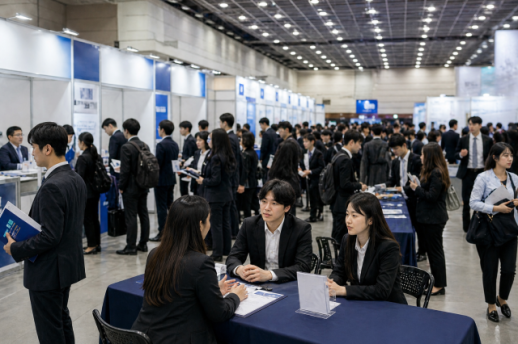 South Korea to Hold Largest-Ever Youth Jobs Fair With About 700 Companies The government and business groups will hold the largest job fair on record to address youth employment difficulties, offering a one-stop program from hiring consultations to on-site interviews and job training. About 700 companies will participate online and offline. The Korea Enterprises Federation said Sunday it will host the "2026 Korea Shared Growth Job Fair" on April 28-29 at the aT Center in Seoul’s Yangjae area with the Ministry of Employment and Labor and 15 major conglomerate groups, including Samsung, SK, Hyundai Motor and LG. Organizers said the event is the biggest of its kind, with about 700 participating companies across online and in-person programs. It was designed as an integrated hiring event that combines counseling, interviews, training and hands-on activities, rather than simply posting job openings. Companies taking part on site include LS Electric, Oracle Korea, Hanmi Pharmaceutical, Kolmar Korea, HDC Labs, SK Shieldus and Starbucks, among others. The lineup spans partners of large companies, mid-sized and small firms, startups and foreign companies, with a focus on reducing job mismatches. The venue will run themed zones tailored to job seekers. About 170 companies will join a hiring consultation zone to provide job-specific information. A K-Digital Training zone will offer guidance on government-backed programs to develop digital talent. A K-Digital Training zone featuring participants such as Samsung Electronics and Hyundai Engineering & Construction will operate alongside a promotion zone for shared-growth programs involving large and smaller companies, with participants including Samsung C&T, POSCO and Hanssem. Organizers said job seekers can connect hiring opportunities with better understanding of roles and skills development. In an intensive interview zone, 10 mid-sized and small companies — including three based outside the Seoul area — will conduct first-round interviews. Support services such as suit rentals and hair and makeup assistance will also be provided. In one-on-one coffee chats with working professionals, employees from companies including Kakao, Toss and SK will share job-search strategies by role. Organizers will also run experience-based events aimed at encouraging young job seekers to participate. An LED photo zone will allow visitors to take commemorative photos against backdrops of well-known sites that have drawn attention among younger people, including Yeonjudae on Gwanaksan Mountain. A program to create self-promotion business cards will let participants present their strengths and job skills. A stamp-tour event will award prizes to those who complete all stamps by visiting company booths, with giveaways planned including iPads and gift certificates for Starbucks and Olive Young. The federation said it will continue an online job fair through July 31 on Saramin, an online recruitment platform, after the in-person event ends.* This article has been translated by AI. 2026-04-27 12:10:19
 -
 Minister Song Mi-ryeong to launch agriculture energy transition task force; NH reform plan due in June Song Mi-ryeong, South Korea’s minister of agriculture, food and rural affairs, said April 27 that the government will form an agriculture and rural energy transition task force this week and run it for about three months, citing the growing need for energy transition amid the war in the Middle East. Speaking at a regular briefing at the government complex in Sejong, Song said that if energy issues are neglected or addressed only through the existing fossil-fuel system while the Middle East conflict continues, South Korea’s food security would inevitably be put at risk. Song said solid-fuel production and biogas conversion could help turn discarded materials in agriculture into energy and allow them to be used as meaningful fertilizer, making them an important resource. She also stressed that farmland could be a key asset because it can be used alongside solar power generation. Song maintained that concerns about strengthening the authority of the chairman of the National Agricultural Cooperative Federation, known as NongHyup, are misplaced. She said she is aware of worries that direct elections by cooperative members could lead to greater power for the federation chairman and that expanded government oversight could infringe on autonomy. But she said that if members are given the power to choose and institutional safeguards such as oversight are put in place, NongHyup can secure democratic governance and operate well. She also said the government will move faster on a second package of reforms for NongHyup. Song said officials have been continuously listening to views from the field in response to criticism that the reform process lacked sufficient input. She said the second reform plan, including key measures such as revitalizing economic businesses, is scheduled to be announced in June. Song played down concerns about shortages of agricultural supplies due to the Middle East war. She said the government has secured raw materials for urea through the end of August to ensure there is no disruption to fertilizer supplies. She added that raw materials for agricultural plastic film have been secured through June and that supplies will be increased for some areas facing shortfalls. On the government’s farmland survey, Song said the first goal is to eradicate speculation and the second is to build a farmland database to improve various systems in the future. On the rural basic income program, she said 72.7% of the funds that must be used within six months have been spent, contributing to local economic activity. Regarding a South Korea-Vietnam memorandum of understanding on animal quarantine cooperation signed on April 22, Song said it appears to be accelerating exports related to heat-treated poultry and Hanwoo beef. She added that if the two countries later follow with an MOU on plant quarantine negotiations, it would lead to a win-win outcome for both sides. 2026-04-27 12:09:20
 -
 South Korea names 187 habitual wage violators, imposes credit curbs on 298 The Ministry of Employment and Labor said on 27일 it will publicly disclose the names of 187 employers found to have repeatedly withheld large amounts of wages and will impose credit sanctions on 298 employers. The employers named are classified as high-amount, habitual wage violators: as of Aug. 31, 2022, they had at least two final guilty verdicts for wage arrears within the previous three years and owed a total of at least 30 million won in unpaid wages within a one-year period. Credit sanctions apply to employers with total arrears of at least 20 million won. In one case, an employer identified as A, who ran a travel business in Gumi and regularly employed about 10 workers, failed over three years to pay about 120 million won in wages and severance to nine workers. The employer received two guilty verdicts, including a sentence of 1 year and 4 months in prison, suspended for three years. In another case, an employer identified as B, who operated a construction business in Cheonan, did not pay about 210 million won in wages to 88 workers over three years and received four guilty verdicts, including a two-year prison sentence. The ministry said the names of such high-amount, habitual violators will be posted on its website and other outlets. For those subject to public disclosure, information including name, age, business name and address, and the amount of unpaid wages over three years will be made public from 27일 through April 26, 2029. For corporations, the disclosure will include the representative director’s name, age and address, along with the corporate name and address. The employers will face disadvantages including limits on government subsidies, restrictions on competitive bidding under the National Contract Act, and limits on recruiting under the Employment Security Act. For employers subject to credit sanctions, personal details and arrears data will be provided to the Korea Credit Information Services, a centralized credit information agency. Under the agency’s rules, they will be listed for seven years as credit management targets and may face restrictions such as limits on loans. The ministry said employers newly placed on the public disclosure list will also be subject to travel bans under the amended Labor Standards Act that took effect last year. If they again fail to pay wages during the three-year disclosure period, the law’s provision requiring a victim’s wish not to punish will not apply, making them subject to criminal punishment regardless of the affected workers’ intent. Vice Minister Kwon Chang-jun said workers’ wages are compensation for labor and a means of livelihood, and that habitual, high-amount wage arrears are not a simple debt default but a serious illegal act that undermines the value of work. He said the ministry will ensure strengthened measures, including higher statutory penalties, are implemented to uproot the practice of treating wage arrears lightly.* This article has been translated by AI. 2026-04-27 12:08:34
 -
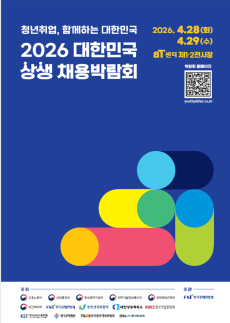 Government, Business Groups to Hold Youth Hiring Fair in Seoul The government and major business groups are joining forces to expand jobs for young people. The Ministry of Employment and Labor said Sunday it will hold the "2026 Korea Shared Growth Job Fair" on April 28-29 at the aT Center in Seoul’s Yangjae area, together with related ministries including the Ministry of Science and ICT, the Ministry of Culture, Sports and Tourism, the Ministry of Trade, Industry and Energy, the Ministry of Health and Welfare, and the Ministry of SMEs and Startups. Seven major economic organizations will jointly take part, including the Federation of Korean Industries, the Korea Chamber of Commerce and Industry, the Korea Employers Federation, the Korea International Trade Association, the Korea Federation of SMEs, and the Korea Enterprises Federation. The fair follows a December "Youth Jobs First Step" pledge by the government and business groups. About 700 companies will participate online and in person, with plans to hire more than 2,200 people. The ministry said both the number of participating firms and planned hires are sharply higher than at the Korea Job Fair held last March and the shared-growth cooperation job fair held in October. A shared-growth hiring zone will feature 169 companies, including suppliers to major conglomerates such as Samsung Electronics, SK, Hyundai Motor and LG, as well as government-recommended mid-sized and small firms, venture startups, and global companies. Participating companies will conduct on-site interviews or provide recruitment information. The event will also run promotion zones for K-Digital Training, with participants including Samsung Electronics, Hyundai Engineering & Construction and Korea Oracle, and for large-small business shared-growth programs, with participants including Samsung C&T, POSCO and Hanssem. Organizers said the zones will offer close counseling to help young job seekers better understand roles and build skills. Programs will include one-on-one coffee chats with employed young professionals who recently landed jobs, practical job-search lectures by corporate recruiters, and an intensive interview zone offering on-site interviews, personal color consultations, suit rentals, and hair and makeup support. Hands-on events will include an LED photo zone for "wishing for success" set against backdrops of well-known sites nationwide, including Yeonjudae on Gwanaksan, and a program to create self-PR business cards highlighting strengths and job skills. For young people and companies outside Seoul who cannot attend in person, an online recruitment hall has been operating since March 19. It will run through the end of July for four months, providing recruitment information and online application services. Labor Minister Kim Young-hoon called youth employment "the most urgent and serious task" facing society. "As this fair shows, solving youth employment is possible when the government and companies work together," Kim said. He added that he hopes the event will go beyond a one-off gathering and become a turning point for large companies and their partners to grow together, with the government and business moving as "one team" to create a virtuous cycle of jobs.* This article has been translated by AI. 2026-04-27 12:07:43
 -
 Survey: About 95% of NH members and public say reform is needed to curb misconduct South Korea’s Ministry of Agriculture, Food and Rural Affairs said April 27 that a survey found about 95% of NongHyup members and the general public agree reforms are needed, with the most common reason being the need to eradicate misconduct by executives, including the chairman and cooperative heads. The ministry said 94.5% of cooperative members and 95.1% of the public supported the need for reform, according to an “awareness survey of members and the general public” on reform measures. The Korea Rural Economic Institute commissioned Gallup Korea to poll 1,079 NongHyup cooperative members nationwide and 1,000 members of the public. Asked why reform is needed, respondents most often cited misconduct by executives such as the chairman and cooperative heads (55.1% of members; 73% of the public). Other leading reasons were an operating structure centered on cooperative heads rather than members (49.4% of members; 47.3% of the public) and problems involving agricultural product distribution and price stabilization (49.4% of members; 54.5% of the public). Support was also high for shifting to direct elections by members for the NongHyup chairman, with 83.1% of members and 90.5% of the public in favor. The main reasons cited were strengthening member sovereignty and democratic governance (66.3% of members; 65.6% of the public) and reducing the risk of corruption such as the provision of money or gifts (48.2% of members; 59.5% of the public). On establishing a NongHyup Audit Committee, support outweighed opposition among both groups (85.8% of members; 93.3% of the public). A key reason was that a separate audit body could conduct fair audits without internal pressure (79.4% of members; 68.6% of the public). Among opponents, a leading concern was increased government influence (70.6% of members; 53.7% of the public). The survey also found support for creating new government oversight authority over NongHyup’s holding company and subsidiaries (67.5% of members; 85% of the public). Strengthening members’ ability to request information disclosure from cooperatives was backed by 68.9% of members and 79.7% of the public. Agriculture Minister Song Mi-ryeong said the results show reform is a shared priority for most members and the public. “We will promptly prepare follow-up reform measures, including revitalizing economic projects and scaling up cooperatives, so that NongHyup can restore its core role,” she said. * This article has been translated by AI. 2026-04-27 12:06:50