
Journalist

Lee Hugh
=
-
 South Korea to Discuss Smart Monitoring to Close Gaps in Industrial Air Pollution Oversight A debate over introducing a “smart monitoring system” to more precisely track air pollutants from industrial sites will move forward at the National Assembly, amid concerns that smokestack-focused oversight misses emissions that leak during production processes. The National Institute of Environmental Research said Sunday it will hold a forum on the smart monitoring system at 10 a.m. on the 28th at the National Assembly Members’ Office Building in Yeongdeungpo District, Seoul, together with the offices of lawmakers Park Hong-bae and Woo Jae-joon of the National Assembly’s Climate, Energy, Environment and Labor Committee. South Korea’s current air pollution control system centers on measuring pollutants released from facility smokestacks. But as industrial operations have grown more complex and chemical and manufacturing sectors have diversified, more cases have been reported of hazardous substances — including volatile organic compounds, or VOCs — escaping from various points across production facilities, exposing limits in the existing approach. In industrial complexes where multiple plants are clustered, officials and experts have also repeatedly pointed to the difficulty of identifying specific sources through inspections of individual sites alone. That has fueled calls for a monitoring system that can manage emissions across an entire industrial complex, beyond a single facility. To address the gap, the institute has operated a monitoring system since 2019 that uses mobile measurement vehicles and spectroscopic remote-sensing technology to track air pollutant emissions in real time. The system is seen as allowing faster checks across wider areas than fixed monitoring methods. At the forum, Kang Dae-il, head of the institute’s Air Engineering Research Division, and Inha University professor Jeon Gi-jun are to present on current operations of the smart monitoring system and on domestic and international technology and policy trends. A panel discussion moderated by Song Ji-hyeon, president of the Korean Society for Atmospheric Environment, will bring together representatives from academia, the government and the National Assembly to discuss expanding the use of advanced monitoring equipment, ensuring the reliability of measurement data and directions for regulatory improvements. The institute said it expects the discussions to accelerate efforts to build the legal and institutional foundation needed to broaden the use of advanced monitoring equipment. “Smart monitoring is an important tool to more accurately understand actual emissions of air pollutants and strengthen on-site response,” NIER President Park Yeon-jae said. “We will actively support the stable establishment of related systems and policies based on scientific evidence and field experience.”* This article has been translated by AI. 2026-04-27 12:06:00
 -
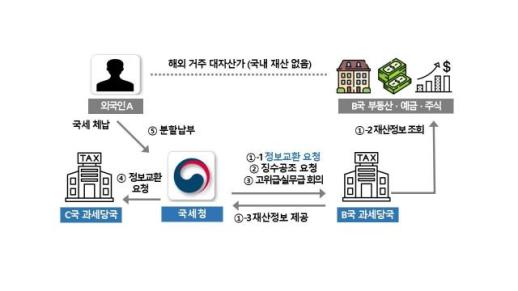 Korea Tax Agency Recovers 33.9 Billion Won in Hidden Overseas Assets From Delinquents The National Tax Service said it has recovered 33.9 billion won in delinquent taxes by strengthening international cooperation against people who hid assets overseas. The agency said dozens of additional cases are still moving through international collection procedures, raising expectations that hundreds of millions of won more could be recovered. According to the NTS on the 27th, since NTS Commissioner Im Gwang-hyeon took office in July last year, the agency has recovered 33.9 billion won in five cases over the past nine months through collection cooperation with tax authorities in three countries. The figure accounts for most of the cumulative results since 2015 — 37.2 billion won across 24 cases — as the agency says international cooperation is now producing tangible collection results. The NTS said it uses two main channels to track overseas assets held by tax delinquents: information exchange and collection cooperation. It identifies overseas accounts and financial assets through automatic exchange of financial information with 119 countries, and obtains information on assets such as real estate through case-by-case requests with 163 countries. When those efforts confirm where a delinquent’s overseas assets are located, the NTS proceeds with collection cooperation by asking the relevant country’s tax authority to carry out compulsory collection. The agency said Korea cannot directly enforce seizures abroad, so local tax authorities conduct attachment and collection on its behalf. In one case, a foreign wealthy individual living overseas who had failed to pay taxes in Korea sold local assets and paid after cooperation with the person’s home-country tax authority began, the NTS said. In another, a foreign professional athlete who had worked in Korea left the country without filing taxes, but paid voluntarily through a representative in Korea after the athlete’s home-country financial account was identified. The NTS also cited a case involving a foreign businessperson who had dispersed and concealed assets across multiple countries. After a third-country financial account was detected and collection cooperation was initiated, the case ended in voluntary payment. For Korean nationals, the agency said it has recovered taxes by tracing accounts of overseas corporations operated under borrowed names and collecting the full deposits, or by using information exchange with countries where delinquents hold permanent residency to seize and collect from overseas accounts. The NTS said it is expanding its methods by directly participating as a creditor in overseas bankruptcy proceedings and by attaching high-end homes abroad. In one case, a delinquent immediately signaled an intent to pay after a luxury home overseas was attached, it said. An NTS official said shifting assets overseas while benefiting in Korea and failing to pay taxes leaves compliant taxpayers feeling deprived, undermines the foundation of public finances, and seriously damages fairness and justice in society. The official said the agency will mobilize all available tax enforcement capacity to respond strictly to malicious delinquents who evade their tax obligations. 2026-04-27 12:04:09
 -
 South Korea orders major open-market platforms to curb overly broad liability waivers South Korea’s competition watchdog ordered corrective steps against what it called overly broad liability waivers used by open-market operators, including clauses that exempt a platform even when fault is shared between the company and users. It also revised provisions that had broadly waived intermediary responsibility on the grounds that the platform was not a direct party to contracts. The Fair Trade Commission said on the 27th it reviewed the terms of service of seven major open-market operators, including Coupang, Naver and Kurly, and corrected 11 types of unfair clauses across four areas: improper exemptions and limits on damages liability; arbitrary exercise of platform operating authority; disadvantages tied to settlement for sellers and refunds for consumers; and other terms unfavorable to users. The commission said the action is intended to strengthen platform accountability and better protect users’ rights as the domestic e-commerce market has expanded rapidly and open markets have become an essential distribution channel. First, it moved to fix clauses that improperly exempt or shift responsibility for protecting personal information. Open-market operators have a duty to securely collect and store users’ personal data, such as names and contact information, gathered during transactions. The commission said some terms had effectively freed operators from responsibility for incidents such as data leaks regardless of whether the company was at fault. It also corrected clauses that broadly waived a platform’s intermediary responsibility. The commission said platform operators that broker transactions between sellers and consumers have a manager’s duty to help ensure transactions are safe and smooth. It said terms will be revised so operators are not exempt when they are at fault, rather than being uniformly shielded because they did not directly participate in contracts. In addition, the commission said it was unfair to exempt a business whenever a user bears any fault in cases where responsibility is shared. When both sides are at fault, it said, liability should be allocated according to each party’s share of responsibility. Other clauses to be corrected include provisions that prioritize separate operating policies over the terms; allow unilateral changes to payment methods without user consent; unfairly delay settlement of sales proceeds to sellers; require users to waive restoration claims when canceling membership; and unfairly differentiate refund conditions based on subscription billing cycles. The commission said the measures were aimed at having major open-market platforms voluntarily correct unfair terms that had been applied unilaterally to users by leveraging superior bargaining power. It said it will continue to review and correct terms to create a safer environment for platform users and improve unfair trading practices. * This article has been translated by AI. 2026-04-27 12:03:17
 -
 Miura Co. Establishes Philippine Subsidiary to Expand Boiler Sales and Service Industrial boiler maker Miura Co. said April 23 that it has established a local subsidiary in the Philippines, Miura Philippines, to strengthen sales and maintenance as demand rises with economic growth. The company set up the unit effective March 25 through its group’s Southeast Asia headquarters in Singapore. It will begin operations May 1. Capital is 18 million pesos (about 47 million yen). The subsidiary will handle sales and rentals of boilers and water treatment equipment, as well as maintenance. In the Philippine market, Miura Singapore has conducted boiler sales and maintenance since opening a branch in 2018.* This article has been translated by AI. 2026-04-27 12:00:14
 -
 Ruling Party Says Middle East Crisis Recovery May Take Over a Year, Energy Supplies Stable The ruling party and the government on April 27 reviewed economic response measures as the war in the Middle East drags on. They said it could take more than a year for energy supplies and global oil prices to return to pre-crisis levels, but assessed that there is no immediate problem with energy supply. They also said an auto insurance discount tied to participation in a driving-day program will be launched next month to ease the burden on households hit by high oil prices. The National Assembly’s special committee on economic responses to the Middle East war said it discussed the issues at its fourth meeting held at the Assembly. Committee Chair Yu Dong-su said the prolonged conflict is expected to require more than a year for energy supply conditions and international oil prices to recover to earlier levels, but added he believes the government is “defending well” against supply-related risks. Rep. Ahn Do-geol, the committee’s secretary, told reporters after the meeting that there were no problems securing crude oil supplies and building naphtha stockpiles. He said 80% of the volume needed for May crude oil supply had been secured, and that with 2.1 million tons of naphtha secured for the year, about 85% to 90% of May needs were covered, allowing for stable supply. On urea solution, Ahn said about three months of inventory has already been secured, but some companies have reported shortages of vehicle-grade urea solution. He said the Public Procurement Service began releasing public stockpiles to companies facing shortages starting on the 23rd. He also said a 25% cut in fuel tax on liquefied petroleum gas (LPG) butane, which is expected to rise in price, is scheduled to take effect next month. The committee said financial support efforts tailored to sectors such as banking, insurance and capital finance are also continuing. Separately, the ruling party and the government announced an auto insurance rider offering a discount for vehicles participating in the driving-day program, following consultations with the nonlife insurance industry. Applications for the rider will open in May for personal auto policies, and the discount will be applied retroactively starting April 1. Subscribers will receive a 2% discount on their annual auto insurance premium. Ahn said 17 million vehicles — 67% of the nation’s 26 million vehicles — would benefit from the discount, calling it a meaningful amount compared with the pace of rising auto insurance premiums. Yu said the discount rider could help ease public anxiety as people face economic hardship from high oil prices. * This article has been translated by AI. 2026-04-27 11:57:19
 -
 EU to Spend 15 Million Euros to Support Myanmar Refugees in Thai Border Camps The European Union said on the 20th it will launch a 15 million euro (about 2.8 billion yen) support program for Myanmar refugees living in nine camps in Thailand along the Myanmar border, as well as refugees living outside camps in Thailand’s northern Tak province, for 2026-28. The EU said the program is intended to help shift support away from reliance on humanitarian aid and toward self-reliance. The program will be carried out in cooperation with the EU, the U.N. refugee agency UNHCR, the International Rescue Committee, and Expertise France, an agency under the French Development Agency. The target areas include refugee camps in four provinces: Mae Hong Son and Tak in the north, and Kanchanaburi and Ratchaburi in the west. Funding will be allocated as follows: 10.5 million euros for essential supplies and employment support through the IRC; 2 million euros to improve health services in Tak province through EF and local medical institutions; and 2.5 million euros for child protection and broader support for refugees within Thailand’s systems led by UNHCR. The EU increased the funding from the originally planned 12 million euros to 15 million euros. The IRC had served for 30 years as a main provider of medical support in northern refugee camps, but ended that assistance in late July last year after U.S. foreign aid was halted.* This article has been translated by AI. 2026-04-27 11:54:37
 -
 HiteJinro Promotes Chamisul at Manila Culture Festival to Reach Young Consumers South Korean liquor maker HiteJinro said it took part in “2026 Round in the Philippines,” a cultural exchange festival between South Korea and the Association of Southeast Asian Nations held in Manila, promoting its brands to younger local consumers. The company set up a tasting booth inside the Araneta Coliseum, featuring its flagship soju brand Chamisul and five fruit liqueur products. It also ran a pop-up store at a nearby shopping mall with hands-on promotions. HiteJinro established its Philippine unit in 2019 and has been working to expand the market through collaborations with local brands. Distribution sales volume in the Philippines in January-March rose about 23% from a year earlier, it said. The company said it plans to keep using music and cultural events for locally focused marketing as it seeks to raise brand awareness across Southeast Asia.* This article has been translated by AI. 2026-04-27 11:48:14
 -
 U.S., Japan Plan First Dual-Use Defense Project: Make U.S.-Developed Drones in Japan The United States and Japan are moving to deepen cooperation on developing defense equipment using dual-use technology that can serve both military and civilian purposes. As a first project, the two sides are considering producing in Japan drones developed by a U.S. startup. The aim is to curb reliance on China, which holds a large share of the global drone market, and to strengthen defense supply chains within the alliance. Japanese media, citing Kyodo News on Monday, reported that the two governments plan to set up a public-private framework within the year to apply dual-use technologies to defense equipment development. The framework would link companies that plan and design equipment with firms that handle manufacturing. The initial concept is to manufacture in Japan drones developed by an emerging U.S. company. Kyodo described it as a structure that combines advanced technologies where the United States has strengths with Japan’s production capacity. Some observers say it could accelerate integration in U.S.-Japan defense equipment development. Drones are a typical dual-use item. In civilian settings they are used for logistics, filming and inspections, while on the battlefield they can be used for reconnaissance, attacks and target tracking. Their military importance has grown through the Russia-Ukraine war and U.S.-Iran clashes. The cooperation is also driven by concerns about China. By producing drones in Japan, the two countries appear to be seeking to reduce dependence on Chinese-made drones and parts and to build a supply chain that can provide stable procurement in an emergency. The plan could also raise concerns inside Japan, including the possibility that lethal attack drones produced domestically could be used in combat or exported to third countries. Japan has recently eased restrictions on defense exports, widening the scope of weapons transfers. If drone cooperation expands, debate could intensify over Japan’s defense export principles and its stance as a pacifist nation.* This article has been translated by AI. 2026-04-27 11:45:20
 -
 Fadu posts 7.7 billion won Q1 operating profit, returns to profitability Data center semiconductor company Fadu said Monday it returned to profitability in the first quarter, posting 59.5 billion won ($59.5 billion won) in revenue and 7.7 billion won in operating profit in a preliminary earnings filing. The company swung from an operating loss of 12.0 billion won a year earlier to an operating profit of 7.7 billion won. Net profit also turned positive, reaching 10.2 billion won after a 12.1 billion won loss in the same period last year. Revenue jumped about 210% from 19.2 billion won a year earlier, the company said, citing accelerating demand tied to growth in AI data centers and a surge in enterprise solid-state drive, or eSSD, demand. Fadu said orders have risen as mass production of its core controller business ramps up for global hyperscalers, and it expects growth to steepen into the second half of the year. The company said controllers accounted for about 80% of first-quarter revenue, reflecting a shift it has pursued since last year and a sharper improvement in profitability. Fadu said it plans to make this year a turning point for a “quantum jump” in both revenue and profit. It said it will cultivate new growth engines such as power management integrated circuits, or PMICs, while broadening its customer base by targeting markets in Asia as well as the United States. The company is also strengthening research and development. In March, it hired Kim Jin-su, a professor in Seoul National University’s Department of Computer Science and Engineering who has researched computer architecture and system software, as chief research officer to pursue next-generation storage system development. Fadu said its goal is to move beyond supplying SSD controllers and become a comprehensive storage solutions company that designs and provides full storage architectures optimized for AI workloads. Chief Executive Nam Yi-hyeon said, “This return to profitability is the result of customers recognizing the technology and sincerity Fadu has worked hard to build over a long time.” She added, “Now that we have fully established ourselves in the global hyperscaler ecosystem, revenue and profit will begin to grow in earnest.” * This article has been translated by AI. 2026-04-27 11:42:42
 -
 India’s Haryana Plans Toy-Focused Industrial Cluster Under 2026 Industry Policy India’s northern state of Haryana plans to develop an industrial cluster specializing in toys, Chief Minister Nayab Singh Saini said on the 23rd, according to PTI. Saini made the remarks after a high-level meeting to review the final draft of the “Haryana Industrial Policy 2026.” He said the state aims to build a toy industry cluster on a 250- to 350-acre site (about 101 to 141 hectares). He said the cluster would help diversify industry in the state and could also strengthen India’s economy by boosting exports. The Haryana Industrial Policy 2026 is expected to focus on emerging sectors including electronic system design and manufacturing (ESDM) and IT, as well as animation, visual effects (VFX) and gaming. The policy is also expected to target investment attraction, large-scale job creation and faster technological innovation.* This article has been translated by AI. 2026-04-27 11:42:15