
Journalist

Lee Hugh
=
-
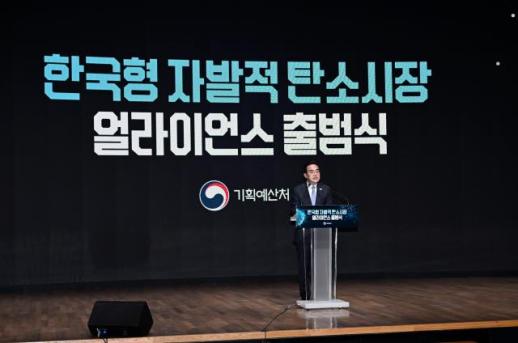 Park Hong-geun Pushes Voluntary Carbon Market Law, Unified Exchange Park Hong-geun, minister of the Office of Planning and Budget, said on the 27th that the government will move to institutionalize a voluntary carbon market as a key tool for meeting carbon-neutrality goals and will pursue the creation of a unified exchange. Speaking at the launch ceremony for the “Korean-style Voluntary Carbon Market Alliance” at the Korea Chamber of Commerce and Industry, Park said carbon cuts are “no longer a cost but a new business model that raises corporate value.” The government also announced its “Korean-style voluntary carbon market development plan,” focusing on building the institutional framework, expanding trading infrastructure and broadening demand to foster a carbon-market ecosystem. As a legal foundation, it will push to enact a “Voluntary Carbon Market Act.” The bill would include operating a registry institution to manage the full lifecycle of carbon credits — issuance, distribution and retirement — and disclosing evaluation standards to improve transparency and trust. To strengthen fairness and stability in trading, the government plans to establish a dedicated voluntary carbon market exchange. It aims to open the exchange within the Korea Exchange by the end of this year to consolidate dispersed carbon-credit trading and improve convenience through standardization by product category. The government also plans to work with overseas rating agencies to bolster international credibility for traded emissions-reduction results and to expand links with international carbon markets. The newly launched alliance is a public-private governance body bringing together companies, financial institutions and research organizations to connect supply and demand and identify tasks for improving the system. The government said activating the voluntary carbon market is needed to strengthen incentives for emissions cuts in nonregulated areas, including small and medium-sized companies and startups that are not covered by the emissions trading system, or ETS. The ETS currently covers about 70% of national greenhouse gas emissions, but incentives for the remaining 30% are insufficient, it said. Park said the government will provide institutional support so the domestic market can become an Asian hub amid the global expansion of carbon markets, and pledged to build a virtuous cycle in which emissions-cutting performance leads to investment and growth. * This article has been translated by AI. 2026-04-27 11:18:39
 -
 Seoul and Tokyo benchmarks touch new highs as tech rally overrides Gulf jitters SEOUL, April 27 (AJP) - Seoul's main KOSPI touched a new ceiling at 6,600 on institutional buying early Monday, brushing aside weekend incidents — the stalemated U.S.-Iran peace talks and a shooting incident during the White House Correspondents’ Dinner attended by U.S. President Donald Trump. Both the KOSPI and junior KOSDAQ gained nearly 2 percent, pushing their combined market capitalization above 6,000 trillion won, up nearly 40 percent from the beginning of the year. As of 11:00 a.m., the KOSPI was up 1.96 percent at 6,602.44, while the KOSDAQ rose 1.76 percent to 1,222.90. Semiconductor shares led the advance, with SK hynix hitting another 52-week high Monday, extending gains on expectations of a semiconductor supercycle. Shares rose 4.83 percent to 1,281,000 won. Support also came from expectations that the current memory upcycle may be stronger than in previous cycles, with investors watching this week’s results from global NAND suppliers for guidance that could lift consensus forecasts for SK hynix’s NAND business. Gains spread across the broader semiconductor sector, with Samsung Electronics rising 1.59 percent to 223,000 won. Autos were mostly firmer, with Hyundai Motor Company surging 3.12 percent to 529,000 won and affiliate Kia edging up 0.13 percent to 153,600 won. Industrial and defense shares were mixed, with HD Hyundai Heavy Industries up 1.04 percent at 678,000 won and Doosan Enerbility adding 0.87 percent to 128,200 won, while Hanwha Aerospace slipped 0.68 percent to 1,453,000 won. Battery names came under pressure, with LG Energy Solution down 3.17 percent to 465,750 won and Samsung SDI dropping 1.72 percent to 630,000 won. The KOSDAQ was lifted by strength in biotech and robotics shares, with nearly all of the top components trading higher. Rainbow Robotics jumped 11.44 percent to 682,000 won, while ABL Bio climbed 8.97 percent to 171,300 won and Samchundang Pharm rose 8.38 percent to 446,000 won. Alteogen added 4.20 percent to 384,500 won, while HLB gained 4.15 percent to 62,700 won. Leeno Industrial — a semiconductor testing equipment maker — was the only decliner among major components, falling 14.63 percent to 106,200 won. The dollar sharply eased on renewed foreign buying, trading at 1,474.30 won compared with the previous close of 1,484.50 won. Japan’s Nikkei 225 rose 1.23 percent to a fresh intraday high of 60,351.95 in morning trade, led by semiconductor-related shares. Advantest climbed 1.24 percent and SoftBank Group added 0.89 percent, as investors positioned ahead of the Bank of Japan’s policy decision due Tuesday. Hong Kong’s Hang Seng Index slipped 0.08 percent to 25,957.25, while China’s Shanghai Composite Index eased 0.02 percent to 4,079.00. Japan’s markets are set to close Wednesday, while South Korea, China, Hong Kong and Taiwan will be shut Friday for Labor Day. Meanwhile, market focus will turn to how earnings from megacap technology firms shape volatility this week, with Microsoft, Alphabet, Amazon and Meta due to report first-quarter results on Wednesday, followed by Apple on Thursday. 2026-04-27 11:15:28
 -
 NHN Cloud to Merge Subsidiary Into Innogrid to Build Full-Stack Cloud Platform NHN Cloud is moving to strengthen its cloud business by reorganizing its operations through a merger in which cloud platform company Innogrid will absorb NHN Inje AI&C, an NHN Cloud subsidiary. NHN Cloud said on 27일 it is pursuing a merger between NHN Inje AI&C and Innogrid. Under the plan, Innogrid will absorb NHN Inje AI&C at a merger ratio of about 1 to 31. The merger date is set for July 6. After the merger, the surviving company, Innogrid, will keep its current management structure under CEO Kim Myeongjin to maintain continuity. Through the integration, Innogrid is expected to secure broader competitiveness in private cloud services by combining technology with operations and management capabilities. Based on that, the company plans to step up its push into the enterprise market, including the public and financial sectors. Once the merger process is completed, NHN Cloud will become Innogrid’s largest shareholder and, as the parent company, will focus on generating synergies across management. The strategy is to combine Innogrid’s cloud platform technology with NHN Cloud’s infrastructure operations to build an integrated service system covering the full process from deployment to operations and management. The companies also plan to strengthen their ability to meet high security requirements in the public and financial sectors while improving support for multicloud and hybrid cloud environments, aiming to enhance full-stack competitiveness across the cloud business. An NHN Cloud official said, “Through this business restructuring, we will strengthen the foundation of our cloud business across both the public and private sectors and build a stable growth framework.”* This article has been translated by AI. 2026-04-27 11:15:16
 -
 North Korea opens memorial for Ukraine war dead with Russian officials in attendance SEOUL, April 27 (AJP) - North Korea has completed a memorial in Pyongyang dedicated to soldiers killed while fighting in Russia's war against Ukraine, state media reported Monday. According to the state-run Korean Central News Agency, a ceremony marking its completion was held the previous day, attended by the country's leader Kim Jong-un and visiting senior Russian officials including Defense Minister Andrei Belousov and Vyacheslav Volodin, speaker of Russia's State Duma, the lower house of parliament. The memorial's opening coincided with the first anniversary of North Korea's deployment to Russia's Kursk region, with Kim using the occasion to tout the two countries' deepening ties and pledge continued military cooperation against what he called Western "injustice." Russian President Vladimir Putin, in a letter read by Volodin, said the "unmatched combat feats" of North Korean troops "will remain forever in the hearts of all Russians," adding that he was confident the two sides would continue to strengthen their "comprehensive strategic partnership." North Korea has reportedly sent around 15,000 combat troops and weapons to Russia to assist Moscow's war in Ukraine since the two countries signed a mutual defense pact during Putin's visit to Pyongyang in June 2024. Thousands of North Korean soldiers, most deployed to Kursk, a southwestern Russian region bordering Ukraine, are believed to have been killed or wounded during the prolonged war. Ukrainian forces seized parts of Kursk in August 2024, but Moscow officially declared the region fully retaken in April the following year, with North Korea claiming its troops played a decisive role in helping Russia regain control of the territory. Kim, who has promoted the deployment as a symbol of the two countries' alliance, ordered the construction of the memorial last October in Pyongyang's newly developed district of Hwasong. The memorial houses the remains of fallen soldiers and displays weapons. 2026-04-27 11:02:24
 -
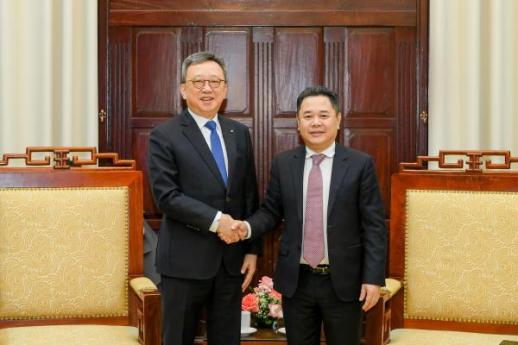 Shinhan Bank Joins Vietnam Economic Delegation, Expands Corporate Finance Push Shinhan Bank is accelerating its push to expand what it calls “productive finance” in Vietnam, following similar efforts in South Korea. The bank said Monday it joined a government-led Vietnam economic delegation from April 22-24, holding talks with the State Bank of Vietnam and signing business agreements with major local financial and industrial groups. Shinhan said the trip was aimed at strengthening the foundation for financial cooperation in Vietnam and meeting financing needs of Korean companies operating there as well as Vietnamese firms. Shinhan entered Vietnam in 1993 as the first South Korean financial company to do so and has expanded its business base since then. Shinhan Vietnam Bank has maintained the top spot among foreign banks in Vietnam in key indicators including total assets, loans and deposits, the bank said. During the visit, Shinhan Bank CEO Jeong Sang-hyeok met with Nguyen Ngoc Canh, deputy governor of the State Bank of Vietnam, to discuss financial support for expanding Korean business activity in Vietnam and cooperation in digital and ESG (environmental, social and governance) areas. Shinhan also signed an agreement with Vietcombank, a state-owned commercial bank, covering cooperation on financial support and retail, foreign-exchange transactions and capital markets, and digital transformation. Shinhan said it aims to support Korean companies entering Vietnam while strengthening its position in the local financial market. With FPT Group, a major Vietnamese information and communications technology company, Shinhan agreed to work on building a digital finance ecosystem based on artificial intelligence and big data. Shinhan also signed an agreement with Agribank, one of Vietnam’s four largest state-owned banks, focused on financial support to help companies from both countries enter each other’s markets. The bank said it plans to expand tailored services for cross-border customers, including Vietnamese workers and students living in South Korea. “Vietnam is a key market that symbolizes Shinhan Bank’s global growth roadmap,” Jeong said. “We will create a model case of ‘productive finance’ that supports the global competitiveness of Korean companies and continue a true financial partnership that grows together with local communities.” * This article has been translated by AI. 2026-04-27 10:58:35
 -
 LH Opens Applications for 1,000 Specialized Purchase-Rental Homes in First Half of 2026 Korea Land and Housing Corp., or LH, said it will begin accepting applications on the 27th for its first-half 2026 call for specialized purchase-rental housing proposals. Under the program, private developers propose and build rental housing tailored to residents’ needs, including dedicated spaces and services. The public sector then purchases the properties and rents them out at lower rates, LH said. Examples include Haesimdang in Seoul’s Dobong district, which supports senior community-building and provides health and care services; Arts Stay in Seoul’s Yeongdeungpo district, which supports young people’s arts and startups; and Dadareum House in Seoul’s Eunpyeong district, which helps people with disabilities live independently. This round seeks about 1,000 units and will use a “private proposal” format, allowing developers to suggest themes such as care and child-rearing, job and startup support, and support for people relocating to rural areas. LH said it will also apply institutional changes starting with this call, including a unified price-calculation method, a cap on total review time, and penalties for poorly run operating organizations, to encourage private participation and ensure stable project delivery. Applications will be accepted through May 11. LH plans document screening in June and a comprehensive review in July before notifying applicants of final results. For selected properties, LH will proceed with appraisals and other steps in October before signing agreements. More information is available in the notice on LH’s Cheongyak Plus platform. * This article has been translated by AI. 2026-04-27 10:57:54
 -
 Korail Ranks No. 1 Among State-Owned Firms in 2025 Public Awareness Survey Korea Railroad Corp., known as Korail, said Sunday it ranked first in the state-owned enterprise (SOC) category in the Ministry of Finance and Economy’s “2025 Public Institutions Public Awareness Survey.” Korail scored 72.2 points overall, 6.9 points higher than the average for state-owned enterprises, which was 65.3. It also topped the SOC group average of 67 by 5.2 points. The survey measures public perceptions of public institutions, including public value, social responsibility and service quality, based on responses from the general public and local residents. It is used to gauge satisfaction with an institution’s overall operations. Korail received 94.1 points in local-resident awareness, reflecting strong marks for communication and cooperation with communities. The company said the result was driven by positive views of its contribution to local economies, delivery of everyday services and expanded collaboration with local partners. Korail President Kim Tae-seung said the company will continue to innovate so the public can feel improvements in rail service, and will more fully carry out its mission as a public railway operator supporting balanced national development and shared growth with regions. * This article has been translated by AI. 2026-04-27 10:57:14
 -
 Jung Cheong-rae says Yoon Suk Yeol should have faced death penalty request in North drone case Jung Cheong-rae, leader of the Democratic Party of Korea, said prosecutors should have sought the death penalty for Yoon Suk Yeol, who was asked to be sentenced to 30 years in prison in a first trial over a North Korean drone infiltration case. Speaking at an on-site Supreme Council meeting in Anseong on the 27th, Jung said that if North Korea had used the incident as a pretext to start even a limited clash, “countless people would have lost their lives.” Earlier, the special prosecutor for the insurrection case said on the 24th it was seeking a 30-year prison term for Yoon, who is accused of ordering an operation to send drones into Pyongyang. Jung also noted that it was the eighth anniversary of the April 27 Panmunjom Declaration, saying South and North Korea found a path to pursue peace together eight years ago, but that it “collapsed under Yoon Suk Yeol’s dictatorship.” He added, “We cannot stop the path to peace. War must not break out on the Korean Peninsula.” “Peace is the economy, and it makes our people richer,” Jung said, adding that under the Lee Jae-myung government there are signs the “Korean Peninsula risk” is easing and shifting toward a “Korean Peninsula premium.” Jung also urged Choo Mi-ae, the party’s candidate for Gyeonggi governor, Park Chan-dae, its candidate for Incheon mayor, and Woo Sang-ho, its candidate for Gangwon governor, who were selected as candidates in border regions, to “do their best” to manage the situation. He added that relief payments for damage from high oil prices caused by the Middle East war began that day, saying the Democratic Party would work with the government to ensure the program is carried out without gaps.* This article has been translated by AI. 2026-04-27 10:54:17
 -
 South Korea’s People Power Party urges government action over Samsung Electronics union strike threat South Korea’s People Power Party on Sunday called for what it described as a responsible government response to a threatened general strike by a Samsung Electronics labor union. The party also urged the government to roll back what it called pro-union policies and to pursue a new revision of the so-called Yellow Envelope Act, an amendment to Articles 2 and 3 of the Trade Union and Labor Relations Adjustment Act. Party leader Jang Dong-hyeok said at a meeting of the party’s top leadership that “Samsung’s union is holding the South Korean economy hostage.” He said the issue had moved beyond labor-management relations to become “a national economy and livelihoods issue,” and criticized President Lee Jae-myung for offering what he called a meaningless call to “resolve it wisely through dialogue.” Jang warned that with local elections approaching, if the government pressures Samsung and sides with the union, it would be “trading the country’s future for votes.” He said the government and the president should step in to persuade the union and mediate the conflict. Floor leader Song Eon-seok cited the union’s demand for performance pay equal to 15% of operating profit and its notice of a general strike from May 21 to June 7. Industry observers have projected Samsung Electronics’ annual operating profit this year at about 45 trillion won, based on forecasts. Song said demanding 600 million won per worker for all employees, not only top performers, “is difficult to see as meeting global standards.” He added that with semiconductors accounting for 55% of economic growth, he viewed the threatened action as repeatedly “holding the national economy hostage” and damaging shareholder interests and the country’s future. Song blamed what he called one-sided, pro-union government policy for the repeated disputes and stressed the need to revise the Yellow Envelope Act again. He said the law should more clearly define employers through contractual and direct supervisory relationships and limit bargaining topics to wages and working conditions. He also called for more effective rules on liability for losses from illegal labor actions. Supreme Council member Shin Dong-wook said workers’ contributions to South Korea’s industrialization should not be underestimated, but warned that alternative legislation is needed before confusion linked to the Yellow Envelope Act grows further.* This article has been translated by AI. 2026-04-27 10:52:29
 -
 Concern Worldwide Korea Gets First Domestic Legacy Giving Pledge From Donor in His 70s International humanitarian organization Concern Worldwide said it has received its first legacy giving pledge in South Korea. Concern Worldwide said it held a pledge ceremony on the 23rd at its Seoul office. At the donor’s request, his name and identifying details were not disclosed. The pledger is a man in his 70s who has made monthly donations to Concern Worldwide since 2021. He began by giving 50,000 won a month, gradually increased the amount, and now donates 350,000 won each month. The donor said he lived through the Korean War as a child and later made a living working on deep-sea fishing vessels. Based on those experiences, he has said he wanted to help people suffering from hunger and poverty. Legacy giving is a form of donation in which a person pledges during their lifetime to use part or all of their assets for the public good after death. It can include cash as well as real estate, stocks and insurance, and can be arranged through notarized wills or trust arrangements that serve as will substitutes. The donor said he decided to make the pledge because he understands hunger firsthand. “Because I know how painful hunger is, I wanted to donate the money I saved over my lifetime to help people in difficult circumstances,” he said. “I hope the assets I leave behind can have a positive impact on the world.” He also described how he first connected with the organization. “By chance, I saw Concern Worldwide’s advertisement at a bus terminal, and it brought back memories of the hungry days in the past, so I started donating,” he said. “I was grateful to learn there was a way to help.” Lee Jun-mo, Concern Worldwide’s representative, said legacy giving is a way to ensure a donor’s intentions reach those who need help most. He called the pledge “a meaningful promise” reflecting the donor’s convictions, and said the organization would do its best to use the donation where it is most needed. Concern Worldwide is an international humanitarian organization working to address hunger and extreme poverty. It runs programs in vulnerable regions worldwide, including health and nutrition, livelihoods, education and humanitarian assistance. The organization said it also provides procedures and guidance through major and legacy giving programs so donors’ intentions can support projects in the world’s poorest areas.* This article has been translated by AI. 2026-04-27 10:51:49