
Journalist

Lee Hugh
=
-
 South Korea Sets 1,714 Passers for 15th Bar Exam, Urges Absolute Grading for Electives South Korea’s Justice Ministry has finalized 1,714 successful candidates for the 15th bar exam and issued recommendations to overhaul how lawyers are selected and trained, including adopting absolute grading for elective subjects. The ministry said April 24 it set the pass list after deliberations by the bar exam management committee on April 23 and after reflecting opinions from the Supreme Court, the Korean Bar Association and the council representing law schools. Those who scored at least 889.11 points passed, for a total of 1,714. The number of passers was down 30 from a year earlier, when 1,744 passed. Of 3,364 test-takers, the pass rate was 50.95%. Measured against the law school admissions quota of 2,000, the pass rate was 85.70%. The first-time pass rate was 70.04%. Among examinees who used all five attempts allowed over five years, the cumulative pass rate was 88.43%. The ministry said detailed grading results and statistics will be posted on its website next month. The ministry said it also provided accommodations for 26 examinees with disabilities, including five with severe disabilities such as total blindness. Support included extended testing time, computers with voice assistance and dedicated proctors. The bar exam management committee also adopted broader reform recommendations as the law school system marks its 15th year, citing ongoing debate over the supply and demand of legal services and concerns about normalizing law school operations. The ministry said it will improve the selection and training system by considering changes in economic growth, population decline, shifts in legal demand and environmental changes such as artificial intelligence. On elective subjects, it recommended moving toward absolute grading, provided that a credit-completion system and achievement-based evaluation indicators are put in place, to address weaker links between education and testing and heavy concentration in certain subjects. The ministry said the recommendations aim to normalize law school education and build a training system that can respond to a changing legal environment.* This article has been translated by AI. 2026-04-24 14:48:20
 -
 Korea Land Trust Pulls Out of Bundang Yangji Village Redevelopment Bid, Citing Fairness Concerns Korea Land Trust said it will not participate in the bid to select a preliminary project operator for the integrated redevelopment of Yangji Village in Bundang, widening debate over the fairness of the process and the adequacy of procedures. The company said on the 24th that it would not take part in the tender for the project’s preliminary operator selection. The Yangji Village integrated redevelopment is a large project covering six complexes — including Hanyang, Kumho and Cheonggu — totaling 4,392 households. The plan calls for rebuilding into up to 37-story apartments with 6,839 households. Korea Land Trust had previously been named preferred bidder, receiving preliminary operator status and moving the project forward. Korea Land Trust said its decision stems from concerns about the overall bidding guidelines, citing three issues it said make it difficult to ensure fairness and stability: the balance of evaluation criteria, procedural representation and how rights and interests would be handled. On evaluation criteria, the company said the structure gives full points only to firms whose corporate group has total assets of at least 50 trillion won, adding that only a limited number of trust companies meet that requirement and that competitive neutrality could be undermined. It also said permitting and approval track records — which it described as critical to redevelopment success — were effectively excluded from scoring. A selection method focused on headline indicators such as asset size would make it difficult to protect owners’ property rights, it said. The company also questioned procedural legitimacy, saying meaningful participation and consent were not secured from representatives of Cheonggu 2 Complex and owners at 32 Sunae-dong, key members of the integrated project. It said bidding guidelines finalized while representatives of major complexes were excluded would be hard to justify procedurally. Korea Land Trust cited unresolved rights issues as another core concern. It said Yangji Village has a complex structure of shared land rights across complexes and alliances, requiring clear standards for separate settlement and principles for allocating rights from the outset. Because the bidding guidelines do not reflect specific operating principles, it said, disputes could arise later at the management and disposition planning stage. If disputes drag on, it added, higher financing costs could increase owners’ contributions. Korea Land Trust said it agreed to terminate an existing memorandum of understanding to expand owners’ choices, but concluded the final bid structure was difficult to trust. Without fair evaluation criteria and transparent procedures, it said, project stability also cannot be assured. Industry officials said Korea Land Trust’s withdrawal, as a leading candidate to serve as project operator, is expected to affect momentum for the Yangji Village redevelopment and reshape the bidding landscape.* This article has been translated by AI. 2026-04-24 14:45:16
 -
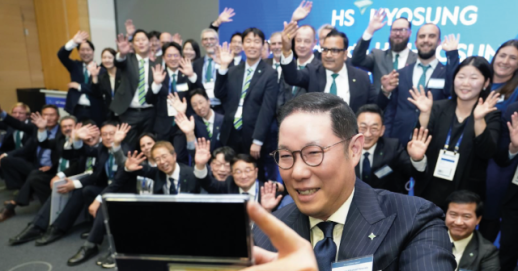 HS Hyosung Vice Chairman Cho Hyun-sang Hosts K-Culture Event at Techtextil 2026 in Germany HS Hyosung Advanced Materials took part in Techtextil 2026, billed as the world’s largest industrial materials exhibition, held in Frankfurt, Germany, from April 21 to 24 local time. The company said April 24 that global partnerships were further strengthened through “HS Hyosung Night,” hosted by Vice Chairman Cho Hyun-sang. HS Hyosung held the event on the evening of April 22, the exhibition’s second day, inviting about 130 guests including representatives from global companies such as Autoliv, ZF and Continental, as well as Lim Sang-beom, South Korea’s ambassador to Germany. The company said the gathering was designed to reinforce ties with key partners and share HS Hyosung Advanced Materials’ future vision. It said Cho listened directly to partners’ views and discussed practical cooperation while reviewing the company’s global network. The venue featured a fusion Korean traditional music performance, a hanbok experience and Korean food including bulgogi and gimbap, the company said. “K-culture is a special way to share Korea’s style, and that experience will help elevate HS Hyosung Advanced Materials’ global partnerships,” Cho said in a statement. He said the company would aim to create differentiated value in the global materials market as “a sincere partner” that goes beyond technology to build emotional connection. Cho added that amid heightened geopolitical uncertainty, the company would continue to practice the HS Hyosung spirit of moving forward with partners under the slogan “Value, and Together.” At the exhibition, HS Hyosung Advanced Materials showcased its full lineup of advanced fiber materials, from so-called super fibers such as carbon fiber and aramid to tire cord, airbags, seat belts and car mats. It also presented recycled polyester tire cord and a range of advanced recycling solutions, the company said, underscoring its position as an ESG-focused management leader. * This article has been translated by AI. 2026-04-24 14:40:23
 -
 Hyundai Card Q1 Net Profit Rises 5.4% to 64.7 Billion Won Hyundai Card reported higher first-quarter net profit, extending year-over-year gains as membership and credit card spending increased and interest costs fell. In a regulatory filing on the 24th, the company said net profit for the January-March period totaled 64.7 billion won, up 5.4% from 61.4 billion won a year earlier. Operating revenue rose 22.4% to 1.1815 trillion won, while operating expenses increased 23.5% to 1.0936 trillion won. Interest expenses declined 5.8% to 179.7 billion won from 190.8 billion won, supporting profitability. Membership also grew. New members increased by 47,000 in the quarter, bringing total membership to 12.71 million. Credit card purchase volume climbed 6% to 44.7843 trillion won from 42.2603 trillion won a year earlier. Asset-quality indicators edged up but remained generally low. The effective delinquency rate rose 0.05 percentage points from the end of last year to 1.21%. The general delinquency rate excluding refinancing loans increased 0.06 points to 0.85% from 0.79%. The 30-day-plus delinquency rate excluding refinancing loans, however, was 0.85%, down 0.05 points from a year earlier. A Hyundai Card official said strengthened product competitiveness helped sustain growth across key indicators, including membership and credit card spending, and that operating profit and net profit have risen year over year for four consecutive quarters. The official added that a focus on financial products for end users and proactive risk management has improved profitability while keeping asset quality solid.* This article has been translated by AI. 2026-04-24 14:39:47
 -
 Samsung Card Q1 Net Profit Falls 15.3% to 156.3 Billion Won Samsung Card said Friday its first-quarter results fell from a year earlier as credit-loss provisions and selling and administrative expenses increased. The company reported net profit of 156.3 billion won for the January-March period, down 15.3% from a year earlier. Revenue rose as spending and card receivables increased across all business segments, but financing costs, credit-loss expenses and selling and administrative costs also climbed. Total transaction volume in the quarter rose 9.3% from a year earlier to 47.3345 trillion won. Card transaction volume increased 9.4% to 47.1438 trillion won. By segment, credit purchases totaled 42.4597 trillion won and financial services 4.6841 trillion won. Installment and lease transaction volume was 190.7 billion won. The company said expanded partnerships with top-tier affiliates strengthened product competitiveness, lifting membership and spending per customer. The delinquency rate for payments overdue by more than one month was 0.92%, slightly improved from the end of last year and remained stable. A Samsung Card official said volatility in the operating environment is expected to persist after the second quarter, including continued swings in funding markets. The official said the company will respond proactively to rising internal and external uncertainties while working to maintain its competitive edge and continue investing in future growth areas such as platforms, data and artificial intelligence. 2026-04-24 14:39:15
 -
 Hyundai Motor Group vice chairman calls China toughest must-win market as CATL backs Ioniq V Hyundai Motor Group Vice Chairman Jang Jae-hoon met with CATL Chairman Zeng Yuqun in Beijing and reaffirmed their commitment to work together as Hyundai steps up its China strategy. Jang and Zeng met at the 2026 Beijing Auto China show, where Hyundai unveiled the China-focused electric vehicle Ioniq V. Jang made an unannounced visit to the show floor to view the Ioniq V, which Hyundai said it revealed for the first time in the world. Zeng also visited Hyundai’s booth to congratulate the company on the launch. The Ioniq V uses a battery developed in cooperation with CATL, and Hyundai expects a driving range of more than 600 kilometers on a single charge under China’s CLTC standard. “China is the most difficult market, but it is also a market where we must succeed,” Jang told reporters. “We will learn a lot and take a lot away.” He said electrification and smart technologies are already widespread in China, and Hyundai will focus on how it can differentiate itself with specific technical strengths. He added he hopes the newly launched Ioniq will receive a strong response. Zeng was also reported to have applauded the Ioniq V and expressed support for its success. Hyundai executives attending included Munoz; Park Min-woo, head of Hyundai’s Advanced Vehicle Platform (AVP) division; and Zhang Jianyong, vice president of BAIC Group, Hyundai’s joint-venture partner in China. “China is the market with the most advanced ecosystem in electric vehicles and software-defined vehicles,” Munoz said. “To secure global competitiveness, we must prove real competitiveness in China, so we will build a new future in China through a pipeline of 20 new-vehicle developments over the next five years.” After viewing the Ioniq V, Park said the design was “bold and beautiful,” adding he hopes the results for the newly launched Ioniq in China will be strong. On Momenta, the Chinese autonomous-driving company whose technology is applied to the Ioniq V, Park said he had been familiar with Chinese technologies since his time at Nvidia and had driven them. He said Hyundai will proceed without setbacks in preparing to internalize autonomous-driving technology. Hyundai said the Ioniq V incorporates a CATL battery, Momenta autonomous-driving technology and platform technology co-developed with BAIC. The company’s strategy is to deepen its integration into China’s electrification ecosystem by strengthening development partnerships with local firms. Hyundai’s goal is to build an annual sales base of 500,000 vehicles through 20 electrified new models aimed at the China market over the next five years. 2026-04-24 14:37:00
 -
 South Korea Overhauls Volunteer Service Law for Citizen-Led System After 21 Years The Ministry of the Interior and Safety said on the 24th that the National Assembly has passed a full revision of the Framework Act on Volunteer Service to foster a self-sustaining, civil society-led volunteer ecosystem. The revision aims to build a “citizen-centered volunteer ecosystem” that expands volunteers’ autonomy and creativity, building on infrastructure previously developed by the government. Under the revised law, government-run volunteer centers will be phased out. Of the nation’s 246 volunteer centers, 110 are directly operated by public officials. Those centers will have a three-year transition period to incorporate or shift to operation by a contracted nonprofit, a move the ministry said is expected to strengthen professionalism and independence. The revision also creates a legal basis for local governments to establish regional volunteer promotion committees that include private-sector experts, aiming to better reflect community needs in policy. For the first time, the law spells out a basis to train and support volunteer managers — key personnel at grassroots groups and volunteer centers who coordinate activities and connect volunteers. The government will provide administrative and financial support, and plans to detail qualifications and scope in a presidential decree. The law’s title will change from the “Framework Act on Volunteer Activities” to the “Framework Act on Volunteer Service.” It also broadens the definition of volunteer service to include providing talent and skills, not only time and effort, and it covers volunteer work conducted through online platforms. The eligible participants are expanded from “citizens” to “individuals,” including foreign residents. To strengthen infrastructure, the revision clarifies the legal basis for operating the 1365 Volunteer Portal and codifies the basis for compiling volunteer statistics, which were designated as government-approved statistics in January, enabling more data-driven policymaking. The revised law is set to take full effect one year after it is promulgated. Interior and Safety Minister Yoon Ho-jung said the revision marks a shift beyond a government-led era to one in which citizens’ voluntary participation and creativity become a key driver in solving social problems. “On the stable legal foundation 마련ed for the first time in 21 years, we will provide full support so volunteer service can take root as a valuable asset to our society,” he said.* This article has been translated by AI. 2026-04-24 14:36:09
 -
 Rep. Kim Min-jeon Proposes Law Requiring Substitute Staff for Kindergarten Absences Kim Min-jeon, a lawmaker from the ruling People Power Party, introduced a bill on the 24th to require substitute staff at kindergartens when teachers or other employees are unexpectedly unable to work, aiming to prevent disruptions and keep schools running smoothly. The proposed revision to the Early Childhood Education Act would mandate assigning a substitute teacher when a staff member cannot perform duties due to illness, infectious disease or other unforeseen reasons, creating a gap in operating the curriculum. It also calls for the education minister and provincial education superintendents to establish and implement measures to secure, manage and support the placement of substitute personnel, with the stated goal of improving the quality of early childhood education and protecting teachers’ rights to teach and to health. The proposal follows a recent case in which a first-year teacher died after going to work despite illness because a substitute could not be found, even amid a flu situation. In a survey released on the 23rd by the Korean Teachers and Education Workers Union of 6,689 teachers nationwide across kindergarten, elementary, middle, high and special schools, 64.5% of kindergarten teachers surveyed (3,547 respondents) said they had gone to work while sick with the flu. The findings fueled calls to better protect staff health and build a substitute staffing system. Current law does not explicitly provide for assigning or supporting replacement staff when employees cannot work due to illness or leave, the lawmaker’s office said, and kindergartens have faced serious disruptions. Private kindergartens, in particular, have struggled with costs and staffing shortages, leaving teachers to keep classrooms running while ill, it said. “The tragic loss of a private kindergarten teacher exposed the harsh reality of an education system without a way to replace sick teachers,” Kim said. “This revision should address structural gaps in early childhood education and create a safe personnel management system so teachers do not have to protect classrooms at the expense of their health.”* This article has been translated by AI. 2026-04-24 14:33:17
 -
 Korea watchdog issues online harm casebook, warns of data theft in used-goods job scams A growing number of cases last year involved personal information being stolen during hiring and job-seeking processes conducted through used-goods trading apps, leading to unauthorized sign-ups for specific apps, officials said. Authorities warned the stolen data could be used for follow-on crimes such as financial fraud. The Korea Communications and Media Commission and the Korea Information and Communications Promotion Association said Thursday they published the “2025 Online Harm Counseling Casebook,” summarizing 50 major cases drawn from consultations received by the Online Harm 365 Center. The casebook is based on counseling records from the center, which provides one-on-one consultations and follow-up support for online harm. The center handled 4,181 consultations last year, pushing its cumulative total past 10,000, the agencies said. The publication organizes 50 selected cases by type, chosen for frequency and significance. It covers eight areas — goods and services, telecommunications, content, rights violations, cyber financial crime, illegal and harmful content, digital sex crimes and cyber violence — and includes real-world examples along with prevention tips and response measures. Officials highlighted a noticeable rise in cases in which scammers obtained personal data through job-related exchanges on used-goods apps. They said the information can be exploited in “romance scam” schemes, in which a perpetrator approaches a victim by feigning romantic interest, then uses the data to create unauthorized accounts or to facilitate financial fraud. The commission said victims should quickly close any accounts opened without consent and take steps to block additional harm. Along with counseling narratives, the casebook includes response guidance, consultation outcomes, and related laws and court precedents. It also provides information on the center’s operations, how to request counseling, annual intake and processing figures, and user reviews. “As the online environment changes, the types of harm are becoming more diverse and more sophisticated,” commission Chairman Kim Jong-cheol said. He said he hopes the casebook will help the public prevent harm and respond quickly when incidents occur.* This article has been translated by AI. 2026-04-24 14:30:16
 -
 Whiskers and wallets: cat show at KINTEX SEOUL, April 24 (AJP) -The air at KINTEX hums with a different kind of energy this week — softer, furrier, punctuated by the occasional impatient meow. At the “2026 Nyangnyang Punch Cat Show Ilsan,” aisles fill quickly as visitors weave through rows of pastel-toned booths, peering into carriers, testing treats, and pausing for photos with cats that seem, at times, more composed than their human companions. From the entrance, the scale is unmistakable. Around 140 companies and 200 booths stretch across Hall 7, turning the exhibition floor into a marketplace of feline lifestyles — not just products, but identities. Premium feed brands tout grain-free formulas and tailored nutrition. Designers showcase sculptural cat towers that double as living room centerpieces. Even litter has evolved, marketed with the language of sustainability and wellness. At one booth, a vendor demonstrates an automated litter system, its quiet rotation drawing a small crowd. Nearby, a seminar space hosts a talk on feline nutrition, where attendees jot notes as if preparing for an exam. Elsewhere, visitors crouch low, coaxing shy cats forward with feather toys — small, intimate moments unfolding amid the commercial buzz. The crowd itself tells a story. Young couples, families with children, solo visitors — many carrying cats in transparent backpacks or cradling them gently — move through the space with a mix of curiosity and care. Conversations drift between product specs and personal anecdotes: allergies, aging pets, adoption stories. This is not casual browsing. It is, in many ways, caregiving in public. 2026-04-24 14:28:34