
Journalist

Lee Hugh
=
-
 Pension Lottery 720+ Draw 312 Numbers Draw Attention as Past Winner Shares Story "We married later in life and have a daughter born in 2019, and I think she has brought us good luck." With attention focused on the Pension Lottery 720+ Draw 312 winning numbers on the 23rd, a personal account from a Draw 294 winner has resurfaced online. The winner said they held one first-prize ticket and four second-prize tickets in Draw 294. In a post on Donghaeng Lottery’s winners’ bulletin board, the winner said they bought the Draw 294 ticket after feeling disappointed in the previous draw, when a similar number came up but they won only a seventh prize. The winner said they later checked the results at home using a QR code and first realized they had won second prize. "I was happy and grateful just for that," the winner wrote. Then, remembering that set purchases can result in simultaneous wins, they checked the remaining tickets and discovered they had won both first and second prizes. The winner said they shared the news with their spouse, and the couple comforted each other by saying, "You worked hard," adding they felt they could live more happily going forward. The winner also wrote that they married later in life and have a daughter born in 2019, saying they believe the child has brought them good fortune. The ticket was purchased at a lottery retailer in Yangpyeong-eup, Yangpyeong County, Gyeonggi Province. Asked what they usually buy, the winner said they purchase small amounts of Lotto and Pension Lottery tickets. For the winnings, the winner said they plan to repay loans and set aside money for their child and for retirement. The Pension Lottery 720+ Draw 312 winning numbers will be available after 7:05 p.m. today (23rd).* This article has been translated by AI. 2026-04-23 18:51:57
 -
 South Korea watchdog begins inspections of brokerage hub branches, starting with Hana Securities South Korea’s Financial Supervisory Service has begun on-site inspections of securities firms’ hub branches, part of an inspection plan it has outlined in its work program. According to financial authorities on the 23rd, the FSS is conducting an on-site inspection of Hana Securities. The scope covers sales processes at hub branches and other outlets, as well as the head office’s overall internal control system. The FSS previously said it would expand inspections after checking hub branches at Samsung Securities and Meritz Securities last year. At this year’s briefing on supervision of the investment sector, it said it would move quickly with additional inspections if it finds illegal or improper conduct, or weaknesses in internal controls, during branch reviews. Internal controls at branches and possible mis-selling of high-risk investment products are expected to be key areas of focus. Industry changes in branch networks are also cited as a backdrop. While the number of branches has fallen, assets have increasingly been concentrated in a smaller number of hub locations, and concerns about internal controls during that shift have persisted. The FSS plans to soon begin an unscheduled inspection of Korea Investment & Securities branches as well. A Hana Securities official said the FSS had launched an on-site inspection and that the firm understands other brokerages will be reviewed in sequence. * This article has been translated by AI. 2026-04-23 18:51:21
 -
 Korea SMEs and Startups Agency Earns Top Rating in 2025 Public-Sector Customer Survey The Korea SMEs and Startups Agency said on the 23rd it received an “excellent” rating in the 2025 public-sector customer satisfaction survey. The survey, conducted under the Ministry of Finance and Economy, found the agency exceeded its targets across all 11 business areas evaluated. The agency said it created a dedicated customer-communication team to hear feedback directly from the field and has continued outreach aimed at addressing difficulties faced by small and midsize companies and small merchants. It also cited customer-service training for employees and benchmarking innovation cases from other institutions as part of efforts to embed a “customer first” culture. Lee Tae-sik, the agency’s president and CEO, said, “Earning an excellent customer satisfaction rating reflects the unified efforts of all employees to become a trusted partner for our core customers—small and midsize companies and small merchants.”* This article has been translated by AI. 2026-04-23 18:36:16
 -
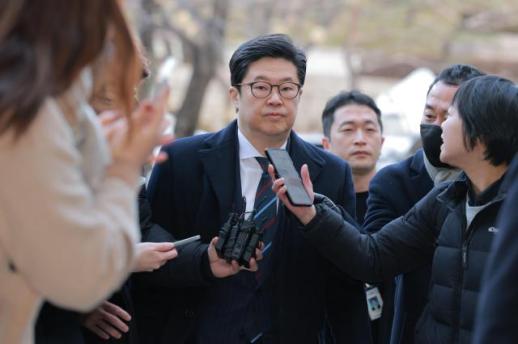 Japan Urges MBK to Halt Makino Machine Tool Deal, Citing National Security Private equity firm MBK Partners, which previously drew concerns in South Korea over potential leaks of national core technologies through overseas sales, has now been urged by the Japanese government to stop a planned acquisition on similar grounds. The move is expected to affect the outlook for the ongoing management control dispute at Korea Zinc involving MBK and Young Poong. According to the Nikkei newspaper on the 23rd, the Japanese government issued a recommendation to halt MBK’s plan to acquire Japanese machine tool maker Makino Milling Machine Co., citing the Foreign Exchange and Foreign Trade Act. Machine tools are considered dual-use goods that can be used for both civilian and military purposes and are designated a “core sector” under the law. Foreign investors must undergo prior government screening before acquiring shares. Japan said Makino’s machine tools are sensitive items with high potential military use and are widely used across defense equipment, including missiles and submarines, as reasons for the recommendation. A company receiving such a recommendation must decide within 10 days whether to accept it; if it refuses, the government can issue a stop order. Chief Cabinet Secretary Minoru Kihara said at a regular briefing that “it is true that a recommendation to halt the investment was issued as of the 22nd,” adding that it reflected the review panel’s judgment that there was a risk of developments that could harm national security. Japan’s sensitivity to technology leakage is often linked to the “Toshiba Machine COCOM violation” case from 40 years ago, in which a Japanese company illegally exported high-performance machine tools to the former Soviet Union, contributing to improvements in Soviet submarine technology. The decision also aligns with a broader global tightening of rules around strategic industries and materials, including defense, rare earths, critical minerals and mining. Major countries such as the United States and China have strengthened efforts to limit foreign influence in key technologies and strategic sectors on economic security grounds. The fact that MBK’s fund includes capital from China and the Middle East likely weighed on Japan’s assessment. Concerns over MBK’s overseas sales of core technologies have surfaced in South Korea before. In 2019, MBK pursued a sale of Doosan Machine Tools to China, but the deal was reported to have collapsed after opposition from the South Korean government over fears of leaking national core technologies, including design and manufacturing know-how for high-precision five-axis machining centers. Subsequent overseas sale attempts also failed, and the company was ultimately sold in 2021 to South Korean firm DTR Automotive. With Japan now also moving to block MBK’s acquisitions and sales, related controversy is expected to intensify in the Korea Zinc control fight. Korea Zinc is described as the country’s only company producing critical minerals based on national core technologies and advanced strategic technologies, and analysts say the identity of any acquirer could significantly affect supply-chain stability and key national industries. As the importance of Korea-U.S. supply-chain cooperation has grown following plans to build a smelter in Tennessee, U.S. political circles, as well as those in South Korea, are closely watching MBK’s bid to secure management control of Korea Zinc.* This article has been translated by AI. 2026-04-23 18:27:23
 -
 South Korea passes cornerstone investor rules to curb IPO sell-offs South Korea’s financial authorities are moving to address recurring post-IPO short-term selling and sharp price drops by overhauling rules aimed at making IPO pricing more rational and expanding medium- to long-term investment. The Financial Services Commission said April 23 that amendments to the Capital Markets and Financial Investment Services Act, including the introduction of a cornerstone investor system, passed the National Assembly plenary session the previous day. The amendments create a new cornerstone investor framework that allows a portion of IPO shares to be allocated in advance to institutional investors on the condition they agree to a lockup of at least six months. The goal is to secure long-term oriented institutions ahead of listing, reduce large sell orders immediately after trading begins and ease price volatility. The FSC said shares allocated to cornerstone investors will be adjusted from the institutional tranche and will not affect the retail allocation ratio of 25%, seeking to minimize fairness concerns. It said it will also reflect internal control standards in subordinate rules to prevent conflicts of interest. The amendments also introduce a pre-demand forecasting system, allowing underwriters to gauge institutional demand before filing a securities registration statement — a step that had been effectively unavailable due to legal concerns. The FSC said this should help underwriters reflect market demand from the early stage of setting an initial indicative price band, improving the reasonableness of IPO pricing. Authorities said the changes target a persistent “quick-flip” pattern in the IPO market, where money seeking short-term gains has crowded into offerings, prices have surged on the first trading day and then fallen amid continued selling. IPO prices have also often been driven more by supply and demand than by companies’ medium- to long-term value, undermining market confidence, the FSC said. The amendments are set to take effect six months after promulgation. The government said it will design detailed rules after collecting views from institutional and retail investors and underwriters. Financial authorities said, “By introducing the cornerstone investor system, we expect to secure stable medium- to long-term institutional investors in advance, enhance trust in IPOs, and improve the ‘IPO horror stories’ such as steep post-listing price drops,” adding that they will “swiftly push ahead with revisions to subordinate regulations by gathering feedback from market participants.”* This article has been translated by AI. 2026-04-23 18:21:16
 -
 NH Investment & Securities posts record quarterly profit as net income jumps 128.5% NH Investment & Securities said in a regulatory filing on the 23rd that its first-quarter operating profit rose 120.3% from a year earlier to 636.7 billion won. Net income climbed 128.5% to 475.7 billion won, the company’s highest quarterly result on record. Annualized return on equity was 19.6%. Brokerage and financial products led the gains. Brokerage benefited from a surge in trading on South Korea’s stock market. First-quarter brokerage commission revenue jumped 57.4% from the previous quarter to 349.5 billion won. Domestic stock entrusted assets totaled 316 trillion won and contract value reached 850 trillion won, up 17.6% and 91.4%, respectively, from the prior quarter. Market share rose 0.5 percentage point to 10.7%, the company said, citing a jump in average daily trading value for domestic stocks to 66.8 trillion won, up 80.5% from the previous quarter. Fees from selling financial products rose 87.7% to 49.1 billion won as sales of investment products such as wrap accounts and funds increased. Total financial product assets were 173 trillion won, unchanged from the previous quarter. The number of high-net-worth clients rose to 358,000 with at least 100 million won and 24,000 with at least 1 billion won, up 15.2% and 13.6%. In investment banking, quarterly fee revenue was 97.2 billion won. The firm kept the top spot in equity capital markets underwriting with a 30.9% share and ranked first in IPO underwriting with a 37.4% share. It also maintained an industry-leading 32.0% share as lead manager for credit card and other specialty finance bonds, it said, and completed large deals including IPOs for K Bank and Inventera and refinancing for a collateralized loan tied to the Seoul International Finance Center, or SIFC. In the investment management business, investment gains and related net interest income rose 21.5% from the previous quarter to 424.2 billion won. The company reported 243.0 billion won in investment gains and 181.2 billion won in related net interest income, citing strategic asset allocation despite rising interest rates. Net interest income tied to wealth management rose 8.1% to 127.4 billion won on higher average customer deposits and average securities lending balances. Chief Executive Officer Yoon Byeong-woon said the record quarter reflected broad-based growth across the company. “We will foster IMA as a new core growth engine, while working to ensure the capital market can contribute to real-economy growth through productive finance,” Yoon said. He added that the company would strengthen enterprise-wide risk management amid uncertainty, including Middle East-driven geopolitical risks and greater volatility in interest rates and exchange rates, and “establish ourselves as a securities firm trusted by both shareholders and customers.”* This article has been translated by AI. 2026-04-23 18:19:42
 -
 Democratic Party Names Song Young-gil, Kim Nam-jun as Incheon Strategic Candidates The Democratic Party said it will make strategic nominations in Incheon for the by-elections being held alongside the June 3 local elections, naming Song Young-gil for Yeonsu A and Kim Nam-jun for Gyeyang B. The party’s Strategic Nomination Management Committee made the decision at a meeting held Thursday afternoon at the National Assembly. Senior spokesperson Kang Jun-hyeon told reporters after the meeting, “The committee decided to strategically nominate former party leader Song Young-gil in Incheon’s Yeonsu A and former presidential office spokesperson Kim Nam-jun in Gyeyang B.” Kang underscored the importance of Yeonsu A, calling it “a difficult district for our party and a core strategic area we must defend.” He said Song was placed there strategically, citing his political weight as “a valuable asset” who has served as a five-term lawmaker, Incheon mayor and party leader. Kang added that Song “had to endure an unjust sacrifice due to excessive targeted investigations by the Yoon Suk Yeol prosecution government,” but left the party temporarily, proved his innocence and returned. “We judged him to be the most competitive candidate in Yeonsu A,” Kang said. On Kim, Kang said he “deeply understands President Lee Jae-myung’s governing philosophy,” and has strong knowledge of the district after assisting Lee since Lee’s time as a lawmaker for Gyeyang B. Kang also cited Kim’s communication skills as a former journalist and spokesperson. Kang said Kim is a candidate who can “accurately grasp the president’s intentions” and address local issues quickly, calling him the right person to help the district move forward and to advance the party’s goals of winning the local elections and ensuring the success of the Lee Jae-myung government. The party also explained why it did not select former Incheon Mayor Park Nam-chun, who had sought the Yeonsu A nomination. Secretary-General Cho Seung-rae said Park is “a valuable asset” and “a regrettable loss” from the party’s perspective, but said that after considering the overall situation, the party concluded Song was the more appropriate choice. Cho said the committee plans to meet nearly every day to wrap up strategic nominations quickly. “We have to finish by the first week of May,” he said, adding that the party will narrow down the remaining districts through frequent meetings.* This article has been translated by AI. 2026-04-23 18:18:51
 -
 Kakao Pay Securities Says Client Deposits Top 15 Trillion Won, Up 31% YTD Kakao Pay Securities said on April 23 that its client deposit assets topped 15 trillion won as of April 17, up 31.2% from the start of the year. The company cited strong inflows. Net inflows in the first quarter totaled 3.668 trillion won. Growth was led by Korean stocks: related assets rose 94% to 6.5323 trillion won from the point when they first exceeded 10 trillion won. The share of Korean stocks in total deposits increased to 44.2% as of April from 33.6% over the same period. Tax-advantaged accounts also helped lift deposits. Pension savings assets rose 58% from January, and assets in individual savings accounts, or ISAs, launched in November last year, grew about fourfold over the same period. The combined share of pension savings and ISAs in total deposits increased to 7.6% from 5.5%. The user base also expanded. Monthly active users rose to 4.02 million in March from 3.65 million in January. Kakao Pay Securities said it plans to upgrade its portfolio so users can meet a range of investment needs on one platform, including pension savings, ISAs and RIA accounts, which it described as accounts for returning to the domestic market. CEO Shin Ho-cheol said the company aims to reach 20 trillion won in client deposit assets within this year, adding it will continue to strengthen investment experiences and product competitiveness tailored to users’ asset-building stages.* This article has been translated by AI. 2026-04-23 18:16:20
 -
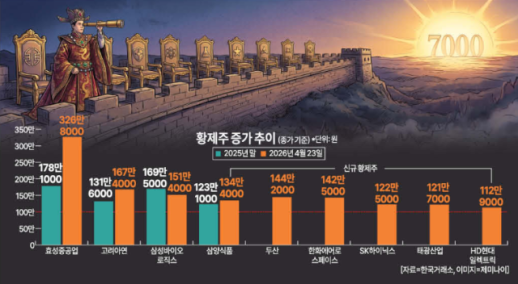 Korea’s ‘Million-Won’ Stocks Jump to 9 as KOSPI Rally Lifts High-Priced Shares A new era of so-called “million-won stocks” is taking shape in South Korea as a market rally pushes more shares above 1 million won. In less than five months, the number of such stocks has grown to nine from four, and the pipeline of potential newcomers is also expanding. The Korea Exchange said the KOSPI closed Thursday up 57.88 points, or 0.90%, at 6,475.81, extending its run of three straight record closes. The index briefly topped 6,500 in intraday trading. The gains came despite external uncertainty over stalled ceasefire talks between the United States and Iran, as buying concentrated in sectors seen as beneficiaries of the postwar environment, including semiconductors and defense. As the rally accelerated, more stocks joined the million-won club based on closing prices: Hyosung Heavy Industries (3,268,000 won), Korea Zinc (1,674,000), Samsung Biologics (1,514,000), Doosan (1,442,000), Hanwha Aerospace (1,425,000), Samyang Foods (1,344,000), SK hynix (1,225,000), Taekwang Industrial (1,217,000) and HD Hyundai Electric (1,129,000). The count has more than doubled from four at the end of last year. A day earlier, LIG Defense & Aerospace closed at 1.02 million won, putting it on the verge of becoming the 10th member. Hyosung Heavy Industries has been at the center of the surge. Its share price, 1,781,000 won at the end of last year, climbed to a closing 3,058,000 won on April 13, breaking above 3 million won. It is now the highest-priced stock among listed Korean companies. A close above 3 million won was the first in 11 years since Amorepacific and the third such case on record. Brokerages have raised targets accordingly, with Yuanta Securities setting a target price of 4.2 million won. Targets for other high-priced stocks have also been moving higher. Shinhan Investment raised its target for Korea Zinc to 1.9 million won, forecasting further gains. Hana Securities lifted its target for LIG Defense & Aerospace by 56.3% to 1.11 million won. Hana said expectations for exports of the Cheongung-II air defense system could persist because shortages of Patriot interceptor missiles continue and rapid production increases are difficult in the short term. The next tier is also growing. Nine stocks closed above 500,000 won, including Samsung Electro-Mechanics (774,000 won), SK Square (728,000), HD Hyundai Heavy Industries (641,000) and Samsung SDI (630,000). Still, some in the market are wary of what is sometimes called the “million-won stock curse.” Past cases show that after reaching the milestone, some stocks have faced pullbacks as liquidity thins and valuations look stretched. An industry official said, “Whether they settle in at these levels will ultimately be decided by earnings and the order pipeline.”* This article has been translated by AI. 2026-04-23 18:15:19
 -
 South Korea Says Lee’s Vietnam Trip Deepens Energy, Infrastructure Cooperation The presidential office said Thursday (local time) that President Lee Jae-myung’s state visit to Vietnam produced agreement to upgrade cooperation in areas including infrastructure and energy. National Security Adviser Wi Sung-lac said at a briefing at a press center in Hanoi that Lee and To Lam, Vietnam’s Communist Party general secretary and state president, shared the view at their summit the previous day that the two countries are each other’s most reliable partners in driving development. Wi said the trip expanded exchanges into future-oriented areas and helped raise the quality of bilateral cooperation. To Lam was reported to have welcomed participation by South Korean companies in Vietnam’s energy transition, including nuclear power plant construction. Asked about specific projects such as the Ninh Thuan nuclear power plant project in central Vietnam, Wi said discussions remain at an early stage and both sides are reviewing feasibility and risks. Doosan Enerbility was reported to have signed an MOU with two Vietnamese state-owned companies to cooperate on nuclear power projects. The leaders also discussed supply chains for critical minerals. Wi noted Vietnam ranks fifth to sixth globally in rare earth reserves and said the two sides would broaden cooperation through efforts such as a “Korea-Vietnam Critical Minerals Supply Chain Technology Cooperation Center.” On defense industry cooperation, Wi said there were no “overwhelming” results, but the two sides agreed to explore expanding technology cooperation, joint production and joint development. Wi said the leaders also exchanged views on international affairs, including the Iran war. He said both sides recognized that supply chains have faced disruptions and that Vietnam is also experiencing difficulties related to oil, adding that the two countries would pursue ways to support each other on such issues. Wi said the leaders agreed to strengthen joint efforts for peace and prosperity in the international community and shared the view that peaceful coexistence on the Korean Peninsula serves the common interest of the international community. 2026-04-23 18:13:00