
Journalist

Lee Hugh
=
-
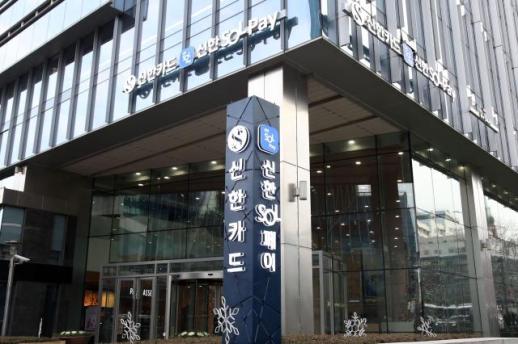 Shinhan Card Says 2,600 Merchant Records Confirmed as Credit Data Leak in 2025 Breach Shinhan Card said Wednesday that a financial regulator’s investigation found about 2,600 cases within a merchant data breach disclosed in December 2025 also involved leaked credit information. In a notice posted on its website, the company said the findings relate to a personal data leak that occurred on Dec. 23, 2025, and that the regulator confirmed additional exposure of credit information. Shinhan Card said it cannot individually notify 52 of the roughly 2,600 affected cases because the data subjects cannot be identified, and it is issuing the public notice for that reason. The company said it took steps to block further leakage as soon as it became aware of the incident in December and completed a review of related internal processes. It emphasized that no separate leak has occurred since that time. Shinhan Card previously reported that the December incident involved 192,088 leaked records tied to merchants. It said the latest review confirmed that about 2,600 of those cases qualify as leaks of personal credit information. The company again apologized for the leak of personal credit information and said it will work to ensure customers can use Shinhan Card services with confidence. 2026-04-23 18:00:16
 -
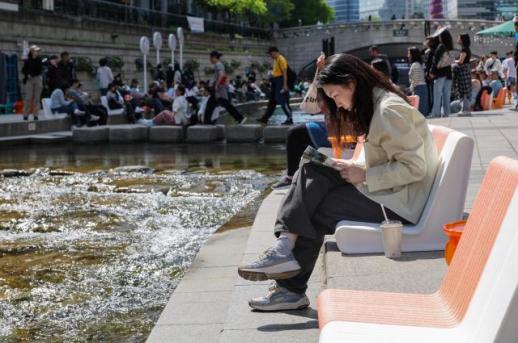 Text-hispters indulge in reading trend in Seoul SEOUL, April 23 (AJP) - In an era dominated by short videos and rapidly consumed content, young people in South Korea are turning back to books and written text. Reading books, copying favorite passages by hand, and visiting bookstores and libraries have become part of a growing lifestyle trend known as “text-hip,” where reading is seen not as an act of studying or self-improvement, but as a way to express personal taste and emotion. April 23 marks World Book and Copyright Day, established by UNESCO in 1995 to promote reading, publishing, and the protection of intellectual property rights. The day is observed around the world through book-related events and campaigns. The trend is visible across central Seoul, where the city government is operating outdoor reading spaces including Gwanghwamun Book Yard, Reading Seoul Plaza, and Reading Clear Stream. The program transforms plazas, streamsides, and other open urban areas into public libraries with bookshelves, beanbags, and lounge areas where visitors can read freely. This year, the city has also introduced walking tours for foreign tourists and a “Travel Library” featuring participation from 14 countries. Scenes at the outdoor libraries differ from traditional quiet reading rooms. Visitors read with drinks beside them, share books with friends, or photograph memorable lines to post online. At sunset in Gwanghwamun Square, reading spaces host concerts and film screenings, turning reading into a leisure activity. The reading boom has also expanded into tourism. At HiKR Ground, a cultural space located in the eastern hipster district of Seongsu, a recent exhibition titled “Text-Hip x Local Travel” introduced 109 regional typefaces from across the country. The exhibition invited visitors to read, write, and experience fonts inspired by local identity, including seaside-themed lettering from Sokcho and typefaces reflecting the landscape of Andong. Programs included handwriting sessions, postcard making, and Korean-language tattoo experiences. The shift reflects changing travel preferences. While tourism once focused on famous landmarks and food, younger travelers increasingly seek local stories, design, and atmosphere. Experts say the trend is also linked to digital fatigue. In a world of endless scrolling, turning paper pages and writing by hand offers a slower form of concentration and rest. Books were once seen as something to enjoy quietly alone. But in Seoul today, they are bringing people together, reshaping urban spaces, and inspiring new journeys. On World Book Day, young readers and tourists alike are experiencing the city through words once again. 2026-04-23 17:58:09
 -
 Court Jails Driver Accused in Union Protest Death, Member Accused of Ramming Police Barricade A court has ordered the detention of a truck driver accused of running over and killing a union member at a Cargo Truckers Union rally and a union member accused of injuring a police officer by driving into a barricade. Legal officials said the Changwon District Court’s Jinju branch on the 23rd issued arrest warrants for a truck driver in his 40s, identified only as A, on suspicion of murder and other charges, and for a union member in his 60s, identified only as B, on suspicion of obstructing official duties with a dangerous weapon and other charges. The judge cited concerns they could flee or destroy evidence. Arriving at court for their warrant hearings, A responded to reporters’ questions — including whether the act was intentional and whether he had anything to say to the victim — by saying only, “I’m sorry,” before entering the building. B also repeatedly said, “I’m sorry,” to reporters. The incidents occurred on the 20th outside the CU Jinju logistics center in Jeongchon-myeon, Jinju, South Gyeongsang Province, where the Cargo Truckers Union held a rally urging BGF Logis, CU’s headquarters, to normalize operations. Authorities said A drove his truck toward union members. As members in front of the vehicle banged on it and demanded that he stop, A continued driving, running over them. Two members were seriously injured and one died. On the same day, officials said B drove a van into a police barricade set up at the logistics center’s main gate, and an officer stationed in front of it was struck and injured. A union member in his 50s, identified only as C, was detained the previous day after allegedly threatening police with a weapon. With the latest warrants, three people have now been detained in connection with the rally. Despite the casualties, union members have continued demonstrating near the CU logistics center in Jinju, marching in the area and chanting while demanding an apology from the company and a thorough investigation. Police have deployed riot units and are monitoring the scene to prevent further injuries, officials said.* This article has been translated by AI. 2026-04-23 17:54:18
 -
 South Korea to Check Crypto, Financial Assets in Debt Relief Reviews to Curb Abuse The South Korean government has secured a legal basis to let debt workout agencies review a debtor’s virtual assets, along with other financial holdings, during screening for debt relief programs. Officials said the goal is to curb moral hazard and focus support on people who genuinely need help. The Financial Services Commission said Thursday that a revision to the Credit Information Use and Protection Act passed the National Assembly’s plenary session the same day. The key change allows debt restructuring bodies to verify a debtor’s holdings of deposits, savings products and securities, as well as virtual assets, when assessing repayment capacity. Reviews previously relied mainly on real estate and tax information, which critics said left room for hiding assets. Under the revision, the agencies may obtain necessary financial and property information without a debtor’s prior consent, within a limited scope. Debtors must be notified individually that their information was provided and will be able to check the inquiry. The measure applies to government debt restructuring programs such as the Sae Do-yak Fund and the Sae Chulbal Fund. These entities buy the claims of long-term delinquent borrowers and provide support such as debt write-offs or reductions in principal and interest. The FSC said the change will make repayment-capacity reviews more precise, basing decisions on actual ability to repay rather than debt size alone, and easing fairness concerns for borrowers who repay in good faith. It also said the revision will allow full-scale debt adjustment procedures for cases among the Sae Do-yak Fund’s holdings that require repayment-capacity screening, which is expected to speed support for long-term delinquent borrowers seeking to get back on their feet. The revision is set to take effect three months after promulgation. The FSC said it will also update related subordinate regulations, including enforcement decrees.* This article has been translated by AI. 2026-04-23 17:51:20
 -
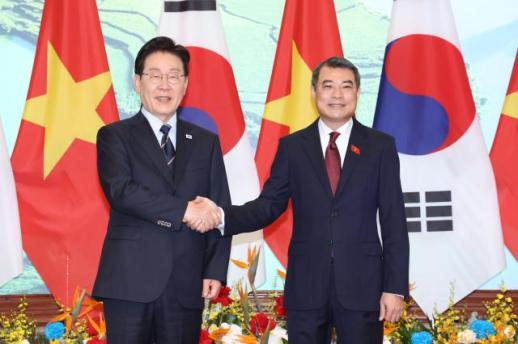 South Korea’s Lee Meets Vietnam’s Prime Minister, National Assembly Speaker on Cooperation South Korean President Lee Jae-myung met Thursday (local time) with Vietnamese Prime Minister Le Minh Hung and National Assembly Speaker Tran Thanh Man, the country’s No. 2 and No. 3 leaders, to discuss ways to strengthen bilateral cooperation. The meetings followed Lee’s talks the previous day with To Lam, Vietnam’s top leader, the Communist Party general secretary and state president, completing two days of meetings with the country’s newly formed leadership. At the prime minister’s office in Hanoi, Lee asked for support to expand strategic cooperation in areas he described as new growth engines for economic development, including nuclear power, transportation infrastructure and energy, saying the two countries could build a new “Red River miracle” together. Lee said he believed the prime minister would provide strong support so South Korean companies could invest with confidence, and expressed hope the talks would further deepen economic cooperation in line with the countries’ close partnership and lead to shared prosperity. Hung said Vietnam is focused on carrying out strategic tasks to achieve rapid and sustainable national development. He said Vietnam aims to become a high-income developing country with modern industry by 2030 and a high-income advanced country by 2045. Hung also formally invited Prime Minister Kim Min-seok to visit Vietnam. Lee later met Tran at the National Assembly building and said he hoped exchanges between the two legislatures would expand so bilateral cooperation could be supported institutionally. He asked for the Vietnamese National Assembly’s active role in ensuring ties continue to develop steadily. Lee said South Korea and Vietnam have built an unusually fast-growing, mutually beneficial partnership based on trade, investment and active people-to-people exchanges. He said bilateral trade has increased 190-fold and people-to-people exchanges 2,400-fold compared with the time the two countries established diplomatic relations in 1992. Lee said the two countries are among each other’s top three trading partners and that South Korea is Vietnam’s largest source of foreign investment, adding that consistent support from the Vietnamese National Assembly helped make those results possible. Tran said Lee’s trip was his first visit to Vietnam since taking office and a state visit taking place after Vietnam’s 16th National Assembly was newly formed, reflecting Vietnam’s special emphasis on relations with South Korea.* This article has been translated by AI. 2026-04-23 17:49:35
 -
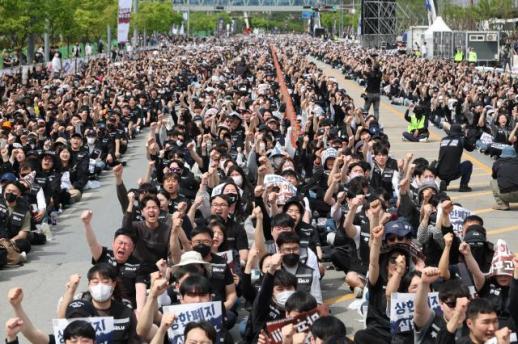 Korea's chip irony: record Samsung Elec shares and mass workers rally PYEONGTAEK, April 23 (AJP) -On the same day the KOSPI scaled a record high and South Korea posted its strongest quarterly growth in five years, tens of thousands of workers at the very heart of that boom took to the streets — protesting what they called a widening gap between record profits and compensation. “Even at this very moment, our colleagues are leaving,” shouted Thursday Woo Ha-kyung, acting head of the National Samsung Electronics Union, her voice hoarse as it carried across a sea of nearly 40,000 workers. The setting itself underscored the contradiction. Sprawling across a site roughly the size of Yeouido and employing around 60,000 workers, the campus is a monument to South Korea’s semiconductor supremacy — the very engine powering the country’s headline growth. Yet on this day, it became a stage for discontent. Workers arrived in waves, many clad in black vests, some traveling hours by bus, others taking leave to join what is fast becoming the largest show of labor force in Samsung’s history. “I took a day off to be here. I keep asking myself how we got to this point,” one union official said quietly. The rally, though limited to two hours, carried the unmistakable weight of escalation. A full general strike — scheduled from May 21 to June 7 — now looms, threatening only the second walkout since the company’s founding. At stake is not just pay, but the distribution of one of the most lucrative earnings cycles in corporate history. The union is demanding that 15 percent of annual operating profit be returned to workers as bonuses and that caps on performance pay be scrapped — a structure they argue better reflects the industry’s boom-bust reality. Management has drawn a firm line, insisting such demands are legally indefensible and financially destabilizing, warning that dismantling bonus limits could erode funds for research and future investment. The clash is unfolding against a backdrop of extraordinary profits. Samsung Electronics posted 57 trillion won in operating profit in the first quarter alone, with projections pointing to roughly 300 trillion won for the year — the bulk driven by its semiconductor division. To union leaders, the disparity is glaring. “Chairman Lee Jae-yong’s stock value has surged by tens of trillions, executives are taking home massive bonuses — yet for workers it’s ‘no performance, no reward,’” Woo said. “A standard that somehow stops at the executive floor.” The rally’s most arresting moment came when Choi Seung-ho, head of the enterprise-wide union’s Samsung Electronics branch, rose above the crowd — literally — delivering his speech from a crane lift suspended high in the air. “We are here because we can no longer endure this,” he declared, denouncing what he called an opaque and unequal compensation system. Below him, the scale of the gathering briefly overwhelmed the surrounding infrastructure. Workers queued for up to 30 minutes just to cross a single 100-meter intersection leading into the campus, moving in slow, disciplined lines under heavy police presence. Tensions flickered at the edges — a minor scuffle broke out when a livestreamer pushed through the crowd — but the union largely maintained order under a strict “no-response” directive. Elsewhere, a small group of shareholders staged a counter-protest, voicing unease over demands that could eclipse returns to the company’s 4.6 million investors. The economic stakes are substantial. Union estimates suggest an 18-day strike could inflict losses of 20 trillion to 30 trillion won — roughly 1 trillion won per day — once production disruptions and equipment downtime are factored in. The timing is especially fraught. With global uncertainty rising amid Middle East tensions and supply chain disruptions, semiconductors have become even more critical to South Korea’s economic resilience. Even as chants of “Transparently change!” reverberated across Pyeongtaek, Samsung Electronics shares closed at a record 224,500 won — a stark reminder of the widening gulf between financial markets and the factory floor. 2026-04-23 17:48:55
 -
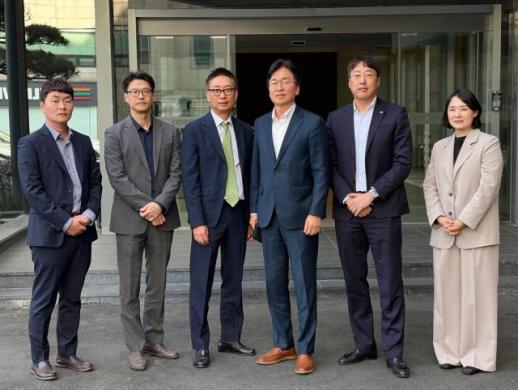 Korea Pharmaceutical and Bio-Pharma Association Names Moon Jong-hoon PR Committee Chair The Public Relations Committee under the Korea Pharmaceutical and Bio-Pharma Association held its regular general meeting on April 22 at the association’s office in Bangbae-dong, Seocho-gu, Seoul, and completed the election of a new chair and the formation of its executive team, the association said April 23. The committee is a consultative body of public relations and external communications professionals from pharmaceutical and biotechnology companies. Moon Jong-hoon, a director at Chong Kun Dang, was elected chair. Park Jae-hyeon, an executive director at Jeil Pharmaceutical, and Yoo Jeong-jae, a head at JW Pharmaceutical, were chosen as vice chairs. The secretariat will be led by Lee Jeong-seok, a director at SillaJen, and Jeon Ha-na, a team leader at Hugel. Jeong Chan-ung, deputy head of the association, will serve as both secretary-general and auditor. The chair and other executive members will serve two-year terms. The meeting also approved the 2025 financial settlement and the 2026 business plan as originally proposed. Moon said he felt a “heavy sense of responsibility” in taking the post at what he called an important turning point for the pharmaceutical and biotechnology industry, and pledged to strengthen communication among member companies and expand information exchanges between the association and the media.* This article has been translated by AI. 2026-04-23 17:48:16
 -
 South Korea to Auction 19 Trillion Won in Treasury Bonds in May; 1.1 Trillion Won FX Stabilization Bonds The Ministry of Economy and Finance said it will issue 19 trillion won in Korean Treasury bonds next month through competitive auctions with primary dealers participating, citing improved market conditions including inflows tied to the World Government Bond Index. The amount is up 1 trillion won from the previous month. The ministry said Thursday the issuance by maturity will be: 3 trillion won in 2-year notes; 3.1 trillion won in 3-year notes; 3.2 trillion won each in 5-year and 10-year notes; 600 billion won in 20-year bonds; 5 trillion won in 30-year bonds; 800 billion won in 50-year bonds; and 100 billion won in inflation-linked Treasury bonds. Primary dealers and the general public may subscribe to a set amount on a noncompetitive basis at the auction’s awarded yield for each maturity. The ministry said it will separately announce whether it will conduct noncompetitive subscriptions through a subscription-based method in May, depending on market conditions. To support liquidity in the Treasury market, the ministry said it plans a 500 billion won switch operation between off-the-run 10-year, 20-year and 30-year issues and the 30-year benchmark issue. To cover temporary funding shortfalls caused by timing mismatches between revenue and spending within the fiscal year, the ministry said it will also issue 10 trillion won of 63-day fiscal securities in May. It said fiscal securities — short-term government debt that must be repaid within the fiscal year — and temporary borrowing from the Bank of Korea are used within a National Assembly-approved ceiling of 40 trillion won. The fiscal securities auctions will be open to 32 institutions, including Monetary Stabilization Bond auction participants, Treasury primary dealers, preliminary primary dealers and government cash management institutions, the ministry said. As of Thursday, the outstanding balance of fiscal securities was 22.5 trillion won, and temporary borrowing from the Bank of Korea stood at 5.3 trillion won, the ministry said. On an average outstanding basis for this year, the figures were 9.9 trillion won and 1.3 trillion won, respectively. The ministry also said it will issue 1.1 trillion won of one-year, won-denominated foreign exchange stabilization bonds in May through competitive auctions, up 300 billion won from the previous month. A total of 31 institutions, including primary dealers, preliminary primary dealers and eligible Monetary Stabilization Bond auction institutions, will participate, it said. * This article has been translated by AI. 2026-04-23 17:39:07
 -
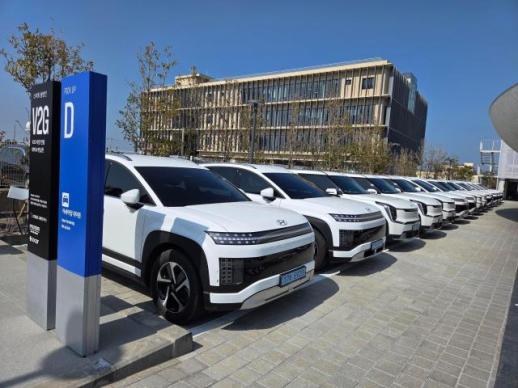 Tariffs and rising costs bite Hyundai despite record quarterly revenue SEOUL, April 23 (AJP) - Despite posting record revenue, Hyundai Motor saw its profitability come under intense pressure as tariffs and rising costs eroded margins. Revenue rose 3.4 percent year on year to 45.9 trillion won, marking the highest first-quarter figure on record. The increase was supported by strong sales of high-margin SUVs and hybrid vehicles, even as global industry demand contracted 7.2 percent. Hybrid vehicles accounted for 17.8 percent of total sales, with the U.S. market reaching a record 24.8 percent. This helped the company expand global market share despite weakening demand. Operating profit, however, fell 30.8 percent to 2.51 trillion won, with the operating margin narrowing to 5.5 percent from 8.2 percent a year earlier. The result came in at the lower end of market expectations, with estimates compiled by FnGuide pointing to operating profit in the range of 2.4 trillion to 2.6 trillion won. A breakdown of earnings drivers showed that tariff-related costs were the single largest drag on profitability, reducing operating profit by 860 billion won. Lower volumes cut earnings by 247 billion won, while a weaker product mix — driven by higher incentive spending — reduced profit by a further 337 billion won. The earnings pressure came despite relatively resilient sales. Wholesale volumes declined to 976,000 units from 1.0 million a year earlier, reflecting weaker industry demand and temporary disruptions, including supply chain issues and geopolitical uncertainty. Cost pressures were also evident in the company's structure, with the cost of sales rising to 82.5 percent of revenue, up 2.7 percentage points from a year earlier, driven largely by higher raw material prices. The automaker said raw material costs - including nickel, lithium and precious metals — added more than 200 billion won in additional expenses in the first quarter and are expected to remain elevated into the second quarter, even as some prices begin to stabilize. It also acknowledged production disruptions following a fire at a key engine valve supplier, though it expects to normalize output from April and recover lost production in the second half through global production adjustments. Regional dynamics also weighed on profitability. Incentive spending remained elevated in Europe amid tightening emissions regulations, while India emerged as a rare bright spot, with record sales and minimal incentive burden. Despite pressure in its core automotive business, Hyundai's financial arm delivered stable earnings growth supported by asset expansion, partially offsetting the decline in vehicle operations. Looking ahead, the company said it is accelerating autonomous driving development through collaboration with Nvidia to secure data and enhance competitiveness. It is also shifting its China strategy toward export-driven growth, with exports already accounting for around 40 percent of local sales. Shares of Hyundai Motor closed at 532,000 won, down 1.7 percent on the day. 2026-04-23 17:38:43
 -
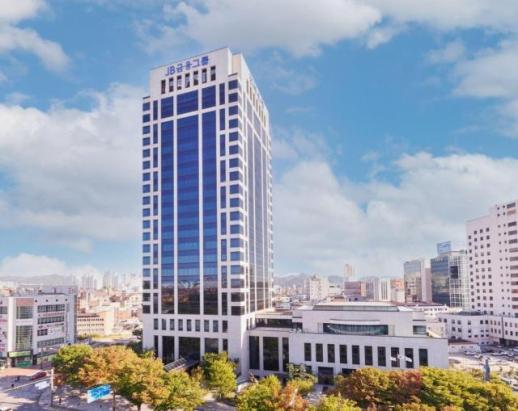 JB Financial Posts Q1 Net Profit of 166.1 Billion Won, Lifted by JB Woori Capital JB Financial Group said in a regulatory filing on the 23rd that it posted first-quarter net profit of 166.1 billion won, up 2.1% from a year earlier. The group reported a return on equity attributable to controlling shareholders of 11.2% and a return on assets of 0.94%. Its preliminary common equity Tier 1 ratio stood at 12.61%, up 0.03 percentage points from the end of last year. By affiliate, JB Woori Capital led results with net profit of 72.7 billion won, a 24.3% increase from a year earlier. Banking units Jeonbuk Bank and Gwangju Bank posted net profit of 39.9 billion won and 61.1 billion won, respectively, weighed down by higher selling, general and administrative expenses tied to special retirement programs and losses from securities valuation. JB Asset Management and JB Investment reported net profit of 1.1 billion won and 3.0 billion won, respectively. The group’s second-tier subsidiary Phnom Penh Commercial Bank in Cambodia posted net profit of 12.4 billion won, up 21%. JB Financial also said its board approved a quarterly cash dividend of 311 won per common share, about double the 160 won paid for the first quarter of last year.* This article has been translated by AI. 2026-04-23 17:36:06