

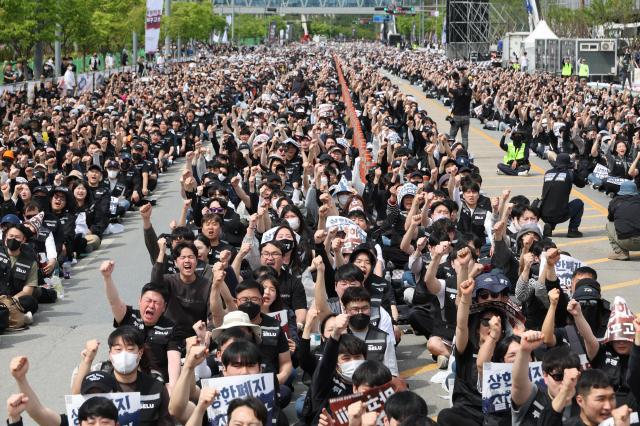
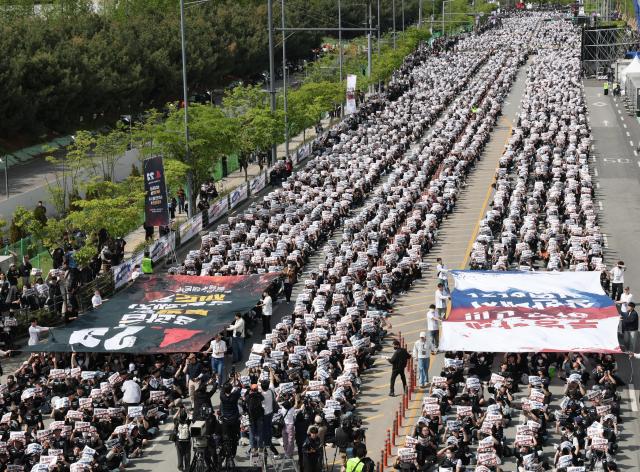
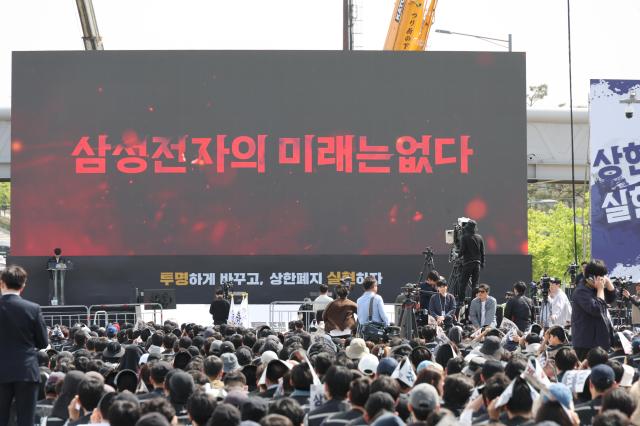
“Even at this very moment, our colleagues are leaving,” shouted Thursday Woo Ha-kyung, acting head of the National Samsung Electronics Union, her voice hoarse as it carried across a sea of nearly 40,000 workers.
The setting itself underscored the contradiction. Sprawling across a site roughly the size of Yeouido and employing around 60,000 workers, the campus is a monument to South Korea’s semiconductor supremacy — the very engine powering the country’s headline growth.
Yet on this day, it became a stage for discontent.
“I took a day off to be here. I keep asking myself how we got to this point,” one union official said quietly.
The rally, though limited to two hours, carried the unmistakable weight of escalation. A full general strike — scheduled from May 21 to June 7 — now looms, threatening only the second walkout since the company’s founding.
At stake is not just pay, but the distribution of one of the most lucrative earnings cycles in corporate history.
Management has drawn a firm line, insisting such demands are legally indefensible and financially destabilizing, warning that dismantling bonus limits could erode funds for research and future investment.
The clash is unfolding against a backdrop of extraordinary profits. Samsung Electronics posted 57 trillion won in operating profit in the first quarter alone, with projections pointing to roughly 300 trillion won for the year — the bulk driven by its semiconductor division.
To union leaders, the disparity is glaring.
“Chairman Lee Jae-yong’s stock value has surged by tens of trillions, executives are taking home massive bonuses — yet for workers it’s ‘no performance, no reward,’” Woo said. “A standard that somehow stops at the executive floor.”
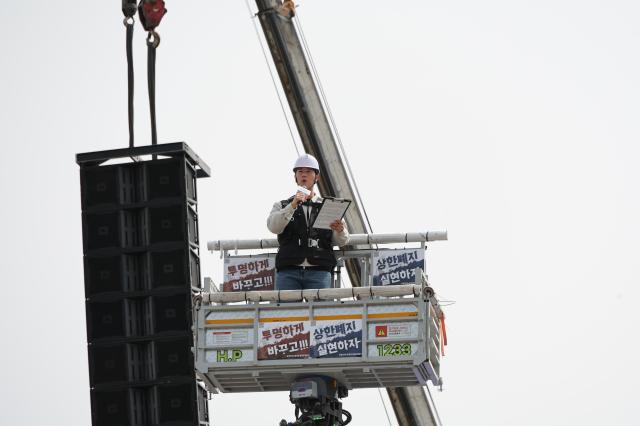
The rally’s most arresting moment came when Choi Seung-ho, head of the enterprise-wide union’s Samsung Electronics branch, rose above the crowd — literally — delivering his speech from a crane lift suspended high in the air.
“We are here because we can no longer endure this,” he declared, denouncing what he called an opaque and unequal compensation system.
Below him, the scale of the gathering briefly overwhelmed the surrounding infrastructure. Workers queued for up to 30 minutes just to cross a single 100-meter intersection leading into the campus, moving in slow, disciplined lines under heavy police presence.
Tensions flickered at the edges — a minor scuffle broke out when a livestreamer pushed through the crowd — but the union largely maintained order under a strict “no-response” directive.
Elsewhere, a small group of shareholders staged a counter-protest, voicing unease over demands that could eclipse returns to the company’s 4.6 million investors.
Union estimates suggest an 18-day strike could inflict losses of 20 trillion to 30 trillion won — roughly 1 trillion won per day — once production disruptions and equipment downtime are factored in.
The timing is especially fraught. With global uncertainty rising amid Middle East tensions and supply chain disruptions, semiconductors have become even more critical to South Korea’s economic resilience.
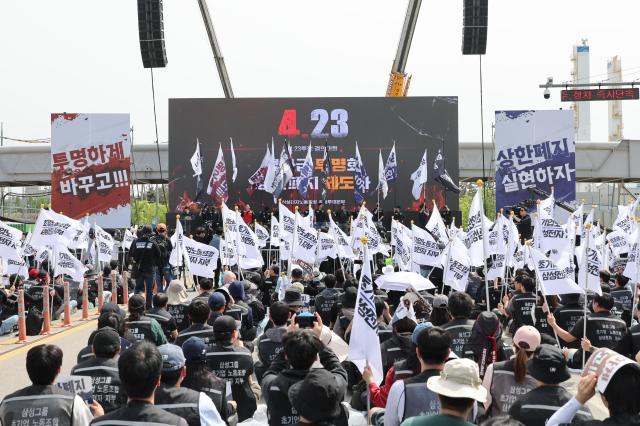
Even as chants of “Transparently change!” reverberated across Pyeongtaek, Samsung Electronics shares closed at a record 224,500 won — a stark reminder of the widening gulf between financial markets and the factory floor.

Copyright ⓒ Aju Press All rights reserved.
