
Journalist

Lee Hugh
=
-
 Amara Raja to Double Telecom Lithium Storage Deployments in India to 2 GWh by 2026 Amara Raja Energy & Mobility Ltd., a major Indian maker of industrial and automotive batteries, said on April 21 it plans to double cumulative deployments of lithium energy storage systems in the telecommunications sector to 2 gigawatt-hours by the end of 2026. The company said cumulative installations have already exceeded 1 gigawatt-hour, with systems deployed at 50,000 telecom sites nationwide as India’s energy transition accelerates. In a statement, the company said energy storage is becoming “core infrastructure” for India’s shift in energy use. Amara Raja said demand for high-performance storage products is rising domestically as fifth-generation, or 5G, mobile networks and data centers expand, and it is aiming to reach the 2 gigawatt-hour target by late 2026. It identified data centers and broader industrial uses as its next growth areas.* This article has been translated by AI. 2026-04-23 15:46:01
 -
 Defense Minister Ahn Kyu-back touts military reading program tied to national campaign The Ministry of National Defense said on the 23rd it will launch a barracks reading initiative called the “One Gun, One Book (a gun in one hand, a book in the other)” project, linked to the nationwide “2026 Reading Korea Campaign.” The phrase combines “gun,” symbolizing the military’s core mission, with “book,” representing knowledge, culture and preparation for the future. The ministry said the goal is to help about 205,000 young people who enlist each year use their service not only to fulfill national defense duties but also to grow through reading. Defense Minister Ahn Kyu-back said service members will be supported so they can “explore their dreams and career paths through intense and steady reading” and turn their time in uniform into “a period of intellectual growth to plan for the future,” rather than a pause in life. Starting in the second half of this year, the ministry will encourage new recruits to bring one book when they enter basic training — either a personal “life book” or a “tomorrow book” they want to read — to help spark motivation. It also plans to offer reading coaching by professional instructors and provide rewards, including one day of leave, for writing book reports to create a sense of achievement. The ministry has also been running a tailored e-book support program since February, providing 128,000 won for book purchases over a service member’s full term of service. Ahn also plans to lead reading lectures for commanders and add reading-coaching instruction to command and management courses for midlevel and senior officers, the ministry said, aiming to have commanders drive a reading culture in units. “Because even what is not in books can come through people in a deeply felt way, reading is the best way to awaken a commander’s spirit and gain major insight,” Ahn said. He added that classics “wake up a sleeping brain,” while bestsellers can leave a deep impression, and said the two should be read in balance for their meaning to be fully absorbed. * This article has been translated by AI. 2026-04-23 15:45:15
 -
 Director Maggie Kang Signs Exclusive Deal With The Present Company, Expands Korea Work Maggie Kang has signed an exclusive contract with The Present Company. The Present Company said on 23 that it plans to develop a range of projects with Kang based in South Korea and that it expects strong synergy with a director known for creativity and a global sensibility. The company added that Kang is a symbolic figure who has demonstrated the global potential of Korean content and will continue that work as a creator representing South Korea. Kang, a Korean Canadian director born in South Korea and raised in Canada, began her career as a story artist at global studios. She later drew worldwide attention directing Netflix’s “K-Pop Demon Hunters.” The title has surpassed 500 million cumulative streams, delivering one of Netflix’s top-level performances, and also earned international recognition, including two wins at the 98th Academy Awards and the feature animation prize at the 83rd Golden Globe Awards. Kang has also been noted for stylish visuals and fine detail, expanding her influence into fashion, including appearing on magazine covers and establishing herself as an artist watched by high-end brands. “K-Pop Demon Hunters,” which blends K-pop with a Korean-inspired universe, has been credited with helping set a new trend in the global content market. Kang received the Okgwan Order of Cultural Merit in recognition of her contribution to expanding Korean content. The Present Company is a management agency representing actors Ahn Hyo-seop, Shin Se-kyung, Kim Seol-hyun and Park So-dam. Ahn previously connected with Kang by participating in “K-Pop Demon Hunters” as a voice actor. Kang plans to broaden her work with The Present Company with South Korea as her base while continuing overseas activities in partnership with global agency UTA.* This article has been translated by AI. 2026-04-23 15:42:16
 -
 Interior Minister Yoon Ho-jung inspects crackdown on illegal stream facilities in Seoul Insu Stream in Seoul’s Gangbuk district has long been packed during peak outing season, with platforms crowded by visitors and sunshades strung overhead, leaving the waterway constricted and the valley effectively turned into a commercial space. On the morning of the 23rd, Yoon Ho-jung, South Korea’s minister of the interior and safety, visited the Insu Stream area in Ui-dong. The scene had changed, but the cleanup was not finished. Yoon looked toward sections still being dismantled: where platforms and tents had been removed, marks remained from fixtures wedged between rocks, and some exposed concrete was still visible. Officials said most illegal facilities such as tents and platforms had been taken out, but remaining structures and incomplete streambed restoration varied by section. No workers or heavy equipment were seen at the time, underscoring that work completed and work still pending existed side by side. As Yoon walked downstream, he listened to a briefing from Kim Yong-gyun, head of the ministry’s Natural Disaster Management Office. “Major illegal temporary facilities are being removed, and we are now removing remaining structures while restoring the streambed,” Kim said. “Is it cleaned up to here?” Yoon asked. After being told progress differed by section and additional removal was planned, Yoon nodded. “If traces remain, (illegal facilities) will come back,” he said. The work is part of the ministry’s policy to eradicate illegal activity along rivers and valley streams. Targets include not only illegal facilities such as tents and platforms, but also illegal buildings and structures in development-restricted zones, aiming to break repeated patterns of occupation. According to Gangbuk-gu, 15 restaurants and three lodging businesses operate near Insu Stream. A recent full inspection found 10 cases of illegal activity. Illegal occupation facilities, centered on platforms and tents, totaled 305 cases; eight sites had repeated the same conduct in the past. The district said it has completed corrective work at one site and is pursuing administrative measures at seven. The remaining two will undergo surveying to determine whether violations occurred. Farther downstream, the changes were clearer. Areas once crowded with platforms were more open, though some concrete debris remained. “There’s still some left here,” Yoon said, and officials replied that removal of remaining structures would continue. Along the stream, a deck walkway came into view. Some sections were already installed, with additional construction planned. Yoon stopped to look it over. “This is how the space needs to be organized,” he said. Officials described the deck as more than a path: it is intended to clearly designate the cleared area for public use and to block illegal temporary structures from returning. During the walk, officials also outlined follow-up management steps, including plans to install CCTV and conduct drone inspections. Yoon stressed that enforcement alone was not enough. “It can’t end with a crackdown,” he said. After looking over the stream, rocks and remaining signs of work at the site where merchants and business facilities had been removed, Yoon said the area must stay as it is. “This condition has to be maintained. People must be made to understand that the losses from demolition and fines are greater than the profits gained through illegal activity,” he said. * This article has been translated by AI. 2026-04-23 15:36:23
 -
 Saikyo Bank Opens First Overseas Unit in Indonesia to Boost Hiring Support Saikyo Bank said April 21 that it has established a local subsidiary in Jakarta, Indonesia, called Saikyo Consulting Indonesia. It is the bank’s first overseas entity and will support client companies’ recruitment of Indonesian talent and their expansion into the country. The subsidiary was set up April 17 with capital of 2.749 billion rupiah (about 25 million yen) and is wholly owned by the Saikyo Bank group. Through the local unit, the bank plans to strengthen support for hiring in Indonesia, including highly skilled workers. It will also expand consulting aimed at developing key personnel and helping clients move overseas. A bank official told NNA the group plans to partner with three Indonesian universities by the end of September to bolster support for recruiting highly skilled talent. The bank began consulting services in April 2024 to help companies recruit Indonesian workers and enter the market, and has served more than 30 firms so far. In Yamaguchi Prefecture, labor shortages have worsened due to a declining birthrate, an aging population and young people moving to the Tokyo area, prompting the bank to deepen ties with Indonesia, which has a large population and is expected to keep growing as a market.* This article has been translated by AI. 2026-04-23 15:32:48
 -
 Daewoo E&C Opens 2026 First-Half Hiring for Entry-Level Employees Daewoo Engineering & Construction has opened public recruitment for entry-level employees for the first half of 2026, the company said on the 23rd, citing efforts to strengthen organizational competitiveness and lay the groundwork for future growth. Applications will be accepted from the 23rd through May 6 on the company’s recruitment website. Openings are in architecture, civil engineering, plant and nuclear power, and safety. The company plans to hire more than about 70 people. The hiring is tied to an organizational overhaul aligned with the Czech nuclear power project and the company’s push to expand overseas nuclear markets, including Vietnam and the United States. It also aims to secure staff for major infrastructure projects such as the new Gadeokdo airport and the GTX-B private investment project. Applicants must have graduated from a four-year university or higher, or be expected to graduate in August 2026. The process includes a written test in May, followed by first- and second-round interviews in June. Final hires are expected to start work in July 2026. “As our business portfolio diversifies and our global footprint expands, securing talent is becoming more important,” a Daewoo E&C official said. “We will continue to develop people who can raise competitiveness across all business areas, including housing as well as civil engineering and plant projects.”* This article has been translated by AI. 2026-04-23 15:31:56
 -
 Joo Ho-young Says He Won’t Run in Daegu Mayor Race After PPP Cutoff Rep. Joo Ho-young, who was cut from the People Power Party’s primary for Daegu mayor in the June 3 local elections, said Wednesday he will not run in the race. Speaking at a news conference at the National Assembly, Joo said, “I have decided not to run in this June 3 local election.” He also voiced disappointment over a court decision the previous day rejecting his appeal of an injunction request to suspend the cutoff’s effect. Joo said the court “cowardly stepped back behind the words that this is an internal party matter and that party autonomy should be respected,” adding it “stopped short at a chance to draw a clear line against the abuses of nominations.” Joo sharply criticized the party’s decision as well. “This cutoff will remain a wrong example for a long time,” he said. He accused the leadership of removing a candidate with strong chances of winning and filling the field with “uncompetitive candidates” favored by party leaders, then telling citizens to accept the outcome. He said major conservative election defeats stemmed from “botched nominations” and ultimately led to the impeachments of presidents from the party. Despite his efforts to break what he called a cycle of conservative failure, he said, he did not succeed in changing what he described as the People Power Party’s flawed nomination structure. In closing, he took aim at party leader Jang Dong-hyeok, quoting a saying that those with “no character but high position, little wisdom but big dreams” rarely avoid disaster. “Please know when to step forward and when to step back,” Joo said. * This article has been translated by AI. 2026-04-23 15:31:23
 -
 OPINION: Paradox of the second shock - Why protectionism cannot solve productivity problem KARACHI, April 23 (AJP) - The global economic order is currently grappling with a phenomenon that many have termed China Shock 2.0. Unlike the first iteration at the turn of the millennium, which saw a surge of low cost textiles and plastic toys, this new wave is defined by high technology, precision engineering, and the critical components of the green transition. From electric vehicles to advanced semiconductors, Chinese manufacturing has moved up the value chain with a speed that has caught Western policymakers off guard. However, as the United States and Europe move toward a regime of high tariffs and industrial subsidies to counter this trend, they risk misdiagnosing the problem and pursuing a strategy that could ultimately undermine their own economic vitality. The prevailing narrative in Washington and Brussels suggests that China's current export surge is merely the result of state intervention and domestic overcapacity. There is no doubt that the Chinese government provides significant support to its strategic sectors. Yet, to attribute China's dominance in fields like battery technology or solar energy purely to subsidies is to ignore a more uncomfortable reality. Over the past decade, Chinese firms have achieved genuine breakthroughs in manufacturing efficiency and supply chain integration. The sheer scale of their domestic market has acted as a crucible, forcing a level of competition that has produced world class companies. By the spring of 2026, the data indicates that China's lead in green technologies is not just a matter of price, but of quality and innovation. For example, the latest generation of Chinese solid state batteries, which began hitting the global market early this year, offers energy densities that Western competitors are still struggling to reach in laboratory settings. When Western leaders speak of overcapacity, they are often describing a level of productivity that their own industries are currently unable to match. The response from the West has been a rapid retreat from the principles of free trade that it once championed. The United States has expanded its use of Section 301 tariffs, and the European Commission has implemented a series of anti subsidy duties targeting Chinese electric vehicles. The intent is to create a defensive perimeter behind which domestic industries can rebuild. But history suggests that protectionism rarely fosters innovation. Instead, it often insulates domestic firms from the very competitive pressures that drive efficiency. By raising the cost of Chinese high tech imports, the West is effectively taxing its own green transition. If the goal is to reach net zero emissions by mid century, making the most efficient tools for that transition more expensive is a counterproductive policy. Furthermore, the attempt to decouple from the Chinese industrial base overlooks the intricate nature of modern supply chains. Even as Western nations seek to build their own battery factories and semiconductor plants, they remain deeply dependent on Chinese intermediate goods. Many of the components that go into a made in America electric vehicle still originate in Chinese factories. A fragmented global trade system does not necessarily reduce dependence; it simply makes the supply chain more opaque and more expensive. There is also a deeper geopolitical miscalculation at play. The current focus on containing China's economic rise assumes that the rest of the world will follow the West's lead. However, the data from 2025 and early 2026 shows a different trend. While trade between China and the United States has cooled, China's trade with the Global South has reached record levels. Countries in Southeast Asia, Latin America, and Africa are not viewing Chinese high tech goods as a shock, but as an opportunity. For these nations, affordable Chinese technology is the key to their own industrialization and digital transformation. If the West persists in a policy of exclusion, it may find itself increasingly isolated from the fastest growing markets of the future. Instead of focusing on defensive measures, the West should consider why it has fallen behind in these specific sectors. The success of the Chinese model in high tech manufacturing is partly due to a long term commitment to infrastructure and technical education. While the United States has spent decades prioritizing the financialization of its economy, China has focused on its industrial base. The solution for the West is not to build walls, but to rediscover its own competitive edge. This requires a shift in focus toward massive investment in basic research, a more flexible labor market, and an openness to learning from the manufacturing processes that have made Chinese firms so effective. We must also recognize that the integration of Chinese technology into the global economy provides a measure of stability. Economic interdependence has historically acted as a check on geopolitical tensions. As China becomes a more sophisticated player in the global high tech market, it gains a greater stake in the stability of the international system. By pushing for total self sufficiency, Western nations are inadvertently encouraging China to develop its own closed economic sphere, which would be far more dangerous for global security in the long run. The challenge posed by China's industrial rise is significant, but it is not an existential threat that justifies the abandonment of an open trading system. The first China shock was painful for many manufacturing communities in the West, but it also led to a period of low inflation and allowed Western economies to move into higher value services and software. The second shock could offer similar benefits if managed correctly. It could accelerate the global response to climate change and provide the competition necessary to spur a new era of Western innovation. As we navigate this complex landscape in 2026, the goal should be a managed integration rather than a forced separation. This means insisting on fair play and intellectual property protection while acknowledging that China’s technological progress, outlined in the Five-Year Plan, is a reality that cannot be legislated away. The West has always thrived when it has leaned into competition rather than shying away from it. To win the future, the United States and its allies must compete with China on the factory floor and in the research lab, not just in the halls of government. The current obsession with protectionism is a sign of a lack of confidence in the Western model. If we believe that our system of open markets and liberal democracy is superior, then we should not fear the arrival of better, cheaper products from abroad. We should welcome the challenge as a catalyst for our own renewal. The real shock would be if the West, in its attempt to contain China, ended up losing the very openness and dynamism that made it the leader of the world. 2026-04-23 15:27:04
 -
 Harim to rescue Homeplus Express, completing farm-to-fork empire SEOUL, April 23 (AJP) - South Korea's poultry giant Harim Group has been named preferred bidder for Homeplus Express, the supermarket arm of the country's No. 2 retailer Homeplus, in a deal that could throw a lifeline to the creditor-protected hypermarket chain and complete Harim's long-pursued vertical integration from chicken farm to checkout counter. Homeplus said on Tuesday that Harim Group affiliate NS Shopping was selected as the preferred bidder for its smaller-format supermarket division, following a public tender conducted as part of the retailer's court-led rehabilitation. Industry watchers peg the likely acquisition price at around 300 billion won ($202 million), well below the 1 trillion won once floated when the unit first went up for sale. NS Shopping, which has pledged to link Homeplus Express' nationwide brick-and-mortar network with its TV home shopping, T-commerce and online mall businesses, described the acquisition as a strategic move to strengthen its omnichannel competitiveness. The move marks Harim's return to the super supermarket (SSM) segment after a 14-year absence. Homeplus Express, with about 295 stores at the end of last year, ranks third by store count behind GS Retail's GS The Fresh (585) and Lotte Shopping's Lotte Super (338). The acquisition would effectively complete a food value chain Harim has pieced together over the past decade. Starting out as a chicken processor in the late 1970s, the group expanded into feed, pork and processed foods before buying bulk shipper Pan Ocean for 1 trillion won in 2015 to secure grain imports. Harim has also spent years developing an urban high-tech logistics complex in Seoul's Yangjae district, after acquiring the site in 2016 for 452.5 billion won. Industry observers say Homeplus Express' store network, roughly 80 percent concentrated in the Greater Seoul area, dovetails with that logistics hub and could serve as last-mile delivery nodes. Still, experts caution that the strategic logic alone may not be enough to carry the deal through. "Securing a retail channel has long been Harim's unfulfilled ambition, but given the structural downturn in offline retail and Harim Industries' current financial condition, the risks are significant if the deal is justified by vertical integration alone," said Kim Dae-jong, a professor of business administration at Sejong University. "The outcome will depend on whether the group can genuinely turn its stores into quick-commerce logistics hubs and extract real cost savings through manufacturing-to-retail integration." For Homeplus, the deal offers a rare piece of good news after a brutal year. The chain, wholly owned by private equity firm MBK Partners since 2015, filed for court-led rehabilitation in March 2025 after credit rating downgrades triggered a liquidity squeeze. MBK had acquired the retailer from British owner Tesco for 7.2 trillion won in what was then Asia's largest leveraged buyout. Homeplus has since shuttered dozens of stores, fallen behind on supplier payments and drawn regulatory scrutiny. The National Pension Service, which invested 612.1 billion won in the original deal, has estimated potential losses of about 900 billion won. The deal has also unsettled labor, though not in the direction often assumed. The Korea Mart Labor Union (KMLU)'s Homeplus branch, affiliated with the militant Korean Confederation of Trade Unions, had long opposed selling Express as a stand-alone asset, viewing it as a prized division whose disposal could hollow out the rest of the chain. Rather than opposing a change in management, it has called for a professional restructuring specialist such as UAMCO to replace MBK at the helm — a distinction widely misread as hostility to the sale itself. "We believe a professional restructuring firm like UAMCO would manage the company far better than a non-specialist private equity group such as MBK," said Choi Cheol-han, general secretary of the KMLU's Homeplus branch. "This sale is not just about a supermarket chain. It is the golden hour for Homeplus as a whole to stabilize, and for the wage arrears and supply disruptions to finally be addressed." The Seoul Bankruptcy Court set a May 4 deadline for creditors to approve Homeplus' rehabilitation plan, after granting a two-month extension in March. The plan hinges on selling Homeplus Express to raise operating funds and persuading creditors led by Meritz Financial Group, which holds senior beneficiary rights over a trust backed by 62 store properties securing 1.22 trillion won in loans. Risks loom on both sides. Harim's food manufacturing arm Harim Industries posted a 146.7 billion won operating loss last year and has accumulated more than 500 billion won in cumulative losses over the past five years. On the Homeplus side, approval of the revised rehabilitation plan is far from certain, with major creditors earlier balking at a 300 billion won debtor-in-possession financing proposal. 2026-04-23 15:26:58
 -
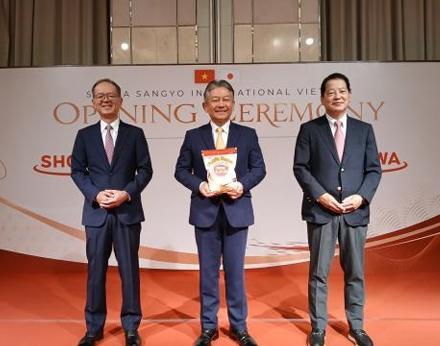 Showa Sangyo Launches Tempura Flour Tailored for Vietnam Market Showa Sangyo, a food company that produces flour and other products, held an opening ceremony on the 22nd for its local unit, Showa Sangyo International Vietnam, at a hotel in central Ho Chi Minh City. The company invited local media and influencers and unveiled a premixed tempura flour made at its Vietnam factory, highlighting adjustments in flavor and color to suit Vietnamese tastes. At the event, the company held cooking demonstrations and tastings using tempura flour produced at the factory, which began operating in March. Showa Sangyo said its immediate goal is to win market share among Vietnamese consumers and restaurants, and it will also consider exporting to global markets. The company said the product was developed to match local preferences. Based on market research, it said Vietnamese consumers tend to prefer a stronger yellow color than typical Japanese tempura, and they rate highly a “crispy” texture with a firm bite. The head of the Japanese cuisine section at the event venue, Hotel Nikko Saigon, demonstrated tempura preparation. “Showa Sangyo’s tempura flour stays crispy for a long time even after frying, which is excellent from an operational standpoint,” he said. Showa Sangyo said it is looking beyond retail sales to supply Japanese restaurants and other food-service operators in Vietnam. It also plans to expand its production lineup step by step, including products for bakeries. For now, the company said it will focus on building share in Vietnam, while longer term it will consider expansion to other countries, including neighboring markets. President Hideyuki Tsukagoshi said the company is also looking to global markets, including across Asia as well as Europe and North America. He added that it aims to create new value by combining the quality control and product development capabilities built in Japan with Vietnam’s rich food culture.* This article has been translated by AI. 2026-04-23 15:26:48