
Journalist

Lee Hugh
=
-
 Lee Jae-myung Says South Korea, Vietnam to Expand Cooperation in Nuclear, Infrastructure Lee Jae-myung: Korea, Vietnam to expand cooperation in nuclear, infrastructure President Lee Jae-myung said April 22 (local time) that South Korea and Vietnam will broaden cooperation in “strategic areas” including nuclear power, infrastructure and science and technology innovation. Speaking at a luncheon with members of the Korean community at a hotel in Hanoi during his state visit to Vietnam, Lee said he aims to develop bilateral ties — already “at the highest level” — into a more future-oriented and strategic partnership. Lee noted that the two countries established diplomatic relations in 1992 and “in just one generation” became each other’s top three trading partners. He added that Vietnam is South Korea’s largest destination for investment, with about 10,000 Korean companies operating there. Ruling party, government: Auto insurance discount for 5-day driving plan next month An auto insurance product offering discounts to drivers who join a five-day driving rotation system is set to be launched next month, officials said. A fourth round of a maximum oil price system will be decided after weighing market impact, global oil prices and the public burden. The Democratic Party, the government and the presidential office said they discussed responses to the Middle East situation at a high-level meeting April 22 at the prime minister’s official residence in Seoul’s Samcheong-dong. Kang Jun-hyeon, the party’s chief spokesperson, said the non-life insurance industry will introduce a special rider next month that discounts auto premiums for participation in the five-day system, providing benefits to people who voluntarily conserve energy. Officials said they will decide whether to implement the fourth maximum oil price system after a comprehensive review of market effects, international factors and the burden on the public. Unification Ministry explains Jeong Dong-young remarks on Kusong nuclear site…“Based on research and reporting” South Korea’s Unification Ministry said Unification Minister Jeong Dong-young’s recent public mention of Kusong as the location of a uranium enrichment facility in North Korea was a summary assessment based on outside information. In reference material distributed to reporters on April 22, the ministry said Jeong’s remarks drew on comments by International Atomic Energy Agency Director General Rafael Grossi and information from the Institute for Science and International Security, among other sources, to address the status of North Korea’s nuclear facilities. The ministry said Jeong referred to Grossi’s March 2 keynote speech to underscore the seriousness and urgency of the North Korea nuclear issue. It added that Jeong had mentioned Kusong in the same context during his confirmation hearing in July last year. Samsung Electronics union plans rally, steps toward May general strike Tensions are rising as Samsung Electronics’ labor union has signaled large-scale rallies and a general strike, drawing criticism that such moves could amount to self-inflicted damage as global competition in semiconductors intensifies. Industry officials said April 22 that the union’s joint struggle headquarters will press ahead with a rally at the Pyeongtaek campus on April 23 as a prelude to a general strike in May. The hard line has heightened unease in the industry, recalling conditions two years ago when uncertainty and weakening chip results coincided with the company’s first-ever strike. KOSPI hits record again as money crowds into Samsung, SK Hynix chip stocks South Korea’s benchmark KOSPI extended its run of record highs for a second straight session, topping 6,400. While the rally has been clear, uncertainty over whether the Middle East war will end has also fueled caution. The market’s gains have been uneven, with money increasingly concentrated in the top two chipmakers by market value. About 40% of institutional and foreign buying flowed into Samsung Electronics and SK Hynix, and the exchange-traded fund market is also shifting toward semiconductors. A planned launch by the end of next month of 2x leveraged ETFs tied to Samsung Electronics and SK Hynix is expected to intensify the concentration of funds in semiconductor-related products. * This article has been translated by AI. 2026-04-22 21:51:22
 -
 Court Jails Influencer’s Husband in Alleged Police Cover-Up; Officer Arrest Denied A businessman accused of asking a police officer to cover up his influencer wife’s fraud case was arrested, while the officer suspected of helping him avoided detention. Judge Hwang Jung-yeon of the Seoul Southern District Court on April 22 issued an arrest warrant for a man identified only as Lee, who is accused of offering bribes and violating the Capital Markets Act, citing concerns he could destroy evidence after a warrant review hearing. Lee’s spouse, identified only as A, is an influencer who also worked as a model for a Pilates academy. She was accused around July 2024 by franchisees of fraud and violating the Franchise Business Act. In December that year, Seoul’s Gangnam Police Station decided there was no basis to pursue the case. Prosecutors suspect Lee met a superintendent from Gangnam Police Station, identified only as Song, through an officer he knew, treated him at a room salon and provided money and valuables. Prosecutors also suspect Song leaked investigative information to Lee about A’s case, which was being handled by another team. Prosecutors sought arrest warrants for both men. It was prosecutors’ second attempt to detain Lee. Last month, prosecutors sought a warrant on suspicion he conspired with stock price manipulators — including a brokerage firm department head and businesspeople — to rig the share price of a KOSDAQ-listed company, but the court denied the request. With Lee now in custody, prosecutors plan additional investigation into the alleged cover-up and the stock manipulation allegations. The court denied the arrest warrant for Song, who is accused of taking bribes and leaking official secrets. Hwang said there is a dispute over whether the entertainment or money and valuables amounted to a bribe, making it necessary to protect Song’s right to defense. On the alleged leak of official secrets, Hwang said there is also a dispute over whether a crime was established, given the content and importance of the information provided and its impact on the overall investigation. Prosecutors said they will review the court’s reasoning and then decide whether to seek another warrant.* This article has been translated by AI. 2026-04-22 21:33:19
 -
 Fashion mogul Park Sun-ho, model for 'Fashion 70s,' reveals rise from poverty to 1 trillion won sales The turbulent life of Park Sun-ho — the real-life model for the 2005 TV drama “Fashion 70s” — will be featured on EBS’ “Seo Jang-hoon’s Next-Door Millionaire,” tracing his rise from a penniless boy who did not finish middle school to the head of a fashion business that later posted 1 trillion won in annual sales. The program airing on the 22nd presents Park as a “living witness” to South Korea’s apparel industry, with a success story that began in 1973 as a small wholesale operation at Busan’s Jungang Market. His company grew into a major fashion firm, using top celebrities as advertising models — from Lee Moon-se and Jeon Kwang-ryeol to Jung Woo-sung, Lee Dong-wook and Namgoong Min. In 2011, it reached the long-sought benchmark of 1 trillion won in annual sales. The broadcast also shows four company buildings facing each other across a single street in Busan, underscoring the scale of what it calls his “fashion empire.” Park said his start was harsh. “I never once got to wear clean clothes properly,” he recalled of a childhood when even meals were hard to come by. Unable to enter middle school, he helped with farming from age 14 and, at 16, took a job at an underwear wholesaler in Masan. He said the conditions were so poor he suffered frostbite in winter, and he received no wages — only three meals a day — but learned the trade. Two years later, he headed to Busan’s Jungang Market with hopes of starting his own business and got a chance to open a shop without paying any deposit. He went on to secure exclusive supply deals with 130 retailers and expanded into wholesaling, becoming what the show calls a “young tycoon” in his 20s. “I brought money home in sacks. There was so much I couldn’t tell if it was bills or just paper,” he said. The program says it will reveal how he managed to break into the market with no money. After striking it big in apparel wholesaling, Park moved into manufacturing. He said he studied production closely while visiting factories and eventually succeeded in producing cotton T-shirts, the second such effort in South Korea. A self-developed “seamless turtleneck” became a major hit, he said, with orders surging so much that shops hid inventory to sell it. His rise was interrupted by an unexpected crisis. “Inventory piled up like a mountain. At the time my debt was 38 million won — in today’s value, it would be tens of billions,” he said. “When I talk about it, I cry,” he added. The program says it will detail what drove him to the brink and how he paid off the debt and recovered within four years, in the episode airing at 9:55 p.m. on the 22nd.* This article has been translated by AI. 2026-04-22 21:21:21
 -
 Special Prosecutor Questions Cho Tae-yul on Alleged Martial Law Justification Message to U.S. Kwon Chang-young’s second comprehensive special prosecutor team, which is investigating remaining allegations after three special prosecutor teams (insurrection, Kim Keon Hee, and the late Marine) wrapped up, questioned former Foreign Minister Cho Tae-yul as a witness over suspicions that former President Yoon Suk Yeol sought to send allied countries including the United States a message justifying martial law. The team said in a media notice on the 22nd that it questioned Cho about the circumstances in which the presidential office, immediately after the “12·3 insurrection,” allegedly instructed the Foreign Ministry to deliver a message to the United States aimed at justifying the martial law declaration. Investigators said the message included claims such as: “This measure is to defend liberal democracy,” and that the National Assembly had “paralyzed the executive branch” through impeachment motions and budget cuts and sought the “substantial destruction” of South Korea’s constitutional order, prompting a “political demonstration within constitutional bounds.” It also said Yoon “maintains a stance” against “pro-North leftists” and “anti-Americanism,” the team said. The team believes Yoon tried to deliver the message through former National Security Office chief Shin Won-sik and former first deputy national security adviser Kim Tae-hyo. Earlier, on the 8th, the team searched Kim’s home and office. The warrant reportedly cited allegations that Shin and Kim played key roles in an insurrection and abused authority to obstruct the exercise of rights, and that Yoon abused authority.* This article has been translated by AI. 2026-04-22 21:15:15
 -
 Lee Jae-myung says South Korea, Vietnam expanding cooperation from infrastructure to future industries Lee Jae-myung said April 22 that South Korea is pursuing broad cooperation with Vietnam, ranging from “hardware” sectors such as logistics, transportation, energy and infrastructure to future industries including science and technology, intellectual property and creative industries. Lee, on a state visit to Vietnam after visiting India, made the remarks in a joint press statement after a summit with To Lam, the Communist Party general secretary and state president. Lee said South Korea is “the best partner” for Vietnam’s vision of becoming a high-income advanced country by 2045. The two leaders said the summit further strengthened cooperation under their “comprehensive strategic partnership.” They said the countries agreed to develop trade and investment ties on a more mutually beneficial basis to meet a goal of $150 billion in trade by 2030. Following is the full text of the South Korea-Vietnam joint press statement: Thank you to General Secretary To Lam and the people of Vietnam for inviting me and our delegation and for your warm welcome. After the launch of South Korea’s new government last year, the general secretary visited South Korea as the first state guest. This time, I am visiting as the first state guest following the launch of Vietnam’s new leadership. I believe this is a special scene that shows how close our relationship is. I am also very pleased to see firsthand Vietnam’s dynamic development under General Secretary To Lam’s leadership. Vietnam is South Korea’s third-largest partner for trade and investment, and South Korea is Vietnam’s largest investor. About 10,000 South Korean companies have entered Vietnam across sectors including petrochemicals, shipbuilding, steel and electronics, building a high level of economic partnership. As the best partner for Vietnam’s vision of becoming a high-income advanced country by 2045, South Korea is pursuing wide-ranging cooperation from logistics, transportation, energy and infrastructure to future industries such as science and technology, intellectual property and creative industries. At today’s talks, we agreed to further strengthen this “comprehensive strategic partnership.” I will outline the main outcomes of the summit. First, to achieve the goal of $150 billion in trade by 2030, we agreed to develop trade and investment cooperation on a more mutually beneficial basis. For the first time, the two countries agreed to mutually export heat-treated processed meat. Based on the memorandum of understanding on cooperation in animal health and quarantine signed this time, we agreed to accelerate cooperation to expand trade in agricultural and livestock products. I again thank General Secretary To Lam for highly valuing the role of our companies in Vietnam and for saying he will actively work to ensure stable and predictable business conditions for them. Second, based on firm mutual trust, we agreed to strengthen strategic cooperation in energy and infrastructure. We shared the view that cooperation is even more necessary amid supply-chain instability stemming from the recent Middle East situation. We agreed to work more closely to strengthen energy security and stabilize supply chains. Tomorrow, a contract will be signed for South Korea to export rail cars for Ho Chi Minh City’s urban railway. I hope the contract contributes to improving Vietnam’s rail infrastructure and leads to expanded cooperation on major transportation and logistics infrastructure projects Vietnam is pursuing. We also agreed to communicate closely so that projects such as new cities and new airports, which Vietnam is pursuing as part of its national development vision, can produce many model cases of bilateral infrastructure cooperation. Third, we agreed to expand cooperation in forward-looking areas including science and technology, climate change and the environment, and culture and education. I expressed support for General Secretary To Lam’s science and technology development policies and said South Korea will actively contribute. Based on the “master plan for cooperation in science, technology and innovation,” we will strengthen cooperation on joint research in semiconductors, secondary batteries and biotechnology, and on support for training research talent. The memorandum of understanding on digital cooperation signed this time will expand cooperation in digital fields such as AI and semiconductors and will also contribute significantly to the expansion of our IT companies into Vietnam. In addition, we signed a memorandum of understanding on water security cooperation to prevent flood damage linked to climate change and to secure water security. We also agreed to work together to strengthen cultural cooperation, including media, with Vietnam, where the outlook for creative industries is bright, and to strengthen Korean-language education in Vietnam. Fourth, we agreed to cooperate closely to ensure stable stays and to enhance the rights and interests of each other’s citizens and multicultural families. Vietnam is the second most visited country in the world for South Koreans, with as many as 4.5 million South Koreans visiting each year. It is also the top country for international marriages involving South Koreans, forming 100,000 multicultural families. It is also the ASEAN country with the largest population of overseas Koreans. General Secretary To Lam said he will support the safety of our citizens visiting Vietnam and help ensure convenient stays for overseas Koreans in Vietnam and second-generation South Korea-Vietnam families. I also promised to continue working to enhance the rights and interests of Vietnamese workers and marriage immigrants in South Korea. Finally, the two leaders also exchanged broad views on ways to promote peace and stability in the region, including the Korean Peninsula. I explained our vision for a Korean Peninsula where North and South coexist peacefully and grow together. General Secretary To Lam highly valued our government’s sincere will to resume dialogue and cooperation and said he will contribute to peace and stability on the Korean Peninsula. Our two countries will also communicate closely and expand cooperation on the international stage, including at the United Nations. Our government will faithfully implement the cooperation measures agreed with General Secretary To Lam today and further develop the comprehensive strategic partnership between our two countries. Once again, I express my deep gratitude for the hospitality of General Secretary To Lam and the people of Vietnam. Thank you. 2026-04-22 21:03:30
 -
 South Korea, Vietnam to Boost Strategic Cooperation; Metro Railcar Export Deal Set The South Korean government said April 22 (local time) it agreed with Vietnam to strengthen strategic cooperation, aiming to raise bilateral trade to $150 billion by 2030. To reach that goal, the two sides said they will expand cooperation across sectors, from logistics, transportation, energy and infrastructure to future industries such as science and technology, intellectual property and creative industries. President Lee Jae-myung, on a state visit to Vietnam after visiting India, made the remarks in a joint press statement after a summit with To Lam, the Communist Party general secretary and state president. “Korea is the best partner for realizing Vietnam’s vision of becoming a high-income advanced country by 2045,” Lee said. Vietnam is South Korea’s third-largest partner for trade and investment, while South Korea is Vietnam’s largest investor, the government said. About 10,000 South Korean companies operate in Vietnam across industries including petrochemicals, shipbuilding, steel and electronics. The two countries agreed for the first time to allow mutual exports of heat-treated processed meat. They also signed a memorandum of understanding on animal health and quarantine cooperation to speed efforts to expand trade in agricultural and livestock products. They also signed MOUs on safety cooperation for food, pharmaceuticals, cosmetics and medical devices, and on deeper cooperation in intellectual property. Citing strong mutual trust, the two sides agreed to strengthen strategic cooperation in energy and infrastructure. Lee said both countries shared the view that supply-chain instability linked to the recent Middle East situation has increased the need for closer cooperation, and agreed to work together to bolster energy security and stabilize supply chains. Lee said a contract is expected to be signed “tomorrow” for South Korea to export railcars for Ho Chi Minh City’s urban railway. He said he hopes the deal will help improve Vietnam’s rail infrastructure and lead to broader cooperation on major transportation and logistics projects Vietnam is pursuing. The leaders also agreed to keep communicating so they can build more model cases of infrastructure cooperation through Vietnam’s new city and new airport projects, which are part of its national development vision. In forward-looking areas such as science and technology, climate change and the environment, and culture and education, the two sides said they will strengthen cooperation based on a “master plan” for science and technology innovation. That includes joint research and support for training research talent in semiconductors, secondary batteries and biotechnology. They also signed a digital cooperation MOU to support South Korean IT companies entering Vietnam, and a water security cooperation MOU aimed at preventing flood damage linked to climate change and securing water security. The two countries said they will also work to expand cultural cooperation, including media, and strengthen Korean-language education in Vietnam. On people-to-people ties, Lee said Vietnam is the second most-visited country for South Koreans, with about 4.5 million visits a year. He also described Vietnam as the top country for international marriages involving South Koreans, with 100,000 multicultural families, and as the largest home to overseas Koreans within ASEAN. Lee pledged continued efforts to improve the rights and interests of Vietnamese workers and marriage immigrants living in South Korea. The two leaders also exchanged views on ways to promote peace and stability in the region, including on the Korean Peninsula. Lee said the two countries will communicate closely and expand cooperation on international stages such as the United Nations, and will further develop their comprehensive strategic partnership. * This article has been translated by AI. 2026-04-22 21:01:10
 -
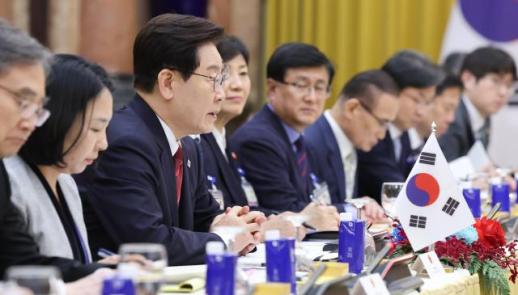 Lee urges shift to higher-quality cooperation with Vietnam; To Lam stresses trust President Lee Jae-myung said April 22 (local time) that South Korea and Vietnam should turn quantitative gains into higher-quality cooperation to build “a sustainable future of shared prosperity” as geopolitical uncertainty rises and global competition for technological leadership intensifies. Speaking at an expanded summit meeting with Vietnam’s Communist Party chief and state president, To Lam, at the Presidential Palace in Hanoi, Lee praised Vietnam for posting “one of the region’s highest economic growth rates” last year and for serving as a key economic engine in ASEAN. Lee called for mutually beneficial cooperation beyond trade and investment, including energy security, transportation and infrastructure, science and technology, and education and culture, and urged both sides to deliver tangible results that people and businesses can feel. Lee said the two countries have built a “top-level partnership” across politics, the economy and people-to-people exchanges in the 34 years since establishing diplomatic relations in 1992. He said about 5 million people travel between the two countries each year and exchanges in culture, education and other areas continue to expand. He said the two nations are among each other’s top three trading partners, and that South Korea is Vietnam’s largest investor. More than 10,000 South Korean companies operate in Vietnam, he said, contributing to both countries’ economic growth and Vietnam’s industrial development. In opening remarks, To Lam said Lee’s visit “most clearly demonstrates” the comprehensive strategic partnership based on high mutual trust, and he congratulated the South Korean government and people on their recent achievements. To Lam said he was impressed by Lee’s governing principles that prioritize coexistence and harmony, respect and trust. He said he believes South Korea will achieve further results under Lee’s leadership and strategic vision and contribute to peace and prosperity in the region and the world. He said the Vietnam-South Korea comprehensive strategic partnership has produced “remarkable achievements” across all fields over 35 years of development, and welcomed that the two sides have worked strategically as close friends who understand each other and as partners that can truly be trusted. To Lam said Vietnam’s party, state and people highly value Lee’s commitment to bilateral ties from his time as Seongnam mayor through his inauguration as president. He said Vietnam is ready for in-depth discussions on ways to strengthen strategic trust, expand practical cooperation and deepen the comprehensive strategic partnership, as well as on regional and international issues of mutual interest. 2026-04-22 21:00:15
 -
 Iran’s Revolutionary Guard Says It Seized 3 Ships in Strait of Hormuz Iran’s Islamic Revolutionary Guard Corps said on April 22 (local time) it seized three vessels in the Strait of Hormuz. The Iranian military has been tightening what it calls an armed blockade of the strait after a second round of U.S.-Iran ceasefire talks collapsed and U.S. President Donald Trump extended the ceasefire deadline until negotiations are concluded. The Guard’s navy said it detained two container ships — the MSC Francesca and the Defaminodas — and took them into Iranian waters, alleging they tried to slip out of the strait without Iranian military authorization. It also claimed the MSC Francesca is linked to Israel and said the two ships repeatedly violated regulations and manipulated their automatic identification system, or AIS. Iran’s Mehr news agency reported that a third container ship, the Euphoria, was also seized by the Guard’s navy as it attempted to pass through the strait. The navy said it would “continuously monitor” any actions that obstruct enforcement of Iran’s declared rules for passage through the strategic waterway or run counter to safe navigation. The Associated Press reported the Guard fired on the three vessels before seizing them. Earlier, the United Kingdom Maritime Trade Operations said that at about 7:55 a.m. a vessel in the Strait of Hormuz was attacked by Guard fast-attack craft. The vessel reported to UKMTO that it had not communicated with the fast-attack craft before being hit, but Iran’s state-run Nour News said the Guard opened fire after the ship ignored military warnings.* This article has been translated by AI. 2026-04-22 20:57:21
 -
 Lee Jae-myung tells Koreans in Vietnam he aims to deepen strategic cooperation President Lee Jae-myung said April 22 (local time) that South Korea will expand cooperation with Vietnam in strategic areas including nuclear power, infrastructure and science and technology innovation, while stepping up coordination on global challenges such as supply chain stability, sustainable growth and climate change. Speaking at a luncheon meeting with Koreans in Vietnam at a hotel in Hanoi during his state visit, Lee said he wants to develop the two countries’ cooperation — already at its highest level — into a more future-oriented and strategic partnership. Lee noted that since diplomatic ties were established in 1992, the two countries have become each other’s third-largest trading partners within a generation. He said Vietnam is South Korea’s largest destination for investment, with about 10,000 South Korean companies operating there. In 2022, marking the 30th anniversary of diplomatic ties, the two countries elevated relations to a comprehensive strategic partnership. Lee said South Korea and Vietnam “have a lot in common,” pointing to bonds across history, culture and the economy. He cited shared experiences of enduring foreign domination, overcoming hardship through their own efforts, and suffering the pain of division and war, adding that both are rooted in a Confucian cultural sphere that fosters close emotional ties. Lee also singled out Kim Sang-sik, head coach of Vietnam’s national soccer team, who attended the luncheon. Noting that soccer is called the “king sport” in Vietnam, Lee joked that would make Kim the “king of kings,” calling it “something to be proud of.” Lee referred to his time as mayor of Seongnam, when he served as owner of Seongnam FC, saying he is currently on trial after being accused of what he described as a “strange” offense while trying to help the club succeed. Turning to the Korean community, Lee said the Korean population in Vietnam has grown to about 200,000, making it the largest Korean community in ASEAN and the world’s fifth-largest. He pledged active support. He said about 100,000 South Korea-Vietnam multicultural families are a valuable foundation that connects the two countries “by blood,” but face difficulties. Lee said the “people-sovereignty government” will closely examine the challenges faced by overseas multicultural families and do its best to resolve them quickly as part of building an inclusive South Korea. After Lee’s remarks, Yang Mo-se, president of the Korean Association in Hanoi, said South Korea and Vietnam are neighbors that share a resilient history of preserving their identity against outside powers and a spiritual foundation in Confucian culture. He asked for the homeland’s warm attention and support so Koreans in Vietnam can act with greater confidence and contribute to South Korea amid the deepening partnership. Three community representatives shared their experiences: Pham Thi Nua, vice chair of the legal and administrative committee of the Vietnam council of the National Unification Advisory Council; Lee Yong-deuk, vice president of the Hanoi Korea-Vietnam Family Association; and Jung Ye-won, president of the Hanoi Korean Students Association. Pham said she was born in Vietnam but has regarded South Korea as her second home since forming a family with her South Korean husband 28 years ago. She said she will continue to do her best to serve as a bridge between the two countries as a “civilian diplomat.” Lee Yong-deuk said there are about 8,000 Korea-Vietnam families in Vietnam, and that 40% of the elementary division at the Korean International School in Hanoi are children of Korea-Vietnam families. He urged support so second-generation children can grow into true leaders linking the two countries. Jung described the students association’s roles, including protecting students’ lives and rights and supporting summit interpretation and overseas voting-site operations. After listening, Lee said the South Korea-Vietnam partnership, built on shared experience of overcoming adversity, is not a coincidence but an inevitable result created by Koreans living in Vietnam. He said that although they live outside South Korea, overseas Koreans often show even greater concern for the homeland, and he pledged continued government support so they can work in a more stable environment. He also said he would consider a system to better reflect overseas Koreans’ views. A cultural performance followed, with the Hanoi Boys and Girls Choir singing the children’s song “Mungge Cloud,” and the Hanoi Traditional Korean Music Research Institute’s “Sori Dongne” presenting an “Arirang” medley.* This article has been translated by AI. 2026-04-22 20:33:22
 -
 Korea to Launch Auto Insurance Discounts for Drivers Joining License-Plate Rationing Auto insurance products offering discounts to drivers who join the vehicle “5-day rotation” program are expected to be launched next month. Officials also said they will decide whether to implement a fourth round of an oil price cap after weighing market impact, global oil prices and the public burden. The Democratic Party, the government and the presidential office said they discussed those steps and other responses to the Middle East situation at a senior meeting held April 22 at the prime minister’s official residence in Samcheong-dong, Seoul. Kang Jun-hyeon, the Democratic Party’s senior spokesperson, said the nonlife insurance industry will roll out “a special rider” next month that discounts auto insurance premiums for drivers who participate in the 5-day rotation, providing benefits to people who voluntarily join energy-saving efforts. He said officials plan to draw up measures within this month to ease crowding on public transportation and broaden participation in energy conservation. He added they will also prepare steps to promote “green consumption,” including boosting tourism during the May holiday period. On the fourth oil price cap, the party, government and presidential office agreed to make a decision after comprehensively considering market effects, international factors and the burden on the public. During the meeting, the Democratic Party asked the government to respond more actively to minimize supply-chain disruptions affecting naphtha and crude oil. The government said it will manage the smooth import of 273 million barrels of crude oil and 2.1 million tons of naphtha that a strategic economic cooperation envoy team secured in Central Asia and the Middle East. It also said it will actively support crude imports through Yanbu Port in Saudi Arabia and proceed with a 670 billion won program, reflected in the supplementary budget, to cover the gap in naphtha import unit costs to support naphtha imports. Of the 26.2 trillion won supplementary budget, the government said it has selected 25 trillion won for management and plans to execute more than 85% of 10.5 trillion won in projects requiring rapid spending in the first half of the year. The party, government and presidential office said they will continue efforts to stabilize domestic supplies of energy and key raw materials amid rapidly shifting Middle East conditions. They also agreed to strengthen on-site inspections to ensure current measures to stabilize supply chains for naphtha, urea solution and syringes operate effectively. * This article has been translated by AI. 2026-04-22 20:21:23