
Journalist

Lee Hugh
=
-
 South Korea says Coupang probe follows domestic law, separate from security talks with U.S. Cheong Wa Dae said the government will continue consulting with the United States so issues involving Coupang do not negatively affect South Korea-U.S. security discussions. A Cheong Wa Dae official said on the 22nd that the two countries are communicating closely through various channels to implement security agreements outlined in a joint factsheet. The official said Seoul’s position in talks with Washington is that security discussions should move forward separately from the Coupang matter. The official also stressed that any investigation into Coupang will be handled under South Korean domestic law and due process. Park Yoon-joo, first vice foreign minister, told the National Assembly’s Legislation and Judiciary Committee that the government is explaining that fair law enforcement will be carried out in areas related to domestic legal procedures. He said the government will manage and communicate closely so the issue does not become an obstacle to matters agreed between the two governments. The Foreign Ministry also said in a media notice on the 22nd that the two countries are in close communication through various channels to implement the joint factsheet’s security agreements, and that Seoul has conveyed its view that security discussions should advance separately from the Coupang issue. Earlier, a media report said the U.S. administration had asked the South Korean government to ensure the legal safety of Kim Beom-seok, chairman of the board of Coupang Inc., and indicated that without such steps it would be difficult to hold high-level South Korea-U.S. diplomatic and security talks. * This article has been translated by AI. 2026-04-22 18:30:18
 -
 Cash-strapped artists recount struggles with red tape at forum in Seoul SEOUL, April 22 (AJP) - A forum to improve the rights of artists and entertainers alike was held at the National Assembly in Seoul on Wednesday. At the forum hosted by lawmaker Son Sol of the minor far-left Progressive Party, participants discussed various measures to improve their legal rights, address workplace mistreatment, and strengthen support measures. Many of them, hired on independent freelance-based contracts and struggling to make ends meet, are unable to access state-funded support as they are currently bound by regulations that require proof of employment, with red tape making it difficult for them to receive assistance. 2026-04-22 18:25:33
 -
 South Korea Forecast: Rain in Parts of the South; Dust to Ease on Easterly Winds Thursday the 23rd will be mostly cloudy nationwide, with continued cloud cover in the Seoul metropolitan area and Gangwon Province. Rain is expected to persist in parts of the south. Forecast rainfall over the two days starting on the 22nd is 30 to 80 millimeters on Jeju Island (excluding the north), 10 to 40 millimeters in northern Jeju, 5 to 20 millimeters in Gwangju and South Jeolla Province and along the southern coasts of Busan and South Gyeongsang Province, and less than 5 millimeters in Ulsan and inland areas of South Gyeongsang. Morning lows are forecast at 6 to 12 degrees Celsius, with daytime highs of 14 to 23 C. Inland areas of the central region will see a large day-to-night temperature swing of around 15 degrees. Air quality is expected to be poor through the morning due to lingering yellow dust and fine particles from overseas. PM-10 levels are forecast to be "bad" in the capital region, Gangwon, Chungcheong and North Jeolla, while PM-2.5 is expected to be "bad" through the morning in southern Gyeonggi and South Chungcheong. From the afternoon, easterly winds are expected to move in and lower fine-dust concentrations. Waves are forecast at 0.5 to 2.5 meters in the East and South seas and 0.5 to 1.5 meters in the West Sea. In offshore waters (about 200 kilometers from the coast), wave heights are expected at 0.5 to 3.0 meters in the East Sea, 0.5 to 2.5 meters in the West Sea and 1.0 to 3.5 meters in the South Sea.* This article has been translated by AI. 2026-04-22 18:24:16
 -
 PM Kim Min-seok urges tight party-government coordination, fast rollout of extra budget Prime Minister Kim Min-seok said on the 22nd that the ruling party and the government must work in “perfect coordination” to improve people’s livelihoods. Speaking at the opening of the eighth senior party-government meeting at the prime minister’s official residence in Samcheong-dong, Seoul, Kim said that if the party examines issues one by one and raises concerns, the government and the presidential office will do their best to review them and resolve them. Kim thanked the National Assembly for what he called swift action, noting that floor leaders from both parties held an emergency review meeting on the 17th and that the National Assembly passed the first supplementary budget for 2026 on the 10th after an “unprecedentedly fast” review. “Now is the time — in a crisis like this — to show that the party and the government are taking responsibility together and looking after people’s livelihoods,” he said. On the supplementary budget, Kim said the government will quickly execute more than 85% of 10.5 trillion won in major project funding in the first half of the year to ease the burden of high oil prices, stabilize livelihoods and minimize industrial damage. Kim also said many key bills that must be handled in the first half have yet to clear the National Assembly, and he asked lawmakers for active cooperation to pass measures including the materials, parts and equipment law, the strategic export finance support law, the national protocol academy law, the Telecommunications Business Act and a bill to support victims of rental fraud. * This article has been translated by AI. 2026-04-22 18:21:17
 -
 Dong-A Pharm, Hanmi and Others Mark Earth Day, Awards and Product Verification Efforts Dong-A Pharm’s Tempo runs eco-friendly giving campaign for Earth Day Dong-A Pharm’s feminine care brand Tempo said April 22 it teamed with global coworking operator JustCo to run an eco-friendly giving campaign for Earth Day. The campaign ran through April 22 for the tenant community at six JustCo locations in Seoul. Tempo said it designed the event to help people practice resource circulation in everyday life, focusing on working women and promoting consumption that considers the environment and ethics. Participants who donated unused items received Tempo’s vegan-certified “Natural Cotton Tampon Light.” Tempo said the product uses an applicator that is 2 millimeters slimmer than earlier versions and is made with 100% organic cotton for the absorbent core, cover and removal string. It has also received certification from The Vegan Society in the U.K. Hanmi Pharmaceutical’s Rolontis wins IR52 Jang Young-sil Award Hanmi Pharmaceutical said April 22 that its neutropenia treatment Rolontis, marketed in the United States as Rolvedon, has won the IR52 Jang Young-sil Award. The award ceremony was held April 14 at the Peace & Park Convention in Seoul’s Yongsan district. Choi In-young, head of Hanmi Pharmaceutical’s R&D Center, and executives Bae Seong-min and Kim Dae-jin, among researchers involved in developing Rolontis, attended and received a certificate and trophy. Rolontis is a long-acting biologic used to prevent and treat severe neutropenia in patients undergoing chemotherapy. Hanmi said it applied its “Lapscovery” platform technology to extend the drug’s effect and dosing interval. Based on those results, the drug was newly listed in the 2022 NCCN guidelines as an option for preventing and treating neutropenia, about 20 years after a new option was added, the company said. “Our focus was on helping patients continue chemotherapy through to the end,” Choi said. “Building on Hanmi’s philosophy, we will further advance our R&D capabilities and devote ourselves to developing innovative new drugs.” PharmaResearch releases video guide to verify authentic Rejuran products PharmaResearch said April 22 it released a “Rejuran Authenticity Verification Guide” video with Rejuran global ambassador Kim Se-jeong to help consumers check whether a product is genuine before a procedure. The company said that as the medical aesthetics market expands, consumer confusion has grown due to similar products, increasing the need for clear verification steps. The video outlines a three-step process: confirming the phrase “DOT® DNA Optimizing Technology” on the product box, checking information by scanning a QR code, and using an NFC tag for authentication. PharmaResearch said the guide is intended to help consumers directly confirm procedure steps and product information. Kwangdong Pharmaceutical holds in-house used-goods market for Earth Day Kwangdong Pharmaceutical said April 22 it held an in-house used-goods trading event, the “KD Goodcycling Treasure Market,” to mark Earth Day. KD Goodcycling is an ESG campaign aimed at reducing waste and spreading a culture of resource circulation, now in its fourth year. The company said the Treasure Market was the first program in this year’s campaign, with employees buying and selling secondhand household items. About 450 items were submitted, including household goods, small appliances and childcare products, the company said, about a 50% increase from a year earlier. Unsold items will be donated to social welfare organizations. “Through various eco-friendly campaigns that are easy to practice in daily life, we will fulfill our social responsibility for a sustainable future,” a company official said.* This article has been translated by AI. 2026-04-22 18:17:13
 -
 Defense Minister Ahn Denies Claim U.S. Forces Commander Protested Unification Minister’s Remarks Defense Minister Ahn Gyu-back said a lawmaker’s claim that the commander of U.S. Forces Korea protested remarks by Unification Minister Jeong Dong-young was not true. Ahn made the comment at a National Assembly Legislation and Judiciary Committee meeting, responding to a question from People Power Party lawmaker Yoon Sang-hyun. Ahn said it would be inappropriate in terms of South Korea-U.S. military diplomacy for the U.S. commander to lodge a protest with the South Korean defense minister. Ahn said he communicated several times with USFK Commander Xavier Brunson after Jeong’s March 6 remarks, but added they did not discuss Jeong’s comments specifically. He said they spoke only about broader matters. Asked how he viewed Jeong’s remarks, Ahn said the unification and defense ministers should speak with a unified voice even when their positions differ. He added that, from an outside perspective, he did not see it as a major issue. Ahn also agreed with Democratic Party lawmaker Park Jie-won’s view that Jeong’s National Assembly remarks could not be considered a leak because information that North Korea has nuclear facilities in Kusong has already been reported and discussed in academic papers and other writings. On concerns that the United States protested Jeong’s remarks and restricted some intelligence on North Korea, Ahn said there had been no such limits so far. Asked whether restrictions could be imposed later, he said he was limited in what he could say about plans. Ahn said that since March 11, North Korea has launched ballistic missiles four times and cruise missiles once, and that South Korea and the United States shared combined intelligence assets in real time and issued announcements after discussions each time. He said there had not been many significant restrictions. * This article has been translated by AI. 2026-04-22 18:16:03
 -
 Korea Technology Finance and Woori Bank Sign MOU to Boost SME M&A Financing Korea Technology Finance Corp., Woori Bank sign MOU to boost SME M&A financing Korea Technology Finance Corp. said Tuesday it signed a business agreement with Woori Bank on M&A financing support to promote business succession and technology innovation. Under the deal, KOTEC will provide 20 billion won in special contribution-backed guarantees funded by a 1 billion won special contribution from Woori Bank. Benefits include a higher guarantee coverage ratio (85% to 100% for three years) and a reduced guarantee fee (down 0.3 percentage points for three years). KOTEC will also supply 21.4 billion won in guarantee-fee support-backed guarantees based on 300 million won in Woori Bank funding. Woori Bank will cover guarantee fees by 0.7 percentage points for two years. Lee Sang-chang, a director at KOTEC, said the agreement is expected to help spur M&A activity among small and midsize companies and support sustained growth. He said KOTEC will expand cooperation with related institutions to strengthen support for companies pursuing M&A and to build an M&A ecosystem aimed at preventing the disappearance of technology firms and promoting business continuity. Baemin runs Earth Day promotion Woowa Brothers, operator of the Baedal Minjok food delivery app, said Tuesday it will run an Earth Day promotion for customers who opt out of disposable spoons and forks and for those who order using reusable containers. Through April 28, Baemin will select 3,000 customers by lottery from those who choose the “no disposable cutlery” option and place an order, awarding each a 5,000 won discount coupon for food delivery orders. Customers can enter by replying on the in-app event page to a message “sent by the Earth” with their views on skipping disposable cutlery, then completing an order while keeping the opt-out option selected. Kim Jeong-eun, head of Woowa Brothers’ ESG team, said the company designed the promotion to help customers practice environmental protection in daily life. She said the company will continue efforts to spread eco-friendly delivery culture, including expanding areas served by its reusable-container service. Torder launches AI class for small merchants Torder said Tuesday it has launched an education program, the “Torder Small Merchant AI Class,” to support sustainable growth and improve store operations efficiency, and that it successfully completed its first session. The first session, held April 6 at Torder’s headquarters in Yeongdeungpo-gu, was offered to franchisees of “Geunom Pocha.” The curriculum focused on practical topics that can be applied directly to store operations, including use of smart-solution equipment, draft beer quality control, local marketing strategies and AI-based store management. A core session covered training on automating store management using Torder’s small-merchant AI tool, “TorderGPT,” which was recently released in beta. Kwon Seong-taek, Torder’s CEO, said the company will continue supporting an environment in which store owners can reduce repetitive management tasks and run their stores more efficiently, centered on TorderGPT.* This article has been translated by AI. 2026-04-22 18:15:02
 -
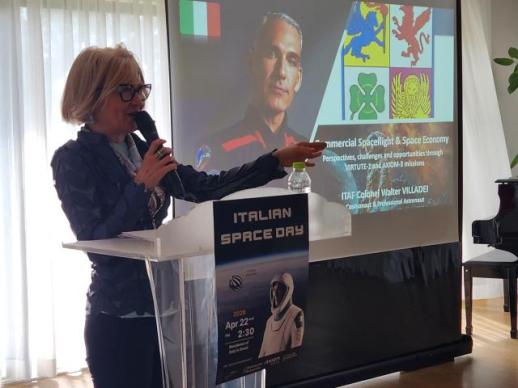 Rome pivots to Seoul as lunar race demands global alliance SEOUL, April 22 (AJP) - Italy and South Korea are formalizing a strategic aerospace corridor as the technical and economic pressures of the second lunar age render national isolation obsolete. During the 2026 Italian Space Day in the South Korean capital on Wednesday, Teodoro Valente, the president of the Italian Space Agency, told a delegation of industry leaders that the era of the solo spacefaring nation has ended. As the global community readies for a permanent human presence on the lunar surface, the alignment between industrial powers Italy and South Korea signals a shift away from regional competition toward a system of integrated diplomatic and scientific risk. The gathering at the Residence of Italy commemorated the sixty-second anniversary of the 1964 San Marco satellite launch, a milestone that established Italy as the third nation to reach space. However, the proceedings on April 22 suggested that historical prestige is now secondary to the immediate necessity of shared supply chains and a common defensive posture. Diplomatic momentum drives industrial ties Ambassador Emilia Gatto framed the event as a pivot point in a high-stakes year for bilateral relations. Gatto noted that Prime Minister Giorgia Meloni visited Seoul in January, and South Korean President Lee Jae Myung is scheduled to visit Italy in June. Gatto characterized the current environment as a very good time for the relations between Italy and South Korea. "Welcome in your house," Gatto told the assembly. "It is not mine. It's just for you all to meet." The ambassador's remarks set the stage for an all-day program involving leadership from the Korea Aerospace Administration, or KASA, and the Italian Space Agency, known as ASI. Strategic alignment in the New Space era The industrial roadmap is anchored by the institutional synchronization between KASA and ASI. Valente characterized the creation of the South Korean agency as a unique opportunity to build a structured and long-term partnership. This alignment follows a 2023 memorandum of understanding (MoU) signed during the state visit of President Sergio Mattarella. Valente revealed that the Italian Space Agency is planning a dedicated industrial mission to South Korea between the end of 2026 and early 2027 to bring together large system integrators with small and medium enterprises. The mission aims to move the relationship beyond a traditional client-supplier model toward a harmonized system. "Space remains to us the greatest achievement never reached alone, and this is not only for economic reasons," Valente said. "International cooperation and space diplomacy are not simply an added value. They are essential." Technical collaboration and the human frontier The afternoon focused on bridging specific technical capabilities between the two nations. Following introductory remarks from CEOs Giampiero Di Paolo from Thales Alenia Space Italia and Jay Kim from South Korea's Boryung, an international collaboration session brought together institutional and academic leaders. These discussions featured policy director Kim Eun-jeong from the Korea Aerospace Research Institute and Sean Yim from Hanwha Systems, alongside researchers from KAIST, Seoul National University, and the University of Padova. A keynote by Colonel Walter Villadei, an astronaut and Italian Air Force officer, moved the conversation from industrial logistics to the existential requirements of the human species. Villadei highlighted the transition of space from a scientific frontier to a daily human environment, emphasizing that the focus has shifted toward building the infrastructure required for humanity to inhabit the lunar surface permanently. "Space is no longer science fiction," Villadei said. "It is not something belonging just to a few lucky people flying to space. It is now this kind of daily environment from which all of us already depend very much for our Earth applications, but it is our future. So we are expanding and to make our human species able to live permanently in space, both in LEO (low-Earth-orbit) and on the Moon." 2026-04-22 18:10:09
 -
 Kia to Start EV3 Production in Mexico in June to Ease U.S. Tariff Impact Kia is expected to begin full-scale production of its small electric SUV, the EV3, at its Mexico plant as early as June as it seeks to reduce the burden of U.S. tariffs, industry sources said. The company is expected to start with a limited allocation to support launches in North and Central America in the second half of the year, with the possibility of gradually increasing local output. According to the auto industry on Tuesday, Kia plans to ramp up EV3 production in Mexico as early as June. The company is reported to have shared the plan in its annual business roadmap presented at a labor-management production briefing last month. The EV3, launched in July 2024, has been popular in South Korea and Europe. It is considered one of the most accessible models in Kia’s EV lineup, offering advanced features at a competitive price point. Data from the Korea Automobile & Mobility Association showed the EV3 sold 21,254 units in South Korea last year, ranking second among passenger EVs. In Europe, about 65,200 units were sold last year, placing it ninth in the region’s EV market. Kia’s push to strengthen local production comes as U.S. tariff costs rise. Since April last year, the United States has imposed a 15% tariff on imported vehicles, increasing cost pressure. As a result, Hyundai Motor Group’s tariff costs for the first quarter this year alone are estimated at about 2 trillion won. With the EV3 set for its first entry into the U.S. market, Kia is moving to cut tariff exposure through production closer to the market. Kia plans to launch the “The all-new 2027 Kia EV3” in the United States in five trims in the second half of this year. It will offer two battery options: a long-range model with an 81.4-kWh battery and a standard model with a 58.3-kWh battery. Labor opposition to shifting production is a key hurdle. Until now, all EV3 units have been built at Kia’s Gwangmyeong plant in South Korea. The decision would make the EV3 a dual-production model, built both at home and overseas. It would also be the first EV produced at Kia’s Mexico plant, which has previously made only internal-combustion models such as the K3 and K4. Kia’s labor union is opposing the shift, citing concerns including job security. A union official said, “The company is pushing it through unilaterally.” The initial volume to be moved to Mexico is said to be relatively small at 10,000 units, but as U.S. sales grow, further expansion of local production would be a natural next step. * This article has been translated by AI. 2026-04-22 18:07:59
 -
 Questions Raised Over Hankook & Company Shareholder Group’s Motives Questions are growing over the "Hankook & Company Shareholders Alliance," which some critics say was used as a public-relations tool by the company’s second-largest shareholder at the firm’s annual meeting. The group, formed in the name of protecting minority shareholders, is now facing allegations that it has been used to advance a legal network tied to the owner family. Industry watchers warn that if a voluntary minority-shareholder group is diverted to serve a particular faction’s interests, it could lead to unintended harm for ordinary investors. According to the industry on April 22, attorney Kim Hak-yu, who led the alliance’s activities, was recently listed as legal counsel in a Supreme Court appeal in an ongoing lawsuit between Honorary Chairman Cho Yang-rae and his second daughter, Cho Hee-won, over the return of unjust enrichment. The case is being handled by Shinwon Law Firm, where Kim works, with the firm serving as counsel and Kim participating on the legal team. The appeal stems from events that began in 2019, when Cho gifted Hankook Tire shares to Cho Hee-won and paid the gift tax on her behalf. After a tax tribunal canceled the gift-tax assessment, the tax authority refunded 33.3 billion won in gift tax to Cho Hee-won rather than to Cho, who had paid it. Cho then filed a lawsuit seeking the return of unjust enrichment, won in the first and second trials, and the case is now in the Supreme Court. Kim is also the legal representative for the Hankook & Company minority-shareholder alliance. In 2025, he recruited shareholders through an open KakaoTalk chat room, saying he would "improve Hankook & Company’s outdated governance structure and maximize shareholder value." Critics, however, have described the group’s activities as one-sided. They say the alliance focused less on proposing broader governance reforms and more on repeatedly attacking Chairman Cho Hyun-beom, the controlling shareholder, over his high compensation and calls for him to step down. Separately, it later became known that Cho Hyun-sik, a former Hankook & Company adviser who previously fought a stake battle, was involved in the alliance, prompting claims that the group has shifted into a tool to pressure management. An industry official said minority and majority shareholders have "completely different" interests, and doubts grew after the name of a major shareholder — Cho Hyun-sik, who holds an 18.93% stake — appeared on a list of minority shareholders. The official said investors should cross-check not slogans about "protecting minority shareholders" but who is acting, what interests they have, and where the effort is headed. 2026-04-22 18:06:35