

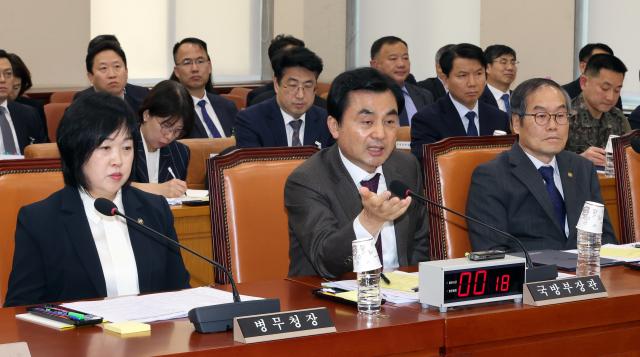
Defense Minister Ahn Gyu-back said a lawmaker’s claim that the commander of U.S. Forces Korea protested remarks by Unification Minister Jeong Dong-young was not true.
Ahn made the comment at a National Assembly Legislation and Judiciary Committee meeting, responding to a question from People Power Party lawmaker Yoon Sang-hyun. Ahn said it would be inappropriate in terms of South Korea-U.S. military diplomacy for the U.S. commander to lodge a protest with the South Korean defense minister.
Ahn said he communicated several times with USFK Commander Xavier Brunson after Jeong’s March 6 remarks, but added they did not discuss Jeong’s comments specifically. He said they spoke only about broader matters.
Asked how he viewed Jeong’s remarks, Ahn said the unification and defense ministers should speak with a unified voice even when their positions differ. He added that, from an outside perspective, he did not see it as a major issue.
Ahn also agreed with Democratic Party lawmaker Park Jie-won’s view that Jeong’s National Assembly remarks could not be considered a leak because information that North Korea has nuclear facilities in Kusong has already been reported and discussed in academic papers and other writings.
On concerns that the United States protested Jeong’s remarks and restricted some intelligence on North Korea, Ahn said there had been no such limits so far. Asked whether restrictions could be imposed later, he said he was limited in what he could say about plans.
Ahn said that since March 11, North Korea has launched ballistic missiles four times and cruise missiles once, and that South Korea and the United States shared combined intelligence assets in real time and issued announcements after discussions each time. He said there had not been many significant restrictions.
Ahn made the comment at a National Assembly Legislation and Judiciary Committee meeting, responding to a question from People Power Party lawmaker Yoon Sang-hyun. Ahn said it would be inappropriate in terms of South Korea-U.S. military diplomacy for the U.S. commander to lodge a protest with the South Korean defense minister.
Ahn said he communicated several times with USFK Commander Xavier Brunson after Jeong’s March 6 remarks, but added they did not discuss Jeong’s comments specifically. He said they spoke only about broader matters.
Asked how he viewed Jeong’s remarks, Ahn said the unification and defense ministers should speak with a unified voice even when their positions differ. He added that, from an outside perspective, he did not see it as a major issue.
Ahn also agreed with Democratic Party lawmaker Park Jie-won’s view that Jeong’s National Assembly remarks could not be considered a leak because information that North Korea has nuclear facilities in Kusong has already been reported and discussed in academic papers and other writings.
On concerns that the United States protested Jeong’s remarks and restricted some intelligence on North Korea, Ahn said there had been no such limits so far. Asked whether restrictions could be imposed later, he said he was limited in what he could say about plans.
Ahn said that since March 11, North Korea has launched ballistic missiles four times and cruise missiles once, and that South Korea and the United States shared combined intelligence assets in real time and issued announcements after discussions each time. He said there had not been many significant restrictions.
* This article has been translated by AI.
Copyright ⓒ Aju Press All rights reserved.