
Journalist

Lee Hugh
=
-
 Elizabeth Arden Launches Two Green Tea Strawberry Basil Products for Spring and Summer Beauty brand Elizabeth Arden said Tuesday it is introducing two new products aimed at spring and summer: Green Tea Strawberry Basil Eau de Toilette and Green Tea Strawberry Basil Honey Drops Body Cream. The eau de toilette opens with wild strawberry, adds basil, moves into a woody birch note and finishes with the brand’s signature green tea scent. The fragrance was created by Rodrigo Flores-Roux, a senior perfumer and vice president at Givaudan. “To add a natural, lively feel to green tea’s freshness, I layered strawberry and basil with a herb garden accord,” he said. The matching body cream features added cocoa butter. Elizabeth Arden said it uses a less-sticky formula with green tea and Honey Drops ingredients and applies Givaudan’s MoodScentz fragrance technology. The company said the cream provides moisturizing benefits for up to 24 hours. Amber Garrison, president of Elizabeth Arden’s fragrance division, said offering the eau de toilette and body cream together is intended to help consumers experience the scent in a more layered way. Elizabeth Arden traces its roots to 1910, when founder Elizabeth Arden opened the Red Door salon on Fifth Avenue in New York. The founder is also known for promoting sun protection, yoga and adequate hydration beginning in the 1920s. * This article has been translated by AI. 2026-05-06 17:20:40
 -
 China-Iran Foreign Ministers Discuss Talks, Hint Hormuz Strait Could Reopen Soon China and Iran’s top diplomats met Tuesday in Beijing and stressed a peaceful resolution of the Iran issue through diplomacy. Iran signaled the Strait of Hormuz could reopen soon and said it expects China to play a mediating role. The talks came about a week before a planned summit between U.S. President Donald Trump and Chinese President Xi Jinping, and the Iran war is expected to be a key agenda item. According to China’s state-run Xinhua News Agency, Chinese Foreign Minister Wang Yi told Iranian Foreign Minister Abbas Araghchi that the Middle East is at “an important moment” to shift “from war to peace.” Wang said a comprehensive ceasefire is essential, a return to fighting is unacceptable, and continuing negotiations is most important. Wang reaffirmed China’s support for Iran in safeguarding its national sovereignty and security, and praised Tehran’s stated willingness to seek a political solution through diplomatic channels. On the Strait of Hormuz, Wang said the international community shares an interest in restoring normal and safe passage and urged the parties involved to respond quickly to those demands. Araghchi said Iran will firmly defend its sovereignty and dignity while pursuing a “comprehensive and permanent” solution through peaceful negotiations. He said the issue of reopening the Strait of Hormuz “can be resolved soon,” and thanked China for efforts to prevent escalation and a breakdown. He added that Iran trusts China and hopes it will continue to play a positive role in promoting peace and ending the war. It was Araghchi’s first visit to China since the Iran war began. The two foreign ministers have stayed in close contact since the war started, including at least three phone calls to discuss easing tensions in the region. The meeting was held at China’s invitation and was widely seen as strategically significant because it came about a week before Trump’s visit to China. Amir Handani, a director at the U.S. think tank Quincy Institute, told CNBC that Iran and China are coordinating interests ahead of the U.S.-China summit and that the timing was intentional. He said China wants stability in the Middle East to keep trade and energy supplies flowing and would not want inflation shocks and the risk of recession from a prolonged closure of the Strait of Hormuz. Li Mingjiang, a professor at Nanyang Technological University in Singapore, told Singapore’s Lianhe Zaobao that Araghchi’s trip could give China an opportunity to play a role in easing the conflict. He said China would try to apply more indirect pressure on Iran through diplomacy, while Iran would seek to confirm China’s positions on certain issues and its willingness to support Iran. The Iran war has also emerged as a central issue for the upcoming U.S.-China summit. On Monday, Trump said he would discuss Iran with Xi and said Xi had been favorable on the issue. Trump also said China showed the United States “a very respectful attitude” during the war. Bloomberg interpreted Trump’s remarks as an effort to ease U.S.-China tensions over the Iran war ahead of the summit. With negotiations to end the war recently stalled, the United States has publicly raised the idea of a larger Chinese role, citing China’s position as Iran’s biggest trading partner and a major buyer of its crude oil, as well as Beijing’s close ties with key Middle East countries. Some foreign media have reported that China’s influence was also a factor behind a two-week Iran-U.S. ceasefire mediated by Pakistan last month. On May 4, U.S. Treasury Secretary Scott Bessent urged China in a Fox News interview to play a constructive role regarding the risk of an Iranian blockade of the Strait of Hormuz. The United States has also increased economic pressure on China. On April 24, it sanctioned China’s Hengli Group, a major refiner, for importing Iranian oil. China responded by issuing its first “sanctions blocking order,” instructing Chinese companies not to comply with U.S. sanctions. The move was seen as signaling that China would take part in efforts to resolve the Iran issue while drawing a line against unilateral U.S. pressure.* This article has been translated by AI. 2026-05-06 17:19:03
 -
 Woori Bank Launches Samsung Card Savings Account With Rates Up to 10% A new card-linked savings product offering rates as high as 10% a year has hit the market, adding to competition among financial firms rolling out cross-industry partnership products. Woori Bank said Tuesday it launched the “Samsung Card Woori Savings,” which offers preferential rates of up to 10% annually depending on Samsung Card usage and other conditions. The 12-month, flexible-deposit product is limited to one account per person, with monthly deposits capped at 500,000 won. The base rate is 2.5% a year, and customers can add up to 7.5 percentage points in preferential rates for a maximum of 10%. The product is designed to link spending and saving by applying different preferential rates based on card payment volume, so higher card use can translate into a higher savings rate. Preferential rates vary by whether the customer is a new Samsung Card member and by cumulative spending. New cardholders receive an additional 2 percentage points with cumulative spending of at least 6 million won but less than 9 million won, or 4 percentage points with spending of 9 million won or more. Existing Samsung Card users receive an additional 2 percentage points with cumulative spending of at least 10 million won but less than 15 million won, or 4 percentage points with spending of 15 million won or more. In both cases, the spending-recognition period runs from the start of the month the savings account is opened through the month before maturity. Customers can also earn an additional 2.5 percentage points if their card bill is debited from a Woori Bank account in their name and automatic transfers are withdrawn at least six times a month. Another 1.0 percentage point applies to customers who have not held Woori Bank deposits or savings products in the previous six months. The product will be sold on a first-come, first-served basis, limited to 20,000 accounts. “This is a new type of savings product that connects customers’ everyday spending to financial benefits,” said Lee Young, head of Woori Bank’s retail deposit products team. “We will continue to expand innovative products that provide tangible benefits through a range of partnerships.” * This article has been translated by AI. 2026-05-06 17:18:05
 -
 Korean Brokerages Race to Launch One-Stop Accounts for Foreign Retail Investors Foreign brokerages and South Korean securities firms are expanding “integrated accounts” that let foreign retail investors trade Korean stocks without opening separate local accounts. After regulatory changes, major firms have moved quickly, with nine companies having launched services or reviewing plans. With the domestic market posting an unprecedented rally, the industry expects additional support from foreign inflows. According to the financial investment industry on Tuesday, Samsung Securities is preparing to formally launch an integrated account service in partnership with global online brokerage Interactive Brokers (IBKR). It is currently running a pilot program for U.S. investors. IBKR provides access to more than 150 markets worldwide and has about 4.6 million accounts. Hana Securities began offering the service in October last year, the first among Korean brokerages, through a partnership with Hong Kong’s Emperor Securities. Since March, it has also provided the service with Japan’s Capital Partners, and it plans to launch it with Hong Kong’s Futu Securities starting in June. Futu has about 3.36 million accounts. Kiwoom Securities also signed a partnership in February with U.S. online brokerage Webull and is preparing an integrated account service. Mirae Asset Securities, KB Securities, NH Investment & Securities, Yuanta Securities, Meritz Securities and Shinhan Investment are also said to be reviewing launches. Under the integrated account model, an overseas brokerage opens an account at a Korean securities firm in its own name, then aggregates multiple investors’ orders for trading and settlement. The key point is that foreign retail investors can buy and sell Korean stocks through their home-country broker without creating a separate Korean account. Previously, foreigners typically had to complete foreign investor registration (IRC) and open an account at a Korean brokerage, a process seen as complex and time-consuming. As a result, many overseas retail investors tended to gain exposure indirectly, such as through ETFs listed in the U.S. market. Although introduced in 2017, integrated accounts gained traction after Jan. 2 this year, when revisions to financial investment regulations removed restrictions on who could open such accounts and eliminated the need for designation as an innovative financial service (sandbox), shifting the system into a general framework. Market conditions also played a role. The Kospi rose 75.60% last year, ranking first among OECD member countries in stock gains, and demand from global investors for Korean equities has reportedly increased. Analysts expect early trading by foreign retail investors to focus on large-cap stocks. “As access to the domestic market improves for foreign retail investors and demand from nonresident foreign individuals flows in, the investor base will diversify,” said Yoon Yu-dong, a researcher at NH Investment & Securities. “Simplified trading procedures will expand global liquidity in the Korean stock market.” For brokerages, the service is also viewed as a potential new revenue source. Integrated accounts operate through an inter-broker structure between overseas and Korean firms, and fee income rises as trading value increases. Baek Du-san, a researcher at Korea Investment & Securities, said that if foreign retail trading reaches about 10% of existing foreign trading and secures a certain share, annual brokerage fees could have the potential to rise by about 5.5%. Still, the scale of any increase in trading value remains to be confirmed, and fee structures are a key variable. Brokerage fees for overseas stock trading are about 8 to 9 basis points (1 bp = 0.01 percentage point), and about 2 bp is reportedly paid to local brokers. Integrated accounts are expected to follow a similar structure, but given that IBKR’s commission for trading Korean stocks is 0.03% to 0.06%, initial profitability could be limited. 2026-05-06 17:13:44
 -
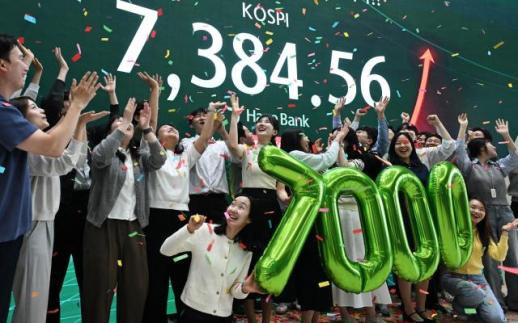 KOSPI shatters 7,300, outpacing Asia as foreign buying floods chip stocks SEOUL, May 06 (AJP) - South Korea’s benchmark KOSPI surged to a fresh record high Wednesday, sharply outperforming regional peers as foreign investors piled into semiconductor heavyweights, while most Asian markets posted more modest gains and Japan remained closed for the Golden Week holiday. The KOSPI jumped 6.5 percent to close at 7,384.56, after moving between an intraday low of 7,093.00 and a high of 7,426.60, briefly breaking above the 7,400 level during the session. The latest advance highlights the extraordinary pace of the rally, with the index surging from 4,949.59 on January 26 to above 7,300 in just over three months, driven largely by concentrated gains in semiconductor heavyweights. Foreign investors purchased 3.13 trillion won ($2.15 billion) worth of shares, while retail and institutional investors sold 572.4 billion won and 2.31 trillion won, respectively, indicating that the rally was overwhelmingly driven by offshore flows. Investor sentiment was underpinned by a strong lead from Wall Street, where the S&P 500 and the Nasdaq Composite closed at record highs, while the Dow Jones Industrial Average rose 0.7 percent. The Philadelphia Semiconductor Index climbed 4.2 percent. Sentiment was further buoyed by easing geopolitical tensions after Marco Rubio said the U.S. military operation against Iran, dubbed “Operation Epic Fury,” had concluded successfully, easing concerns over potential disruptions in the Strait of Hormuz. Oil prices extended declines, with Brent crude falling 1.4 percent to $108.3 per barrel and West Texas Intermediate crude dropping 1.4 percent to $100.8, while the VIX volatility index fell 5 percent to 17.38. The easing risk environment supported the Korean won, which strengthened to 1,454.5 per dollar, down 1 percent from the previous session, extending its recovery toward levels seen before the recent escalation in Middle East tensions. Despite South Korea’s heavy reliance on Gulf energy imports, the KOSPI has remained resilient, reflecting strong global liquidity conditions and concentrated inflows into semiconductor exporters. Sector gains were led by semiconductors and financials, with chip-related stocks and equipment makers jumping 12.1 percent. Life insurers and brokerage firms rose 11.2 percent each, supported by expectations of improved earnings amid surging trading activity. Among large-cap stocks, Samsung Electronics surged 14.4 percent to close at 266,000 won, supported by expectations of a prolonged memory upcycle and reports that Apple is considering the company as a potential foundry partner alongside Intel as part of efforts to diversify supply chains beyond TSMC. SK hynix rose 10.6 percent to 1,601,000 won, while SK Square gained 9.9 percent to 1,089,000 won. LG Energy Solution added 2.12 percent to 482,000 won, and Hyundai Motor rose 2.0 percent to 550,000 won. In contrast, Doosan Enerbility slipped 0.2 percent to 127,000 won, Hanwha Aerospace fell 2.2 percent to 1,433,000 won, while Samsung Biologics edged down 0.3 percent to 1,480,000 won and Samsung Electro-Mechanics declined 0.7 percent to 912,000 won. The KOSDAQ slipped 0.3 percent to close at 1,210.20, after moving between 1,197.01 and 1,220.90. Retail investors bought 610.1 billion won, while foreigners and institutions sold 61.6 billion won and 543.9 billion won, respectively. The divergence reflected continued weakness in biotech shares and fund rotation into large-cap semiconductor stocks on the main board. Among KOSDAQ heavyweights, Ecopro BM rose 6.03 percent to 228,500 won, and Ecopro gained 4.5 percent to 162,800 won, while Rainbow Robotics advanced 2.5 percent to 702,000 won. However, Alteogen fell 2.6 percent to 363,500 won, Samchundang Pharm slipped 0.9 percent to 406,000 won, and Lino Industrial dropped 3.4 percent to 116,700 won. HLB rose 1.3 percent to 61,700 won. Elsewhere in Asia, Hong Kong’s Hang Seng Index rose 1.1 percent to 26,178.8, and China’s Shanghai Composite gained 1.14 percent to 4,158.88, while Japanese markets remained closed for the Golden Week holiday. 2026-05-06 17:11:47
 -
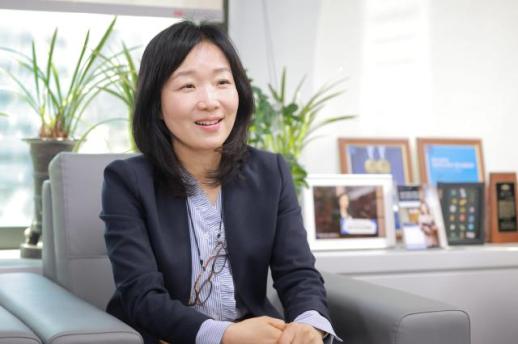 IBK Research Chief Warns Small Firms Face Failures; Calls for More Productive Lending 최근 고환율·고유가 등 대외 여건이 악화되면서 한국 경제의 허리인 중소기업들이 전례 없는 위기에 직면했다. 조달 비용 상승으로 마진은 줄고 이자조차 감당하기 어려운 한계기업이 속출하고 있다. Seo Gyeong-ran, head of the IBK Economic Research Institute, said the biggest challenge facing South Korea is what she called a “downward chain reaction of polarization.” She said global bloc tensions are widening the gap between export industries and domestic-demand industries, deepening differences in companies’ ability to recover and ultimately affecting people’s livelihoods. “Small firms’ survival is the banks’ survival,” Seo said, calling on lenders to balance productive finance and inclusive finance by learning to assess value beyond financial statements. The following is a Q&A with Seo. -최근 대내외 경제 여건이 녹록지 않다. 한국 경제를 짓누르는 가장 큰 부담 요인은 무엇인가. “Rising exchange rates and oil prices,” she said. Companies that import raw materials to process and export face higher procurement costs, squeezing already thin margins. More firms cannot cover interest with operating profit, which can lead to loan delinquencies, she said. Zombie firms with an interest coverage ratio below 1 have increased for three straight years since 2023 and are expected to rise again this year, she said. -기업 가운데 중소기업의 연체율이 급등하고 있다. 원인은 무엇인가. Seo cited three structural problems: shrinking scale, aging and polarization. Large companies are export-oriented, while small and medium-sized enterprises rely on domestic demand, she said, making it hard to build resilience and lowering survival rates. The average lifespan of long-lived companies has recently fallen to 10 years, she said. She also pointed to aging industrial infrastructure and management. Industrial complexes built for small firms in the late 1960s are now 50 to 60 years old, with high vacancy rates and weak productivity, she said. Many CEOs are 60 or older, but succession and business shifts are difficult, and young workers are no longer coming in, she said. As conditions worsen, corporate lending has concentrated in stronger, high-tech sectors, creating a financing divide that contributes to small-firm failures, she said. -올해 중소기업들의 건전성 회복은 어려울까. Small firms’ distress was delayed for about two to three years during the COVID-19 period due to government support, but delinquencies began rising again in 2022, she said. With Middle East war-related risks and tariff policy issues added this year, a prolonged period could increase pressure on soundness and delinquency rates, she said. -이런 상황에도 은행권은 생산적 금융 차원에서 기업 대출을 늘려야 한다. 어떻게 해야 기업에 도움이 되고 은행도 건전성을 지킬 수 있을까. Seo said companies can be grouped into four levels by technology: high, upper-middle, lower-middle and low. Bank funding is concentrated in upper-middle and lower-middle firms because that ecosystem is largest and often has collateral such as real estate and factories, she said. High-level firms include many technology-driven companies, while low-level firms include declining sectors such as textiles and apparel, she said. She said the institute’s role is to identify where funding is concentrated and where it is lacking and to encourage financial support accordingly. She added that the institute is also focusing on research to help banks find ways to support the upper-middle and lower-middle segments while appropriately hedging risk. -정부와 금융권, 중소기업이 어떻게 역할을 분담해야 시너지가 커질까. Seo said productive finance and inclusive finance should be pursued together in corporate lending. Narrowly, inclusive finance supports credit recovery for low-income borrowers, she said, but broadly it can include companies facing temporary difficulties due to credit ratings or the business cycle — including firms that temporarily struggle to pay interest. She said the government should design support systems that reflect these varied situations. The financial sector, she said, should be able to provide funding by assessing nonfinancial factors such as technological capability and CEO competence even when financial ratings are low. Companies also need to present long-term visions, concrete business plans and future directions such as industry shifts, she said. Firms should first seek consulting to raise productivity, with financing attached to build a sustainable structure, she said. -생산적 금융 싱크탱크 역할을 하며 어떤 것을 최우선 과제로 보고 있나. Seo said the Industrial Bank of Korea was founded in 1961 and evolved into a specialized lender for small firms as the need for SME support grew. Its creation itself marked the start of inclusive finance, she said. SMEs that were once the target of inclusive finance have grown into key players in productive finance, while some still need inclusion, she said. Finding the right balance between productive and inclusive finance is IBK’s core task, she said. -기업은행만의 차별화된 지원책은. Seo said IBK operates the largest corporate consulting center, providing free management diagnostics and connecting companies to policy funds. Based on the belief that small firms’ fortunes are tied to the bank’s, IBK is investing in nonfinancial services, she said. She added that IBK carries a heavy responsibility because it is, in her words, unique worldwide as a listed company dedicated to SME finance that reinvests its profits back into small firms. -올해 경제성장률은 어떻게 전망하나. Seo said the International Monetary Fund’s estimate for South Korea’s economic growth this year is 1.9%, below the global average of 3.1%. Many research institutions are warning of downside risks, she said. The institute analyzed five industries closely tied to energy supply chains — coal and petroleum products, electricity, chemical products, nonmetallic minerals, and transportation and warehousing — and found their sales all fell from a year earlier and by more than the overall industry average, she said. She said restoring potential growth should start with raising productivity and innovation capacity across the broader corporate ecosystem, rather than relying on the performance of a few strong companies. -앞으로 한국 경제가 집중해야 할 과제는. Seo said South Korea is already an advanced economy by GDP size and trade volume, but still has unresolved issues in business efficiency, including labor-related challenges. The most urgent issue is demographics, she said. The working-age population began declining in 2020, and low birthrates are constricting the supply of human capital, she said. She called for considering measures such as expanding women’s participation in the workforce, adopting flexible work systems and using foreign labor.* This article has been translated by AI. 2026-05-06 17:07:28
 -
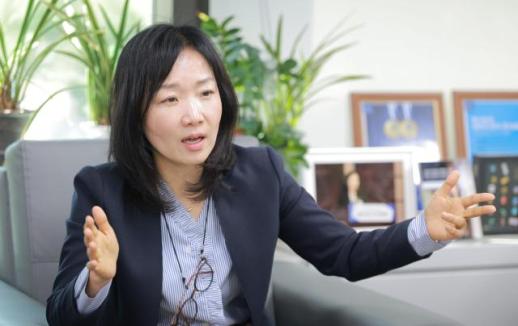 IBK Economic Research Chief: AI-Driven Industry Shift Could Be Turning Point for SMEs Seo Gyeong-ran, head of the IBK Economic Research Institute, is known as a specialist with experience across finance and industry. Building on that background, she is pushing research beyond economic analysis to examine the role of policy finance and link it to the bank’s growth strategy. Seo earned a doctorate in business administration from the University of Seoul and began her career as a researcher at the Korea Development Institute, or KDI. For more than 20 years, she has analyzed financing for small and midsize enterprises and the broader business environment, offering policy recommendations to government and the financial sector. Last year, she also worked as an expert member of the current administration’s state affairs planning committee, gaining firsthand policy experience. She is now deeply involved in setting policy direction and mid- to long-term strategy at IBK, a policy lender specializing in SMEs. Her top research focus recently has been the sweeping changes artificial intelligence is bringing to finance. With global economic uncertainty persisting and AI-driven industrial restructuring accelerating, she said the moment could be a major turning point for both the South Korean economy and its SMEs. Seo said AI should be viewed not merely as a workplace tool but as a foundation for expanding finance’s role. She argued AI can create new industries while also being integrated into manufacturing, reshaping it. Korea’s shipbuilding, auto and steel sectors, she said, should not decline in the face of AI but instead build new competitiveness by adopting it — a shift she sees as essential to sustaining the country’s potential growth rate. She expects finance to expand toward supporting corporate decision-making as AI adoption spreads. Using AI-based evaluation systems, lenders could more precisely assess growth potential and risks based on sales trends and productivity data, then design and supply tailored financial products. More customized consulting that reflects a company’s specific situation would also become possible. Seo said the success of the AI transition will hinge on data. “We are focusing on building a system that selects useful information from the vast amount of continuously generated data and links it organically,” she said. She added that “beyond simple adoption, developing business models that can generate profitability is essential,” underscoring IBK’s deliberations over its artificial intelligence transformation, or AX, roadmap.* This article has been translated by AI. 2026-05-06 17:06:08
 -
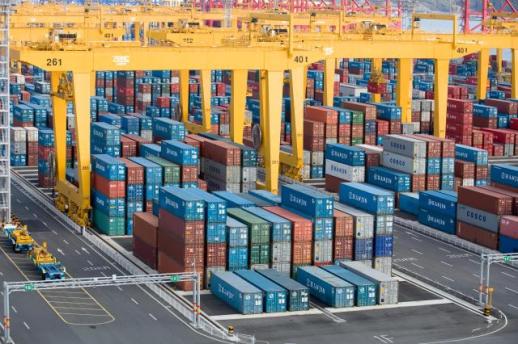 South Korea’s Q1 Exports Hit Record as Semiconductor Shipments Jump 139% South Korea posted its strongest first-quarter exports on record, helped by an artificial intelligence investment boom and a rebound in the semiconductor cycle. But the surge was heavily concentrated in chips — especially memory — raising concerns about the stability of the country’s export structure. The Ministry of Trade, Industry and Energy said Tuesday that first-quarter exports rose 37.8% from a year earlier to $219.9 billion, the highest ever for the period. The ministry cited expanding investment in AI servers and strong semiconductor demand. Semiconductor exports jumped 139% to $78.5 billion, underscoring the long-running risk of overreliance on a narrow set of products. Within semiconductors, growth diverged sharply between memory and system chips. With rising demand for high-bandwidth memory, exports of DRAM and NAND surged 249.1% and 377.5%, respectively. But system semiconductors, including foundry output, grew 13.5%. Across the broader export basket, the chip dominance was even clearer. Exports increased in 13 of the top 20 items, but semiconductors accounted for 35.7% of total exports. Exports excluding semiconductors rose 11.6%, less than half the overall growth rate. Other key industries slowed or slipped. Auto exports totaled $17.2 billion in the first quarter, down 0.3% from a year earlier. Truck exports rose, but shipments of passenger cars and vans fell. Passenger-car exports declined 2.2% to $16.3 billion, while van exports plunged 31.7%. In batteries, overall secondary-battery exports increased on strong lithium-ion battery shipments, but exports of cathode materials fell 5.5%. Steel and textiles were also weak. Steel exports were tallied as down 18.1% from the previous standard after some items were reclassified as other steel and metal products during an MTI revision. Textile exports slipped 0.6% due to weakness in fabrics and raw materials, though finished textile products held up on demand for K-fashion. Markets are increasingly wary that heavy dependence on a memory-led semiconductor supercycle could amplify volatility. The article cited uncertainty over U.S.-driven tariffs and expanding oil and supply-chain risks tied to a prolonged Middle East war as factors that could turn a concentrated export structure into a liability. Domestic risks are also in focus, including a threatened general strike by Samsung Electronics’ union. If production disruptions hit semiconductor output, the broader economy could face a significant shock. The Korea Development Institute has estimated that a 10% drop in exports due to semiconductor production disruptions would cut gross domestic product by 0.78%. The government said it is watching the risks closely. A ministry official said semiconductors are taking on the characteristics of a core industry and are closely linked to IT devices and supply chains, adding that the direction of the Middle East war is the biggest variable and that a negative scenario could hurt overall exports. * This article has been translated by AI. 2026-05-06 17:05:07
 -
 South Korea’s Q1 Exports Hit Record as DRAM and NAND Shipments Surge AI server chip exports surged in the first quarter, pushing South Korea’s DRAM exports up 249.1% and NAND flash exports up 377.5%, according to newly compiled government data. With exports reaching a record high for the period, officials and analysts said South Korea could rise to fifth in the global export rankings, ahead of Japan and Italy. The Ministry of Trade, Industry and Energy said Tuesday it revised its MTI product codes for export-import analysis and released an assessment of 2026 first-quarter trade using the updated system. The MTI codes reclassify the globally used HS codes to better reflect South Korea’s industrial structure. It was the first revision since 2020. The ministry expanded its list of major export items to 20 from 15, adding five categories including electrical equipment, nonferrous metals, agricultural and fisheries foods, cosmetics and household goods, to provide more consistent statistics and make trends easier to track. It also refined subcategories for key sectors including semiconductors, autos and biohealth. Semiconductor data now separate memory and system chips, with memory broken down into DRAM and NAND. Autos are classified by vehicle type, such as passenger and cargo vehicles. A separate MTI code was created for biohealth, with subcategories for pharmaceuticals and medical devices. Based on the revised statistics, first-quarter exports totaled $219.9 billion, up 37.8% from a year earlier, the highest on record for the period. Exports rose in 13 of the 20 major categories. Semiconductor exports jumped 139% to $78.5 billion. With memory prices rising, DRAM exports climbed to $35.79 billion and NAND flash to $5.39 billion. System semiconductors increased 13.5% to $12.11 billion. Auto exports slipped 0.3% to $17.2 billion. Cargo vehicle exports rose 63.9% to $710 million, but passenger car exports fell 2.2% to $16.3 billion and vans dropped 31.7% to $70 million. Biohealth exports rose 0.6% to $4.2 billion, and electrical equipment exports increased 2.5% to $4.05 billion. South Korea’s global export ranking could also improve. Under World Trade Organization data, South Korea ranked fifth in exports in January and February, behind China, the United States, Germany and the Netherlands. With Japan, the sixth-ranked exporter for the two-month period, trailing South Korea by about $12.9 billion, the ministry said South Korea’s chances of holding fifth place for the full first quarter improved once March results are included. A ministry official said Japan’s Ministry of Economy, Trade and Industry reported March exports in yen that, when converted to dollars, were estimated at about $189.5 billion, roughly $30 billion less than South Korea. The official said it would be the first time South Korea ranks fifth in quarterly global exports if confirmed. The ministry cited risks including the war in the Middle East. It said a negative scenario in which the conflict affects conditions through the second half of the year and influences oil prices into next year would make export trends difficult to predict. It also noted that a strike issue involving Samsung Electronics’ labor union remains unresolved. Trade Minister Kim Jeong-gwan said export conditions ahead would not be easy, citing higher oil prices from the Middle East war, global supply-chain instability and uncertainty over U.S. tariffs. He said the government would expand trade finance and export insurance to ease companies’ funding burdens and continue measures to stabilize transport and supply chains to guard against logistics disruptions and support the first-quarter export momentum.* This article has been translated by AI. 2026-05-06 17:04:42
 -
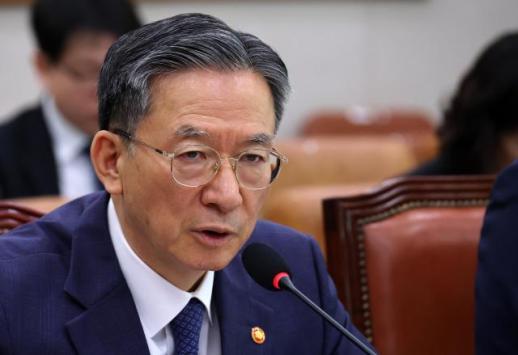 Justice Minister Jeong Seong-ho urges caution on special counsel bill over alleged prosecutorial fabrication The ruling Democratic Party is pushing a bill to appoint a special counsel to investigate allegations of fabricated investigations and indictments by prosecutors, but Justice Minister Jeong Seong-ho said the measure requires a cautious approach. Speaking at a full meeting of the National Assembly’s Legislation and Judiciary Committee on May 6, Jeong responded to a question from People Power Party lawmaker Yoon Sang-hyun, who asked whether Jeong, “as a conscientious legal professional,” would tell President Lee Jae-myung the bill should not proceed. Jeong said he agreed with the bill’s “basic legislative purpose,” but added that the special counsel’s powers and the scope of cases should be decided through deliberations in the Assembly. Jeong said suspicions were raised during a previous parliamentary investigation that the prosecution, the National Intelligence Service and the Board of Audit and Inspection abused their authority, and that prosecutors in particular may have committed significant illegal or improper acts during investigations. He said evidence had emerged that was difficult to explain away, and that the intent was to review the matter broadly. He added that, as President Lee has said, decisions on the special counsel’s authority and targets should be made through Assembly deliberations. On April 30, the Democratic Party submitted to the Assembly a bill titled the “Act on the Appointment of a Special Prosecutor to Uncover the Truth of Allegations of Fabricated Investigations and Fabricated Indictments by the Yoon Suk Yeol administration,” saying it would reexamine investigations and indictments carried out by the Supreme Prosecutors’ Office, the NIS and the audit agency during the Yoon government. The bill lists 12 cases for investigation, including seven cases that were subjects of the parliamentary investigation, such as the Daejang-dong development corruption allegations and the Ssangbangwool remittances-to-North-Korea case involving President Lee. It also includes a provision stating the special counsel would handle the maintenance of prosecutions in cases transferred to it, including decisions on whether to maintain them — language that effectively provides a basis for the special counsel to cancel indictments. After the Democratic Party submitted the bill, the opposition accused it of creating a special counsel aimed at canceling indictments to shield President Lee from criminal cases. In response to the criticism, Lee said on May 4 that the Democratic Party should decide the “specific timing and procedures” after gathering public opinion and going through a deliberative process. * This article has been translated by AI. 2026-05-06 17:03:16