
Journalist

Lee Hugh
=
-
 Hugel Launches China Medical Aesthetics Symposium Tour With Beijing Event Hugel said Thursday it will step up academic exchanges with local medical professionals by holding regional symposiums in major medical aesthetics hubs across China. Starting in Beijing, the company plans events this year in six cities: Shanghai, Guangzhou, Hangzhou, Chengdu and Wuhan. Hugel held its first event, the “Letybo Regional Symposium and Hands-on Training,” in Beijing on April 15. Kim Jeong-hwan, director of Dr. Evers Myeongdong, was invited as a speaker, and about 30 local medical professionals attended. The symposium was organized to raise awareness and trust in Hugel’s botulinum toxin product, Letybo. Participants discussed combined treatment cases using Letybo, their effects and potential future applications. “We will build a medical aesthetics exchange network based on academic events linking China’s key hub cities,” Hugel Vice President Ji Seung-uk said. He added the company aims to expand practical exchanges with local medical professionals and strengthen Hugel’s brand presence and credibility.* This article has been translated by AI. 2026-04-16 13:57:00
 -
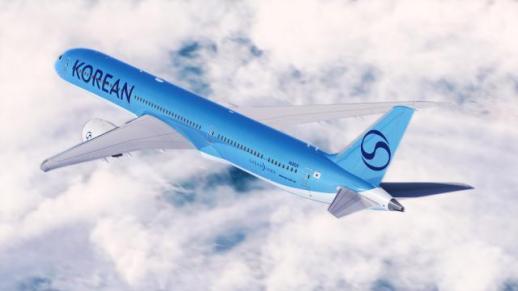 Record-high fuel surcharges to push up airfares ahead of peak summer travel season SEOUL, April 16 (AJP) - Fuel surcharges on international flights will rise to record-high levels next month as oil prices remain high, even as there are some hopes for an end to the prolonged conflict in the Middle East. Both international and domestic flight routes are subject to these surcharges, which airlines adjust based on changes in the average price of fuel traded on Singapore's spot market. According to aviation industry data released on Thursday, the average price of Singapore jet fuel, known as MOPS, soared to 511.21 cents per gallon for the period from March 16 to last Wednesday, which is used to set surcharges for May. The persistently high price will push fuel surcharges for May to the highest level on the 33-tier scale, a jump of 15 levels from this month's level of 18, the biggest jump since the scale was first implemented in 2016. Flagship carrier Korean Air will impose fuel surcharges ranging from 75,000 won to 564,000 won depending on routes, while Asiana Airlines, acquired by Korean Air in December 2024 and set to be fully integrated by early 2027, will charge between 85,400 won and 476,200 won. Low-cost carriers including Jeju Air and T'way Air have yet to release their respective surcharges for the coming month, but similar levels are expected. Accordingly, round-trip fares on long-haul routes such as those from Incheon to Europe or the U.S. are expected to rise by more than 1 million won compared with the previous month. "Hikes in fuel surcharges are unavoidable as airlines seek to recover losses caused by high oil prices," an industry insider said. "However, higher surcharges will inevitably lead to higher ticket prices, raising concerns that travel demand could weaken ahead of the peak summer vacation season." 2026-04-16 13:52:50
 -
 When K-fandom meets baseball, it's no longer just a game Fans cheer during the LG Twins–SSG Landers game at Jamsil Baseball Stadium in Seoul on April 11, 20 SEOUL, April 16 (AJP) - Fanchant, glow sticks, choreographed dancing and a brisk run on merchandise stands — the ritual of K-pop no longer ends at the arena gates. In South Korea, it now spills into the ballpark. Spring, for a growing legion of fans, is no longer about cherry blossoms. It’s about the first flash of team colors under stadium lights, the hum of a crowd finding its rhythm again. Baseball season, like a long-awaited comeback tour, has its own opening night energy. “Ballparks aren’t old men’s turf anymore,” one fan said with a grin, half-shouting to be heard over the music blaring between innings. And she’s right. The Korea Baseball Organization (KBO), founded 45 years ago, is in the middle of a transformation that veteran observers say they’ve never quite seen before. Last year, the league drew a record 12.31 million fans and generated more than 1 trillion won ($740 million) in economic impact. This season, the KBO League is already rewriting its own playbook. It surpassed 1 million spectators in just 55 games over 14 days — the fastest and fewest games on record — breaking last year’s pace only one year later. With 440,000 fans pouring into preseason games, the league is now swinging for 13 million. At this trajectory, another record year no longer looks like a stretch. “It’s not just a game anymore” On a mild weekend afternoon around Jamsil Sports Complex, the air carries a familiar refrain: “Seoul LG, run toward your dreams!” The chant rolls out of the subway exits before fans even glimpse the field. Streams of supporters in red jerseys move like a tide toward the stadium, phones already out, voices already warming up. Among them, the new face of Korean baseball is impossible to miss — women in their 20s and 30s, many in character —collaboration uniforms, some clutching light sticks, others filming snippets for social media before first pitch. “It’s not just about watching the game anymore,” said 23-year-old LG Twins fan Yoo Eun-seo, pausing between takes of a cheer she was recording with friends. “It feels like a full day out — like a festival.” That shift — from spectator sport to immersive experience — is reshaping everything. A fan in her 20s or 30s wearing a Hello Kitty collaboration uniform watches the LG Twins–SSG Landers game at Jamsil Baseball Stadium in Seoul on April 11, 2026. AJP Yoo Na-hyun The new economy of fandom Start with the concessions. Gone are the days when boiled silkworm pupae and draft beer defined the ballpark palate. In their place: mala skewers, fruit ades, designer desserts — food that looks as good on camera as it tastes. Then there’s the merchandise. At team stores, jerseys no longer dominate alone. Key rings, photo cards, and character collaborations fill the shelves. At kiosks, lines stretch long for collectible cards — fans chasing their favorite players like rare pulls in a trading pack. “I keep buying until I get the player I want,” said 26-year-old LG Twins fan Park si-hyun, laughing as she flipped through a fresh stack. “There’s just so much variety now — it makes you want more.” The numbers back it up. According to ticketing platforms, women in their 20s and 30s accounted for 36.6 percent of ticket purchases last year — surpassing their male counterparts in the same age group. The stadium naturally has to change to meet the new demand. “The KBO League is no longer just about watching games. It has evolved into an experience-driven leisure culture that combines food, entertainment and social engagement,” a KBO spokesman said. “Regardless of the outcome, there are now far more elements that encourage fans to stay longer and spend.” The spokesman added that improvements in facilities — including restroom cleanliness and nursing rooms — are helping create an environment tailored to women and family audiences. Efforts are also focused on ensuring a safe viewing experience, expanding amenities, and strengthening merchandise and content offerings. “Under a ‘fan-first’ approach, clubs are enhancing fan services, which has significantly narrowed the distance between players and supporters,” he added. Fans line up at a kiosk to print custom photo cards at the LG Twins goods shop inside Jamsil Baseball Stadium in Seoul on April 11, 2026. A stadium that sings Inside a packed 23,000-seat stadium, the noise is constant — not just cheers, but synchronized singing, a rolling chorus that rises and falls with each at-bat. Phones are always up. Moments are captured in real time — a home run swing, a pitcher’s stare, a perfectly timed dance break between innings. And when the final out is recorded, no one rushes for the exits. Fans linger. They pose with slogans, trade photos, relive the game in curated snapshots for their feeds. The experience doesn’t end with the scoreboard; it extends into the afterglow. Baseball here is no longer just watched. It’s performed, shared, and archived. Fans receive autographs from players after the LG Twins–SSG Landers game at Jamsil Baseball Stadium in Seoul on April 11, 2026. AJP Yoo Na-hyun From players to personas The way fans connect with players is evolving, too. Performance still matters — but so do personality, storytelling, and fan service. Players are no longer just athletes; they’re characters in an unfolding narrative, each with their own following. Clusters of fans wait after games along the players’ exit routes, hoping for a glimpse, a signature, a fleeting interaction. “Once you see a game live, you start to have a favorite player,” Yoo said. “Then you keep coming back.” It’s the logic of fandom — familiar to K-pop, now fully embedded in baseball. Fans take photos with team merchandise during the LG Twins–SSG Landers game at Jamsil Baseball Stadium in Seoul on April 11, 2026. AJP Yoo Na-hyun A customer looks at KBO League collaboration merchandise at a Starbucks store on March 30, 2026. AJP Yoo Na-hyun Beyond the Diamond The ripple effects are spreading far beyond the stadium walls. Major brands — from coffee chains to convenience stores — are rolling out collaborations with teams, extending the fan experience into everyday life. According to the Hyundai Research Institute, professional baseball now generates more than 1.1 trillion won in annual consumption spending, while combined ticket revenues for the league’s 10 clubs have topped 200 billion won for the first time. A spectator watches the LG Twins–SSG Landers game at Jamsil Baseball Stadium in Seoul on April 11, 2026. AJP Yoo Na-hyun On game days, nearby businesses report sales surging by over 90 percent. This is no longer just a sport. It’s an ecosystem. What’s unfolding in Korean baseball isn’t a fleeting trend. It’s a structural shift — driven by a new audience that consumes differently, participates actively and expects more than just nine innings. Fans wait for players after the LG Twins–SSG Landers game at Jamsil Baseball Stadium in Seoul on April 11, 2026. AJP Yoo Na-hyun Like any great season, the game builds inning by inning. And if the early crowds are any indication, this one is headed for a record finish — with a soundtrack, a light show and a fan base that knows every word by heart. Park Eun-seo (30, left) and Lee Na-young (30, right) pose for a photo after the LG Twins–SSG Landers game at Jamsil Baseball Stadium in Seoul on April 11, 2026. AJP Yoo Na-hyun 2026-04-16 13:34:28
 -
 BTS and K-culture boom lift tourist arrivals in Korea to record high Q1 SEOUL, April 16 (AJP) - Foreign tourist arrivals to South Korea rose to a record high in the first quarter, as global demand for Korean cultural content from highly anticipated K-pop supergroup BTS' return to digital hits like K-pop Demon Hunters continued to drive travel interest, Ministry of Culture, Sports and Tourism said Wednesday. Inbound visitors reached 4.76 million in the January–March period, up 23 percent from a year earlier, with March alone setting a monthly record of 2.06 million, according to the Ministry of Culture, Sports and Tourism. The growth was broad-based across key markets. Chinese tourists led with 1.45 million arrivals, followed by Japan at 940,000 and Taiwan at 540,000, the latter posting the fastest growth rate at 37.7 percent. Long-haul travel also gained traction, with visitors from the United States and Europe reaching a combined 690,000, signaling continued diversification of inbound demand. Beyond volume, indicators pointed to improving tourism quality. Cruise traffic rose 52.9 percent on-year to 338 port calls, while arrivals through regional airports surged 49.7 percent, reflecting increased travel beyond major gateways. Spending by foreign visitors climbed 23 percent to 3.21 trillion won, while overall travel satisfaction reached 90.8 points, suggesting stronger consumption and visitor experience. The ministry attributed the growth to the global appeal of K-culture and coordinated efforts between public and private sectors. Kang Jung-won, director general for tourism policy, said Korea is solidifying its position as a global tourism destination, but warned of potential headwinds from rising airfares linked to higher oil prices and geopolitical uncertainty. "We will proactively respond to external risks to sustain the growth of inbound tourism," Kang said. 2026-04-16 11:39:18
 -
 Asian markets rise on hopes for upcoming US–Iran talks as KOSPI stays above 6,000 SEOUL, April 16 (AJP) - Asian markets opened broadly upbeat on Thursday as hopes for a possible end to the conflict in the Middle East started to rise ahead of another round of talks between the U.S. and Iran in Pakistan this month. Japan's Nikkei 225 rose 1.73 percent to 59,139.58. Hong Kong's Hang Seng Index rose 0.73 percent to 26,137.49, and China's Shanghai Composite Index rose 0.17 percent to 4,033.92. South Korea's benchmark KOSPI also extended its gains, rising 1.71 percent to 6,195.54, while the junior KOSDAQ gained 1.11 percent to 1,165.20 shortly after the day's trading began. Large-cap stocks mostly traded higher. Among chipmakers, Samsung Electronics rose 1.66 percent to 214,500 won, and SK hynix gained 0.79 percent to 1,145,000 won. Auto stocks were also broadly higher, led by Hyundai Motor, which jumped 5.71 percent to 537,000 won, on growing expectations for the commercialization of autonomous driving technologies. The automaker has laid out its roadmap through the adoption of NVIDIA's Hyperion platform and a collaboration with Google DeepMind on vision-language-action (VLA) models. The gains were further supported by comments from president José Muñoz, highlighting a broader push into future mobility technologies. He stressed plans to expand autonomous driving capabilities and integrate robotics into manufacturing including the deployment of Boston Dynamics' Atlas humanoid robots on assembly lines. Its affiliates including Kia, Hyundai Mobis and Hyundai Glovis, also rose 4.09 percent, 3.13 percent and 2.72 percent, respectively. Among other major companies, SK Square rose 2.26 percent to 680,000 won, and Hanwha Aerospace added 1.59 percent to 1,533,000 won. Doosan Enerbility surged 5.95 percent to 110,400 won, while HD Hyundai Heavy Industries climbed 4.21 percent to 494,500 won. Financials sectors were also higher, with KB Financial Group up 2.59 percent at 162,300 won and Samsung Life Insurance gaining 1.36 percent to 261,500 won. In particular, communications and broadcasting equipment maker Innox Instruments was the top gainer across both the KOSPI and the KOSDAQ since Feb. 27, surging more than tenfold, or 1,042.11 percent, over the period. It was trading at 4,450 won in morning trade, up 2.53 percent from the previous close. The rally also extended across the broader optical communications value chain. Wooriro jumped 882.70 percent, followed by Kwang Electronics at 773.71 percent, Gigalein at 480.28 percent, Bit & Electronics at 468.00 percent, and Taihan Fiberoptics at 383.52 percent. Momentum accelerated after Nvidia's CEO Jensen Huang highlighted photonics as a key future technology at its annual tech conference GTC in San Jose last month, drawing investor attention to companies involved in optical semiconductors, fiber optics and cable infrastructure. The trend is driven by long-term demand. As global tech companies invest more in data centers and artificial intelligence (AI)-related infrastructure, demand for faster data transmission is expected to grow, supporting further gains in the sector. Meanwhile, Samchundang Pharm, which had been previously flagged for not properly reporting earnings forecasts on March 31, fell in early trading after the Korea Exchange referred the company to its KOSDAQ disclosure review committee. The stock was trading at 532,000 won as of around 10 a.m., down 4.14 percent. Among other stocks on the KOSDAQ, performance was mixed across sectors. Battery materials stocks saw modest gains, with EcoPro rising 0.95 percent to 149,300 won and EcoPro BM adding 1.23 percent to 205,000 won. Pharmaceutical and biotech stocks showed mixed moves. Alteogen edged down 0.40 percent to 371,500 won, while Celltrion Pharm gained 1.47 percent to 620,000 won. ABL Bio rose 1.77 percent to 166,700 won, and Kolon TissueGene jumped 3.44 percent to 108,400 won. HLB declined 3.37 percent to 65,900 won. The Korean won was slightly weaker against the dollar, trading at 1,475.10 won, compared with the previous close of 1,474.20. Earlier, the S&P 500 on Wall Street rose 0.80 percent to close at 7,022.95 overnight, setting a record high. The Nasdaq Composite gained 1.59 percent to 24,016.02 while the Dow Jones Industrial Average edged down 0.15 percent to 48,463.72. 2026-04-16 11:18:42
 -
 TOMORROW X TOGETHER Turns the Page With a More Direct Story on 'The Seventh Year' Dozens of songs and works are created every day, but many never reach a wide audience. The same is true for the artists who sing and act — even strong talent can be overlooked. “Artist Spotlight” introduces artists across fields and tracks their growth, as well as offering an affectionate tribute. <Editor’s note> TOMORROW X TOGETHER’s music has long been built like a continuing narrative, with album series that read as chapters in a coming-of-age story. The group, under BigHit Music, debuted March 4, 2019, as a five-member multinational boy band. Its name means that “you and I, different from each other, come together in one dream to make tomorrow together.” That storyline has moved through releases including “The Dream Chapter: STAR,” “The Dream Chapter: MAGIC” and “The Dream Chapter: ETERNITY,” followed by “minisode1 : Blue Hour.” It continued with “The Chaos Chapter: FREEZE” and “The Chaos Chapter: FIGHT OR ESCAPE,” then “minisode 2: Thursday’s Child,” tracing emotions from excitement and discovery to rupture, confusion, desire and the aftermath of a first breakup. The narrative, however, has not stayed only in a fictional framework. The meaning of the group’s name has been reinforced in its real-life teamwork, marked by trust and affection and a steady commitment to moving forward together. Ahead of their seventh anniversary, all five members renewed their contracts, a decision that underscored they were choosing the next stage as a group. That shift comes into sharper focus on the mini-album “The Seventh Year: When the Wind Stopped for a Moment in the Thornbush.” Where the group previously expressed growing pains through a “boy” persona and an overarching universe, the new release looks more directly at the present — the responsibility and expectations that have accumulated since debut, the gap between ideals and reality, and the anxiety and worry they felt before renewing their contracts. Even as the approach becomes more direct, the group’s emotional texture remains consistent: less blunt force than a feeling that slowly spreads. The mood is often dreamy with a cool edge and a damp lyricism, and the album title and subtitle extend that sensibility, using “thorns” as a metaphor for past pain and a brief calm amid ongoing unease. Those themes carry through the track list. “One More Day” (“하루에 하루만 더”) sings of the desperation to hold on to a love that is nearing its end, while also pointing to determination to keep pursuing a dream — a sentiment the article links to the group’s mindset after renewing contracts. “Bed of Thorns” addresses accepting the results of choices, while “So What” lays out the anxieties and 고민 of the past seven years in more direct terms. “Take Me to Nirvana” and “21st Century Romance” turn to sensations of release and inner signals. The closing track, “Next of Next” (“다음의 다음”), leaves the future uncertain but insists on moving toward tomorrow. In that sense, the album is not simply a “new chapter.” It reframes long-built trust and affection — along with the instability that can come with it — in a more realistic grain. The group’s story, once read mainly as a fictional growth narrative, is now closer to its own names and feelings. The pages, it suggests, are still turning.* This article has been translated by AI. 2026-04-16 10:33:44
 -
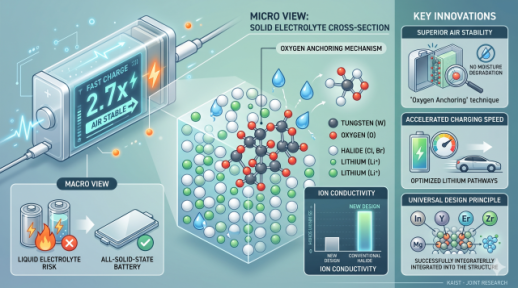 South Korean researchers develop air-stable solid electrolyte for faster battery charging SEOUL, April 16 (AJP) - A joint research team led by the Korea Advanced Institute of Science and Technology has developed a new design technology for solid-state battery electrolytes that maintains structural stability in air while significantly increasing charging speeds. This advancement addresses the chronic vulnerability of halide-based solid electrolytes to moisture, which has long been a barrier to the mass production of safer energy storage systems. The technology could be applied to various sectors, including electric vehicles, robotics, and urban air mobility. The prominent institute said Thursday. Unlike conventional lithium-ion batteries that use flammable liquid electrolytes, all-solid-state batteries utilize solid materials to virtually eliminate the risk of fire and explosion. Halide-based solid electrolytes are considered a leading candidate for these batteries due to their high performance, but they typically degrade rapidly when exposed to humidity in the air. This degradation necessitates expensive moisture-free manufacturing environments and raises safety concerns if the battery is exposed to the elements. To overcome this limitation, the research team introduced a structural technique called oxygen anchoring. This method involves using tungsten to securely bond oxygen within the electrolyte's internal structure, creating a more durable framework. The strong electrostatic attraction of the hexavalent tungsten ensures the oxygen remains fixed, which effectively inhibits the chemical breakdown that occurs when halide materials contact water. The researchers from the Korea Advanced Institute of Science and Technology (KAIST), collaborated with teams from Dongguk University, Yonsei University, and Chungbuk National University to find that this oxygen-anchored electrolyte remained stable in open-air environments. The structural modification also created wider and smoother paths for lithium ions to travel, resulting in higher efficiency. By lowering the energy barrier for ion movement, the material allows for much faster transfer of electricity. Laboratory tests confirmed that the new material achieved an ionic conductivity approximately 2.7 times higher than existing zirconium-based halide electrolytes. This improvement suggests that batteries using this material could be charged at much higher speeds without sacrificing safety or performance. The research demonstrated that this design strategy is a universal principle that can be applied to various other halide electrolytes, including those based on indium, yttrium, and erbium. "This research presents a new material design principle that optimizes multiple performances through a structural design strategy that simultaneously improves air stability and ionic conductivity," Professor Seo Dong-hwa said. "It will serve as a key indicator for future all-solid-state battery research and process development." Dr. Kim Jae-seung, Park Hee-ju, and Kim Hae-yong served as co-first authors of the study. The findings were published in the international academic journal Advanced Energy Materials on March 6, 2026. (Reference Information) Journal/Source: Advanced Energy Materials Title: Universal Oxychlorination Strategy in Halide Solid Electrolytes for All-Solid-State Batteries Link/DOI: https://doi.org/10.1002/aenm.202506744 2026-04-16 10:20:42
 -
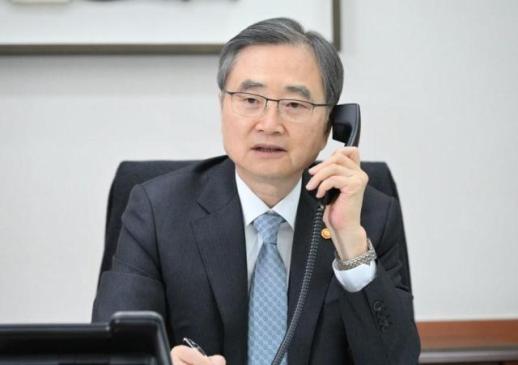 FMs of South Korea and Brazil seek closer cooperation on supply chains SEOUL, April 16 (AJP) - Foreign Minister Cho Hyun spoke with his Brazilian counterpart Mauro Vieira to discuss measures to address supply chain disruptions amid the prolonged conflict in the Middle East, the Ministry of Foreign Affairs said on Thursday. According to the ministry, Cho spoke with him by phone the previous day, during which he explained South Korea is making an all-out effort to secure alternative routes and sources for crude oil and other resources, citing the country's heavy reliance on the Middle East for its energy imports. Cho then expressed hope to expand cooperation with Brazil, South America's largest crude oil producer, while maintaining close consultation on various global issues. Their talks came less than a month after they met on the sidelines of the G7 Foreign Ministers' meeting in France in March. The two also agreed to continue discussing ways to implement the outcomes made during Brazilian President Luiz Inácio Lula da Silva's visit to Seoul for a summit with President Lee Jae Myung in February. 2026-04-16 10:20:28
 -
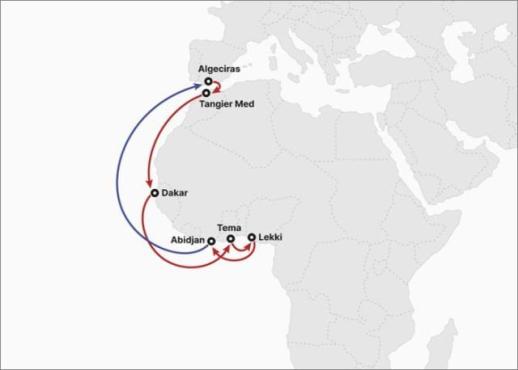 HMM to launch West Africa container service, expanding global network SEOUL, April 16 (AJP) - HMM will launch a new shipping route connecting Spain and West Africa in July, marking its first foray into the African continent as part of a broader push to extend its global reach. The new service announced Thursday, designated MA2 (Mediterranean West Africa), will operate out of Algeciras, Spain — a key Mediterranean hub — and call at ports in Morocco, Senegal, Ghana, Nigeria, and Cote d'Ivoire. The round voyage takes about 35 days and will deploy five container vessels of about 2,800 twenty-foot equivalent units (TEU) each. HMM will co-operate the service with Japan's Ocean Network Express, a fellow member of the Premier Alliance. Sailings are scheduled to begin in the second week of July from Algeciras. The MA2 route is the first tangible step under HMM's hub-and-spoke strategy, a central pillar of the carrier's 2030 long-term plan, in which large vessels handle major deep-sea trunk routes while smaller feeder ships branch out to secondary ports. The company said linking Africa — a market it had not previously served — would meaningfully broaden the services it can offer cargo shippers. "This MA2 service will serve as a starting gun for strengthening HMM's global network through the hub-and-spoke strategy," said an HMM spokesperson, adding the company plans to keep raising customer satisfaction through differentiated service offerings. To support the strategy, HMM has been steadily building up its feeder fleet. The company placed an order for 10 vessels of 2,800 TEU with HD Hyundai Heavy Industries in March, acquired two 1,900 TEU ships earlier this year, and in October 2025 ordered a combined 24 feeder vessels — securing about 24 feeders within a six-month span. 2026-04-16 09:56:47
 -
 Koyote’s Shinji and singer Moon Won cancel honeymoon plans amid Middle East war Koyote member Shinji and singer Moon Won, who are set to marry in May, said they have decided to forgo their honeymoon because of the war in the Middle East. A video titled “A Hannam-dong date course that’s perfect to go on right now” was posted Tuesday on the YouTube channel “Eotteoshinji?!” In the video, Shinji said that with about a month left before the wedding, they decided not to take a honeymoon trip. “Dubai was our transit point, but the situation in the Middle East is dragging on,” she said. She said the plan she originally mapped out “fell apart,” and added that they discussed waiting and taking the route they wanted once conditions improve. “I thought about it for about a month,” she said. Moon Won said the stress at the time caused him to lose weight and become “gaunt.” Shinji said she had wanted to visit Dubai because memories of experiencing the desert sand were vivid, and she also wanted to ride the “Ferrari roller coaster.” Shinji and Moon Won are scheduled to hold their wedding ceremony May 2. The two became a couple after meeting through the radio program “Singlebungleshow,” where Shinji served as DJ. In a handwritten letter in January, Shinji said that living together had brought them closer, strengthened trust and made her grateful to have “someone fully on my side.” She added that they had come to rely on each other and become “stronger.” She also said she was aware of the “affectionate concerns and worries” from many people, and pledged to move forward step by step without changing.* This article has been translated by AI. 2026-04-16 09:33:16