
Journalist

Lee Hugh
=
-
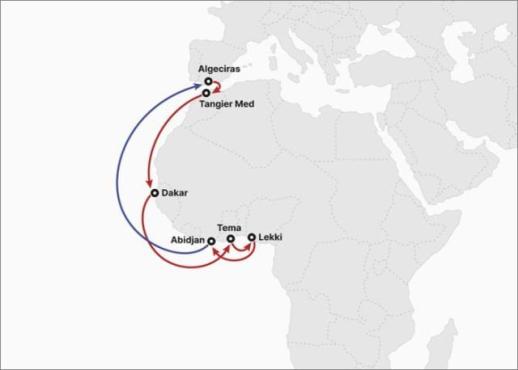 HMM to launch West Africa container service, expanding global network SEOUL, April 16 (AJP) - HMM will launch a new shipping route connecting Spain and West Africa in July, marking its first foray into the African continent as part of a broader push to extend its global reach. The new service announced Thursday, designated MA2 (Mediterranean West Africa), will operate out of Algeciras, Spain — a key Mediterranean hub — and call at ports in Morocco, Senegal, Ghana, Nigeria, and Cote d'Ivoire. The round voyage takes about 35 days and will deploy five container vessels of about 2,800 twenty-foot equivalent units (TEU) each. HMM will co-operate the service with Japan's Ocean Network Express, a fellow member of the Premier Alliance. Sailings are scheduled to begin in the second week of July from Algeciras. The MA2 route is the first tangible step under HMM's hub-and-spoke strategy, a central pillar of the carrier's 2030 long-term plan, in which large vessels handle major deep-sea trunk routes while smaller feeder ships branch out to secondary ports. The company said linking Africa — a market it had not previously served — would meaningfully broaden the services it can offer cargo shippers. "This MA2 service will serve as a starting gun for strengthening HMM's global network through the hub-and-spoke strategy," said an HMM spokesperson, adding the company plans to keep raising customer satisfaction through differentiated service offerings. To support the strategy, HMM has been steadily building up its feeder fleet. The company placed an order for 10 vessels of 2,800 TEU with HD Hyundai Heavy Industries in March, acquired two 1,900 TEU ships earlier this year, and in October 2025 ordered a combined 24 feeder vessels — securing about 24 feeders within a six-month span. 2026-04-16 09:56:47
 -
 Koyote’s Shinji and singer Moon Won cancel honeymoon plans amid Middle East war Koyote member Shinji and singer Moon Won, who are set to marry in May, said they have decided to forgo their honeymoon because of the war in the Middle East. A video titled “A Hannam-dong date course that’s perfect to go on right now” was posted Tuesday on the YouTube channel “Eotteoshinji?!” In the video, Shinji said that with about a month left before the wedding, they decided not to take a honeymoon trip. “Dubai was our transit point, but the situation in the Middle East is dragging on,” she said. She said the plan she originally mapped out “fell apart,” and added that they discussed waiting and taking the route they wanted once conditions improve. “I thought about it for about a month,” she said. Moon Won said the stress at the time caused him to lose weight and become “gaunt.” Shinji said she had wanted to visit Dubai because memories of experiencing the desert sand were vivid, and she also wanted to ride the “Ferrari roller coaster.” Shinji and Moon Won are scheduled to hold their wedding ceremony May 2. The two became a couple after meeting through the radio program “Singlebungleshow,” where Shinji served as DJ. In a handwritten letter in January, Shinji said that living together had brought them closer, strengthened trust and made her grateful to have “someone fully on my side.” She added that they had come to rely on each other and become “stronger.” She also said she was aware of the “affectionate concerns and worries” from many people, and pledged to move forward step by step without changing.* This article has been translated by AI. 2026-04-16 09:33:16
 -
 BLACKPINK's Jennie named among TIME magazine's '100 Most Influential People' SEOUL, April 16 (AJP) - Jennie, a member of K-pop girl group BLACKPINK, has been included in TIME magazine's annual list of the "100 Most Influential People" for this year released on Wednesday. "What makes Jennie a true star is that even in her quiet moments, she possesses the same kind of undeniable presence that cuts through all the noise, and she carries that with kindness and warmth," the magazine wrote. "She is the type of person who will grab both your hands and squeeze them. She has a softness that only emphasizes her strength," it added. The U.S. magazine has released its annual list of influential figures including political leaders, business executives, entertainers, and athletes who have made a significant impact around the world. This year's list includes figures divided into six categories: Artists, Icons, Leaders, Innovators, Pioneers, and Titans, with Jennie becoming the only K-pop artist to make the list for this year. Having earned global recognition as a K-pop star, she has garnered a devoted following through her versatility across music, fashion, and acting. Meanwhile, the remixed version of her song "Dracula" in collaboration with Tame Impala, the music project of Australian singer and multi-instrumentalist Kevin Parker, has been nominated for "Song of the Summer" at this year's American Music Awards scheduled for late May. Released last February, her song will also compete for the prize along with K-pop juggernaut BTS' latest track "SWIM" among other nominees. 2026-04-16 09:29:42
 -
 KakaoBank Launches 'Project Again, Spring' to Help Youth in Financial Crisis KakaoBank said April 16 it has signed a memorandum of understanding with Together Making a World (Social Solidarity Bank) and the Credit Recovery Committee to run “Project Again, Spring,” a program aimed at helping young people in financial crisis become self-reliant. The program targets people ages 19 to 39 who have difficulty using financial services or are undergoing debt restructuring, helping them rebuild credit and re-enter the formal financial system. KakaoBank first launched the project last year by donating 1 billion won to the Social Solidarity Bank to create a fund to support youth in financial distress. Under this year’s agreement, the Social Solidarity Bank will use KakaoBank’s donation to offer ultra-low-interest loans at an annual rate of 1%: living-expense loans of up to 3 million won and refinancing loans for high-interest debt of up to 5 million won. It will also provide financial checkups and financial education. The Credit Recovery Committee will identify and connect young people who need support. A KakaoBank official said the bank wants to help young people facing economic hardship “find hope again and stand on their own,” adding it will continue to pursue inclusive finance for vulnerable groups.* This article has been translated by AI. 2026-04-16 09:21:00
 -
 MMCA to Open Hands-On Children’s Exhibition ‘Still, the Days We Tried’ The National Museum of Modern and Contemporary Art, Korea, said Wednesday it will open “Still, the Days We Tried” on April 17 at the MMCA Children’s Space on the second floor of the education wing at its Seoul museum. The MMCA Children’s Space is a family-focused area first introduced at the Seoul museum in 2025 to broaden children’s and family visitors’ museum experiences through participatory exhibitions and education grounded in contemporary art. The exhibition is presented with artist Yang Jung-uk, the 2024 winner of the museum’s flagship award, Artist of the Year. It features three new works and includes ongoing hands-on workshops designed to help visitors engage with the exhibition’s themes. The title reflects the idea that failure and repetition in the act of trying can lead to new attempts. The museum said the program is intended to help children experience experimentation in the creative process and view failure as a new possibility. Yang will show three new works: “Temporary Map” (2026), “A Small Person and an Even Smaller Person” (2026) and “Watching You” (2026). The museum said the works build on the artist’s view that it can be enough even without explicitly showing something, underscoring that the process itself has meaning. Children can look closely at the works to observe movement and structure and explore how they operate and what they mean. Three always-available workshops linked to the works will offer children a chance to make, try and learn through a range of materials and activities. The artist said he hopes children will focus on attitude and process rather than achievement and results. The museum said the programs can help children build self-efficacy and develop a more positive view of failure by experiencing the artist’s working methods and creative process. Related education programs will also run during the exhibition, including the regular “Museum Kids TokTok” for preschool and elementary school groups and the weekend “Museum Family TokTok” for families with children. Details are available on the MMCA website. Separately, the museum said it has traditionally closed only three days a year — Jan. 1 and the day of Lunar New Year and Chuseok — but will begin a pilot program in 2026 to add temporary closures for safety inspections as visitor numbers rise. It will close on the first Tuesday of June, September and December (6.2., 9.1., 12.1.). * This article has been translated by AI. 2026-04-16 09:12:31
 -
 Park Jeonghye Named Chair of Overseas Korean Cultural Heritage Foundation The Korea Heritage Service said it will appoint Park Jeonghye, a professor at the Academy of Korean Studies’ Graduate School of Korean Studies, as the fifth chair of the Overseas Korean Cultural Heritage Foundation, effective April 16. Her three-year term runs through April 15, 2029. Park has served as president of the Korean Society of Art History, a member of the National Institute of Korean History, dean of the Academy of Korean Studies’ Graduate School of Korean Studies, and chair of the Movable Cultural Heritage Subcommittee of the Cultural Heritage Administration’s Cultural Heritage Committee. The foundation, an affiliate of the Korea Heritage Service, was established in July 2012 to carry out comprehensive and systematic projects related to surveying and researching Korean cultural heritage held overseas, as well as its repatriation and use.* This article has been translated by AI. 2026-04-16 09:04:54
 -
 Comedian Lee Su-ji Satirizes Fake News Targeting Middle-Aged and Older Viewers Comedian Lee Su-ji, who recently drew attention for a satire of kindergarten teachers, has released a new video lampooning the spread of fake news aimed at middle-aged and older audiences. On April 14, Lee posted a video titled “Poet Hwang Jeong-ja’s Lively Day! ” on her YouTube channel, “Hot Issueji.” In the video, Lee plays a character named “Hwang Jeong-ja,” a poet, and spends the day dining out, visiting a cafe and shopping at a department store with Na Bok-ja (Na Bo-ram), introduced as a “silver star” who appeared on the TV program “Achim Madang.” Near the end, Hwang points to her phone and says, “This morning it says this person died.” When the production team tells her it is fake news and should not be believed, she responds angrily, saying people who make such lies “should go to prison.” As she scrolls through other items, Hwang asks, “So is it also a lie that this person got divorced? Why would there be smoke if there’s no fire?” Viewers reacted online with comments such as, “It’s like my parents,” “Fake news needs strong punishment,” and “It’s funny, but bitter.” Lee previously drew widespread attention with an April 7 video titled “Kindergarten Teacher Lee Min-ji’s Never-Ending 24 Hours — Human Documentary: A Real Extreme Job,” parodying a teacher overwhelmed by excessive work and complaints from parents. 2026-04-16 08:51:46
 -
 Court Rejected Hwang Seok-hee’s Claim of Blackout Drunkenness in Sex-Crime Case Translator Hwang Seok-hee, 47, who has faced controversy over past sex-crime convictions, had a court reject his claim that he was mentally incapacitated due to extreme intoxication during his trial, according to a broadcast report. Attorney Park Eun-seok said on YTN’s “Case X-File” on April 13 that the charge of indecent assault causing injury carries a heavy statutory penalty under the Criminal Act, punishable by life imprisonment or at least five years in prison. Park said prison sentences are often imposed because the offense involves not only indecent assault but also injury to the victim. He added that the court’s decision to grant a suspended sentence likely reflected settlements with the victims, and that Hwang’s lack of prior criminal record at the time may also have been a factor. Park said, however, that the court did not accept Hwang’s argument that he was mentally incapacitated because he was heavily intoxicated. Hwang was thrust into controversy after Dispatch reported on March 30 that he had been indicted and convicted in cases from 2005 and 2014 on charges including indecent assault causing injury and quasi-rape. In 2014, he was also indicted on charges including quasi-rape involving a student. In both cases, he received suspended prison sentences. On March 30, Hwang wrote on social media that he was reviewing the matter with his lawyer and would consider seeking corrections and taking action if any parts were inaccurate or went beyond the scope of legal judgment. Hwang is known for translating major works including “Deadpool,” “Spider-Man,” “Bohemian Rhapsody” and “Project Hail Mary,” and has also published essays and given lectures.* This article has been translated by AI. 2026-04-16 08:15:16
 -
Jennie Named to Time’s 2026 100 Most Influential People List, Only K-pop Artist Selected Singer Jennie has again underscored her global reach. On April 15 (local time), U.S. newsmagazine Time published its list of the “2026 100 Most Influential People in the World” on its website. Jennie was the only K-pop artist named to this year’s list. The Time 100 recognizes people worldwide for influence, innovation and achievement across fields. Jennie’s recent results have also drawn attention. Her first full-length solo album, “Ruby,” was included in Rolling Stone’s “The 100 Best Albums of 2025.” She also ranked No. 1 on Forbes Korea’s “KOREAN IDOLS OF THE YEAR 2025.” Her chart performance has been notable as well. “Dracula (JENNIE Remix),” a collaboration with Tame Impala, reached a career-high No. 17 on Billboard’s Hot 100. The track also topped Billboard’s Hot Dance/Electronic Songs chart, a first for a K-pop female solo artist. The song was also nominated for Song of the Summer at the 2026 American Music Awards. Time’s full 2026 Time 100 list is available on the magazine’s official website. * This article has been translated by AI. 2026-04-16 08:04:03
-
 Foreigners dump over $30 bn KOSPI shares and turn net bond sellers in March SEOUL, April 16 (AJP) -Foreign investors staged a record monthly sell-off in South Korean equities in March amid risk aversion and concerns over the energy-dependent economy from the outbreak of the conflicts in the Gulf and de-facto blockade of the Strait of Hormuz. According to the Financial Supervisory Service on Thursday, foreigners net sold 43.5 trillion won ($31.8 billion) worth of locally listed shares last month, more than doubling from February’s 19.6 trillion won outflow. The exodus was concentrated in the benchmark KOSPI which was making record-breaking rally until the war outbreak. Foreign nationals 43.9 trillion won on the main bourse, while posting a modest 384 billion won net buy in the KOSDAQ. By end-March, foreign holdings of Korean equities fell to 1,576.2 trillion won, down 449.4 trillion won from a month earlier, with their ownership share slipping to 30.7 percent of total market capitalization. The sell-off was broad-based across regions. Europe led the outflows with 26.4 trillion won, followed by the Americas at 9.8 trillion won and Asia at 5.6 trillion won, while the Middle East was the only region to post a net purchase. At the country level, the United Kingdom and the United States accounted for the bulk of selling, while Qatar and the Cayman Islands were among the few net buyers. In fixed income, foreign investors turned net sellers for the first time in five months, withdrawing 10.9 trillion won overall. They purchased 5.4 trillion won worth of bonds but redeemed 16.4 trillion won at maturity, resulting in a net outflow, fanning the bond yields to rise to levels of the rapid tightening cycle in the U.S. Foreign holdings of listed bonds stood at 323.8 trillion won, or 11.6 percent of outstanding balances, at end-March. 2026-04-16 07:50:25