
Journalist

Lee Hugh
=
-
 Samsung Biologics Joins DCAT Week 2026 in New York to Boost Global Contracting Samsung Biologics said March 25 it is taking part in DCAT Week 2026, being held March 23-26 (local time) in New York, to step up global contract-winning efforts. With more than 130 years of history, DCAT Week is a global pharmaceutical and biotech networking event that began in 1890 under the New York Chamber of Commerce. Samsung Biologics has attended the event for 11 consecutive years since 2016, except in 2020 when it was not held because of COVID-19. The company said it set up a dedicated meeting room in a main location at the venue and plans to hold more than 50 business meetings with global drugmakers. CEO John Rim is also attending to discuss strategic partnerships with key industry figures. On the first day of the event, March 23, Kevin Sharp, vice president in charge of sales and operations at the company’s sales center, spoke at a member company presentation forum. Only companies selected through DCAT screening can participate, and just 20 companies were given a chance to present this year. Sharp shared recent results under the theme of expanding production capacity and developing networks, including the acquisition of a plant in Rockville, the purchase of land for a third Bio Campus, an open innovation partnership with Eli Lilly, and a vaccine manufacturing partnership with the Coalition for Epidemic Preparedness Innovations, or CEPI. Samsung Biologics also worked to raise brand awareness. It joined a presentation session on March 24 as a co-sponsor and promoted its CDMO capabilities before and after the session. The company also installed banners and promotional materials at the venue. At DCAT’s main gala dinner on March 26, Samsung Biologics will participate as a sponsor alongside global CDMO companies including Lonza and Thermo Fisher Scientific. The company said it plans to expand networking and build business partnerships with industry leaders attending the dinner. * This article has been translated by AI. 2026-03-25 17:18:00
 -
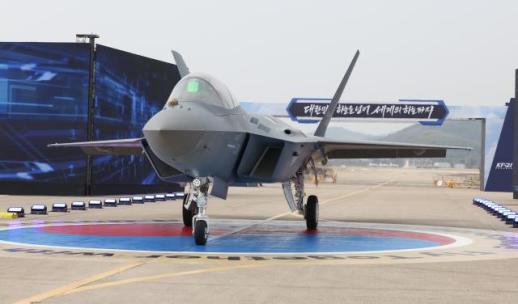 Korea unveils first domestically built KF-21 fighter jet SEOUL, March 25 (AJP) - South Korea rolled out the first mass-produced KF-21 Boramae fighter jet on Wednesday, marking a major milestone in the country’s decades-long push to develop the domestically built 4.5-generation supersonic fighter. President Lee Jae Myung, who attended the ceremony at Korea Aerospace Industries (KAI) in Sacheon, described the rollout as a historic step toward strengthening self-reliant defense capabilities. “South Korea has finally secured weapons developed with our own technology and determination to protect peace not only on land and sea, but also in the skies,” Lee said. “This marks a proud achievement for self-reliant national defense,” Lee said, calling the moment a “historic milestone” for the nation. About 500 attendees joined the ceremony, including test pilots of the KF-21, defense industry officials, air force cadets, students from the aviation science high school and diplomatic representatives from 14 countries. The KF-21 Boramae is a 4.5-generation supersonic fighter jet developed by KAI in cooperation with the Republic of Korea Air Force and the Agency for Defense Development under the KF-X (Korea Fighter eXperimental) program. Lee emphasized that the KF-21 represents decades of national ambition. “This fighter, designed with our own technology and built by our own hands, embodies our long-standing aspiration for self-reliant defense,” he said. He also highlighted the long development process, noting that the project dates back to 2001 when then-President Kim Dae-jung first announced plans to develop a domestically produced fighter jet. “This historic achievement did not come easily,” Lee said. “For 25 years, our researchers and military personnel overcame countless challenges and turned what once seemed impossible into reality.” He added that the KF-21’s success goes beyond strengthening national defense saying that the jet has already drawn strong interest from overseas even before its rollout. Lee also noted that South Korea has already demonstrated its defense capabilities through exports such as the K9 self-propelled howitzer and the Cheongung air defense missile system. The KF-21 is expected to be deployed to the South Korean Air Force later this year. According to government and industry officials, the fighter jet is drawing interest from several countries, including the United Arab Emirates, Saudi Arabia, the Philippines and Poland, in addition to Indonesia, which has already signed on as a development partner. With the KF-21 rollout, South Korea has become the eighth country or region to successfully develop a 4.5-generation or higher supersonic fighter jet, joining the United States, China, Russia, Japan, France, Sweden and a European consortium. 2026-03-25 17:14:46
 -
 Hanwha's stealth KAI stake signals opening salvo in battle for Korea's fighter SEOUL, March 25 (AJP) - The widening Gulf conflicts have caused disruption across markets but are simultaneously delivering a windfall for South Korea’s defense sector, galvanizing acquisition appetite around Korea Aerospace Industries (KAI), the country’s sole aircraft platform maker. Adding to its renewed strategic appeal, KAI rolled out its first mass-produced KF-21 Boramae fighter jet on Wednesday. Hanwha Aerospace disclosed in its latest business report that it holds a 4.41 percent stake in KAI, or 4.86 million shares. Including an additional 0.58 percent held by affiliate Hanwha Systems, the group’s total stake stands at 4.99 percent — just shy of the 5 percent threshold that would trigger stricter disclosure requirements. The precision of that stake has fueled market speculation. By stopping short of the reporting threshold, Hanwha appears to be pursuing a calculated strategy to secure influence while avoiding early scrutiny. Industry officials describe the move as a classic case of “stealth accumulation,” often seen as a prelude to a larger acquisition attempt. The market widely interprets the stake as an opening move toward a potential takeover. If realized, such a deal would allow Hanwha to build an integrated defense structure spanning platforms and core systems — a long-standing gap in its portfolio. Hanwha has steadily expanded its defense footprint in recent years. It has built strength in land systems through Hanwha Aerospace, precision-guided munitions and radar through Hanwha Systems, and naval capabilities through its 2023 acquisition of Hanwha Ocean. Yet aircraft platforms remain the missing piece — an area dominated by KAI. As the country’s only aircraft platform manufacturer, KAI produces the KF-21 fighter, FA-50 light combat aircraft and Surion helicopters. Hanwha, by contrast, has largely remained a component supplier, providing engines and radar systems while relying on KAI for system integration and export negotiations. “Securing a stake in KAI could transform this dependence into a partnership and, over time, allow Hanwha to internalize platform technologies,” said Jeong Kyung-woon of the Korea Association of Military Studies. However, Hanwha is unlikely to move unchallenged. LIG Nex1 is also reviewing participation in a potential KAI acquisition and has reportedly formed a task force, including options for a consortium with LS Group, both of which tracing their origin to LG Group family tree. The combination would bring together missile systems, radar and communications with LS’s strengths in armored vehicle components. Still, financial capacity remains a key differentiator. LIG Nex1, despite record sales exceeding 4 trillion won ($2,667 billion) in 2025, holds roughly 1 trillion won in cash, compared with more than 10 trillion won held by Hanwha Aerospace — underscoring a clear gap in acquisition firepower. KAI itself remains effectively state-controlled despite being publicly listed. The Export-Import Bank of Korea holds a 26.41 percent stake, while the National Pension Service owns 8.20 percent. Privatization has been discussed for decades but repeatedly delayed due to political sensitivities and valuation concerns. Hanwha’s current position could make it a leading contender should the government decide to divest. Although the policy bank has said it has no immediate plans to sell, it has left open the possibility of consultation with the government — keeping the door ajar. Recent moves suggest Hanwha may already be preparing. Hanwha Systems’ sale of its stake in Hanwha Ocean, reportedly worth about 1.7 trillion won, is seen as a step to secure funding for a larger strategic acquisition. The intensifying competition reflects broader shifts in the defense industry, where demand for advanced aircraft, missiles and space-based capabilities is rising alongside geopolitical tensions. As warfare expands beyond traditional domains, control over aerospace platforms is increasingly emerging as the decisive factor shaping the next generation of defense power. Hanwha Aerospace rose 4.9 percent to close at 1,400,000 won, while LIG Nex1 jumped 14.5 percent to 734,000 won. 2026-03-25 17:01:22
 -
 South Korea ranks fourth in global gaming market SEOUL, March 25 (AJP) - South Korea's gaming industry ranks fourth in the global market, remaining one of the fastest-growing tech sectors, with developers vying to attract users through increasingly engaging online and mobile games. With the global gaming market estimated at $220.07 billion, South Korea accounted for 7.2 percent, ranking fourth behind China, the U.S, and Japan, according to a joint report released by the Ministry of Culture, Sports and Tourism and the Korea Creative Content Agency (KOCCA) on Wednesday. The cumulative revenue of the domestic game industry stood at 23.85 trillion won in 2024, up 3.9 percent from a year earlier. Exports also rose by 1.3 percent to US$8.50 billion, with China taking the largest share at 29.7 percent, followed by Southeast Asia at 20.6 percent, North America at 19.5 percent, and Japan at 8.3 percent. Mobile games accounted for more than half of total revenue at 59 percent, followed by PC games at 25.2 percent, console games at 5 percent, and arcade games at 1.2 percent. "The report offers insight to closely assess the industry and develop future strategies," said KOCCA's acting President Yu Hyeons-seok, adding that the agency will continue to provide "systematic, data-based support" so that the country's gaming industry can continue to prosper while staying competitive globally." 2026-03-25 16:55:39
 -
 SK hynix's AI windfall tests investor trust as ADR plan sparks backlash ICHEON, March 25 (AJP) - SK hynix’s meteoric rise on the back of the AI boom is now colliding with a growing backlash from retail investors, as its aggressive capital strategy exposes a widening gap between global ambition and shareholder returns. At its annual general meeting in Icheon on Wednesday, the chipmaker — now a critical supplier of High Bandwidth Memory (HBM) chips to Nvidia — faced unusually sharp criticism despite its record-breaking market performance. Shares have surged roughly fivefold in recent years, recently breaching the symbolic 1 million won ($740) level and lifting the company’s market capitalization beyond 700 trillion won. Yet the mood inside the meeting hall was far from celebratory. Instead, tensions flared over SK hynix’s plan to pursue a U.S. listing through American Depositary Receipts (ADRs), a move seen by management as essential to securing the financial firepower needed to compete in the capital-intensive AI race. The company confirmed it had confidentially filed a Form F-1 with the U.S. Securities and Exchange Commission on March 24, targeting a listing in the second half of the year. The controversy, however, lies less in the listing itself than in how it will be funded. Just weeks after canceling roughly 14 trillion won worth of treasury shares — a move typically aimed at boosting shareholder value — SK hynix now plans to issue new shares to raise an estimated 10 trillion to 15 trillion won. Investors argue the sequence effectively dilutes existing shareholders after temporarily inflating share value. “What you call a 100 trillion won war chest — where is the return for shareholders?” one investor protested during the meeting. “It feels like minority shareholders are being asked to fund the company’s expansion without any reward.” Another shareholder pointed to the mismatch between soaring share prices and stagnant dividends, calling for a stock split to improve accessibility as the stock hovers near the 1 million won mark — nearly six times its level at the start of 2025. Investor frustration has also spilled beyond the meeting floor. “If the goal is proper valuation in the U.S., why raise only 2 percent of market cap?” one investor told AJP. “It raises the question of whether this is truly about global positioning — or simply raising cash at shareholders’ expense.” Chief Executive Kwak Noh-jung pushed back, framing the capital raise as a strategic necessity rather than a choice. “To ensure stable execution of future investments, we aim to secure more than 100 trillion won in net cash,” Kwak said, noting that SK hynix still trails global peers in financial capacity despite improving fundamentals. The cash buffer, he added, is essential in an industry defined by extreme cyclicality and surging capital demands, particularly as companies race to build advanced cleanrooms and infrastructure for next-generation AI memory. On operations, management remained firmly confident. Kwak said HBM3E remains the company’s core product for now, with HBM4 set to gain share in the second half of the year. He also confirmed that samples of next-generation HBM4E chips will be delivered on schedule within the year. Still, the dispute underscores a deeper dilemma facing SK hynix. The company has rapidly ascended to the top tier of global semiconductor players, propelled by the AI boom and its near-monopoly position in advanced memory. But sustaining that trajectory now requires massive upfront investment — increasingly financed in ways that test investor patience. Wednesday’s meeting made clear that while SK hynix has secured its place at the center of the AI supply chain, keeping shareholders aligned with that vision may prove just as critical as maintaining its technological edge. 2026-03-25 16:37:58
 -
 'A Man Living With the King' Tops 15 Million Tickets, Ranks No. 3 All Time in Korea The film ‘A Man Living With the King’ has surpassed 15 million admissions in South Korea, reaching the milestone 50 days after its release. Distributor Showbox said Wednesday that the movie had topped 15 million cumulative viewers as of Wednesday afternoon. It reached 10 million admissions on its 31st day in theaters after opening Feb. 4, then hit 14 million on day 45 before adding another 1 million in just five days. The result makes ‘A Man Living With the King’ the third release in Korean box office history to cross 15 million, following ‘The Admiral: Roaring Currents’ (17.61 million) and ‘Extreme Job’ (16.26 million). It also moved past ‘Along With the Gods: The Two Worlds’ (14.41 million) and ‘Ode to My Father’ (14.25 million) to join the top tier of all-time Korean hits. Directed by Jang Hang-jun, the film is set in Cheongnyeongpo in 1457 and follows a village chief who chooses exile to revive his community and a young deposed king sent into exile. Strong word of mouth, driven by the on-screen pairing of Yoo Hae-jin and Park Ji-hoon, has helped sustain its long run.* This article has been translated by AI. 2026-03-25 16:31:06
 -
 KLPGA Players Pick Rising Star Kim Min-sol as Top Grand Prize Contender Players preparing for the 2026 Korea Ladies Professional Golf Association (KLPGA) Tour domestic opener singled out 20-year-old rising star Kim Min-sol as a leading candidate for the season’s grand prize award. The KLPGA Tour begins its domestic schedule April 2-5 with The Siena Open at The Siena Belluto Country Club in Yeoju, Gyeonggi Province. The 2026 season opened earlier with the Rejuran Championship, held March 12-15 in Chonburi, Thailand. The Siena Open carries a total purse of 1 billion won. Ahead of the domestic opener, the tour held its ‘Opening Ceremony’ on March 25 in Seoul. Attendees included last year’s money leader Hong Jeong-min, along with fan vote top finishers Im Hee-jeong and Park Hyeon-gyeong, and players Kim Min-sol, Park Gyeol, Park Min-ji, Park Hye-jun, Bae So-hyeon, Yoo Hyeon-jo, Lee Ga-young, Lee Se-hee and Lee Yul-lin. At media day, much of the focus was on the expected battle for the season’s top honors. Players pointed to Kim, praising her combination of distance and precision. Born in 2006, Kim won twice last year. Im, a five-time KLPGA winner, said Kim “hits it long and has a good short game,” adding that “if she builds experience well, she can be a strong grand prize candidate this season.” Park Hyeon-gyeong also backed Kim. “The one player who immediately comes to mind as a grand prize candidate is Kim Min-sol,” she said. “She has distance, and she’s strong across the technical parts. I think she’ll have a good season.” Kim thanked the senior players for their support. “I’m grateful they picked me as a grand prize candidate,” she said. “My goal this year is to live up to those expectations.” She named Park Hye-jun as her own pick, saying Park “showed a lot of good things last year.” Veterans also laid out their goals. Park Min-ji, who would set a new KLPGA career wins record with two more victories, said she is entering her 10th year on tour after going winless last season for the first time. “I think it became a turning point for me,” Park said. “I’d been winning every year and got complacent. This year I want to start over from the beginning like a rookie. I’m desperate to win.” Born in 1998, Park added that younger players “come out in short sleeves even in spring and fall,” while she needs “three layers,” and said she needs more fitness work and better body management to keep up. Bae So-hyeon, born in 1993, laughed at Park’s comments. “I’m thinking, what is she talking about?” Bae said, adding that adjusting preparation as players get older “looks professional,” but that it might be “a bit early” for Park to say. Park Gyeol, born in 1996 and in her 12th year on tour, said, “My stamina may be lower than the younger players, but I have the advantage of experience,” adding, “We can win, too.” Several players who joined new teams also set clear targets. Yoo Hyeon-jo, last year’s grand prize winner and scoring average leader, said joining Lotte brings some pressure, but she wants to do better than last year. “I especially want to be the multiple-wins leader,” Yoo said. “Last year I missed out on a lot of wins. I want to fix that and try to lead in wins.” Hong, last year’s money leader and co-leader in wins with three titles, said she has a new sponsor, Korea Land Trust, and is aiming higher. “Since I’m newly sponsored by Korea Land Trust, I’ll set a goal of more than last year’s three wins — four,” Hong said. “I’ll focus on four wins and keep pushing.”* This article has been translated by AI. 2026-03-25 16:18:00
 -
 South Korea's fertility nears 1.0 as births, marriages post double-digit gains SEOUL, March 25 (AJP) — South Korea’s notoriously low fertility rate gained a meaningful boost to 0.99 in January — the highest since monthly tracking began in 2024 — but questions remain over whether it can continue to hold near 1. According to the Ministry of Data and Statistics on Wednesday, the number of births in January reached 26,916, up 2,817, or 11.7 percent from a year earlier, marking the highest January figure in seven years. Marriages also continued to post similar-pace double-digit growth. The baby increase follows a 12.5 percent year-on-year rise recorded in January 2025, extending the upward trend in births into early 2026. The rebound also pushed up the total fertility rate — the average number of children a woman is expected to have over her lifetime — to near 1.0, a sharp jump from 0.74 in December. The figure compares with an annual average of 0.80 in 2025, 0.75 in 2024 and 0.72 in 2023. South Korea became the only OECD country with a fertility rate below 1 in 2022, when the figure first fell into the 0.7 range. Annual births also showed signs of recovery, rising to 254,500 last year from around 230,000 in the previous two years. Still, the sustainability of the rebound remains uncertain. The increase is partly attributed to the so-called “second echo boom,” as those born between 1991 and 1995 — the children of the second baby boom generation (1964–1974) — enter their prime marriage and childbearing years. This cohort, which recorded more than 700,000 births annually, has helped lift marriages, alongside the continued impact of government policies aimed at encouraging childbirth. Despite the uptick, the country still recorded a natural population decline of 5,539 in January, as deaths continued to outnumber births. Jeon Young-soo, a professor of international studies at Hanyang University, urged caution in interpreting the rebound, noting that demographic effects have played a major role. “The rise in fertility is not necessarily a sign that the overall birth environment has fundamentally improved,” Jeon said. “Because fertility is a ratio, changes in both the numerator and denominator matter — while births have increased by tens of thousands, the population base has declined more sharply.” He also pointed to a backlog of delayed marriages following the COVID-19 pandemic as a factor behind the recent increase in births. Jeon said the trend could continue for the next two to three years but warned against overinterpreting short-term gains. “This could be a temporary phase driven by demographic factors,” he said. “Rather than reacting to short-term fluctuations, policymakers should focus on long-term, structural strategies to improve the conditions surrounding marriage and childbirth.” A breakdown by age shows birth rates rose across all groups, led by women in their 30s — the core childbearing cohort. The birth rate for women aged 30–34 climbed to 90.9, up 8.7 from a year earlier, marking the largest increase. The rate for those aged 35–39 also rose sharply to 65.8, up 8.0. Among younger women, the rate for those aged 25–29 rose to 25.6, up 1.5, while rates for those aged 24 and under and 40 and above edged up to 2.4 and 5.1, respectively. On a monthly basis, births increased from 24,099 in January 2025, extending the early-year upward trend. Births rose across all regions except Sejong, indicating a broad-based rebound nationwide. By birth order, the share of first-born children increased by 1.4 percentage points from a year earlier, while the proportions of second-born and third-or-higher births each declined by 0.7 percentage points. Marriages, a leading indicator of births, also increased to 22,640 in January, up 2,489, or 12.4 percent from a year earlier, suggesting continued near-term momentum — though uncertainties remain over its durability. 2026-03-25 15:49:49
 -
 Homegrown sub sets sail on historic trans-Pacific journey for naval exercise in Canada SEOUL, March 25 (AJP) - A 3,000-ton homegrown submarine embarked on a trans-Pacific voyage for the first time to take part in a joint naval exercise with Canada scheduled for June, the Navy said on Wednesday. Attended by over 300 naval officers and other representatives from both countries, a send-off event for the Dosan Ahn Chang-ho, was held at a port in Jinhae, South Gyeongsang Province on Wednesday. Among them were Canadian Ambassador to Seoul Philippe Lafortune and British Ambassador to Seoul Colin Crooks. The heavy-duty submarine began its months-long journey, traveling about 14,000 kilometers from the southern naval port city of Jinhae to Victoria, the capital of British Columbia, with stops in Guam and Hawaii for replenishment. Two Canadian submariners will join the crew for the final leg of the journey. The lengthy voyage would mark the longest distance ever traveled by a South Korean submarine. After the joint exercise in Canada, it will also take part in the U.S.-led multinational Rim of the Pacific (RIMPAC) exercise in Hawaii in late June before returning home. "I hope the voyage will demonstrate the superior technology and operational capabilities of South Korean submarines," Navy chief Kim Kyung-ryul said at the event. The voyage comes as a South Korean consortium led by Hanwha Ocean and HD Hyundai Heavy Industries competes with Germany's Thyssenkrupp Marine Systems (TKMS) for a landmark contract to supply 12 submarines to the Canadian Navy to replace its aging fleet, a deal worth about 60 trillion won (US$40 billion). 2026-03-25 15:42:12
 -
 GM commits $600 mln to South Korea plants, doubling down on small SUV hub SEOUL, March 25 (AJP) - General Motors announced it will invest $600 million in its South Korean operations to upgrade production facilities and sharpen its global competitiveness, cementing the country's role as a key manufacturing hub for small SUVs. The Detroit automaker said Wednesday the latest commitment of $300 million — earmarked for press machinery upgrades and plant modernization — builds on an equal investment announced in December 2025 for product enhancement and technology improvements across its Korea-built SUV lineup, bringing the combined total to $600 million. GM Korea President and CEO Hector Villarreal said the investment reflects the company's confidence in its local workforce and operations. "Competition continues to grow across the global industry, with many new OEMs entering export markets around the world. While our work is not done, we have a strong foundation, and this investment is a sign of confidence in our operations," he said. Korea Development Bank Chairman Park Sang-jin, whose institution holds a stake in GM Korea as a secondary shareholder, said the bank would continue working with GM to ensure the unit sustains its competitiveness in global markets over the long term. 2026-03-25 15:40:29