

Journalist

Ryu Yuna
Julia37@ajunews.com
-
 Semiconductor selloff raises questions over AI rally SEOUL, June 5 (AJP) - A sharp selloff in semiconductor stocks is raising questions about the future of the artificial intelligence-driven rally, following HSBC's prediction on Thursday that the current chip boom is entering a broader phase, with gains spreading beyond chipmakers. While chipmakers such as Nvidia have dominated the AI rally so far, HSBC, one of the world's largest banking groups, said that the current AI cycle has produced an uneven pattern of growth, with AI-related investment surging while spending in many non-tech sectors remains comparatively weak. On South Korean bourse, Samsung Electronics and SK hynix recently accounted for 51.5 percent of the KOSPI200 index, up from 38.7 percent at the start of the year, while the two companies contributed 90.8 percent of the increase in KOSPI earnings estimates through April, according to Meritz Securities. Yet the market's heavy reliance on semiconductor stocks was also on display Thursday. The KOSPI tumbled 5.54 percent after concerns over chip-sector earnings triggered a global selloff in semiconductor shares. Samsung Electronics fell 6.40 percent and SK hynix dropped 9.92 percent, highlighting how closely market performance remains tied to a handful of AI-related companies. That imbalance is one reason the bank expects the next phase of the boom to be defined by what it calls "broadening out." As investment in AI infrastructure continues to grow, HSBC expects the benefits of AI to spread beyond technology companies and across borders, creating opportunities in non-tech sectors and emerging markets. Under its base-case scenario, the bank expects AI-driven growth to become more broadly distributed across industries and regions while U.S. economic growth remains around 2 percent. The bank said strong corporate profits driven by the AI boom are helping markets look past geopolitical tensions and supply-side shocks. The bank described the current environment as one in which "markets and economists describe different worlds," noting that markets have largely shaken off geopolitical concerns despite a complicated macroeconomic backdrop of trade tensions, supply-chain disruptions and geopolitical uncertainty. As spillovers from the AI capital-expenditure boom become more apparent, HSBC expects strong profit growth to hold and broaden beyond borders into non-tech sectors. The bank said emerging markets could be well positioned to benefit from that trend. The report also highlights opportunities outside the United States. HSBC said emerging markets may benefit from expanding AI supply chains and manufacturing investment, while non-U.S. equity markets could gain as AI-driven growth becomes less concentrated in a handful of American technology companies. The bank also urged investors to "diversify the diversifiers," arguing that opportunities are no longer limited to a narrow group of AI-related stocks. The bank said higher bond yields are creating new income opportunities across fixed-income assets and defensive equity sectors. The report comes as investors question whether the AI-driven rally has become overheated. HSBC acknowledged concerns over elevated valuations and the market's reliance on a small number of technology companies. Still, the bank said strong corporate profits continue to support markets despite a complicated macroeconomic backdrop, although periodic volatility remains possible amid geopolitical tensions and supply-side shocks. 2026-06-05 18:15:49
 -
 South Korea signs free trade deal with Serbia SEOUL, June 5 (AJP) - South Korea has signed a comprehensive economic partnership agreement (CEPA), a broader form of free-trade agreement, with Serbia, the Ministry of Trade, Industry and Resources said on Friday. The agreement, which comes after about two years of negotiations, was signed in Belgrade by South Korean Trade Minister Yeo Han-koo and his Serbian counterpart Jagoda Lazarević. The broader deal goes beyond tariff reductions to include economic and supply-chain cooperation, opening new opportunities for exports and access to critical minerals used in batteries and other strategic industries. Despite its relatively small population of seven million, Serbia has become an increasingly important manufacturing hub in Southeast Europe. It also holds significant reserves of lithium, copper, zinc and other minerals used in batteries and other high-tech industries. Under the agreement, the two countries will eliminate tariffs on more than 90 percent of traded goods, covering over 96 percent of import value. It is expected to particularly benefit South Korean technology exporters, as Serbia, which is not part of the World Trade Organization's Information Technology Agreement (ITA), has agreed to eliminate tariffs of up to 25 percent on semiconductors and electronic products. South Korean automakers are also set to benefit, with tariffs on all automotive parts to be removed immediately and market access expanded for electric and hybrid vehicles. Broader access to the Serbian market will be available, with tariffs to be removed on South Korean exports including instant noodles, roasted seaweed, ginseng, cosmetics, pharmaceuticals and defense-related goods. Beyond trade, the agreement is expected to strengthen supply chains for advanced industries. Tariffs on Serbian raw materials, including lithium, cobalt, nickel, graphite and rare-earth elements, will be eliminated either immediately or phased out within five years, supporting South Korea's battery and advanced manufacturing sectors. It would improve business efficiency, with imported goods cleared within 48 hours of arrival and express shipments processed within six hours. It also includes measures to strengthen intellectual property protection, including efforts to curb online infringement. "The agreement marks a major step forward in economic cooperation between South Korea and Serbia," Yeo said. "It creates a platform for collaboration not only in trade but also in supply chains, energy, critical minerals and future industries such as AI and biotechnology." 2026-06-05 17:10:38
 -
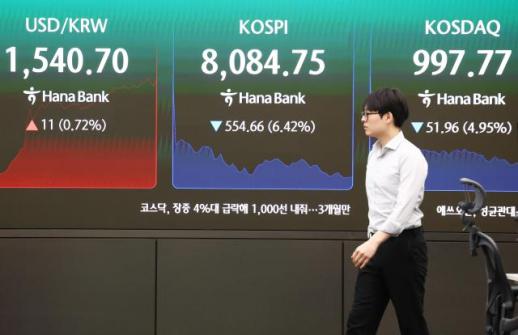 KOSPI slides on semiconductor-led broad sell-off SEOUL, June 5 (AJP) - South Korean stocks fell sharply on Friday as investors took profits from a recent rally, with heavyweight semiconductor shares leading declines after an overnight sell-off in U.S. chipmakers. The benchmark KOSPI fell 6.26 percent to 8,098.52 in early trade, while the junior KOSDAQ dropped 4.65 percent to 1,000.9. The won also weakened further, trading at 1,531.70 against the dollar, compared with a previous close of 1,529.70. Semiconductor-related shares remained under heavy selling pressure despite expectations surrounding Nvidia CEO Jensen Huang's visit to Seoul later in the day and potential cooperation with local tech firms. Samsung Electronics fell 7.18 percent to 326,250 won and SK Hynix dropped 8.83 percent to 209,500 won, with Samsung's preferred shares losing 5.45 percent to 208,000 won and SK Square sliding 9.40 percent to 123,300 won. Samsung Electro-Mechanics slipped 4.37 percent to 1,641,000 won, LG Energy Solution fell 2.96 percent to 409,500 won, Samsung Life Insurance lost 9.02 percent to 398,500 won, Samsung C&T tumbled 16.73 percent to 445,500 won and Doosan Enerbility declined 6.15 percent to 93,100 won. Samsung Biologics was relatively resilient, edging down 0.74 percent to 1,340,000 won. Automakers also came under pressure. Hyundai Motor fell 6.00 percent to 658,000 won, Kia declined 4.93 percent to 156,200 won and Hyundai Mobis dropped 9.22 percent to 679,000 won. Among the gainers, HD Hyundai Heavy Industries rose 0.61 percent to 655,000 won, and KB Financial Group gained 3.59 percent to 170,100 won, bucking the broader market downturn. The retreat came despite another record-setting session for major U.S. equity benchmarks. The Dow Jones Industrial Average rose 1.73 percent to close at an all-time high of 51,561.93, and the S&P 500 gained 0.41 percent. The tech-heavy Nasdaq Composite, however, slipped 0.09 percent as investors rotated out of high-flying semiconductor names and into sectors that had lagged the broader rally. The biggest losses were seen in semiconductor stocks. Broadcom plunged 12.59 percent after its quarterly results failed to meet investors' high expectations. Memory-chip maker Micron Technology dropped 7.74 percent, and SanDisk lost 3.92 percent. The Philadelphia Semiconductor Index fell 2.15 percent. But easing geopolitical concerns over the prolonged Middle East conflict helped cushion broader market losses, as lower oil prices would ease inflationary pressures and support equities outside the technology sector. U.S. West Texas Intermediate crude futures fell 3.1 percent to $93.04 a barrel, and Brent crude declined 2.8 percent to $95.03. U.S. Treasury yields edged lower, with the benchmark 10-year yield slipping to 4.47 percent as weaker economic data and falling oil prices eased inflation concerns. Meanwhile, Asian markets were mostly lower. Japan's Nikkei 225 dropped 1.43 percent to 66,505.61, Hong Kong's Hang Seng Index lost 0.41 percent to 25,148.76, while China's Shanghai Composite bucked the trend, rising 0.17 percent to 4,064.85. 2026-06-05 11:12:07
 -
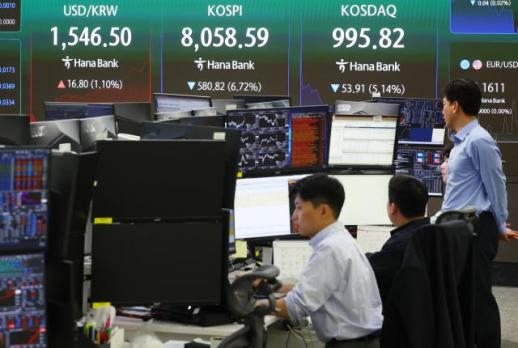 KOSPI opens sharply lower after Wall Street chip sell-off, prompting sidecar halt SEOUL, June 5 (AJP) - South Korean stocks plunged in early trading on Friday, prompting a temporary halt on program sell orders as investors dumped semiconductor shares following an overnight sell-off in U.S. chipmakers. Just 30 minutes into Friday's trading session, the benchmark KOSPI was down 5.65 percent at 8,151.63, while the junior KOSDAQ shed 3.67 percent to 1,011.25. According to the Korea Exchange, a sell-side sidecar was activated at 9:08:25 a.m. after a sharp decline in KOSPI 200 futures. The sharp decline followed heavy losses in U.S. semiconductor stocks overnight, with investors taking profits after a months-long rally in artificial intelligence (AI)-related shares. 2026-06-05 09:46:25
 -
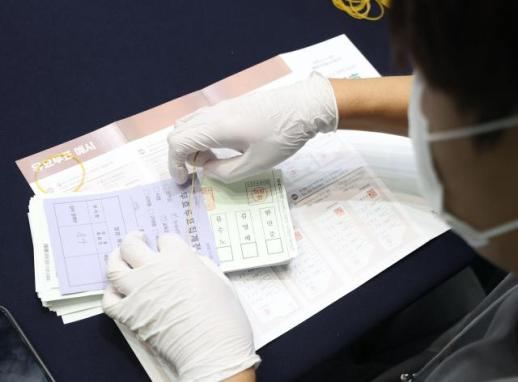 Voter turnout for local elections hits 61% SEOUL, June 04 (AJP) - Voter turnout in Wednesday's local elections reached 61 percent, the National Election Commission (NEC) said Thursday. It marked a sharp increase from 50.9 percent in the previous local elections in 2022 and was the highest turnout in any local elections since 1995, when it reached a record 68.4 percent. A total of 27.25 million voters cast ballots out of 44.65 million eligible voters including those who participated in two-day early voting last week and absentee voting. Early voting held last Friday and Saturday also saw a record turnout of 23.51 percent. Among the country's 17 major cities and provinces, South Jeolla Province recorded the highest turnout at 65.7 percent, followed by Gangwon Province at 64.5 percent, South Gyeongsang Province at 64.4 percent, and both Daegu and Ulsan at 64.2 percent. Contrary to South Jeolla Province's highest turnout, the traditional stronghold of the ruling Democratic Party (DP), the southwestern city of Gwangju in the same region recorded the lowest turnout at 54.3 percent, followed by Jeju at 56.4 percent, Incheon at 58.2 percent, and Gyeonggi Province at 58.4 percent. Seoul recorded a turnout of 63.6 percent, well above the national average. Election officials said the final count could take longer than usual to be finalized after ballot shortages caused voting delays in parts of southern Seoul including districts such as Gangnam, Gwangjin, and Songpa. 2026-06-04 17:25:00
 -
![[WNMC 2026] The Era of Readers Seeking News is Over... AJPs AI Experiment Draws Global Attention](https://image.ajunews.com//content/image/2026/06/04/20260604134815698517_518_323.jpg) [[WNMC 2026]] 'The Era of Readers Seeking News is Over'... AJP's AI Experiment Draws Global Attention "We cannot wait for readers to come to us; we must go to them." On June 3, the 77th World News Media Congress (WNMC) in Marseille, France, attracted over 1,000 journalists and media executives from more than 60 countries. Among the attendees were A.G. Sulzberger, chairman and publisher of The New York Times, and Katharine Viner, editor-in-chief of The Guardian, who gathered to discuss survival strategies for journalism in the age of AI. Seo Hye-seung, editor-in-chief of Aju Media Group's English news agency AJP, was the only speaker from South Korea. With AI emerging as a central theme at this year's congress, AJP's presentation highlighted new possibilities for journalism in the AI era. During the session titled "How AI Is Transforming the News Experience," Seo introduced AJP's multilingual news production and global audience expansion strategies. He defined AJP's identity as "Asian Substance in English," proposing a new role for English-language news agencies in the AI era. "We have discovered our role as a news agency that conveys Asian stories in the language that AI understands best," he said. Aju Media Group publishes content in five languages: Korean, English, Chinese, Japanese, and Vietnamese. AJP serves as the English-language news agency at the center of this multilingual strategy. Seo explained that AJP has utilized AI as a starting point for designing its news production and distribution systems. In an environment where generative AI is transforming news production and distribution, AJP is differentiating itself by using AI not just as a translation tool but as a content expansion platform. "Our goal is not to be journalists who use AI well, but to be journalists that AI can learn from and follow," he said, adding that as technology advances, the role of journalists in reporting from the field and interpreting context becomes even more crucial. This aligns with the message delivered by Sulzberger during his keynote address on the first day of the congress. Sulzberger emphasized that "the important facts that people know ultimately come from journalism's unique reporting," asserting that even as generative AI advances, the role of journalism in uncovering new facts cannot be replaced. He criticized AI companies for using journalistic content as training data without providing fair compensation, stating, "AI operates on information produced by journalism." One of the most frequently mentioned concepts at this congress was 'Liquid Content.' This model involves reconfiguring a single reporting outcome into various forms such as articles, videos, audio, and summaries, tailored to meet readers' situations and needs. News is evolving to be provided in diverse formats that cater to readers' needs rather than waiting for them to seek it out. In fact, major global news organizations are leveraging AI not just as a tool for automating tasks but as a means to redesign reader experiences. Experiments are ongoing to offer personalized news recommendations, transform article archives into interactive services, and reprocess a single article into multiple formats for consumption in ways that readers prefer. While technology is rapidly changing, what readers seek remains reliable information and facts uncovered directly by journalists. Although AI can change how news is produced, it cannot replace the fundamental reasons for the existence of journalism. The way news is delivered to readers is changing, but the value of journalism in discovering and verifying new facts remains unchanged. This was the overarching message of the congress. 2026-06-04 14:09:00
[[WNMC 2026]] 'The Era of Readers Seeking News is Over'... AJP's AI Experiment Draws Global Attention "We cannot wait for readers to come to us; we must go to them." On June 3, the 77th World News Media Congress (WNMC) in Marseille, France, attracted over 1,000 journalists and media executives from more than 60 countries. Among the attendees were A.G. Sulzberger, chairman and publisher of The New York Times, and Katharine Viner, editor-in-chief of The Guardian, who gathered to discuss survival strategies for journalism in the age of AI. Seo Hye-seung, editor-in-chief of Aju Media Group's English news agency AJP, was the only speaker from South Korea. With AI emerging as a central theme at this year's congress, AJP's presentation highlighted new possibilities for journalism in the AI era. During the session titled "How AI Is Transforming the News Experience," Seo introduced AJP's multilingual news production and global audience expansion strategies. He defined AJP's identity as "Asian Substance in English," proposing a new role for English-language news agencies in the AI era. "We have discovered our role as a news agency that conveys Asian stories in the language that AI understands best," he said. Aju Media Group publishes content in five languages: Korean, English, Chinese, Japanese, and Vietnamese. AJP serves as the English-language news agency at the center of this multilingual strategy. Seo explained that AJP has utilized AI as a starting point for designing its news production and distribution systems. In an environment where generative AI is transforming news production and distribution, AJP is differentiating itself by using AI not just as a translation tool but as a content expansion platform. "Our goal is not to be journalists who use AI well, but to be journalists that AI can learn from and follow," he said, adding that as technology advances, the role of journalists in reporting from the field and interpreting context becomes even more crucial. This aligns with the message delivered by Sulzberger during his keynote address on the first day of the congress. Sulzberger emphasized that "the important facts that people know ultimately come from journalism's unique reporting," asserting that even as generative AI advances, the role of journalism in uncovering new facts cannot be replaced. He criticized AI companies for using journalistic content as training data without providing fair compensation, stating, "AI operates on information produced by journalism." One of the most frequently mentioned concepts at this congress was 'Liquid Content.' This model involves reconfiguring a single reporting outcome into various forms such as articles, videos, audio, and summaries, tailored to meet readers' situations and needs. News is evolving to be provided in diverse formats that cater to readers' needs rather than waiting for them to seek it out. In fact, major global news organizations are leveraging AI not just as a tool for automating tasks but as a means to redesign reader experiences. Experiments are ongoing to offer personalized news recommendations, transform article archives into interactive services, and reprocess a single article into multiple formats for consumption in ways that readers prefer. While technology is rapidly changing, what readers seek remains reliable information and facts uncovered directly by journalists. Although AI can change how news is produced, it cannot replace the fundamental reasons for the existence of journalism. The way news is delivered to readers is changing, but the value of journalism in discovering and verifying new facts remains unchanged. This was the overarching message of the congress. 2026-06-04 14:09:00 -
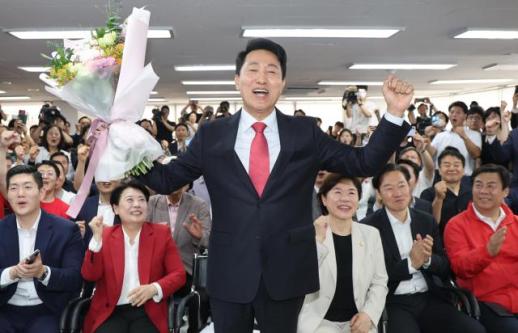 Oh Se-hoon reelected Seoul mayor after dramatic overnight reversal SEOUL, June 4 (AJP) - Incumbent Seoul Mayor Oh Se-hoon of the main opposition People Power Party (PPP) was re-elected on Thursday after a nail-biting overnight count, defeating Democratic Party (DP) candidate Chung Won-o in the closest and most closely watched race of this year's local elections. According to the National Election Commission, with 97.17 percent of ballots counted as of 9 a.m., Oh was leading with 48.87 percent of the vote, edging out Chung's 48.41 percent by just 23,468 votes. Speaking at his campaign office in central Seoul after declaring victory, Oh described the outcome as a "victory for ordinary, hardworking citizens." Chung, a strong contender who had been widely expected to win and was backed by President Lee Jae-myung, conceded defeat. He said, "I humbly accept the choice of Seoul citizens," adding, "I fell short." The mayoral race remained too close to call for much of the night. Chung initially held a substantial lead in the early stages of vote counting, but the margin steadily narrowed after midnight as more ballots were tallied. Oh overtook Chung after more than 93 percent of the votes had been counted and gradually widened his lead overnight, bringing a dramatic late reversal that ended one of the closest mayoral races. Meanwhile, Oh called for a thorough investigation into ballot shortages reported at about a dozen polling stations in southern Seoul, considered to be a conservative stronghold. A rare logistics failure disrupted voting at least 14 polling stations including Gangnam, Gwangjin and Songpa, where ballot papers ran out, delaying the process and angering voters. 2026-06-04 10:20:29
 -
 Songzio and Heliot Emil reunite for falconry-inspired collection SEOUL, June 02 (AJP) - South Korean designer label Songzio, whose designs recently took center stage during BTS's "ARIRANG" comeback performance in March, has collaborated once again with Copenhagen-based fashion brand Heliot Emil on a new collection inspired by falconry. Titled "Falconry," the collection will be released on Friday after the brand's first collaboration sold out shortly after its debut last year. Drawing on themes of speed and control, it reinterprets the old practice of falconry through a contemporary lens. Bringing together Songzio's sculptural silhouettes and Heliot Emil's functional aesthetic, the designs incorporate flowing lines, layered construction and sharply defined forms. Signature metallic accents inspired by falcons' beaks and talons further reinforce the collection's emphasis on form and movement. The lineup includes biker jackets, cropped outerwear, structured T-shirts, and tailored trousers, blending practicality with bold, architectural silhouettes. To mark the launch, the two brands will host an event on Friday at Galerie Noir, Songzio's flagship store in Seoul. Attendees will include Songzio ambassadors ATEEZ member Seong-hwa and actress Choi Hee-jin, along with creative directors from both labels. Founded in 1993, Songzio has presented collections at Paris Fashion Week for more than two decades and established a presence across Asia, Europe, and North America. Its recent collaboration with BTS performance at Gwanghwamun Square this year marked another step in expanding the brand's global footprint. The new collection will be available online from Wednesday and in stores from Friday, including the brand's flagship stores in Seoul and Paris, as well as major department stores across South Korea. 2026-06-02 17:40:40
 -
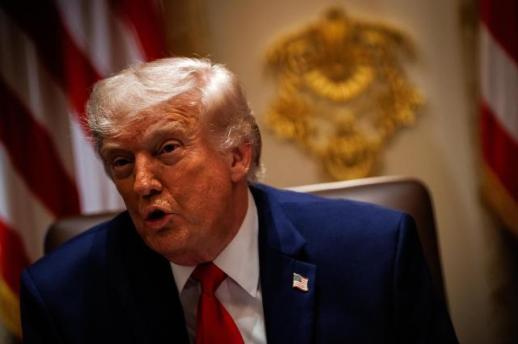 Trump says deal with Iran may be reached 'over the next week' SEOUL, June 2 (AJP) - U.S. President Donald Trump again said that Washington and Tehran are moving closer to a deal that could extend a ceasefire and ease tensions in the Strait of Hormuz, raising hopes for a possible end to the prolonged conflict in the Middle East, which began in late February. In a phone interview with ABC News on Monday, Trump said a memorandum of understanding (MOU) with Iran could be reached "over the next week," calling ongoing talks "looking good." The proposed deal would lay the groundwork for extending the ceasefire while keeping the strait open to shipping, as both sides continue negotiations over Iran's nuclear program and regional security. Trump said there had been "a little glitch" in the negotiations, although he admitted difficulties. "It's not a simple thing," he said. "So it's not an easy thing for them. It's actually not easy from our standpoint either. But we're getting what we need to get." But it still remains to be seen, as this is not the first time Trump has made similar remarks, and several key issues remain unresolved. Adding to the uncertainty, Iran said earlier in the day that it had suspended communications with the U.S. over Israel's military actions in Lebanon. 2026-06-02 16:26:04
 -
 Grocery delivery app Kurly to acquire AI startup SEOUL, June 2 (AJP) - Grocery delivery app Kurly will acquire Seoul-based artificial intelligence (AI) startup 1Z Labs in a bid to improve efficiency across its business operations, according to industrial sources on Tuesday. Kurly plans to issue around 453,518 new shares by early August in a stock-swap deal that will make the startup its wholly owned subsidiary. The two companies have already been jointly developing AI-related technologies, with plans to expand the use of AI across their business, from customer service and advertising to the development of new products and services. According to Kurly, it uses artificial intelligence to automate routine tasks such as producing advertising banners and product images, from planning and design through to final delivery. It also uses AI to handle customer service tasks like inquiries, cancellations, and returns, processing about 40 percent of requests on the same day. The upcoming acquisition comes as the company looks for new growth opportunities after postponing its initial public offering (IPO) in 2023 due to a market downturn that sharply reduced valuations. Founded in 2015, Kurly was among the frontrunners in offering overnight grocery delivery in South Korea through its signature "dawn delivery" service, which allows customers to receive fresh food orders by the next morning. The company was valued at about 4 trillion won (US$3 billion) at its peak in late 2021 after raising 250 billion won in a pre-IPO funding round led by Hong Kong-based private equity firm Anchor Equity Partners. Its valuation later dropped sharply as investor appetite weakened. Since postponing its IPO, Kurly has focused on improving profitability. It posted record first-quarter results in 2026, with revenue up 28.4 percent from a year earlier to 745.7 billion won and operating profit jumping to 24.2 billion won. "The acquisition would help the company strengthen its AI capabilities," said Kurly Chief Executive Sophie Kim. 2026-06-02 11:25:04