
Journalist

Ryu Yuna
Julia37@ajupress.com
-
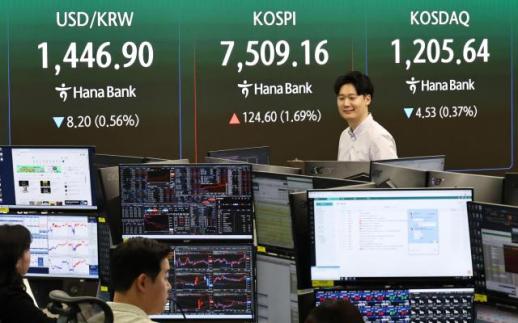 KOSPI briefly tops 7,500 for first time as AI chip rally powers Seoul stocks SEOUL, May 07 (AJP) - South Korean stocks surged to another record Thursday, with the benchmark KOSPI briefly topping the 7,500 mark for the first time as easing oil prices, renewed optimism over a potential U.S.-Iran agreement and another global surge in AI-linked chip shares fueled heavy buying in Seoul’s largest technology stocks. The main index climbed as high as 7,531.88, breaking above the 7,500 mark after Wall Street’s three major indexes closed sharply higher overnight. The KOSDAQ also edged up 0.36 percent to 1,214.50 in early trading. The rally was again led by semiconductor heavyweights, which continued to dominate market momentum. Samsung Electronics rose 2.07 percent to trade at 271,500 won and SK hynix gained 1.12 percent to 1,619,000 won. The advance followed another record-setting day in the United States, where the Dow Jones Industrial Average rose 1.24 percent while the S&P 500 and Nasdaq Composite climbed 1.46 percent and 2.02 percent, respectively, both setting fresh all-time highs. Investor sentiment improved after U.S. President Donald Trump said Iran appeared willing to abandon its nuclear ambitions and pursue a deal, raising hopes that tensions in the Middle East could ease despite lingering geopolitical uncertainty. Oil prices tumbled on expectations that a broader regional conflict could be avoided, easing inflation concerns that had weighed on global equities in recent weeks. Brent crude fell 7.83 percent to settle at $101.27 a barrel, while West Texas Intermediate crude dropped 7.03 percent to $95.08. The global chip rally accelerated after U.S. chipmaker AMD posted surprisingly strong earnings, sending its shares up 18 percent overnight and lifting broader AI-related stocks. NVIDIA climbed 5.77 percent after announcing plans to expand optical manufacturing facilities in the United States with Corning, while Intel gained 4.49 percent and Micron Technology advanced 4.12 percent. The momentum spilled into Seoul, with semiconductor, auto and heavy industry shares remaining resilient despite heavy foreign selling, as retail investors stepped in to support the market after its recent record-breaking surge. Auto stocks traded higher, with Hyundai Motor jumping 5.45 percent to 580,000 won and Kia advancing 2.91 percent to 159,100 won. Among defense and heavy industry names, HD Hyundai Heavy Industries climbed 3.55 percent to 671,000 won, and Doosan Enerbility surged 6.85 percent to 135,700 won. In the financial sector, Samsung Life Insurance edged up 0.34 percent to 299,000 won, while KB Financial Group slipped 0.38 percent to 158,300 won. Battery-related shares underperformed the broader market, with LG Energy Solution falling 1.66 percent to 474,000 won. Hanwha Aerospace also dropped 3.21 percent to 1,387,000 won despite continued strength in defense-related plays overall. Market concentration has intensified rapidly as Korea’s equity rally becomes increasingly dependent on semiconductor heavyweights. As of Wednesday’s close, the combined market capitalization of Samsung Electronics common shares, Samsung Electronics preferred shares and SK hynix reached about 2,848 trillion won, accounting for roughly 47 percent of the KOSPI’s total market value of 6,058 trillion won and responsible for nearly 80 percent behind KOSPI rally. Including related affiliates such as SK Square, Samsung C&T and Samsung Life Insurance pushes that figure above 50 percent, underscoring growing concerns that the market’s gains are becoming narrowly concentrated around a small group of conglomerate-linked AI beneficiaries. The divergence between large and small stocks has widened sharply in recent weeks. Over the past month, the KOSPI large-cap index rose 38 percent, compared with gains of 21 percent for mid-cap shares and 11 percent for small-cap stocks. Since the start of the year, when the KOSPI began its explosive climb on AI-driven optimism, large-cap stocks have surged 82 percent, more than four times the gain posted by small-cap shares. Even during Wednesday’s historic surge into the 7,000 milestone, large-cap stocks climbed 7.22 percent, while mid-cap shares were nearly flat and small-cap stocks declined. The growing divide reflects continued investor demand for large-cap stocks with stronger earnings outlooks amid ongoing geopolitical and energy market uncertainty. Foreign investors bought a net 7.23 trillion won worth of KOSPI shares over the past month, with most inflows concentrated in Samsung Electronics, SK hynix and Doosan Enerbility. Brokerages expect momentum in semiconductor, power equipment, defense, brokerage and renewable-energy shares to continue through the first half, as global AI infrastructure spending and liquidity-driven foreign inflows continue to dominate market direction. 2026-05-07 10:04:03
 -
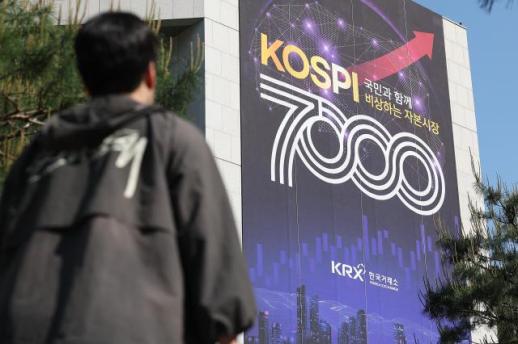 KOSPI flies over yet another milestone on single chip engine SEOUL, May 06 (AJP) - South Korea’s stock benchmark powered through energy shocks and inflation fears to race past one four-digit milestone after another and outperform the S&P 500, though the rally is increasingly raising concerns over overheating and heavy dependence on a single engine: semiconductors. The KOSPI closed at 7,384.56 on Wednesday, up 6.45 percent, blasting through another psychological threshold without the usual consolidation period. The rally remained highly selective, with declining stocks overwhelming gainers 679 to 200. Momentum again rested disproportionately on chip giants Samsung Electronics and SK hynix, which now account for more than 43 percent of the KOSPI’s total weighting. Samsung Electronics closed at 266,000 won, up nearly 390 percent from a year earlier and joining the exclusive $1 trillion market-cap club. SK hynix has soared 761 percent to 1,601,000 won from 186,000 won on May 2 last year. “AI ecosystems need balanced development across infrastructure, models and services, but South Korea remains heavily concentrated on the hardware side,” said Lee Seong-yeob, a professor at Korea University’s Graduate School of Technology Management. Lee said decades of industrial policy helped cement South Korea’s global semiconductor competitiveness, but the heavy concentration has left other sectors lagging behind, complicating efforts to build a sustainable AI ecosystem. The rally has been underpinned by explosive earnings from a prolonged semiconductor supercycle. Samsung Electronics’ semiconductor division posted a nearly 48-fold jump in operating profit to 53.7 trillion won from a year earlier. SK hynix also reported a 405.5 percent jump in first-quarter operating profit from a year earlier. According to the Korea Exchange, foreign investors purchased a net 3.134 trillion won worth of shares on the main bourse Wednesday, surpassing the previous daily record of 3.126 trillion won set on Oct. 2 last year. The KOSPI has surged 188.5 percent since May last year, marking a sharp turnaround from early 2025, when political turmoil and U.S. reciprocal tariffs triggered nine consecutive months of foreign selling. Government efforts to narrow the so-called “Korea discount” later helped restore investor confidence. Despite the blistering rally and a surge in retail trading accounts, the KOSPI’s price-to-book ratio of 2.12 remains well below the S&P 500’s 5.44, even after the Korean benchmark closed above the U.S. index’s 7,259.22 finish Tuesday. Sustainability questions linger. Samsung Electronics faces pressure from rising material costs and the prospect of a labor union strike over profit-sharing disputes. Data flag deeper vulnerability. Outstanding margin loans on the benchmark KOSPI and the tech-heavy KOSDAQ reached 35.84 trillion won ($25.8 billion) as of Monday, after briefly surpassing the 36 trillion-won mark for the first time on April 29. The sharp rebound in retail leverage suggests that so-called “FOMO” money — investors fearful of missing out on the market’s relentless surge — is flooding back into equities through borrowed funds after briefly retreating during the U.S.-Israel-Iran conflict shock. Cash waiting on the sidelines has also ballooned. Investor deposit balances stood at 124.84 trillion won as of Monday, after nearing 130 trillion won late last month, underscoring the scale of speculative liquidity chasing the rally. At the same time, shorting bets are climbing to unprecedented levels, reflecting simmering unease over whether the rally can sustain its pace. Outstanding short-selling positions on the KOSPI reached a record 20.1 trillion won on April 29, the first time the figure has crossed the 20 trillion-won threshold. Short selling involves borrowing and selling shares in anticipation of buying them back later at lower prices. Stock lending balances — often viewed as ammunition for future short-selling — also surged to 174.8 trillion won as of Monday, up roughly 25 trillion won from a month earlier, all pointing to a momentum-driven gold rush vulnerable to a sharp unwind once sentiment reverses. 2026-05-06 17:41:33
 -
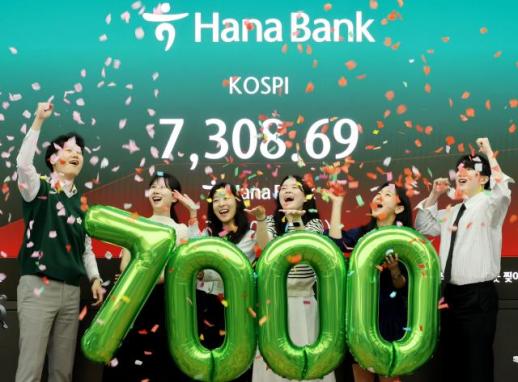 KOSPI rockets above 7,300 in record-breaking chip rally *Updated with performance of other Asian markets. SEOUL, May 06 (AJP) - What once seemed improbable has rapidly become reality as South Korea’s benchmark KOSPI vaulted above the 7,300 mark on Wednesday, just three weeks after reclaiming the 6,000 level as feverish foreign buying turbocharged semiconductor and AI infrastructure stocks despite lingering uncertainty surrounding the Strait of Hormuz crisis. As of 10:09 a.m., the KOSPI stood at 7,325.31, up 5.60 percent from Monday’s close, after surging to an intraday high of 7,338.61 earlier in the session. Foreign buying total 1.25 trillion won, overwhelming local selling. The celebration however was heavily skewed with losers outnumbering gainers by 674 to 204. The move marked the index’s first break above the 7,300 threshold and underscored the extraordinary pace of the rally after the KOSPI first crossed the 6,000 mark on Feb. 25. The Korean won also recovered to near pre-war levels in the 1,450 range against the U.S. dollar. The dollar-won exchange rate fell to 1,457.70 won from 1,462.8 won in the previous session. The KOSPI has remained remarkably resilient despite the Middle East war and South Korea’s heavy dependence on Gulf energy imports for manufacturing and exports. The benchmark first broke above 4,000 in October last year, topped 5,000 in January and crossed 6,000 a month later, before storming into the 7,000 era within barely half a year. The latest leg higher followed another record-setting session on Wall Street overnight, where both the S&P 500 and the Nasdaq Composite closed at all-time highs as easing oil prices and optimism surrounding AI-driven semiconductor demand outweighed lingering geopolitical concerns in the Middle East. Investor sentiment improved after reports indicated that the fragile ceasefire between the United States and Iran was largely holding despite intermittent clashes, easing fears of supply disruptions and pushing oil prices lower. West Texas Intermediate crude futures fell 3.90 percent to settle at $102.27 a barrel. Technology shares led gains in the United States. Intel jumped nearly 13 percent on news of fresh semiconductor supply negotiations with Apple, while the Philadelphia Semiconductor Index soared 4.23 percent. Advanced Micro Devices surged another 15 percent in after-hours trading after posting strong first-quarter earnings. The global semiconductor rally spilled into Seoul, fueling aggressive buying in chip-related shares. Samsung Electronics surged 12.26 percent to 261,000 won, while SK hynix jumped 9.68 percent to 1,587,000 won, with both hitting fresh intraday record highs. SK Square, the largest shareholder of SK hynix, soared 10.80 percent to break above the 1 million won mark. Brokerage firms also rallied sharply on expectations that surging trading activity would boost commissions and earnings. Mirae Asset Securities jumped 15.22 percent to a fresh 52-week high, while Kiwoom Securities advanced 10.06 percent. Automakers and battery-related shares also traded higher, with Hyundai Motor gaining 3.34 percent, Kia rising 1.69 percent and LG Energy Solution adding 0.11 percent. Defense and shipbuilding-related shares, however, lagged behind the broader market rally. Hanwha Aerospace fell 1.30 percent, while HD Hyundai Heavy Industries slipped 4.26 percent. HMM also declined 1.65 percent after a fire broke out aboard one of its cargo vessels anchored near the Strait of Hormuz on Monday, adding another layer of uncertainty to already fragile global shipping routes. Meanwhile, the tech-heavy KOSDAQ bucked the broader rally, slipping 0.90 percent to 1,202.83. Elsewhere in Asia, Japanese markets remained closed for the Golden Week holiday. Hong Kong’s Hang Seng Index traded higher, rising 0.54 percent to 26,037.53 and China’s Shanghai Composite Index also advanced, gaining 1.05 percent to 4,155.44. 2026-05-06 10:34:14
 -
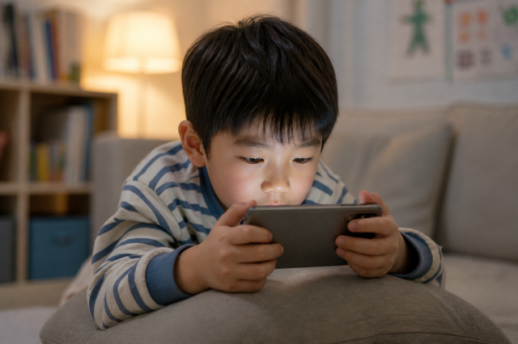 Seven in 10 older elementary students in Korea use AI SEOUL, May 04 (AJP) - Seven out of 10 South Korean elementary school students in upper grades use generative artificial intelligence tools, surveyed showed Monday, with nearly 15 percent frequenting them to underscore how deeply AI has entered childhood education and daily life in one of the world’s most digitally connected societies. According to a nationwide survey released Monday by the Korean Teachers and Education Workers Union, 72.1 percent of fourth- to sixth-grade elementary students said they had used generative AI tools like ChatGPT and Gemini. Among them, 57.4 percent said they used them occasionally, while 14.7 percent reported frequent use. The online survey was conducted from April 9 to 22 among 2,804 upper elementary students nationwide ahead of Children’s Day. Half of respondents said they spend more than two hours a day on smartphones, tablets or other smart devices after school. Smartphones are banned in classrooms in Korea. Among them, 21.1 percent reported using devices for two to three hours daily, while 15.9 percent said they spent three to four hours. Another 12.2 percent said they use smart devices for more than four hours after school. Longer screen time became markedly more common in higher grades. Among sixth graders, 36.8 percent said they used smart devices for more than three hours a day after school — more than double the 16.9 percent reported among fourth graders. Heavy use was also more pronounced among older students. Some 16.5 percent of sixth graders said they spent more than four hours a day on devices, compared with 6.7 percent of fourth graders. Only 4.7 percent of respondents said they do not use smart devices after school. Another 20.5 percent said they use them for less than one hour daily, while 25.6 percent reported one to two hours of use. The survey suggested after-school supervision also plays a role in device dependency. Among children left alone after school, 16.5 percent reported using smart devices for more than four hours daily, compared with 9.7 percent among children who stayed with parents or other adults. The teachers’ union said the findings point to widening gaps in after-school care and warned that a lack of supervision may be accelerating excessive reliance on digital devices. About 40 percent of respondents also acknowledged difficulty controlling their smartphone use. When asked whether they struggled to stop using devices, 7.1 percent said “often,” while 33.9 percent answered “sometimes.” Overall, 42.5 percent reported experiencing problems related to device use. The most common issue was excessive screen time, cited by 21.1 percent, followed by difficulty concentrating on studies at 16.8 percent and conflicts with family members over device use at 12.8 percent. The findings echo broader international concerns over children’s growing dependence on AI and digital technology. The Organization for Economic Co-operation and Development said in its “Digital Education Outlook 2026” report that generative AI is spreading rapidly across education systems worldwide and is becoming increasingly accessible to students, while warning that overreliance on such tools could weaken learning and reduce engagement in cognitive processes. The survey also suggested that smartphones may be filling a broader emotional and social void for children facing intense academic pressure and limited free time. When asked what schools, families and society should prioritize to support children’s development, respondents most frequently cited ensuring sufficient time for rest and play, at 42.4 percent. That was followed closely by reducing academic burden at 42.0 percent. A safe environment free from school violence was cited by 34.8 percent. The teachers’ union said the results reflect structural changes in children’s daily lives amid the rapid expansion of digital technology and called for urgent policy responses. It proposed establishing national guidelines for AI use in education, creating clearer rules for smart-device use between schools and families, strengthening data privacy protections for minors, guaranteeing time for rest and play after school, and easing academic pressure through tighter regulation of private tutoring. 2026-05-04 15:03:52
 -
 KOSPI tops 6,800 on AI-driven chip rally amid easing Hormuz tensions SEOUL, May 04 (AJP) - South Korea’s benchmark KOSPI jumped more than 3 percent at the open on Monday to test a new plateau above 6,800 on strong institutional buying in chip and other large-cap stocks. Market sentiment was also influenced by geopolitical developments after U.S. President Donald Trump said the United States would begin safely escorting ships from “neutral and innocent” countries through the Strait of Hormuz under a new initiative referred to as “Project Freedom.” He described the move as a humanitarian effort but warned that the U.S. would respond strongly to any interference, while also noting ongoing positive discussions with Iran. As of 10:42 a.m., South Korea’s benchmark KOSPI rose 3.40 percent to 6,822.94. Shares of SK hynix and its largest shareholder SK Square surged in early trading, supported by improved investor sentiment driven by strong earnings from global Big Tech firms and growing investment in artificial intelligence infrastructure. The chipmaker was 8.7 percent higher at 1,399,000 won, hitting an intraday record high, while SK Square jumped 12.84 percent to 949,000 won. Among other heavyweights, tech shares led the gains, with Samsung Electronics rising 2.15 percent and its preferred shares up 2.84 percent, while Samsung Electro-Mechanics climbed 5.17 percent. Auto stocks were also strong, with Hyundai Motor and Kia gaining 1.88 percent and 2.83 percent, respectively. In the industrial and defense sector, Hanwha Aerospace rose 4.02 percent and HD Hyundai Heavy Industries added 1.17 percent, while Doosan Enerbility slipped 0.71 percent. Battery makers showed modest gains, with LG Energy Solution up 1.41 percent and Samsung SDI rising 1.29 percent. Biotech and financial stocks were mixed, as Samsung Biologics fell 0.61 percent and KB Financial Group declined 1.25 percent, while Samsung Life Insurance edged up 1.20 percent. On the junior KOSDAQ, most major stocks traded higher, with the index up 1.93 percent to 1,215.35, led by battery and materials names such as EcoPro and EcoPro BM, which gained 2.94 percent and 4.13 percent, respectively. Pharmaceutical and biotech stocks also advanced, including Alteogen, HLB, ABLBio and LigaChem Biosciences, which rose 2.44 percent, 2.14 percent, 0.07 percent and 0.87 percent, respectively, alongside Peptron, up 3.07 percent. Industrial and equipment-related shares also moved higher, with Rainbow Robotics gaining 3.77 percent, LEENO Industrial up 0.25 percent, Kolon TissueGene climbing 4.12 percent, Jusung Engineering edging up 0.24 percent and Wonik IPS rising 1.37 percent. Only Samchundang Pharm bucked the trend, slipping 0.36 percent. Meanwhile, the Korean won strengthened to 1,472.40 per dollar from 1,483.30 in the previous session. Elsewhere in Asia, Hong Kong’s Hang Seng Index rose 1.74 percent to 26,225.42. Japan’s Nikkei 225 was closed on Monday for Greenery Day, while China’s Shanghai Composite Index remained closed for the Labor Day holiday period. 2026-05-04 11:01:37
 -
 Korea's AI boom is outrunning its safeguards, exposing widening governance gap SEOUL, May 03 (AJP) - Artificial intelligence is no longer an emerging technology in South Korea. It is already embedded across offices, software engineering, media production, education and financial services at one of the fastest rates in the world. The problem, experts increasingly warn, is that the systems designed to govern that transformation are evolving far more slowly than the technology itself. “Many organizations claim to have ethical frameworks, but few can demonstrate them through concrete diagnostics or formalized processes,” Lyse Langlois, director of the International Observatory on the Societal Impacts of AI and Digital Technology at Laval University, said during a seminar on AI ethics and safety at Korea University last Thursday. Her warning came as data place South Korea rapidly emerging as one of the world’s most AI-intensive economies. According to Anthropic’s Economic Index released in January, South Korea accounted for 3.06 percent of global Claude AI usage, placing it among the top five AI-using countries alongside the United States, India, Japan and the United Kingdom. Based on approximately one million real-world AI conversations collected in late 2025, the dataset offers one of the clearest snapshots yet of how AI is being integrated into economic activity. What stood out is not merely the scale of Korean AI usage, but its concentration inside professional workflows. More than half, or 51.1 percent, of Korean AI interactions were work-related — the highest proportion among East Asian economies analyzed, exceeding Japan, Taiwan and Singapore. Korea is no longer experimenting with AI at the margins. It is integrating the technology directly into knowledge-intensive production. Software debugging and optimization emerged as one of the country’s largest AI use categories, followed by multimedia content creation, educational support and research assistance. Computer and mathematics-related professions accounted for the largest share of AI users at 25.6 percent, followed by arts, design and media at 14.9 percent, followed by arts, media and education and library-related roles at 13.4 percent. The findings align with broader structural shifts identified by the Korea Institute for International Economic Policy (KIEP), which analyzed Anthropic’s January data and concluded that AI in South Korea is evolving beyond simple automation toward collaborative augmentation. Between August and November 2025, Korea recorded the sharpest decline among East Asian peers in tasks fully delegated to AI, while collaborative human-AI interaction rose sharply. The shift suggests Korean workers are increasingly using AI not as a replacement tool, but as a partner embedded inside complex judgment work. That transition could generate major productivity gains. KIEP projected AI adoption could significantly lift long-term labor productivity growth, particularly in advanced knowledge sectors. But researchers also warned the effects may be uneven, producing simultaneous “deskilling” in routine work and “upskilling” in highly specialized professions. Yet Korea’s institutional safeguards are lagging far behind the scale of that transformation. “AI safety is becoming a matter of building measurable, enforceable and continuously evolving systems,” Lim Ji-hoon, professor at Korea University’s Graduate School of Information Security, said during the seminar. Lim warned that AI risks are changing rapidly as systems evolve beyond passive chatbots into increasingly autonomous “agent-based” models capable of independently planning actions, accessing tools and interacting with external systems. Such systems dramatically expand risks tied to cyberattacks, misinformation, fraud and data misuse, particularly in data-rich economies like South Korea. The frequencies of data breaches already flag the danger. Over the past year, South Korea has suffered a series of major data breaches exposing weaknesses in the country’s digital governance infrastructure. Lotte Card suffered a large-scale personal data leak that led regulators last week to slap a roughly 4.5-month business suspension and a fine of around 5 billion won ($3.6 million). Separate breaches at Coupang and matchmaking company Duo exposed large volumes of highly sensitive information, including names, workplace details, religion, physical characteristics and phone numbers. The Duo breach particularly alarmed regulators because the company failed to promptly notify users and retained hundreds of thousands of outdated records containing resident registration information. Experts at the seminar repeatedly stressed that such incidents carry fundamentally different implications in the AI era. In traditional digital systems, data leaks primarily created risks of identity theft or financial fraud. In AI-intensive environments, however, large-scale structured personal data can become training material, profiling infrastructure or targeting input for automated systems capable of operating at industrial scale. That convergence — mass data exposure meeting rapidly advancing AI capability — increasingly defines the urgency surrounding AI governance debates in South Korea. Yet despite its high adoption rate, Korea’s regulatory framework remains comparatively rudimentary relative to Europe’s tightening approach. A global comparative study evaluating 178 countries across 11 AI governance criteria ranked South Korea below countries operating under the EU AI Act. While Seoul’s 2024 “Act on the Development of AI and Establishment of Trust” established regulatory structures, adopted a risk-based framework and introduced deepfake labeling requirements, analysts said the law remains considerably more industry-friendly than Europe’s stricter regime. Fines remain relatively modest, transparency requirements around copyrighted training data are limited, and environmental impacts tied to large-scale AI infrastructure are largely absent from the legislation. The result, experts say, is a widening gap between AI deployment speed and accountability architecture. Langlois argued governments and corporations globally have spent years drafting ethical principles without building systems capable of real enforcement. “Ethics is not a checklist,” she said. “It is governance architecture.” At the seminar, she proposed a four-pillar framework for institutionalizing AI ethics: establishing enforceable standards, building organizational competency, implementing audit and monitoring systems, and ensuring continuous adaptation as AI systems evolve. Her broader point was that trust in AI cannot depend on voluntary declarations alone. That argument increasingly resonates in Korea because the country’s AI adoption profile is unusually concentrated in industries where data sensitivity and intellectual property risks are highest. Software engineers using AI for debugging and optimization interact directly with proprietary codebases and internal systems. Media professionals increasingly rely on AI-generated or AI-assisted content. Educators handle large amounts of student and institutional data. As AI becomes embedded deeper into those sectors, governance failures could propagate much faster across the economy. For now, much of the responsibility rests with private companies, while regulatory role is confined to post-crisis damage control. Naver AI Safety Center leader Won Seong-jae said the company is rebuilding its internal AI risk evaluation systems around practical service-level risks involving privacy, misinformation and legally sensitive content categories. He described the company’s objective as “unnoticeable safety” — systems robust enough that users can rely on AI-powered services without constantly questioning whether safeguards exist. The challenge facing South Korea is that the country may already be approaching the frontier where AI adoption itself begins exposing the limits of existing institutions. 2026-05-03 10:48:00
 -
 As romance revives from recession in Korea, dating mimics reality TV SEOUL, April 30 (AJP) - For Jason Park, a corporate analyst in his mid-30s, the math of modern romance simply wasn’t adding up. Buried in work under lingering post-pandemic social atrophy, the prospect of a chance encounter felt less like a possibility and more like a statistical anomaly. "If I hadn't been there that day two years ago, I would still be wrapped up in work," Park says, glancing shyly at his girlfriend, Choi, a freelance announcer in her 30s. The pair met not through a serendipitous coffee spill or a mutual friend, but in the polished confines of a premium lounge bar—a curated "rotation dating" event designed for Seoul’s high-achieving singles. "That day, I didn’t just meet my life companion; I found a community." In South Korea, where the "dating desert" has become a matter of national discourse, romance is staging a comeback—not through traditional slow-burn courtships, but through high-end, highly structured social engineering. The statistics tell a story of romantic recession. As of 2024, nearly 75% of South Korean men aged 30 to 34 remain unmarried; for women in the same bracket, the figure sits at 58%. Yet, despite the narrative of a "non-marriage generation," the desire for partnership is rebounding. Recent data from the Planned Parenthood Federation of Korea shows that over 60% of single men and nearly half of single women express a desire to wed—a figure that has climbed for two consecutive years. This gap between desire and reality has birthed a burgeoning industry of "curated" dating. These are not the sterile, interview-like sessions of traditional matchmaking agencies. Instead, they are immersive experiences that feel, by design, like a localized episode of Heart Signal. From Screen to Script At a private lounge in Gangnam on a recent April afternoon, the air is thick with the "syntax of curated romance." Here, 40 participants in coordinated black-and-white attire mingle over wine. The atmosphere is less "blind date" and more "reality TV set." "The traditional setup invests an entire evening in a single proposition that may immediately fail," explains Helen Shin, a professor of Media and Communications at Korea University. "The rotation format diversifies that investment across many short exposures." Shin calls this "emotional portfolio logic." By meeting 20 people in one evening, the psychological sting of rejection is diluted, dispersed across a dozen micro-interactions rather than concentrated in one failed dinner. For Lee, a 36-year-old participant, the appeal is the escape from the "credential-checking" fatigue of apps and agencies. "Traditional agencies felt like interviews," she says. "You evaluate people as resumes. Here, you begin to realize what kind of person you’re genuinely drawn to naturally." At elite clubs like The Grace Club, the "natural" feel is underpinned by rigorous gatekeeping. Entry requires mandatory identity verification, employment screening, and a pre-screening of photographs. Most participants are professionals from "top-tier" backgrounds—lawyers, doctors, and engineers from conglomerates like Samsung and Hyundai. While critics might view this as cold calculation, Professor Shin suggests it is a form of "defensive realism." "Verification functions as a technology of trust in a moment when the social institutions that once underwrote courtship—family introductions, workplace circles, neighborhood networks—have substantially eroded," Shin says. In this new ecology, the dating app, the reality show, and the premium event have merged into a single, recursive loop. Participants arrive already fluent in the observational habits of the screen, viewing their own lives through the "evaluative gaze" of an invisible camera. Despite the rise of AI-driven matching and the efficiency of digital filters, the participants in Yeongdeungpo date night remain firm on one point: chemistry cannot be coded. Even during the height of Covid-19, when "online rotation" sessions were held via group chats, the goal was always the eventual physical meeting. As 10 p.m. nears on a rooftop in western Seoul, the clinking of glasses signals the end of the "event" and the beginning of something more traditional. Phone numbers are exchanged; future dinners are planned. Whether this represents a permanent shift in Korean courtship or a temporary adaptation to economic strain remains to be seen. But for a generation navigating scarcity and uncertainty, the most rational response to a chaotic world appears to be a perfectly curated evening. 2026-05-01 09:00:00
 -
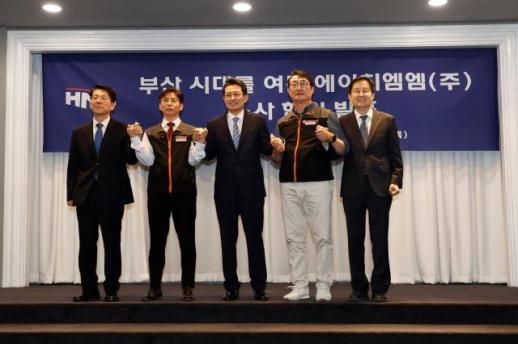 HMM reaches labor-management deal to move HQ to Busan SEOUL, April 30 (AJP) - South Korea’s HMM, the world’s eighth-largest shipping company, said Friday that its labor and management have reached an agreement to relocate the company’s headquarters to the southern port city of Busan, the country’s main maritime gateway, resolving a long-standing dispute that had raised concerns over labor strikes and disruptions to global logistics. Busan, home to South Korea’s largest port, has been positioning itself as a maritime and logistics hub, with the government pushing to cluster shipping, finance, and related industries in the city. While the government expects the relocation to strengthen operational efficiency and create synergies with port infrastructure and maritime institutions in the city, concerned voices erupted from workers from government offices and companies, including HMM, who were worried about their families leaving their hometown to move to Busan. The shipbuilder said that the agreement reflects a shared commitment to national priorities such as regional development and decentralization. HMM added that with the prolonged Middle East conflict continuing to strain global supply chains, the deal was reached to avoid a potential labor strike stemming from labor-management differences, which could have disrupted both domestic and international logistics and led to broader social and economic impacts. Under the deal, HMM will complete legal procedures to change its registered headquarters following an extraordinary shareholders’ meeting scheduled for May 8. Afterward, the company will first relocate the CEO’s office, after which labor and management will begin detailed talks on the relocation, with a focus on business efficiency and potential synergies. The company said the two sides had held multiple rounds of talks since the second half of last year but failed to reach an agreement, with tensions escalating recently as the union filed for mediation, pursued legal action against the CEO and warned of a possible strike. The company also plans to push ahead with the construction of a landmark office building in Busan’s North Port area to support the local economy. Meanwhile, the company reported revenue of 10.89 trillion won ($7.9 billion) and an operating profit of 1.46 trillion won last year. An official of HMM said the deal reflects national priorities and the company’s role as a national flag carrier, adding that with uncertainties now eased, it will focus on addressing external risks and strengthening its global competitiveness. Founded in 1976, HMM operates a global network connecting more than 60 trade routes and over 100 ports across the Americas, Europe, the Middle East and Latin America. The company has secured container capacity exceeding 1 million twenty-foot equivalent units (TEUs) and aims to expand this to 1.55 million TEUs by 2030, alongside investments in eco-friendly vessels and digital transformation. 2026-04-30 15:59:52
 -
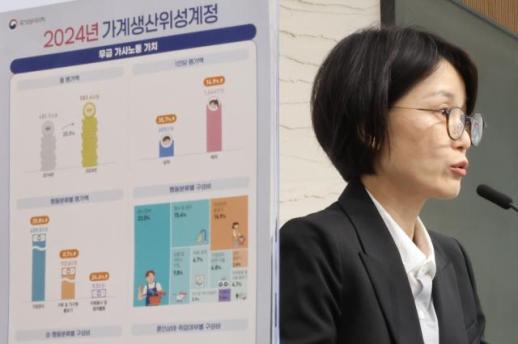 Korean women still do 3 times more unpaid housework, men on faster rise SEOUL, April 29 (AJP) - South Korean women would effectively be 2.7 times richer than men — if unpaid household work were properly compensated — though the gap has eased from 3.2 times five years ago as single life forces more men to take on domestic responsibility, data showed Wednesday. The value of home management in South Korea — encompassing childcare, cooking, cleaning and elder care — was estimated at 582.4 trillion won ($420 billion) in 2024, equivalent to 22.8 percent of nominal gross domestic product, according to the 2024 Household Production Satellite Account released by Ministry of Data and Statistics. The account measures the economic value of unpaid work not captured in GDP. The estimate marked a 20 percent increase over the past five years, though its share of GDP edged down by 1 percentage point. The value of unpaid household work per person was estimated at 11.25 million won annually, up 20 percent over the same period. Housework remains primarily women’s responsibility, with their unpaid labor valued at 16.46 million won per person, compared with 6.05 million won for men — about 2.7 times higher. The shift, however, has been sharper among men. Among unmarried men, the value of unpaid household labor surged 68.7 percent over five years, outpacing the 47.2 percent increase among unmarried women. Married men also recorded a faster rise at 28.9 percent. By category, household management work rose 25.8 percent, while care for pets and plants jumped 60.4 percent. Adult care, including eldercare, increased 20.8 percent as the population aged. By contrast, the value of childcare fell 1.8 percent, reflecting a decline in the school-age population. Single-person households recorded the sharpest increase in unpaid household labor value, rising 66.2 percent over five years, followed by two-person households at 40.9 percent and three-person households at 22.2 percent. Households with five or more members saw an 11.3 percent decline. Three-person households accounted for the largest share at 166 trillion won, followed by four-person households at 147.4 trillion won and two-person households at 136.7 trillion won. By employment status, unpaid household work was valued at 297.4 trillion won for those outside the workforce, slightly exceeding the 284.9 trillion won for those with jobs. Regionally, Sejong posted the steepest increase at 42.3 percent, driven by growth in the child population and rising caregiving time. First introduced in 2018, the household production satellite account is compiled every five years to estimate the value of unpaid work excluded from GDP. 2026-04-29 15:07:53
 -
 KOSPI takes breath amid growing uncertainty over AI-fueled rally SEOUL, April 29 (AJP) - South Korea's benchmark KOSPI fluctuated on Wednesday after opening lower, as investors weighed an overnight Wall Street selloff amid uncertainty over the sustainability of the recent artificial intelligence (AI)-fueled rally. Investors also appeared cautious ahead of earnings reports from five major tech companies, collectively dubbed the "magnificent seven," including Alphabet, Amazon, Apple, Meta, and Microsoft this week. The main index fell 0.43 percent to 6,612.20 shortly after trading began. Foreign investors sold a net 436.4 billion won, outweighing buying by retail and institutional investors. Heavyweight semiconductor shares such as Samsung Electronics and SK Hynix came under pressure, tracking weakness in U.S. technology stocks. Samsung Electronics fell 0.90 percent to 220,000 won, while SK Hynix slipped 0.31 percent to 1,296,000 won. Sentiment had initially been dampened after U.S. equities retreated overnight, with technology shares leading losses amid renewed concerns over elevated valuations tied to the AI boom. The S&P 500 fell 0.49 percent to 7,138.80 and the Nasdaq Composite dropped 0.90 percent to 24,663.80. Among other large caps, Samsung Biologics slipped 1.20 percent to 1,486,000 won, and Hyundai Motor fell 1.08 percent to 549,000 won. LG Energy Solution also declined 1.06 percent to 467,000 won. Gains were led by defense and industrial shares, with Hanwha Aerospace rising 1.79 percent to 1,420,000 won and HD Hyundai Heavy Industries jumping 3.15 percent to 688,000 won. Samsung SDI climbed 2.50 percent to 697,000 won, while SK Square edged up 0.37 percent to 814,000 won. Power equipment shares also remained firm, with Hyosung Heavy Industries adding 0.20 percent to 3,984,000 won. The junior KOSDAQ stocks were also mostly lower, led by Juseong Engineering, which tumbled 7.13 percent to 121,200 won, and LigaChem Biosciences, down 3.83 percent to 195,700 won. Ecopro fell 2.79 percent to 157,000 won, and Alteogen slipped 1.33 percent to 381,500 won. Rainbow Robotics dropped 1.65 percent to 657,000 won, and Ecopro BM lost 1.41 percent to 210,500 won. Among others, Leeno Industrial fell 1.97 percent to 109,200 won, EO Technics dropped 1.95 percent to 503,000 won, Wonik IPS shed 2.06 percent to 118,600 won, and Caregen slipped 1.31 percent to 105,600 won. Gainers were limited, with Alteogen rising 1.33 percent to 381,500 won and ABL Bio edging up 0.14 percent to 139,600 won. The South Korean won strengthened slightly to 1,472.50 per dollar from 1,473.60 previously. Elsewhere in Asia, Hong Kong's Hang Seng Index rose 0.63 percent to 25,842.63, while China's Shanghai Composite fell 0.41 percent to 4,061.82. Japan's Nikkei 225 was closed on Wednesday for Showa Day, a Japanese public holiday honoring former Emperor Hirohito, while markets in South Korea, China, Hong Kong, and Taiwan will be closed on Friday for Labor Day. 2026-04-29 11:21:20