
Journalist

Yang Boyeon
byeony@ajunews.com
-
 Cosmo Robotics Soars on First Day of KOSDAQ Listing Cosmo Robotics, a company specializing in wearable robotics, recorded a remarkable debut on the KOSDAQ market on May 11, achieving a fourfold increase from its initial public offering (IPO) price. According to the Korea Exchange, at 9:46 a.m., Cosmo Robotics was trading at 20,600 won, up 14,600 won (243.33%) from its IPO price of 6,000 won. Shortly after the market opened, the stock surged to 24,000 won, marking a 300% increase. Founded in 2016, Cosmo Robotics specializes in medical and rehabilitation wearable robotics technology. The company conducted its public offering from April 27 to 28, attracting significant interest with a subscription rate of 2,013.8 to 1, raising a total of 6.3 trillion won in deposits. Cosmo Robotics plans to invest the 25.02 billion won raised from the IPO into expanding its presence in global markets, including the United States, Japan, Russia, Europe, and China. Additionally, the company aims to develop next-generation wearable robots that extend beyond the business-to-business (B2B) rehabilitation medical market into business-to-consumer (B2C) and business-to-government (B2G) sectors. CEO Oh Joo-young stated, "Through this IPO, we have confirmed positive evaluations of Cosmo Robotics' technological capabilities and growth potential. We will accelerate our entry into the U.S. home-use market and expand into Japan, Russia, Europe, and China using the funds secured from the listing."* This article has been translated by AI. 2026-05-11 10:20:08
 -
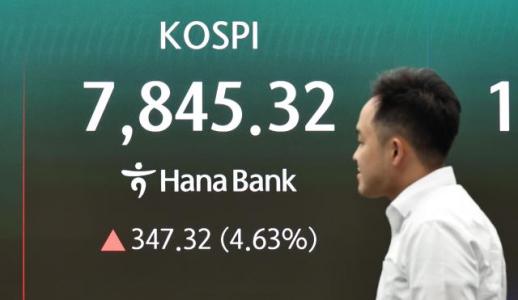 KOSPI Triggers Buy Sidecar After Surge On May 11, the KOSPI surged, prompting the activation of a buy sidecar in the securities market. This marked the first activation in three trading days since May 6. This was the 15th sidecar triggered in the KOSPI market this year, with eight of those being buy sidecars. According to the Korea Exchange, at 9:29:32 a.m., the KOSPI 200 futures index soared, leading to a five-minute suspension of program buy orders. At the time of the sidecar activation, the KOSPI 200 futures index was up 58.82 points (5.10%) at 1210.54 compared to the previous day's closing price. As of 10:10 a.m., Samsung Electronics was trading at 283,000 won, up 14,500 won (5.40%), while SK Hynix surged 17,300 won (10.26%) to 1,859,000 won, both continuing their record-high streaks. The buy sidecar in the KOSPI market is activated when the KOSPI 200 futures price rises more than 5% above the reference price for over one minute. When activated, the effectiveness of program buy orders is temporarily restricted to mitigate excessive price surges. Meanwhile, the KOSPI index opened at 7775.31 and surpassed 7800 shortly after the opening, setting an intraday record. On May 8 (local time), the S&P 500 index rose 0.84%, and the Nasdaq Composite increased by 1.71%, both reaching all-time highs. The Philadelphia Semiconductor Index also rose by 5.51% on the same day.* This article has been translated by AI. 2026-05-11 10:18:36
 -
 KOSPI Surges Past 7800 Mark as Samsung and SK Hynix Lead Gains The KOSPI continues its upward trend, surpassing the 7800 mark shortly after the market opened and consistently breaking previous records. The index is being driven by strong performances from semiconductor giants Samsung Electronics and SK Hynix. According to the Korea Exchange, as of 9:09 a.m., the KOSPI was up 307.33 points (4.10%) at 7805.33. The index started at 7775.31, an increase of 277.31 points (3.70%) from the previous trading day, and has continued to rise. In the securities market, foreign and institutional investors sold a net 420.7 billion won and 132.5 billion won, respectively, while individual investors purchased a net 526.4 billion won. Among the top market capitalization stocks, Samsung Electronics (up 6.15%), SK Hynix (up 9.43%), SK Square (up 6.02%), Hyundai Motor (up 0.98%), Samsung C&T (up 14.79%), HD Hyundai Heavy Industries (up 4.41%), and Hanwha Aerospace (up 3.90%) are all experiencing gains. Conversely, LG Energy Solution (down 1.78%), Doosan Enerbility (down 0.46%), and Samsung Biologics (down 0.54%) are seeing declines. On this day, Samsung Electronics and SK Hynix both saw significant increases of 7-8% in pre-market trading, continuing their trend of reaching record highs, with their combined market capitalization nearing 300 trillion won. At the same time, the KOSDAQ index fell by 1.84 points (0.15%) to 1205.88. The index opened at 1212.88, up 5.16 points (0.43%) from the previous trading day, but turned downward due to selling pressure from foreign and institutional investors. In the KOSDAQ market, foreign and institutional investors sold a net 162.5 billion won and 51.9 billion won, respectively, while individual investors bought a net 216.7 billion won. Among the top KOSDAQ stocks, EcoPro BM (down 2.53%), EcoPro (down 2.39%), Alteogen (down 2.35%), Rainbow Robotics (down 1.40%), Kolon TissueGene (down 3.83%), Samchundang Pharm (down 2.72%), and HLB (down 4.12%) are all declining, while Wonik IPS (up 11.21%) and JUSUNG Engineering (up 9.07%) are rising. Han Ji-young, a researcher at Kiwoom Securities, stated, "The KOSPI is likely to continue its unprecedented rally amid ongoing market dynamics. This week, external events such as the April CPI and the U.S.-China summit are on the horizon, but the sustainability of the semiconductor rally that began last week will be a more critical factor." He added, "Currently, there is a desire for profit-taking among all market participants, which may lead to increased short-term volatility during trading hours."* This article has been translated by AI. 2026-05-11 09:28:51
 -
 Shinhan Investment Raises Target Price for Kolmar Korea Amid Strong Growth Shinhan Investment Corp. announced on May 11 that it has raised its target price for Kolmar Korea from 95,000 won to 123,000 won, citing robust growth driven by strong skincare export performance from its Korean subsidiary. The investment opinion remains at 'buy.' Park Hyun-jin, an analyst at Shinhan Investment, noted, "The strong demand for skincare exports from the Korean subsidiary is enhancing profit leverage," adding that the consolidated operating profit for the first quarter reached 78.9 billion won, a 32% increase compared to the same period last year, exceeding market expectations by more than 14%. He further stated, "The operating profit from the Korean subsidiary surged by 51% to 51.2 billion won, driving the overall performance. The sales from luxury brand skincare contract manufacturing (ODM) are now being fully reflected, alongside strong demand for indie brand exports." Park also highlighted that the proportion of skincare sales in the domestic market is increasing, and revenue contributions from new clients in China are expected to grow. He emphasized that improved profitability for the Chinese subsidiary is anticipated due to increased orders for sun care products. While the U.S. subsidiary recorded a loss due to decreased orders from major clients, Park noted that the loss has been narrowing. He projected that the performance improvement trend will continue, considering the influx of new clients at the U.S. second factory and the base effect in the second half of the year.* This article has been translated by AI. 2026-05-11 08:50:04
 -
 KOSPI Hits Record Highs as Derivatives Investments Surge ◆Ajou Economic Major News ▷- As global markets continue to rally, particularly in the IT sector, the KOSPI has risen to the 7,500 level, and with the surge in KOSPI 200 night futures, domestic markets are expected to start strong early in the week. - During the U.S. first-quarter earnings season, the surprise rates for EPS and revenue among S&P 500 companies significantly exceeded long-term averages, indicating a positive earnings trend, while the sensitivity of domestic markets to earnings is expected to gradually decrease after this week. - The upcoming U.S.-China summit on May 14-15 is likely to address major issues such as the end of the Iran conflict, tariffs, and regulations on semiconductors and AI, with the market reflecting both optimism and caution. - The domestic market is experiencing a stark disparity in returns between the KOSPI and KOSDAQ, with funds increasingly concentrated in large-cap semiconductor stocks like Samsung Electronics and SK Hynix, exacerbating the trend toward large-cap stock dominance. - While concerns about overheating and technical pressures due to the market surge are growing, the upward revisions in earnings estimates for the semiconductor sector and maintained low valuations suggest that the existing strategy focused on leading stocks remains valid. ◆Major Announcements After Market Close (May 8) ▷Dongwon Industries reports first-quarter operating profit of 146.2 billion won, up 17.1% year-on-year. ▷SK Chemicals reports first-quarter operating profit of 21.2 billion won, down 42.6% year-on-year. ▷CJ Freshway reports first-quarter operating profit of 11 billion won, up 3.8% year-on-year. ▷Pumtech Korea reports first-quarter consolidated operating profit of 12.9 billion won, down 3.5% year-on-year. ▷Megastudy Education reports first-quarter operating profit of 26 billion won, down 0.8% year-on-year. ▷Inglewood Lab reports first-quarter consolidated operating profit of 5.6 billion won, up 22% year-on-year. ▷Korea Electric Power Technology reports first-quarter operating profit of 14.1 billion won, up 194.8% year-on-year. ◆Fund Trends (as of May 7, excluding ETFs) ▷Domestic equity funds: -93 billion won ▷Overseas equity funds: -29.8 billion won ◆Today's Schedule (May 11) ▷China: Consumer Price Index (April), Producer Price Index (April) ▷United States: Existing Home Sales (April)* This article has been translated by AI. 2026-05-11 08:48:33
 -
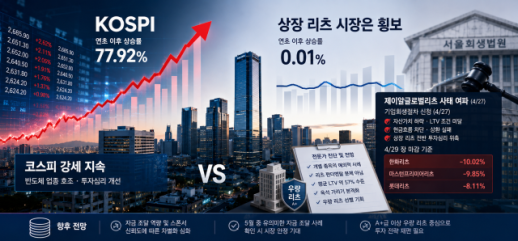 REIT Stocks Struggle Despite KOSPI Surge, Investors Urged to Differentiate The KOSPI index has recorded a rise of over 77% since the beginning of the year, continuing its bullish trend. However, the listed REIT market appears to be left out of this rally. Experts attribute the decline in investor sentiment to downward pressure from delayed global interest rate cuts and the recent corporate rehabilitation filing by JR Global REIT. They predict that while short-term volatility is inevitable, this situation will lead to a clearer differentiation between quality and poor-performing REITs. According to the Korea Exchange, as of market close on May 8, the KRX Prime Office REIT Index recorded zero returns since the start of the year. Similarly, the KRX Real Estate REIT Infrastructure Index saw only a 0.01% increase during the same period, indicating a stagnant trend. This starkly contrasts with the KOSPI's 77.92% rise since January. Analysts suggest that as investors focus on risk assets and growth stocks driven by the semiconductor sector, the appeal of REITs, which are generally considered defensive investments, has diminished. The situation worsened on April 27 when JR Global REIT filed for corporate rehabilitation at the Seoul Bankruptcy Court. With assets based in the Brussels Finance Tower and Manhattan office in New York, JR Global REIT faced a cash trap due to a decline in asset value, failing to meet loan-to-value (LTV) requirements, and ultimately defaulting on repayments. As a result, on April 29, many listed REITs, including Hanwha REIT (-10.02%), Mastern Premier REIT (-9.85%), and Lotte REIT (-8.11%), experienced significant declines, raising concerns about funding across the industry. However, analysts believe that the current crisis is unlikely to escalate into a fundamental issue for the entire REIT sector. They view the situation as an exceptional case influenced by the decline in overseas asset values and burdens from foreign exchange hedging settlements. Lee Hye-jin, a researcher at Daishin Securities, stated, "The JR Global REIT issue is a unique case stemming from the decline in overseas asset valuations and a lack of liquidity. REITs backed by large corporate sponsors with high credit ratings (AA- to A+) will likely face limited impacts on their funding environment." The average LTV for domestic listed REITs is managed at approximately 57% based on fair value, indicating a low risk level. The REIT industry has diversified its borrowing structure beyond secured loans to include corporate bonds and short-term bonds, enhancing its resilience to crises. Looking ahead, the REIT market is expected to see increased differentiation among stocks based on funding capabilities and sponsor credibility. Some analysts suggest that this could present an opportunity to select high-quality REITs. Lee Kyung-ja, a researcher at Samsung Securities, noted, "The recent JR Global REIT incident stems from exceptional risks associated with overseas assets, and it is important to avoid overextending this interpretation to the entire sector. REITs rated A+ and above still enjoy favorable conditions for issuing corporate bonds and can secure funding at lower rates than bank loans, preserving dividend payouts (DPS)." She added, "In the future, market differentiation will become more pronounced among top REITs with strong funding capabilities and sponsor competitiveness. If significant funding cases are confirmed in May, market sentiment is expected to stabilize gradually."* This article has been translated by AI. 2026-05-08 17:38:22
 -
 KOSPI Closes Slightly Higher on Individual Investor Buying Amid Profit-Taking The KOSPI, which started lower, closed slightly higher on May 8, buoyed by buying from individual investors. As the market digests the recent surge, a rotation among stocks continues. According to the Korea Exchange, the KOSPI rose by 7.95 points (0.11%) to close at 7,498.00. The index opened at 7,353.94, down 136.11 points (1.82%) from the previous session. Lee Kyung-min, a researcher at Daishin Securities, noted, "The domestic market is seeing profit-taking after a sharp rise recently, with foreign investors expanding net selling, particularly in large electric and electronics sectors." He added, "The semiconductor sector within the KOSPI is taking a breather, while rotation into robotics and neglected sectors continues." In the securities market, individuals and institutions net bought 4.79 trillion won and 1.28 trillion won, respectively, while foreign investors net sold 6.23 trillion won. Among the top market capitalization stocks, SK Hynix (1.93%), Hyundai Motor (7.17%), Samsung C&T (4.32%), and Samsung Biologics (0.27%) saw gains, while Samsung Electronics (-1.10%), SK Square (-0.09%), LG Energy Solution (-1.35%), Doosan Enerbility (-4.99%), and HD Hyundai Heavy Industries (-5.05%) declined. The KOSDAQ index closed at 1,207.72, up 8.54 points (0.71%). It started the day at 1,199.47, a slight increase of 0.29 points (0.02%), and quickly regained the 1,200 mark shortly after opening. In the KOSDAQ market, foreign and institutional investors net bought 518.3 billion won and 82.6 billion won, respectively, while individuals net sold 592 billion won. Among the top KOSDAQ stocks, EcoPro BM (0.85%), Rainbow Robotics (12.48%), Kolon TissueGene (11.52%), Samchundang Pharm (1.13%), ABL Bio (2.93%), and Rigakem Bio (2.41%) closed higher, while EcoPro (-2.94%), Alteogen (-4.49%), Rino Industrial (-0.79%), and HLB (-2.18%) fell.* This article has been translated by AI. 2026-05-08 16:07:16
 -
 Hyundai Motor Shares Surge Over 7% Following Atlas Robot Video Release Hyundai Motor shares rose more than 7% during trading on May 8. According to the Korea Exchange, as of 3:14 PM, Hyundai Motor's stock was trading at 613,000 won, up 41,000 won (7.17%) from the previous trading day. At one point, the stock surged by 13.11% to reach 647,000 won. At the same time, Hyundai Glovis saw an increase of 21,500 won (9.33%), trading at 252,000 won, while Hyundai Mobis rose by 68,500 won (15.52%) to 520,000 won. Kia's shares also experienced a boost, rising by 6,500 won (4.12%) to 164,100 won. The surge in Hyundai Motor's stock is attributed to the recent release of a video showcasing the operation of the humanoid robot Atlas by its robotics subsidiary, Boston Dynamics. Additionally, analysts suggest that the influx of investment may be a result of a rotation in the market, as semiconductor stocks, which had been driving the market's rise, showed signs of stabilizing on this day.* This article has been translated by AI. 2026-05-08 15:47:26
 -
 Lumiere Expands Engine Parts Supply to Hanwha Engine After Exclusive Deal with HD Hyundai Heavy Industries Aerospace company Lumiere is accelerating its expansion into the ship engine parts business. The company is currently supplying solenoids, a key component for ship engines, exclusively to HD Hyundai Heavy Industries while also pursuing supply agreements with Hanwha Engine. The rapid growth of the power demand for artificial intelligence (AI) data centers is emerging as a new growth driver in the power generation engine market. According to investment banking sources on May 8, Lumiere is in discussions with Hanwha Engine to expand its supply of solenoids, which are essential for controlling fuel in ship engines. The company currently has an exclusive supply agreement for these components with HD Hyundai Heavy Industries' medium-speed engine brand, HiMSEN. A Lumiere representative stated, "This is one of several scenarios that may arise during our business expansion process." Solenoids are electronic valve components that actively regulate engine fuel. Lumiere has successfully localized this product by applying precision control technology acquired during the development of actuators for satellite attitude control. The company is known to have obtained international explosion-proof certification, becoming the first in the world to do so for this product, which had previously relied heavily on Japanese manufacturers. Recently, Lumiere has also expanded its overseas supply chain. In February, the company signed a contract with Japanese engine parts manufacturer Niko Precision, and last month, it entered into a supply agreement with Amidas Security Tech, based in the United Arab Emirates. Industry experts believe that Lumiere is entering an initial phase of expanding its customer base beyond HD Hyundai Heavy Industries to other domestic and international engine manufacturers. The market is noting that the surge in power demand from AI data centers is leading to new growth across the shipbuilding and power generation engine sectors. The demand for engine-based power generation facilities is rapidly increasing due to shortages of gas turbines and long lead times. In fact, HD Hyundai Heavy Industries recently signed a supply contract for power generation facilities worth 627.1 billion won with American company Aepirion Energy Group (AEG), marking the largest contract of its kind in the company's history. Hanwha Engine is also in the process of expanding its medium-speed engine business by constructing a new factory. In line with these trends, Lumiere has begun expanding its production capacity. The company decided on April 30 to issue permanent convertible bonds worth approximately 33 billion won. The funds will be used to expand the production line for engine solenoids and for operational expenses. The current operating rate of the related production line is reportedly at full capacity. The company's business focus is also rapidly changing. Internally, Lumiere expects the revenue share from its shipbuilding division to rise from about 23% in 2023 to over 50% this year. Industry analysts predict that if the market for power generation engines for data centers expands, related revenues could nearly double compared to last year. An investment banking source remarked, "Lumiere is a rare case in South Korea of extending aerospace precision control technology into the ship engine sector. The company is attracting market interest as it can reflect both the recovery expectations of the space industry and the growing demand for engines from AI data centers."* This article has been translated by AI. 2026-05-08 15:35:33
 -
 InBody Hits Upper Limit Following Strong Q1 Earnings Report InBody's stock has surged to its upper limit following a significant increase in its first-quarter earnings compared to last year. According to the Korea Exchange, as of 10:20 a.m. on May 8, InBody's shares rose by 8,850 won (29.85%) to 38,500 won, reaching the maximum allowable price increase. The company reported that its consolidated revenue for the first quarter of this year was 68.445 billion won, a 23.1% increase from the same period last year. Operating profit soared by 86% to 13.025 billion won, while net profit jumped 138.1% to 16.298 billion won. Kim Chung-hyun, a researcher at Mirae Asset Securities, noted, "Revenue exceeded market expectations, marking the ninth consecutive quarter of record performance," adding that operating profit also surpassed forecasts. He further stated, "As the obesity treatment market grows in the U.S. and Europe, obesity clinics and pharmaceutical companies researching obesity treatments are emerging as new demand sources. The obesity treatment market will continue to provide growth momentum." 2026-05-08 11:52:13