
Journalist

Yang Boyeon
byeony@ajunews.com
-
 KOSPI Falls Over 2% Amid U.S. Market Decline The KOSPI opened lower on May 8, dropping over 2% after surpassing 7,500 points the previous day, influenced by declines in the U.S. market. As of 9:16 a.m., the KOSPI was down 154.71 points (2.07%) at 7,335.34. It started the day at 7,353.94, down 136.11 points (1.82%), and continued to fall amid foreign selling. Han Ji-young, a researcher at Kiwoom Securities, noted, "Today’s market is experiencing a pause due to profit-taking pressures stemming from uncertainties surrounding U.S.-Iran negotiations and weakness in the Philadelphia semiconductor index. During this time, sectors that suffered declines due to recent news and earnings reports, such as defense, may see a rotation in buying." All three major U.S. indices closed lower overnight. The Dow Jones Industrial Average fell 0.63% to close at 49,596.97. The S&P 500 dropped 0.38% to 7,337.11, while the Nasdaq declined 0.13% to 25,806.20. Despite reaching record highs during the day, the S&P 500 and Nasdaq reversed gains in the afternoon as uncertainties regarding U.S.-Iran negotiations emerged. In the securities market, foreign and institutional investors sold a net 1.689 trillion won and 121.2 billion won, respectively, while individuals bought a net 1.7824 trillion won. Most large-cap stocks declined, including Samsung Electronics (-3.50%), SK Hynix (-2.72%), and LG Energy Solution (-1.45%). Hyundai Motor also saw a drop of 3.85%. At the same time, the KOSDAQ index rose 13.13 points (1.09%) to 1,212.31, starting the day at 1,199.47, up 0.29 points (0.02%). In the KOSDAQ market, individuals sold a net 293.4 billion won, while foreign and institutional investors bought a net 298.1 billion won and 30.5 billion won, respectively. Among top KOSDAQ stocks, EcoPro BM (1.06%), Alteogen (0.42%), and Rainbow Robotics (10.76%) saw gains, while EcoPro (-0.31%) and Rino Industrial (-1.50%) declined. 2026-05-08 11:41:48
 -
 Samsung Securities Raises Target Price for HD Hyundai Heavy Industries Samsung Securities announced on May 8 that it has raised its target price for HD Hyundai Heavy Industries from 890,000 won to 1,030,000 won, citing improvements in profitability across all business divisions and the anticipated impact of high-value contracts. The investment rating remains at 'Buy.' Analyst Han Young-soo noted, "First-quarter operating profit exceeded market expectations by 14%. Even without one-time gains, the results are impressive considering conservative performance bonuses and a high proportion of currency hedging." He added that despite the merger with HD Hyundai Mipo, the shipbuilding sector has seen improved profitability, while the marine division has experienced significant revenue and profit growth due to the advancement of major projects. The engine division also continues to show improved operating margins. Han emphasized that further profitability improvements are possible with the recognition of revenue from high-value contracts. As of the end of the first quarter, net cash approached 3.7 trillion won, and additional cash inflow is expected from the successful sale of the Gunsan yard. He also highlighted the positive effects of increased orders for power engines for North American data centers and price hikes due to tight supply for ship engines, stating, "Considering premium factors, the current valuation is conservative, with ample room for further increases."* This article has been translated by AI. 2026-05-08 08:51:21
 -
 Samsung ETFs Surge 93%, LG and Hyundai Stumble Amid Market Rally ◆Ajou Economic Key News ▷Samsung Group ETFs Lead with Over 93% Returns, Others Lag - The KOSPI index continues its rally, with Samsung Group ETFs achieving returns exceeding 93% since the start of the year, dominating the ETF market. - ETFs like 'TIGER Samsung Group' (93.64%) and 'KODEX Samsung Group' (86.15%) significantly outperformed the KOSPI's 77.73% rise, largely due to Samsung Electronics' surge. - In contrast, ETFs for major groups like LG, Hyundai, POSCO, and Hanwha reported returns between 43% and 62%, falling short of the KOSPI's gains. - Fund flows varied, with 'TIGER Hyundai Group Plus' attracting 574.1 billion won, while 'KODEX Samsung Group' saw 72.1 billion won exit due to profit-taking. - Analysts warn that the expansion of the ETF market could increase volatility in the stock market, advising caution amid the ongoing high performance and potential for technical corrections. ◆Key Reports ▷Caution Advised on Middle East Situation, Oil Price Rebound Pauses Market - U.S. markets reached record highs early but reversed course due to a spike in oil prices linked to Iran, with the Dow down 0.63%, S&P 500 down 0.38%, and Nasdaq down 0.13%. - Semiconductor stocks weakened due to profit-taking and ARM's earnings impact, leading the Philadelphia Semiconductor Index to drop 2.7%, with Intel, Micron, and Broadcom falling around 3%. - International oil prices briefly dipped amid U.S.-Iran peace hopes but surged again after concerns about potential Iranian blockades in the Strait of Hormuz, with WTI rising to $97.8 and Brent to $103.6. - U.S. job data showed initial unemployment claims below expectations, indicating a solid labor market, while unit labor cost growth slowed, easing wage inflation concerns. - Rising oil prices and strong economic indicators pushed U.S. Treasury yields higher, while geopolitical risks in the Middle East and tech sector layoffs dampened investor sentiment. ◆Major Announcements After Market Close (May 7) ▷Inbody Reports Q1 Operating Profit of 13 Billion Won, Up 86% Year-on-Year ▷DA Technology Changes Major Shareholder to Jeong Chan-soo ▷XQUR Exercises 500 Million Won Convertible Bond Rights ▷Apten Lifts Trading Suspension on May 8 ▷Barunson Lifts Trading Suspension on May 12 ▷Cafe24 Reports Q1 Operating Profit of 6.2 Billion Won, Up 4.6% Year-on-Year ▷Harim Reports Q1 Operating Profit of 111.66 Billion Won, Up 67.82% Year-on-Year ◆Fund Trends (As of May 6, Excluding ETFs) ▷Domestic Equity: -167 Billion Won ▷Foreign Equity: -23.5 Billion Won ◆Key Schedule for Today (May 8) ▷South Korea: Current Account (March) ▷Germany: Trade Trends (March), Industrial Production (March) ▷UK: House Price Index (April) ▷U.S.: Employment Report (April), Consumer Sentiment Index (May)* This article has been translated by AI. 2026-05-08 08:06:28
 -
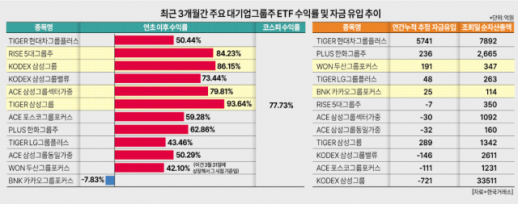 Samsung Leads ETF Market with 93% Returns, LG and Hyundai Lag Behind In the ongoing rally toward the "dream 7000-point" mark, Samsung Group has solidified its dominance in the domestic exchange-traded fund (ETF) market, achieving over 93% returns since the beginning of the year. In contrast, major companies like Hyundai and LG have underperformed, contributing to a growing disparity in returns. According to the Korea Exchange, as of May 7, ETFs tracking major conglomerates (excluding bonds) have shown that Samsung-related products dominate the top returns. The standout performer is the 'TIGER Samsung Group' ETF, which has achieved a remarkable 93.64% return. Following closely are 'KODEX Samsung Group' at 86.15% and 'RISE 5 Major Groups' at 84.23%, which has a high concentration of semiconductor stocks like Samsung Electronics and SK Hynix. The 'ACE Samsung Group Sector Weighted' ETF also recorded a solid 79.81% return. This surge in ETF performance is largely attributed to Samsung Electronics' significant rise, driven by the AI semiconductor supercycle. The KOSPI index has increased by 77.73% during the same period, but Samsung-related ETFs have outperformed by 10-15 percentage points, with Samsung Electronics soaring by 126.44%. In contrast, the returns for the other five major groups have lagged behind the KOSPI. The 'TIGER LG Group Plus' ETF showed the weakest performance at 43.46%, followed by 'TIGER Hyundai Group Plus' at 50.44% and 'ACE POSCO Group Focus' at 59.28%. Even the 'PLUS Hanwha Group' ETF, which benefited from strong shipbuilding and defense sectors, could only manage 62.86%, falling short of the KOSPI's gains. Among other large corporate groups, the disparity in returns is even more pronounced. The 'WON Doosan Group Focus,' launched on March 31, has achieved a 42.10% return, exceeding the KOSPI's 41.93%. However, the 'BNK Kakao Group Focus' has reported a -7.83% return, the only major group ETF in negative territory. This divergence in returns has led to polarized capital flows. Notably, the 'TIGER Hyundai Group Plus,' which underperformed, attracted a substantial inflow of 574.1 billion won, likely due to investor optimism regarding Hyundai's value-up program and new business ventures in robotics. Conversely, the high-performing 'KODEX Samsung Group' saw an outflow of 72.1 billion won as investors took profits, believing the index had peaked. Kim Seong-no, a researcher at BNK Investment & Securities, noted, "While the expansion of the ETF market has created favorable supply conditions, ongoing macroeconomic uncertainties could amplify stock market volatility. Given the concerns over slowing growth amid the index's rise, investors should be prepared for potential technical corrections due to overheating."* This article has been translated by AI. 2026-05-07 23:20:19
 -
 Simtech Shares Jump Nearly 14% as Brokerages Raise Price Targets Simtech shares surged more than 13% intraday, as investors appeared to respond to upbeat brokerage outlooks and a string of higher price targets. According to the Korea Exchange, Simtech was trading at 106,900 won as of 1:50 p.m. on the 7th, up 13,100 won, or 13.97%, from the previous session. Daishin Securities said in a report that earnings improvement should begin in earnest, driven by expanding sales of server memory modules and SOCAMM2. It maintained its “buy” rating and raised its target price to 105,000 won from 60,000 won. Park Kang-ho, an analyst at Daishin Securities, said Simtech is estimated to have the largest share of SOCAMM2 supply among the three major memory makers. He added that operating margin gains should continue as the company increases the share of higher-profit products. Daishin Securities expects the pace of improvement to accelerate in the second quarter after gains in the first. It estimated second-quarter operating profit at 40.2 billion won, up 193% from the prior quarter. NH Investment & Securities also raised its target price to 120,000 won from 66,000 won. Hwang Ji-hyun, an analyst at NH Investment & Securities, said the revision reflected a rise in the sector’s average valuation multiple, from 21 times to 27 times. Hwang said margin improvement is progressing faster than expected as price increases and stabilizing raw material costs take effect. She added that the firm expects upward revisions to full-year results and further profitability gains on the back of expanding demand centered on SOCAMM and FC-CSP. Shinhan Investment Corp. raised its target price to 150,000 won from 120,000 won, and iM Securities lifted its target to 135,000 won from 105,000 won.* This article has been translated by AI. 2026-05-07 14:02:16
 -
 KB Securities Raises Target Price for Samsung E&A on Record Order Cycle Outlook KB Securities said May 7 it raised its target price for Samsung E&A to 73,500 won from 67,000 won, citing a boom in the global plant market and expanding orders. It maintained its “buy” rating. Jang Moon-jun, an analyst at KB Securities, said the rapid buildout of artificial intelligence infrastructure and stronger energy security are shifting the key competitive factor in the global plant market to speed. “In terms of execution capability to deliver large projects within a set period, Samsung E&A’s competitiveness is standing out,” Jang said. He said the company is facing its best environment for new orders since its founding. “In the first quarter alone, it secured about 40% of its annual guidance, and this year’s annual orders will reach at least 15.5 trillion won,” he said. Jang said a resumption of capital spending by affiliates, increased global ordering tied to energy security, and postwar reconstruction demand in the Middle East are converging, calling it a structural shift rather than a one-off cycle. He said Samsung E&A has strengthened its ability to shorten construction schedules through wider use of modular methods, a FEED-to-EPC structure and investment in AI-based design automation. He said the company has entered a phase in which it is selected for execution rather than price, and that revenue and profit growth will resume in earnest starting in 2026.* This article has been translated by AI. 2026-05-07 08:21:14
 -
 Opinion: Self-Approved Executive Pay Raises and Self-Directed Dropping of Charges Allowing a controlling shareholder who also serves as a director to vote on a shareholders meeting resolution setting directors’ compensation is a classic conflict of interest. Courts and prevailing views long allowed a shareholders meeting — even with the controlling shareholder participating — to set an overall cap on total directors’ pay, with the board later deciding each director’s amount. That structure, however, left room for a board formed by the controlling shareholder to set that shareholder’s director pay at a high level. After the Namyang Dairy case, courts began taking a stricter approach to shareholder votes involving conflicts. At a 2023 shareholders meeting, then-largest shareholder and director Hong Won-sik participated in and passed an agenda item setting the directors’ compensation cap at 5 billion won. The Seoul High Court canceled the resolution, finding it illegal because he exercised voting rights as a “special interested party” on a matter directly tied to his own pay. In April 2025, the Supreme Court dismissed the appeal, upholding that judgment. The Supreme Court went further in a ruling issued April 2 that the article describes as a milestone in Korean corporate governance history (2025Da219931). The court held it illegal for a CEO who is also a shareholder to raise his own compensation by increasing the total annual salary pool for directors. The court said the CEO, who held a 76% stake, had a special interest and therefore could not exercise voting rights, and that his participation amounted to a conflict of interest barred by Article 368(3) of the Commercial Act. The court also made clear that shares held by a shareholder whose voting rights are restricted must be excluded from the “total number of issued shares,” the base used to calculate quorum. Under the Commercial Act, a shareholders resolution requires approval by at least one-quarter of the total issued shares (Article 368(1)). If a conflicted controlling shareholder is excluded from the calculation, minority shareholders can become decisive. In effect, the ruling creates a “majority of the minority” outcome in conflict-of-interest cases involving large shareholders. Because the case concerned a regular shareholders meeting in March 2024, before amendments to the Commercial Act on shareholders’ duty of loyalty, the ruling did not reflect those changes. Taking the amended law into account, the article says the reasoning could be extended beyond executive pay to other conflict situations such as mergers and business transfers, limiting controlling shareholders from making decisions for their own benefit in conflicted matters. Separately, a bill introduced April 30 by the Democratic Party, titled the “Special Prosecutor Bill to Uncover the Truth Behind Allegations Including Manipulated Indictments by the Yoon Suk Yeol administration,” has sparked controversy. The bill specifies as targets for investigation several cases where allegations of illegal prosecutorial investigations have been raised, including the Daejang-dong development project, the Seongnam FC case and the Ssangbangwool remittances to North Korea case. Many of those cases involve Lee Jae-myung, described in the article as the president, as a defendant. Because first trials are still underway, some cases could be subject to withdrawal of indictment under the Criminal Procedure Act. The article says the bill’s stated purpose — correcting past wrongdoing by “political prosecutors,” in light of aggressive investigations and indictments revealed through parliamentary probes and media reporting — is not hard to understand. But it argues that, considering how a special prosecutor would be appointed and the power to withdraw indictments, the bill is difficult to justify from a conflict-of-interest perspective. Under the bill, the Democratic Party, the People Power Party and the Rebuilding Korea Party would each recommend one candidate, and the president would appoint one of them as special prosecutor. Article 8(7) would grant authority to decide whether to maintain prosecutions, including the power to withdraw indictments in already-indicted cases. The result, the article says, is a structure in which a law proposed by the ruling party and promulgated by the president enables the president to appoint a special prosecutor, and that special prosecutor could then withdraw indictments involving the president. Critics argue that withdrawing an indictment would prevent a verdict, effectively allowing the president to choose the judge in his own case, the article says. The directors’ pay issue and the special prosecutor bill are separate matters, and they differ in level — legal interpretation versus legislation. But the article says they share a core question: who should make decisions, and how, when conflicts of interest are involved. The article says law must be a general and abstract norm applied fairly and reasonably to everyone — a core principle of modern rule of law — so that all members of the community can accept outcomes and trust in the legal system is maintained. It says the Supreme Court ruling reaffirmed a broadly accepted principle: in conflict situations, a person should not exercise decision-making power for personal gain. By contrast, it says the current special prosecutor bill’s legitimacy is being questioned, to the point that opposition voices have emerged even within the ruling party. A “self-approved” executive pay raise harms shareholders of the company, the article says, but a president’s “self-directed” withdrawal of indictments could shake the rule of law for the entire community. The public, after witnessing what the article calls improper actions by the Yoon Suk Yeol government, has only begun to regain trust in the rule of law, it says, and the bill could undermine that trust again. * This article has been translated by AI. 2026-05-06 18:05:17
 -
 Mirae Asset’s Covered-Call Assets Top 10 Trillion Won, an Industry First Mirae Asset Global Investments said its covered-call products have surpassed 10 trillion won ($) in net assets, the first such milestone in the industry, as demand grows for income-focused strategies during periods of heightened market volatility. The firm said Monday that as of April 27, net assets in its covered-call series totaled 10.4484 trillion won, including 3.4416 trillion won in public mutual funds and 7.0068 trillion won in exchange-traded funds. The combined covered-call assets across mutual funds and ETFs are among the largest in South Korea, it said. A covered-call strategy sells call options on stocks already held to collect option premiums. The approach aims to generate steadier cash flow by combining dividends with option income, and premiums can rise when volatility increases, helping drive recent investor interest. Mirae Asset Global Investments said it introduced covered-call strategies in 2012 and has built a long operating track record. Its flagship public fund, the Mirae Asset Dividend Covered Call Active, has posted cumulative returns of more than 357% since inception. Growth has been led recently by ETFs. The TIGER Dividend Covered Call Active ETF, listed in 2023, quickly surpassed 1 trillion won in net assets after listing and drew retail money with a monthly distribution structure. The addition of the TIGER Semiconductor TOP10 Covered Call Active ETF has broadened the strategy beyond dividend-focused products toward combining covered calls with investments in growth industries. The firm attributed the expansion to running both mutual funds and ETFs: mutual funds provide stability based on long-term performance, while ETFs broaden access through easier trading and liquidity. Market conditions have also supported the strategy, it said, as volatility tied to interest rates and geopolitical factors has reinforced investor preference for steady cash flow over directional bets. Demand for distribution-based investing has also been rising, particularly in pension accounts. Jeong Ui-hyeon, head of ETF management at Mirae Asset Global Investments, said rapid asset growth from the early days of listing reflected both expectations for semiconductor growth and demand for monthly payouts. He said investor interest has also been driven by what he described as South Korea’s first covered-call structure using single-stock options, which can secure distribution resources differentiated from index-based approaches. Jeong said the semiconductor covered-call ETF plans to begin its first distribution payment in mid-May, adding that the strategy aims to increase participation in upside during an improving semiconductor cycle while providing steadier cash flow when volatility rises.* This article has been translated by AI. 2026-05-04 16:34:40
 -
 KOSPI Hits Record Above 6,900 as Analysts Debate Whether Rally Can Last in May After surging more than 30% in April, South Korea’s benchmark KOSPI kept running in May, setting another record on the first trading day of the month. The move has undercut the market adage “Sell in May,” but investors are watching whether the rally can hold after such outsized gains, which have often been followed by sharp pullbacks. According to the Korea Exchange, the KOSPI on May 4 jumped 338.12 points, or 5.12%, to close at 6,936.99, a record high by closing price. The index rose 30.61% last month, and the latest gain was driven by strong buying from foreign and institutional investors from the start of May trading. In the main board market, foreigners were net buyers of 3.9623 trillion won and institutions bought a net 2.5569 trillion won, lifting the index. Retail investors, meanwhile, sold a net 6.3364 trillion won as they took profits. By stock, chipmakers led: SK hynix rose to a record 1.45 million won, while Samsung Electronics touched 230,000 won and climbed as high as 232,500 won. Even amid the record run, some investors are again discussing a “Sell in May” approach. Historically, May has tended to see returns cool after strong gains from November through April, as institutions rebalance portfolios and lock in profits. Recent market patterns highlight that risk. Last year, the KOSPI posted a historic 165.96% surge in April, but the gain slowed sharply to 5.52% in May. In 2024, a 1.99% drop in April was followed by another decline of 2.06% in May, as concerns about elevated levels weighed on prices. With seasonal volatility often rising as investors digest earnings and the market shows fatigue after sharp moves, some analysts say April’s 30.6% return could again be followed by a pause in early May. Brokerage forecasts are mixed. Choi Bo-won, a researcher at Korea Investment & Securities, said earnings releases by top market-cap companies have largely wrapped up and tariff uncertainty could re-emerge, making a temporary pullback possible. Still, Choi said expectations for medium- to long-term earnings improvement could provide further upside, adding that even if there is a brief early-May correction, investors may consider re-entering large-cap IT and infrastructure shares. Han Ji-young, a researcher at Kiwoom Securities, said investors should focus on macro indicators and fundamentals. Han said weak April employment data could be neutral or better for stocks because it may help cool the rise in the 10-year yield, which recently climbed into the 4.4% range, making the jobs data particularly important for growth-stock investors. Han also pointed to improving earnings expectations, saying the 2026 KOSPI operating profit consensus rose 32% in a month to 850 trillion won. Han added that April export data delivered an earnings surprise led by semiconductors and solid-state drives, and said that with upside factors such as potential further upgrades to profit forecasts, it is appropriate to set a base-case outlook that the KOSPI continues to push to higher highs this week.* This article has been translated by AI. 2026-05-04 16:04:54
 -
 KOSPI Jumps 5.1% to Record Close Near 7,000 on Foreign, Institutional Buying The KOSPI surged Monday on heavy buying by foreign investors and institutions, climbing to just shy of the 7,000 mark and posting a record closing high. The benchmark jumped more than 5% to finish above 6,900. According to the Korea Exchange, the KOSPI closed up 338.12 points, or 5.12%, at 6,936.99. It opened at 6,782.93, up 184.06 points, or 2.79%, and extended gains as foreign and institutional demand strengthened. The index also reset an intraday record. It moved above 6,800 at about 10:16 a.m. and later broke through 6,900 at about 12:57 p.m. as buying accelerated. Lee Kyung-min, an analyst at Daishin Securities, said the KOSPI has continued to rally as stronger earnings momentum and what he called attractive undervaluation have come into focus. He added that local stocks reflected gains in U.S. markets during the May 1 holiday, while foreign net buying expanded ahead of the May 5 holiday, adding to the market’s upward momentum. In the main board market, foreigners were net buyers of 3.9623 trillion won and institutions bought a net 2.5569 trillion won. Retail investors sold a net 6.3364 trillion won. Among top market-cap stocks, Samsung Electronics rose 5.44%, SK hynix gained 12.52%, SK Square jumped 17.84%, LG Energy Solution added 2.50%, Hyundai Motor rose 1.51%, Doosan Enerbility gained 0.08% and Hanwha Aerospace climbed 3.39%. HD Hyundai Heavy Industries fell 0.73%. SK hynix traded as high as 1.45 million won during the session, setting a record. Samsung Electronics, which had slipped on profit-taking after touching 230,000 won on April 30, rebounded in a single session to as high as 232,500 won. The KOSDAQ closed up 21.39 points, or 1.79%, at 1,213.74 after opening at 1,212.28, up 19.93 points, or 1.67%. In the KOSDAQ market, foreigners bought a net 613.9 billion won. Retail investors and institutions sold a net 520.5 billion won and 76.1 billion won, respectively. Among KOSDAQ heavyweights, EcoPro rose 1.90%, EcoPro BM gained 4.61%, Alteogen added 1.22%, Rainbow Robotics rose 3.16%, Lino Industrial gained 1.26%, Kolon TissueGene climbed 2.75% and HLB added 0.16%. Samchundang Pharm fell 1.44% and ABL Bio slipped 1.71%.* This article has been translated by AI. 2026-05-04 15:48:19