

Journalist

Candice Kim, Lim Jaeho
candicekim1121@ajupress.com, ajupresswogh@ajupress.com
-
 UPDATE: Samsung Electronics retains memory leadership amid AI boom in bumper Q1 * Updated with additional information SEOUL, April 30 (AJP) - Samsung Electronics retained its memory leadership in a bumper first quarter, generating its strongest three-month performance to beat expectations and local rival SK hynix, as the AI-driven gold rush fueled demand for both premium DRAM and flash memory, its final earnings report showed Thursday. The Device Solutions (DS) division set quarterly records for both top and bottom lines, earning 53.7 trillion won ($39.2 billion) in operating profit on revenue of 81.7 trillion won, translating into a stunning operating margin of 65.7 percent, albeit still short of SK hynix’s 71.5 percent. “The Memory Business surpassed its quarterly sales record by addressing high-value-added AI demand despite limited supply availability, with industry-wide memory price increases also a contributing factor,” the company said in a statement. The memory giant maintained an upbeat outlook for the second quarter and the rest of the year, citing continued enterprise adoption of AI, the expansion of agentic AI and its AI-centric sales strategy. The company, whose business spans chipmaking to smartphones and appliances, confirmed consolidated revenue of 133.9 trillion won, an all-time quarterly high, marking a 43 percent increase from the previous quarter. Operating profit also reached a record 57.2 trillion won, in line with its earlier guidance. To solidify its market dominance, Samsung stated it has begun the industry's first simultaneous mass production of HBM4 and next-generation low-power memory modules, dubbed SOCAMM2. It also plans to supply its first samples of HBM4E in the second quarter. The foundry business successfully secured orders from a major optical communication module provider, building a foundation for its silicon photonics operations. While semiconductors drove the bulk of the profits, the Device eXperience (DX) division, which oversees smartphones and home appliances, reported an operating profit of 3 trillion won on sales of 52.7 trillion won. The mobile business saw steady growth driven by robust sales of its flagship Galaxy S26 Ultra. Elsewhere, the display panel business posted an operating profit of 400 billion won, while Harman, Samsung's automotive electronics subsidiary, reported 200 billion won in profit amid an off-season for the audio market. The company invested a record 11.3 trillion won in research and development during the first quarter. A strong U.S. dollar against the Korean won also resulted in a positive impact of approximately 1.8 trillion won on the company's overall operating profit compared to the previous quarter. Looking ahead to the second quarter and the second half of the year, Samsung expects further earnings momentum in its semiconductor business. This will be driven by sustained AI infrastructure investments and an ongoing upward trend in memory prices. The company stated it will actively address the robust demand for server DRAM and enterprise SSDs while expanding its proportion of high-value AI memory products. Meanwhile, the DX division will focus on improving profitability by expanding sales of premium smartphones and AI-enabled home appliances, navigating potential headwinds from rising component costs and ongoing macroeconomic uncertainties. Shares of Samsung Electronics were trading flat at 226,000 won as of 9:50 a.m. in Seoul. The stock briefly touched an intraday high of 230,000 won in early morning trade following the record earnings report, but gave up its earlier gains as investors locked in profits ahead of the conference call. 2026-04-30 09:22:53
 -
 LG Electronics pivots to subscriptions, auto as profit engine strengthens SEOUL, April 29 (AJP) - LG Electronics is weathering a global spending slowdown by rapidly expanding subscription-based rentals for premium home appliances and scaling its vehicle solutions business, as demand grows for smarter mobility and recurring revenue models, its quarterly breakdown showed Wednesday. The first-quarter results underscored a structural shift in earnings quality, with high-margin recurring income from appliance subscriptions and a solid order backlog in the vehicle component solutions (VS) unit helping buffer the company against macro headwinds and rising raw material costs. Headline figures were unchanged from earlier guidance, with record quarterly revenue of 23.73 trillion won and operating profit of 1.67 trillion won. Beneath the surface, however, the VS division emerged as a key driver, with operating margin climbing above 6 percent — reinforcing its role as a core profit pillar alongside the home appliance business. The shift, analysts say, reduces LG’s traditional exposure to cyclical swings in consumer electronics. Business-to-business operations are gaining weight, now accounting for 36 percent of total revenue. B2B sales rose 19 percent on-quarter to 6.5 trillion won, supported by expansion into industrial cooling systems for AI data centers and electric vehicle components. The Home Appliance & Air Solution (HS) unit also showed resilience, maintaining an 8.2 percent operating margin despite U.S. tariff pressure and a weaker Korean won. Growth was driven by subscription-based sales, which rose 15 percent on-year and 8 percent on-quarter, as LG accelerates the model across emerging markets to secure steadier cash flow. Looking ahead, the company is positioning for the AI infrastructure cycle by expanding its Eco Solution (ES) portfolio, particularly advanced liquid cooling systems for global data centers. “The first-quarter results have effectively confirmed a recovery in profitability across core businesses,” said Jeong Min-gyu, an analyst at Sangsangin Investment & Securities. “Expectations are rising as commercialization of robot actuators and chiller orders for AI data centers gains visibility.” 2026-04-29 16:31:33
 -
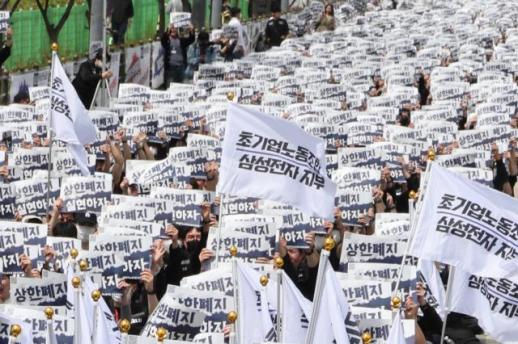 Court to rule on Samsung Electronics' injunction against strike by mid-May SEOUL, April 29 (AJP) - A South Korean court said Monday it will decide by May 20 whether to grant an injunction filed by Samsung Electronics to block what the company describes as "illegal" industrial action by its labor unions. The decision by the Suwon District Court is expected just one day before the unions’ scheduled general strike on May 21. During a closed-door hearing, Samsung Electronics management argued that any work stoppage would cause "irreparable damage" to the semiconductor manufacturing process, emphasizing the need to maintain essential personnel to prevent the spoilage of silicon wafers. The company further claimed that a production halt could damage high-cost equipment, noting that major global competitors have maintained operations despite labor disputes. In response, legal representatives for the unions stated they have no intention of damaging facilities and that their planned activities are within legal bounds. The unions argued they are willing to cooperate on safety protocols but accused management of failing to specify the minimum personnel required for such tasks. Addressing concerns over earlier rhetoric regarding "criminal punishment," the unions clarified that such comments were intended to show their resolve to continue collective bargaining rather than an intent to engage in unlawful acts. The legal tension follows a massive rally on Thursday, where approximately 40,000 union members gathered in Pyeongtaek to demand 15 percent of the company's operating profit as performance bonuses. The unions have signaled an 18-day general strike starting May 21, including a protest at the Pyeongtaek office. The court will hear the unions’ formal defense on May 13 before issuing its ruling in the following days. 2026-04-29 15:17:11
 -
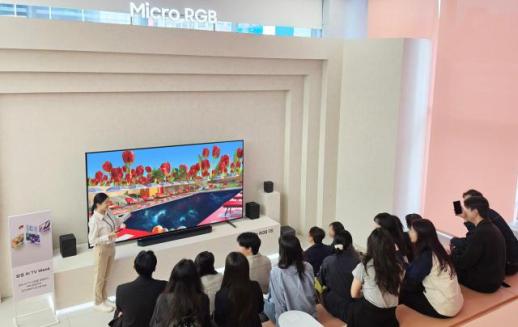 Samsung mulls TV pullout option after smartphone-like defeat in China SEOUL, April 28 (AJP) -Samsung Electronics is weighing a pullout from its TV business in China, in what would mark a second setback in the world’s second-largest market after its retreat from smartphones. Samsung Electronics said Tuesday that “no such decision has been finalized,” responding to speculation over a possible withdrawal. A company spokesperson said market conditions in China are under review, but denied reports of a full exit from its TV and home appliance business. According to market research firm AVC, Samsung’s share of the Chinese color TV market stood at just 3.62 percent as of early this month, more than halved from 8.48 percent share in March 2024. Japan's Nikkei reported Samsung plans to end its direct home appliance and TV sales in China by the end of the year, and AVC forecasts the company is likely to transition from a direct sales model to a proxy agency model within the second half of the year. Samsung Electronics Visual Display (VD) Division President Yong Seok-woo earlier this month admitted that the China business was difficult, adding that the company is "looking at the business in various forms, and discussions are currently ongoing." A retreat from the TV market would represent a second major blow to Samsung in China, echoing its earlier failure in the local smartphone sector. Much like its mobile division—which lost its dominance to domestic brands and saw its market share evaporate to roughly 1 percent—Samsung's TV division is being squeezed out by aggressive local competitors. Samsung first entered the Chinese market in the mid-1990s and established itself as a top-tier brand. By early 2011, the company led the Chinese flat-panel TV market with a 12.3 percent share, firmly cementing its image as a premium electronics manufacturer. However, Chinese rivals such as Hisense and TCL rapidly closed the gap, leveraging superior panel procurement capabilities, aggressive pricing, and expansive local distribution networks. While Samsung’s OLED TVs are still highly regarded by Chinese tech reviewers for their AI chips, design, and gaming performance, superior product quality is no longer translating into business viability. Industry analysts note that high-end strategies are failing to gain traction as domestic manufacturers successfully push into the premium segment. Foreign brands as a whole are struggling; total TV shipments in China for Sony, Samsung, Sharp, and Philips combined fell short of 1 million units last year, capturing less than a 5 percent collective market share. 2026-04-28 14:01:01
 -
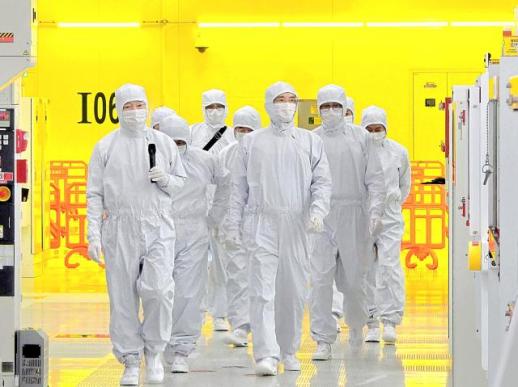 Samsung, SK hynix morph into AI foundries as Big Tech reshapes chipmaking SEOUL, April 27 (AJP) - The traditional line between memory makers and foundries is rapidly blurring as Samsung Electronics and SK hynix pivot toward customized chip production to meet surging artificial intelligence demand. As AI workloads grow more specialized, Big Tech clients are no longer buying standardized memory at scale but demanding tightly integrated, tailor-made solutions such as High Bandwidth Memory (HBM) co-designed with their own architectures — forcing Korea’s two largest chipmakers to rethink their traditional mass-production model. Companies like Nvidia and Tesla are driving this shift, pushing suppliers to align memory, logic and packaging into unified, customized stacks. In response, SK hynix and Samsung are increasingly operating less like commodity fabs and more like contract foundries for a handful of deep-pocketed clients. SK hynix has effectively become a dedicated memory partner to Nvidia, dominating supply of HBM3 and HBM3E used in the latter’s AI accelerators. To extend that lead into next-generation HBM4, SK hynix has forged closer ties with TSMC, outsourcing logic foundry work for base dies to leverage TSMC’s 12-nanometer and upcoming 3-nanometer processes. The strategy marks a departure from traditional vertically integrated expansion. Instead of pouring capital into logic fabrication, SK hynix is channeling its estimated 40 trillion won ($29 billion) 2026 capital expenditure into advanced packaging and custom HBM design — prioritizing speed, yield stability and alignment with Nvidia’s roadmap. Samsung, by contrast, is leaning into its identity as a full-stack Integrated Device Manufacturer (IDM), combining memory, foundry and advanced packaging under one roof. It is pitching a “turnkey” model to clients seeking to bypass Nvidia’s ecosystem and build proprietary AI chips. Alongside supplying HBM and foundry services to AMD, Samsung is expanding cooperation with Tesla on next-generation self-driving chips (HW 5.0) and custom memory, while working with AI chip startups such as Tenstorrent and Naver. To support the shift, Samsung plans to invest about 40.9 trillion won in its Device Solutions division this year, aiming to more than triple its custom HBM capacity. Industry experts say the transition from standardized memory production to client-specific design will define the next phase of the AI supercycle. “The market so far has been dictated by the Nvidia–TSMC–SK hynix axis because Nvidia required specific memory components for its GPUs,” said Kim Duk-ki, a professor of semiconductor engineering at Sejong University. “But as other Big Tech players like Tesla and Intel demand entirely new AI architectures, foundry demand is surging.” Kim added that while the current AI boom could run for another two years before facing structural constraints such as data center energy limits, Samsung’s breadth offers a strategic hedge. “Samsung is crucial because it has everything — from memory to foundry,” he said. “Its ability to shift capacity across DRAM, NAND and custom foundry services positions it to adapt to a future where Big Tech dictates increasingly diverse, bespoke chip designs.” 2026-04-27 16:51:42
 -
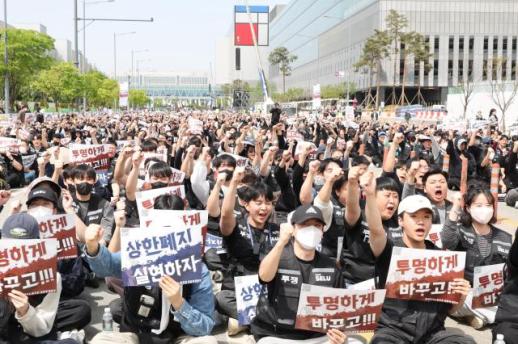 Samsung union flags 18% output hit, raises stakes with 18-day strike threat SEOUL, April 27 (AJP) - Unionized workers at Samsung Electronics said last week’s rally cut memory output by nearly 20 percent, signaling the scale of disruption a looming 18-day strike could unleash on global chip supply. In a statement Monday, Choi Seung-ho, head of the company’s Enterprise Union branch, said a hours-long rally on April 23 led to a 58 percent drop in foundry production and an 18 percent decline in memory chip output, based on overnight wafer transfer data. According to the union, wafer movement — a key production indicator — fell sharply during the night shift following the rally. Foundry output dropped about 58.1 percent, with the Giheung S1 line plunging 74.3 percent. Memory production fell 18.4 percent overall, with a steeper decline in DRAM processes. “A union of 40,000 members is a reality management cannot ignore and a powerful driving force for change,” Choi said, warning that an 18-day general strike would create a “30 trillion won ($21.7 billion) vacuum.” An estimated 40,000 workers — about 30 to 40 percent of union members — joined the rally at the Pyeongtaek campus on April 23. The union plans to proceed with an 18-day strike from May 21, beginning protests at Chairman Lee Jae-yong’s residence. The scale marks a sharp escalation from Samsung’s first-ever strike in 2024, which drew about 5,000 workers, or roughly 15 percent of union members. Semiconductor cleanrooms must operate continuously, as chipmaking involves hundreds of tightly sequenced processes building microscopic circuit layers on silicon wafers. Even brief disruptions risk yield losses and equipment instability. The union is demanding the removal of caps on performance bonuses and greater transparency in the compensation system, accusing management of abandoning Samsung’s “people first” philosophy and reducing employee contributions to market-driven metrics. Samsung maintained a neutral stance on the union’s claims. “It is not for us to confirm or deny the figures; they should be understood as the union’s position,” a company official said, adding that efforts to reach a settlement would continue. Analysts warn that any disruption at the world’s largest memory chipmaker could tighten an already constrained market. “If the May strike materializes, supply shortages could deepen due to production disruptions, adding upward pressure on prices,” said Kim Dong-won, head of research at KB Securities. Kim added that even in a worst-case scenario where the strike lasts 18 days, it could take an additional two to three weeks to fully restart and stabilize automated production lines. Given Samsung’s global market share — about 36 percent in DRAM and 32 percent in NAND — and the production weight of its Pyeongtaek and Hwaseong campuses, KB Securities estimates the strike could reduce global supply by 3 to 4 percent for DRAM and 2 to 3 percent for NAND. “In a tight supply-demand environment, this strike could become a key variable reinforcing upward price pressure,” Kim said. The union has said it will proceed with the strike from May 21 to June 7 unless an agreement is reached on its demands, which include scrapping the performance bonus cap and implementing a more transparent compensation system. Shares of Samsung Electronics continued to rally, regardless of the strike risk. They ended Monday 2.3 percent up at 224,500 won, a tad off the record-high closing of 229,500 won. 2026-04-27 15:32:54
 -
 US Treasury weighs permanent dollar swap lines for Gulf, Asian allies SEOUL, April 25 (AJP) - U.S. Treasury Secretary Scott Bessent confirmed that the United States is in discussions to establish currency swap lines with Gulf and Asian partners, pitching the move as a strategic step to bolster the U.S. dollar's global dominance amid regional geopolitical tensions. Bessent stated that several allied nations requested the swap lines to help manage the economic fallout and energy shocks stemming from the Iran conflict. "Additional swap lines can benefit our nation by reinforcing dollar usage and liquidity internationally, maintaining smooth functioning in dollar funding markets, promoting trade and investment with the United States," Bessent said in a post on X on Friday. He further emphasized the long-term strategic goal, adding, "Extending permanent swap lines can be a major first step in creating new U.S. dollar funding centers in the Gulf and Asia." While traditional swap lines are typically handled by the Federal Reserve, analysts note that these new agreements would likely be drawn from the Treasury's limited Exchange Stabilization Fund. Experts view the potential facilities not as emergency bailouts for cash-strapped nations, but rather as confidence-building measures to prevent market disruptions and reduce the need for these nations to sell off U.S. Treasury assets. Bessent noted the strong financial positions of the requesting nations, stating, "Many of these countries have pristine sovereign balance sheets and large dollar holdings – larger than many major economies with whom we maintain permanent swap facilities." The United Arab Emirates, which was named as one of the countries in discussions, strongly pushed back against any market speculation that it was facing a liquidity squeeze. Yousef al-Otaiba, the UAE’s ambassador to Washington, stated on X that "any suggestion that the UAE requires external financial backing misreads the facts." "The UAE is one of the world’s most financially resilient economies, underpinned by more than $2tn in sovereign investment assets," he added. 2026-04-25 18:00:37
 -
 Canada evaluates South Korean weapons for major army modernization SEOUL, April 25 (AJP) - Canada is in discussions with South Korean defense contractors regarding its largest army modernization project in over 25 years, the commander of the Canadian Army said, explicitly naming Hanwha Aerospace's artillery and armored vehicles as potential candidates. Lt. Gen. Michael Wright told Yonhap News Agency in an interview published Saturday that Ottawa is actively exploring avenues to rapidly upgrade its military capabilities amid growing defense cooperation between the two nations. "The Canadian Army is in the midst of our largest modernization of equipment in over 25 years, and we're looking in accordance with our defense industrial strategy — what we can do to rapidly accelerate bringing new equipment into the Canadian Army," Wright said. When asked about specific areas for arms cooperation, the commander confirmed that South Korean platforms are under consideration. "The K9 howitzers, I know, is something that Hanwha has spoken about. The Redback Infantry Fighting Vehicle is another example," Wright said, though he noted that Canada's defense ministry and defense investment agency will determine the final procurement details. Hanwha Aerospace previously announced it had proposed an integrated package deal to Canada, combining its K9 self-propelled howitzers, the Chunmoo multiple launch rocket system, and Redback infantry fighting vehicles. Wright made the remarks while visiting South Korea to commemorate the 75th anniversary of the Battle of Gapyeong, a key engagement during the 1950 to1953 Korean War where Canadian troops fought alongside other Commonwealth forces. The commander emphasized that the bilateral military ties are growing stronger in an increasingly "fractured world." "For Canada, it's a reaffirmation of our partnership that started on the battlefields in Korea in 1950 and endures to this day and, if anything, is getting stronger," Wright said. "I really think that the history that we share is an indicator of what we'll do together in the future." 2026-04-25 16:50:04
 -
 S. Korean PM lauds Pearl Abyss' 'Crimson Desert' for 5 mln sales, pledges industry support SEOUL, April 25 (AJP) - South Korean Prime Minister Kim Min-seok congratulated video game developer Pearl Abyss (263750.KQ) on the record-breaking global sales of its latest title, "Crimson Desert," pledging proactive government support to bolster the country's gaming industry across broader platforms. In a social media post late Friday, Kim highlighted the action-adventure game's milestone of surpassing 5 million copies sold just 26 days after its release, calling the feat a "splendid achievement." Kim praised the developers for captivating global users with a "living game world created entirely with their own technology, photorealistic graphics, and active communication." He added that the game seamlessly integrated South Korean cultural elements, such as Taekwondo and traditional cuisine, thereby "opening a new chapter for K-content." The prime minister framed the title's commercial success as a significant indicator of the domestic industry's potential abroad. "This is an important turning point showing that the domestic gaming industry can expand and leap forward across various platforms, including consoles," Kim wrote. "The government will take responsibility and actively support this to create an environment where K-games can shine as a core pillar of K-content." "Crimson Desert" launched on March 20 and immediately set a record for the fastest-selling South Korean packaged game, moving 2 million copies on its first day. Global sales reached 3 million by the fourth day, 4 million by April 1, and crossed the 5 million mark on April 15. Separately, Pearl Abyss released the game's first official soundtrack album, featuring 75 tracks, on domestic and global streaming platforms on Friday. 2026-04-25 15:29:23
 -
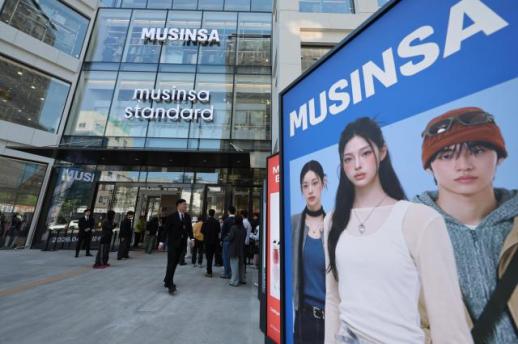 K-shopping wonderland lands in Seongsu as Musinsa scales offline push SEOUL, April 24 (AJP) - Gone are the days when group tourists shuffled through duty-free shops and the Dongdaemun marketplace. K-shopping today is about hip, affordability and fun — and sharing the experience with friends, on or off camera. To amplify that shift, a shopping-themed amusement park has arrived in Seoul’s trendiest district, Seongsu-dong. "I wish there was a store like this in the U.S.," said Maddie, a tourist from the United States, as she explored the newly opened Musinsa Megastore Seongsu on Friday. Alongside her friend Hannah, she was among the thousands who flocked to the 6,600-square-meter facility for its official grand opening. As South Korea’s leading fashion and beauty enterprise, Musinsa is pivotally expanding its domestic physical presence. While already a dominant force online and a growing name in Japan and China, this megastore—South Korea’s largest single-brand offline retail space—signals a major strategic evolution. By blending over 1,000 brands with experiential entertainment, Musinsa aims to broaden its appeal from its core Gen Z demographic to include families and shoppers in their 40s. Spanning five floors from the basement to the fourth floor, the store utilizes a "shop-in-shop" concept to present brands in a multidimensional way. Dedicated concept zones include "Girls" — featuring brands like Glowny, Low Classic Lc, and The Barnnet — as well as "Young," "Sports," and "Next Outdoor" sections featuring global names like Nike and Adidas. For international visitors, the curated selection is a primary draw. "I realized that I didn't know many of the brands, but they look cool," Maddie noted. "I feel like Musinsa has curated that for us... It’s less cumbersome. Shopping time is valuable". Hannah added that for their age group, "uniqueness" and "style" outweigh brand names, describing the quality as significantly better than "Walmart quality". The Americans compared the experience favorably to major international retailers. "We basically have things like Muji and Uniqlo, but it’s only clothes and basics," they said. "Here, you have more edgy clothes, you have Musinsa Standard on one floor, beauty on another... it’s like a department store in one". The second floor houses a massive 150-pyeong (approximately 500-square-meter) "Musinsa Beauty" section, stocking approximately 7,500 items from 700 brands. This includes several brands exclusive to Musinsa's offline channel, such as Glif, Tense, Snidel Beauty, Sensle, and Ares. The sheer scale of this offline beauty section signals Musinsa's bold expansion into a category long dominated by established offline health and beauty (H&B) giants. The move represents a direct challenge to the existing market hierarchy, sparking fierce behind-the-scenes competition for brand curation as Musinsa aggressively disrupts the traditional H&B retail landscape. Anne, a visitor from the Philippines who came specifically for skincare, praised the store’s spaciousness. "The store is massive, but it’s not too crowded that it’s uncomfortable for shopping," she said. However, some Western shoppers noted a difference in organization, observing that the beauty section is arranged by product type rather than brand, a departure from typical U.S. store layouts. Musinsa has packed the facility with "experiential content" to keep shoppers engaged. Features include the "Musing-sa" coin karaoke booth in the basement, an NCT WISH idol pop-up zone, and a custom soccer jersey marking service on the fourth floor. The top floor features a "Food Garden" with popular eateries like Tteoksan and Fuglen coffee. Musinsa officials described the F&B zone as a convenience facility designed for customer retention rather than direct profit. "You have to eat and get energy to shop again," a representative noted. The megastore is part of Musinsa's broader "O4O" (Online-for-Offline) strategy. The company now operates 75 offline locations and recently secured naming rights to Seongsu Station to solidify its presence in the district. For international visitors, the Seongsu location serves as a highly calculated business hub rather than a simple tourist attraction. The facility is equipped with multilingual self-checkout kiosks and in-store tax refund machines to streamline purchasing for foreign tourists. Furthermore, Musinsa integrates this physical experience with its "Global Store" app, allowing tourists to seamlessly continue shopping and receive direct shipments to 13 different countries after returning to their home countries. To celebrate the opening, Musinsa is holding the "ON & OFF FESTIVAL" through May 3 across 11 offline stores and its online platform, offering discounts up to 80 percent. Opening day specials include the "Mega Bag," a 49,900-won bundle containing merchandise and vouchers worth up to 400,000 won. "Musinsa Megastore Seongsu will be the pinnacle of offline retail that captures the essence of the fashion and beauty we pursue," a company official said. 2026-04-24 15:44:34