

Journalist

Ryu Cheong-bit
cbryu@economidaily.com
-
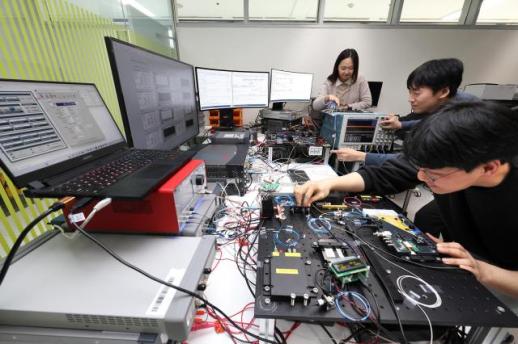 KT advances quantum internet push with enhanced encryption system SEOUL, February 03 (AJP) - South Korean telecom operator KT said Tuesday it has developed a quantum key distribution (QKD) device capable of generating 300,000 encryption keys per second, or 300 kilobits per second (kbps). The system is designed to prevent eavesdropping on physical communication lines by using quantum-mechanical properties that make encryption keys impossible to copy with current technology, the company said. KT previously developed a 150 kbps system in 2024 and has more than doubled the key-generation speed in about 18 months. "The new device represents the fastest QKD system built using domestic technology and delivers performance comparable to leading global manufacturers," the company said in a press release. "If deployed on commercial networks, the system could supply quantum keys to more than 70,000 encryption devices within a minute." Quantum key distribution systems operate using single photons, the smallest units of light energy. Because quantum states are highly sensitive and can collapse when light is dispersed or scattered, transmission errors can increase sharply. KT said it developed a proprietary filtering and system technology that reduces errors while boosting key-generation speed. The company said technical verification was completed late last year in collaboration with South Korean organizations involved in quantum cryptography development and certification, including the Telecommunications Technology Association, the Electronics and Telecommunications Research Institute, and the National Information Society Agency. KT also conducted joint verification with a research team led by Professor Heo Jun at Korea University’s Communications and Information Systems Laboratory. KT said it plans to further enhance system reliability by improving its ability to generate and detect quantum states at precise timing intervals, enabling more stable performance. The technology is expected to play a key role in the development of the future quantum internet, a next-generation communications network. “KT will help expand South Korea’s quantum industry ecosystem through continued development and technology transfer of our quantum communications technologies,” said Lee Jong-sik, head of KT’s Network Research Institute. * This article, published by Aju Business Daily, was translated by AI and edited by AJP. 2026-02-03 10:24:12
 -
 LG CNS invests in Cha Biotech to scale AI-driven healthcare SEOUL, January 15 (AJP) - LG CNS said on Thursday it is moving to scale up its digital healthcare business through a strategic partnership with Cha Bio Group. The IT services firm, led by Chief Executive Hyun Shin-gyun, said it signed a partnership agreement with Cha Biotech. The deal includes a 10 billion won ($7.4 million) equity investment and cooperation on artificial intelligence transformation and digital transformation projects. Hyun and Cha Won-tae, vice chairman of Cha Bio Group, attended the signing ceremony along with other executives from both sides. Cha Bio Group is a healthcare conglomerate spanning hospitals, pharmaceuticals, biotechnology research and medical services. The group also operates hospitals and medical businesses overseas, including in the United States, Singapore, Australia and Japan. LG CNS said it will establish a regular consultative body with Cha Bio to drive key AI and digital transformation initiatives. In the near term, the partners plan to migrate the group’s cloud infrastructure and build a smart big data platform that integrates data across operations. They also plan to upgrade drug manufacturing facilities with AI-based systems to improve efficiency throughout the production process. Over the mid to long term, the companies plan to jointly commercialize a “connected healthcare service,” a strategic growth area for Cha Bio. The service would use healthcare-specific AI models to analyze health and lifestyle data generated by hospitals, homes and wearable devices. LG CNS said it plans to deploy “EXAONE,” a large language model developed by the LG AI Research Institute, to build a healthcare-focused smaller language model and implement a big data platform to collect and manage medical, genetic and lifestyle data. 2026-01-15 09:42:08
 -
 Over 150,000 KT subscribers switch to other mobile carriers SEOUL, January 9 (AJP) - More than 150,000 subscribers of telecom company KT have switched to different mobile service providers, industry sources said on Friday. The massive exodus comes after the country's second-largest mobile carrier began waiving early termination fees following a major data breach detected in September last year. Of some 154,851 users who left KT from Dec. 31 to early this week, 15,701 or 64.7 percent switched to SK Telecom. Another 5,027 joined LG Uplus, while 3,524 moved to budget providers. As part of its compensation package following the breach, KT is allowing subscribers to terminate their contracts without penalties until next Tuesday. Rival SK Telecom offered a similar program after a major data leak last summer, which led about 166,000 subscribers to leave in about 10 days. 2026-01-09 17:06:21
 -
 Kakao Healthcare steps up digital healthcare push with distribution deal with US firm SEOUL, December 12 (AJP) - Kakao Healthcare said Friday it has signed an exclusive supply agreement with Dexcom, giving the South Korean digital health platform sole distribution rights for Dexcom's continuous glucose monitoring (CGM) products in South Korea. Dexcom is a U.S.-based medical technology company specializing in CGM systems for people with diabetes. Under the deal, the two companies will expand real-time blood glucose management services using Dexcom’s CGM lineup, including the Dexcom G7. Kakao Healthcare will oversee domestic distribution and market operations to broaden access to CGM devices and grow the user base amid rising demand for digital health services. Kakao Healthcare said it aims to integrate its platform technology with Dexcom’s biosensing capabilities to advance data-driven chronic disease management and develop more precise, personalized health models. The agreement follows roughly 18 months of collaboration. Dexcom reviewed Kakao Healthcare’s technology, digital infrastructure and distribution potential before formalizing the partnership. The companies also plan to widen their focus beyond glucose monitoring by incorporating lifestyle data — such as exercise, diet, sleep and stress — to enhance personalized care services. Kakao Healthcare said the partnership will help strengthen its AI- and mobile-based healthcare platform, improve digital tools and engagement systems, and expand its omnichannel care offerings to solidify its position in the domestic digital health market. “Through our partnership with Kakao Healthcare, access to Dexcom G7 in South Korea will improve and our vision for global digital connectivity will advance,” Jennifer Cho, Dexcom’s head of APAC, said in a press release. She said the collaboration reflects Dexcom’s commitment to incorporating AI-driven digital features into future products. Kakao Healthcare CEO Hwang Hee said the extended collaboration has deepened the relationship between the two companies and is expected to support expansion into hospital services through synergies with Cha CareS and Cha AI Healthcare under South Korea’s Cha Bio Group. * This article, published by Aju Business Daily, was translated by AI and edited by AJP. 2025-12-12 10:57:23
 -
 Hyundai Glovis completes shipment of tanks, howitzers to Poland SEOUL, November 17 (AJP) - Hyundai Glovis, the logistics arm of Hyundai Motor Group, said Monday it has completed another shipment of South Korean-made military equipment to Europe, as the company expands its role in the region’s defense supply chain. The company delivered 20 K2 main battle tanks built by Hyundai Rotem and 21 K9 self-propelled howitzers produced by Hanwha Aerospace to the Polish port of Gdansk on Nov. 13. The hardware was transported aboard Hyundai Glovis’s car carriers — vessels traditionally used for moving automobiles but now increasingly repurposed for heavy defense cargo as European demand surges. The shipment follows a delivery of six K9 howitzers to Estonia earlier this year and builds on the company’s logistics work for global defense exhibitions. Since early 2025, Hyundai Glovis has supported the distribution of 124 K2 tanks and 60 K9 howitzers across Europe, with inland transport managed by its Polish subsidiary, Adampol. The company uses a roll-on, roll-off, or RORO, loading system that allows armored vehicles to be driven directly onto ships. The method minimizes the risk of damage, improves loading efficiency and avoids the need for cranes, giving Hyundai Glovis an operational advantage, according to the company. Hyundai Glovis said it aims to expand its car-carrier fleet to 128 vessels by 2030, including new ships capable of carrying up to 10,000 vehicles. * This article, published by Economic Daily, was translated by AI and edited by AJP. 2025-11-17 13:56:15
 -
 Korean firms scale back UAM plans amid delays in commercialization SEOUL, November 12 (AJP) - Major South Korean companies are retreating from the once-hyped Urban Air Mobility, or UAM, market as delays in commercialization and regulatory hurdles cloud the industry’s near-term prospects. The technology, envisioned as a new mode of eco-friendly urban transport that could ease traffic congestion, has been touted globally as a growth industry worth more than $60 billion by 2035. But with commercialization timelines slipping and profitability still out of reach, Korean companies are beginning to reconsider their roles. South Korea’s Ministry of Land, Infrastructure and Transport had originally planned to commercialize its “K-UAM” program this year, but postponed the target to 2028 in August — a move that dampened momentum among corporate participants. Analysts say the long development horizon and uncertain returns have made it difficult for companies to justify continued investment. LG Uplus, the telecommunications affiliate of LG Group, recently dismantled its UAM division after initially joining a development consortium. SK Telecom also withdrew from the second phase of the K-UAM demonstration program last month, citing technological and regulatory challenges. The company, which began its UAM project in early 2021, told shareholders in March that it would take a cautious approach amid the changing market environment. Hanwha Group, one of the earliest Korean investors in UAM technology, is also scaling back. Its subsidiaries Hanwha Aerospace and Hanwha Systems halted funding for the U.S. eVTOL startup Overair in June and are reportedly moving to divest their shares, signaling a strategic retreat from direct aircraft development. Industry experts warn that these moves could slow South Korea’s broader ambitions to develop a domestic UAM ecosystem. “For such projects to succeed, comprehensive management strategies are needed, but the momentum has stalled,” said Kim Kwang-ok, a professor at Korea Aerospace University. “Profitability and revenue cannot be guaranteed, making the UAM market outlook cloudy.” * This article, published by Economic Daily, was translated by AI and edited by AJP. 2025-11-12 16:06:37
 -
 Korean automakers turn out sales growth despite US tariffs SEOUL, October 03 (AJP) - South Korea’s five major automakers posted a 5.4 percent increase in sales in September from a year earlier, overcoming stronger U.S. tariffs and partial union strikes at home. The companies shipped 683,150 vehicles last month, up 5.4 percent from a year ago, according to disclosures.Hyundai Motor sold 66,001 units domestically, up 18.3 percent, and 306,297 units overseas, up 6.4 percent, buoyed by robust performance of its key brands. “Our flagships did well globally, helping to keep up growth,” a Hyundai spokesman said. Kia sold 49,001 units at home, up 28.5 percent, and 218,782 units overseas, up 3.7 percent, led by demand for clean-fuel vehicles. A Kia spokesman said the jump in domestic sales reflected a base effect, as last year’s Chuseok holiday fell in September, along with record third-quarter sales of SUV hybrids and EV models. KG Mobility sold 4,100 units domestically and 6,536 units overseas, surging 39.3 percent thanks to rising demand for eco-friendly vehicles. The company reported its best monthly sales, powered by exports of its Musso EV and Torres EVX fleet. Renault Korea sold 4,182 units domestically and 4,528 overseas. Overseas sales rose 25.2 percent, offsetting a 16.5 percent drop at home. Strike-hit GM Korea sold 1,231 units domestically and 22,492 overseas, down 39.1 percent from last year. Domestic sales plunged 37.1 percent and overseas sales fell 39.2 percent. But compared with the previous month, domestic sales inched up 2.0 percent while overseas sales gained 13.3 percent. “Global demand for GM’s strategic models, including the Chevrolet Trax Crossover and Trailblazer, remains strong,” said Gustavo Colosi, GM Korea’s vice president of sales, service, and marketing. * This article, published by Aju Business Daily, was translated by AI and edited by AJP. 2025-10-03 15:00:08