
Journalist

Jo Seung-jun
critic@ajunews.com
-
 South Korea Braces for Delayed Oil-Price Shock as War-Driven Crude Surge Filters In As the war sparked by a surprise U.S.-Israeli strike on Iran enters its third month, South Korean industry is bracing for a delayed surge in energy costs that has so far been held back by inventories and price controls. With companies already facing supply-chain uncertainty, the coming pass-through could add a major new burden. According to industry officials on Tuesday, the Bank of Korea’s data show Dubai crude averaged $61.97 a barrel in January, then more than doubled to $128.52 in March after the war began on Feb. 28. In early May, it has been hovering in the $104 range. Much of the petroleum products now being sold were imported 2 to 4 months ago at an average in the mid-$60s, and electricity rates have not fully reflected the spike because of a cap in the fuel-cost adjustment mechanism. Dubai crude typically feeds into the system marginal price (SMP) for wholesale power with a 4- to 5-month lag, meaning March’s surge is likely to affect power bills directly or indirectly in July and August, when cooling demand peaks. An analysis by the Korea Institute for Industrial Economics and Trade found that a 10% rise in oil prices increases average manufacturing production costs by 0.71%. The biggest hits fall on petroleum products (6.30%), chemical products (1.59%) and rubber and plastics (0.46%). With Dubai crude jumping 87.9% in March alone, the on-the-ground impact could be larger than the headline figures suggest. The path out remains unclear. With U.S.-Iran talks dragging on, the United States has also moved to block all vessels traveling to and from Iran, in what the article described as a “reverse blockade.” Even if the Strait of Hormuz reopens depending on negotiations, it would take six weeks to restore 80% of Gulf oilfield output to normal. Factoring in additional lags from shipping, refining and inventory drawdowns, the cost pressure from high oil prices is likely to persist through the third quarter. Major global investment banks have raised their alerts. Citigroup said Brent could rise above $150 a barrel if supply disruptions continue through June. With Dubai crude already well above $84 a barrel — the refining industry’s break-even level — domestic refiners are expected to enter loss territory starting about two months from now as low-cost inventories run out. Experts warned that today’s surface-level price stability could amplify the shock later. Kim Kwang-seok, head of economic research at the Korea Economic and Industrial Research Institute, said that while energy prices typically rise first at the start of a war, increases later spread to naphtha, ethylene, fertilizer and urea, as well as consumer goods, food and services. If the Middle East war does not end within this month and becomes prolonged, he said, inflation is likely to shift from a concern to a reality. 2026-05-07 05:05:09
 -
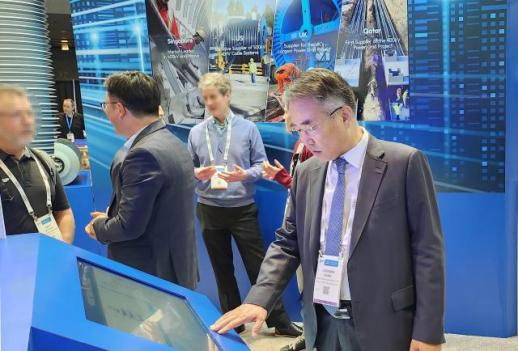 Taihan targets North American grid investment with HVDC and subsea cables Taihan Electric Wire said it is stepping up its push into the North American power-infrastructure market, highlighting high-voltage direct current (HVDC) and subsea cable technologies. The company said Tuesday it is taking part in the 2026 IEEE PES T&D exhibition in Chicago from May 4 to 7. The event is the largest U.S. gathering in the transmission and distribution sector, bringing together power-equipment makers, utilities and related organizations. Taihan said it is featuring HVDC cables, subsea cables and technologies for replacing aging power grids, focusing on areas where it sees strong project potential as electricity demand rises, renewable energy expands and existing grids age across North America. HVDC was the main focus. Citing its experience supplying 320kV-class HVDC cables in the United States, Taihan introduced solutions for 525kV-class underground and subsea HVDC cables. It also put forward a 525kV-class HVDC subsea cable that it said could be applied to South Korea’s “West Coast Energy Highway” project, underscoring its ability to serve long-distance, large-capacity transmission needs. The company also outlined plans to expand its subsea cable business. Taihan shared its domestic and overseas order track record and provided an update on construction of its second subsea cable plant in Dangjin, which it is pursuing with a target completion in 2027. It also introduced the “Palos” cable-laying vessel dedicated to offshore wind projects and its subsea cable installation subsidiary, Daehan Ocean Works, emphasizing end-to-end capabilities from manufacturing to installation. Solutions for replacing aging grids were also highlighted. Taihan said the technology can increase transmission capacity while using existing conduits, making it suitable for the U.S. market, where demand for grid reinforcement is high. The industry expects demand for related equipment to rise quickly as AI data centers expand and electrification increases pressure to add grid capacity in the United States. Industry observers also say regional transmission bottlenecks are worsening as AI data centers concentrate in areas including Virginia and Texas, potentially accelerating demand for extra-high-voltage cables and substation equipment replacements. For Taihan, securing U.S. references could serve not only to win orders but also as a prequalification factor for future utility tenders, the company said. Song Jong-min, Taihan’s vice chairman, visited the exhibition and met with major North American utilities and business partners. The company said Song reviewed ongoing business with local subsidiary staff and discussed ways to expand cooperation. “North America is seeing rapid market growth as grid investment expands and renewable energy spreads at the same time,” Song said. “Based on the experience and references we have built in the United States, we will continue to expand results in key areas such as HVDC, subsea cables and solutions for aging power grids.”* This article has been translated by AI. 2026-05-06 15:34:09
 -
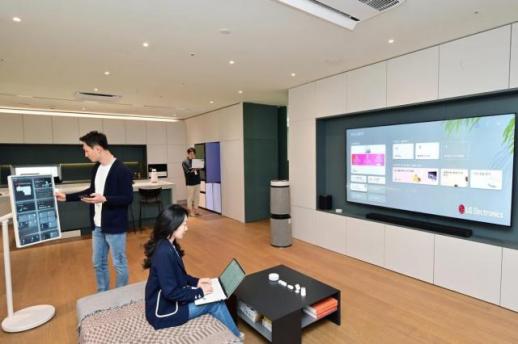 LG Upgrades ‘ThinQ Real’ AI Living Lab to Accelerate Smart Home Development LG Electronics has overhauled a research space used to validate AI-based living environments, stepping up efforts to advance its AI home business. The company said Tuesday it upgraded 'ThinQ Real,' located at LG Sciencepark in Seoul's Magok district. The facility serves as a research hub to refine AI technology using data gathered in a real-life setting and to apply the results to products and services. First built in 2022, the roughly 100-square-meter space has been redesigned to match a typical 30-pyeong home layout. LG said the focus has shifted from comparing different household types to recreating a more common housing form to closely analyze everyday living patterns. The interior is arranged like an actual home, including an entryway, living room, kitchen and bedroom, with furnishings and installations set up to mirror real use. AI appliances, IoT devices and sensors are connected to collect and analyze living data in real time. LG said it built an integrated control environment centered on its AI home hub, 'ThinQ On.' Using generative AI, the system is designed to converse with users in natural language, learn behavior and context, and automatically optimize the home environment. Researchers will run a range of daily-life scenarios in the space, verify automation functions and reflect the findings in products and services. The accumulated data will be used to improve AI algorithms and develop new services, the company said. One citizen said, "If the home responds like a single system rather than appliances working separately, convenience in daily life would increase a lot." LG said the revamp also targets expanded business-to-business demand. It strengthened the site's showroom function so construction firms, telecom companies and interior design businesses can experience AI home solutions, and said feedback gathered during visits will be incorporated into research and development. The company said the location inside LG Sciencepark, where major business divisions and research organizations are concentrated, is also intended to improve collaboration and speed the link between technology development and commercialization. Industry observers said global home-appliance makers are rapidly shifting from product competition to platform competition based on living data, and viewed LG's investment as a signal of a mid- to long-term strategic pivot. Jeong Gi-hyeon, vice president of LG Electronics' HS Platform Business Center, said, "We will quickly advance data-based AI home solutions to improve convenience in customers' daily lives." * This article has been translated by AI. 2026-05-06 10:04:20
 -
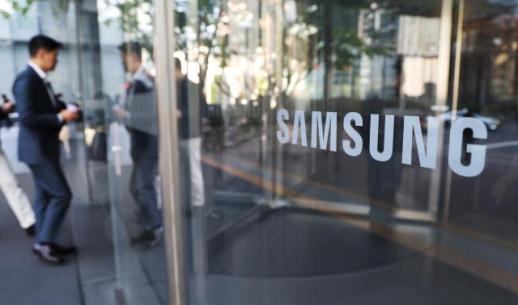 Samsung Electronics Faces Growing Divide Between Chip and Device Units as Union Rift Deepens Samsung Electronics is seeing an increasingly stark performance gap between its semiconductor business (DS) and its device business (DX), and the divide is now spilling into open friction inside its labor groups. According to industry officials on May 5, Samsung’s first-quarter results showed the DS division posting more than 53 trillion won in operating profit, accounting for most of the company’s earnings. The DX division, which covers mobile phones, TVs and home appliances, posted about 3 trillion won over the same period. DS operating margins were well above 60%, while DX margins were in the single digits. Some in the industry are even raising the possibility that DX could post an annual loss, and analysts say restructuring has already begun in parts of the home-appliance business. That imbalance has become a direct backdrop to labor tensions. A joint struggle committee led by an umbrella union has demanded that Samsung pay 15% of DS operating profit as performance bonuses and has signaled the possibility of a strike. That would amount to several hundred million won per person, a level some outsiders view as excessive. Amid the dispute, the Donghaeng union, made up largely of DX workers, formally withdrew from the joint committee on May 4. The union cited DS-centered agenda-setting and a lack of internal communication as reasons for leaving. Some observers say the split reflects more than a tactical disagreement, arguing that outsized compensation demands — raised as DS workers view the division’s results as their own achievement — have widened cracks across the organization. They also say a DS-driven labor campaign does not match the reality facing DX employees under restructuring pressure. Shin Je-yoon, chairman of Samsung Electronics’ board, recently posted a message on the company’s internal bulletin board urging the sides to close ranks. “For the semiconductor business, a foundational national industry, timing and customer trust are key,” he wrote, warning that development or production disruptions and missed delivery dates could “undermine fundamental competitiveness,” drive customers to rivals and erode market leadership. He added that it was time for employees to unite and resolve issues through “sincere dialogue.” There are also reports that some global customers are stepping up checks on delivery stability risks and monitoring the possibility of internal production disruptions. Many in the industry view the situation as more than a wage dispute, saying it reflects structural change and conflicting interests between business divisions. As long as DS continues to post strong results, the case for bigger bonuses may persist, but from a companywide perspective it could weaken internal cohesion. Experts say the semiconductor business now faces the need to manage internal conflict risks alongside external competition. An industry official said the DS union’s bonus push has spread beyond concerns about competitiveness to broader internal conflict, creating a crisis that could damage the strength of the Samsung brand.* This article has been translated by AI. 2026-05-05 18:04:09
 -
 Samsung Electronics board chair urges talks to resolve labor dispute Shin Je-yoon, chairman of Samsung Electronics' board, posted a public message to employees urging management and labor to resolve their dispute through dialogue. In a post on the company's internal bulletin board on the 5th, Shin said he was concerned about the situation and felt a strong sense of responsibility. "Many people, including shareholders and customers, as well as the public, are deeply worried about the company's recent situation," he wrote. "As board chairman, I feel a heavy responsibility and I am sorry for causing concern." Shin warned that a worsening standoff could damage the company's overall competitiveness. "Both labor and management could lose their footing," he said, adding that the fallout could include weaker business competitiveness, loss of customer trust, losses for shareholders and investors, and "serious negative effects" on the national economy. He pointed to the semiconductor business as particularly vulnerable. "In semiconductors, a foundational national industry, timing and customer trust are key," Shin wrote. He said disruptions in development and production, or missed delivery deadlines, could undermine core competitiveness and lead customers to shift to rivals, eroding market dominance. Shin also warned of broader economic consequences if a strike leads to heavy losses and customer departures. If the company's value falls, he said, it would cause serious losses for shareholders, investors, employees and local communities. He added that exports could drop by "hundreds of billions of dollars" and tax revenue by "tens of trillions of won," and that a weaker currency could reduce GDP. Inside Samsung Electronics, tensions have continued over wages and the performance-based pay system, with some unions leaving open the possibility of labor action. The standoff has persisted as the sides have failed to narrow differences in negotiations. Shin called for cooperation and talks. "Now is the time for all employees to unite for sustainable growth amid relentless competition and to resolve issues through sincere dialogue," he wrote. He urged employees to work together so the current conflict can become a foundation for a more constructive labor-management relationship, adding that he would do his best to work with management to find a solution. The message is notable as a case of the board directly stating its position on the labor dispute, and it could influence the course of negotiations.* This article has been translated by AI. 2026-05-05 13:33:04
 -
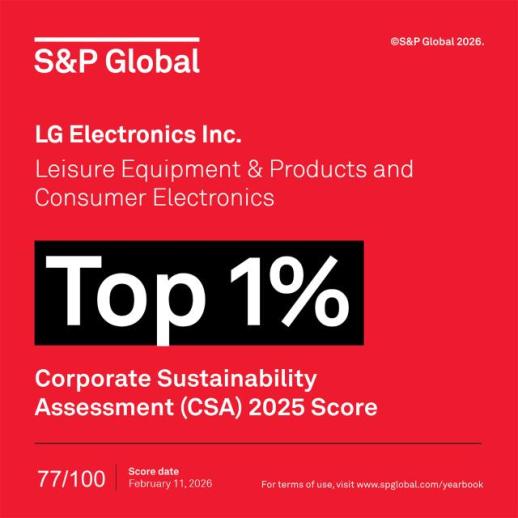 LG Electronics Again Ranks in S&P Global’s Top 1% for ESG, Third Straight Year LG Electronics has again placed near the top of major global ESG assessments, underscoring its sustainability management results. The company said Monday it was named to the “Top 1%” in S&P Global’s Corporate Sustainability Assessment for a third consecutive year. The assessment covered 9,243 companies worldwide, with only the top 1% in each industry group classified separately. LG Electronics scored 77 points in the household durables and leisure equipment category, the highest score in that industry group. Across all industries, only 70 companies made the “Top 1%” list, and just two were South Korean firms, including LG Electronics. S&P Global’s assessment reflects performance across environmental, social and governance factors. LG Electronics received consistently strong marks in key areas including environmental policy, human rights management, supply chain management and board independence, the company said. LG Electronics also said it has been included in the Dow Jones Sustainability Indices World Index for 14 consecutive years, indicating it has maintained sustainability performance in the global top 10%. Other evaluators reported similar results. In MSCI’s ESG rating, LG Electronics moved up one notch to “AA” from “A.” In EcoVadis’ assessment, it maintained a platinum rating for a second straight year, placing it in the top 1%. In Sustainalytics’ ESG risk rating, it received a “low” risk grade. The company said it is accelerating efforts to shift to renewable energy and expand resource circulation. It is pursuing a goal of converting 100% of electricity used at all business sites to renewable energy by 2050, while also improving packaging by increasing recycled plastic use and introducing paper cushioning materials. It is also seeking carbon-reduction certification using high-efficiency heat pumps, it said, as part of broader greenhouse-gas reduction efforts. On governance, LG Electronics said it is working to strengthen independence and transparency by appointing a board chair drawn from outside directors. “Recent ESG assessments are moving beyond image management and are increasingly tied directly to supply chain risk and cost structures,” an industry official said. “LG Electronics’ ability to maintain top-tier ratings is likely to translate into real business competitiveness.”* This article has been translated by AI. 2026-05-05 10:10:17
 -
 Blue House Monitors Samsung Electronics Strike Risk; Taiwan Growth, Iran Warning, LG Energy Deal, Nobel Field Blue House watches Samsung Electronics closely as strike deadline nears As a union-planned general strike at Samsung Electronics draws closer, the presidential office is closely tracking developments. Yonhap News reported on April 30 that the Blue House policy office recently prepared a report analyzing the potential impact on the South Korean economy if a strike materializes. Samsung Electronics has helped drive economic growth and a strong stock market during a semiconductor boom cycle, and officials are reviewing how a walkout could ripple across multiple sectors. A Blue House official called it a routine reporting process on social issues, saying the office regularly prepares reports on major public matters. Earlier, President Lee Jae-myung said at a meeting of senior aides that if some organized workers make excessive or unfair demands to protect only themselves and draw public criticism, it would harm not only that union but other workers as well. Senior presidential spokesperson Kang Yu-jeong said the remarks were not about any specific company. Taiwan posts 13.69% first-quarter growth, highest since 1987 Taiwan’s economy logged growth in the 13% range in the first quarter, boosted by surging demand for artificial intelligence semiconductors. Yonhap reported on April 30 that Taiwan’s statistics agency, the Directorate-General of Budget, Accounting and Statistics, said first-quarter gross domestic product rose 13.69% from a year earlier. It topped the previous quarter and marked the highest level since 1987, far exceeding market expectations in the 11% range. Semiconductors were the main driver as demand for AI, high-performance computing and cloud infrastructure lifted exports and investment. First-quarter exports jumped 51% from a year earlier. Results at Taiwan Semiconductor Manufacturing Co., the world’s largest foundry, also weighed heavily on the broader economy. TSMC posted a record performance, with net profit up 58% over the same period. Iran’s top leader calls U.S. attack a defeat, formalizes Hormuz control plan Iran’s top leader, Mojtaba Khamenei, described U.S. military involvement as a “defeat” and declared plans to build a new order around the Strait of Hormuz. Yonhap reported on April 30 that Khamenei, in a message marking “Persian Gulf Day,” said the U.S. attack ended in a “shameful failure” and that it was time to fully remove outside influence from the region. He said Iran would establish a new management system for the strait to block its use by hostile forces. Iran views the Strait of Hormuz as a strategic chokepoint tied directly to its security. Khamenei criticized the U.S. military presence, saying U.S. bases are vulnerable and do not guarantee regional stability. The remarks were seen as a hard-line message following U.S. and Israeli airstrikes in February. The strait is a key route for about 20% of global oil shipments, and analysts say rising tensions could affect international oil prices and maritime logistics. LG Energy Solution set to supply BMW batteries worth more than 10 trillion won LG Energy Solution posted a first-quarter loss despite expectations for large orders, but is seeking a rebound by expanding its electric-vehicle battery and energy storage system businesses. Yonhap reported on April 30 that LG Energy Solution is expected to supply BMW with cylindrical EV batteries worth more than 10 trillion won. The batteries are expected to be used in next-generation EVs, and the contract period is projected to run as long as 10 years. On a conference call, the company said it secured more than 100 gigawatt-hours in new orders for its 46-series cylindrical batteries and that its total order backlog exceeds 440 GWh. In the first quarter on a consolidated basis, LG Energy Solution posted an operating loss of 207.8 billion won, swinging to a loss from a year earlier. Revenue fell 2.5% to 6.555 trillion won. The company said it aims to lift the share of ESS sales to the mid-30% range by year’s end to improve profitability. Nobel Peace Prize field set at 287 nominees; South Korean citizens, Trump mentioned The Nobel Peace Prize field this year totals 287 nominees, reflecting a broad range as global conflicts expand. Yonhap and foreign media reported on April 30 that the Norwegian Nobel Committee designated 287 nominees for the 2026 Nobel Peace Prize: 208 individuals and 79 organizations. The list is kept confidential for 50 years, but some nominations become known through outside disclosures. South Korean civil society may be among the nominees, after it emerged that figures in South Korea’s political science community recommended “citizens as a whole,” citing a nonviolent overcoming of a martial law crisis. U.S. President Donald Trump was also mentioned as a possible nominee. The committee said the peace prize remains important even as international cooperation weakens. The winner will be announced on Oct. 9.* This article has been translated by AI. 2026-04-30 21:53:44
 -
 ECB, Bank of England Hold Rates as Middle East War Clouds Inflation Outlook The European Central Bank and the Bank of England kept their benchmark interest rates unchanged, as the Middle East war added uncertainty to energy prices and inflation while concerns about slowing growth also mounted. According to Yonhap on April 30, the ECB held its deposit rate at 2.00%, its main refinancing rate at 2.15% and its marginal lending facility rate at 2.40% after a policy meeting that day (local time). The ECB said recent information broadly matched its previous assessment of the inflation outlook, but that “upside risks to inflation and downside risks to economic growth have increased.” Eurozone consumer inflation in April rose to 3.0% from 2.6% a month earlier. In contrast, eurozone economic growth in the first quarter was just 0.1% from the previous quarter, heightening concerns about stagflation. The ECB said the war’s impact on inflation and economic activity would depend on the size and duration of the energy price shock, warning that a longer conflict and sustained high energy prices could weigh more heavily on both prices and growth. Reuters reported that some in the market expect the ECB could raise the deposit rate three times over the next 12 months, to 2.75%. Britain’s central bank also held rates steady the same day, keeping its benchmark rate at 3.75%. Eight of the Bank of England’s nine Monetary Policy Committee members backed no change, while one favored a 0.25 percentage-point increase to 4.00%. Britain’s consumer inflation rate stands at 3.3%, well above the central bank’s 2% target. The Bank of England said the Middle East conflict has made the outlook for global energy prices “highly uncertain,” and it is ready to take whatever steps are needed to meet its inflation goal. The bank outlined three scenarios depending on the severity of the energy price shock. In the worst case, inflation could rise to 6.2% in early next year, which could require strong monetary tightening. Gov. Andrew Bailey called the decision to hold rates “reasonable” given the unpredictability of economic conditions and the situation in the Middle East, and said the bank would watch developments closely.* This article has been translated by AI. 2026-04-30 21:52:31
 -
 Nobel Peace Prize Field Set at 287 Nominees; South Korean Citizens and Trump Mentioned The field for this year’s Nobel Peace Prize has been tallied at 287 nominees, reflecting a broad mix as global conflicts spread. According to Yonhap News Agency and foreign media reports on the 30th, the Norwegian Nobel Committee registered 287 nominees for the 2026 Nobel Peace Prize — 208 individuals and 79 organizations. The total reflects an increase in new nominees from a year earlier. The committee does not release the list, keeping nominations confidential for 50 years, though some names become known when nominators disclose their recommendations. In South Korea, there is speculation that the country’s civil society could be among the nominees after it became known that figures in the political science community recommended “all citizens,” citing what they described as a nonviolent overcoming of an emergency martial law situation. President Donald Trump is also being mentioned as a possible nominee after leaders in some countries, including Israel and Pakistan, said they intended to nominate him. The Nobel Committee has stressed that the peace prize remains important even as international cooperation weakens. Some foreign media have also suggested that, with the war in Gaza and the situation in Ukraine dragging on, this year’s award could be more likely to go to a humanitarian aid group or to an individual who played a mediating role. The Nobel Peace Prize winner will be announced Oct. 9, and the award ceremony will be held Dec. 10 in Oslo, Norway.* This article has been translated by AI. 2026-04-30 21:09:18
 -
 Hanwha Solutions Rights Offering Delayed Again After Regulator Seeks More Disclosures Hanwha Solutions’ plan for a paid-in capital increase has been delayed again after South Korea’s financial regulator demanded further revisions, saying more investor-protection disclosures are needed even after the company reduced the deal size. According to Yonhap News Agency on Wednesday, the Financial Supervisory Service again asked Hanwha Solutions to submit an amended securities registration statement for its rights offering. It was the second such request, following an earlier one on April 9. The filing has not been accepted and its effectiveness has been suspended, leaving the subscription schedule and other issuance procedures uncertain. The watchdog said key information was missing or unclear, raising concerns it could hinder investors from making a reasonable judgment. If the company fails to address the issues within a set period, the filing will be deemed withdrawn. Hanwha Solutions had initially sought a rights offering of about 2.4 trillion won, but after controversy cut the plan by 600 billion won to about 1.8 trillion won and resubmitted it. The revised filing still did not clear the regulator. The issue has moved beyond a procedural dispute to broader questions of market confidence in the purpose and structure of the fundraising. Analysts have pointed to shareholder backlash fueled by the size of the offering aimed at debt repayment and what they described as insufficient prior communication. A securities firm official said regulators have become more conservative as scrutiny of rights offerings tightens, adding that large deals are increasingly reviewed through the lens of governance and shareholder value. Hanwha Solutions said it “takes the FSS request seriously” and will “faithfully prepare” an amended filing.* This article has been translated by AI. 2026-04-30 20:48:16