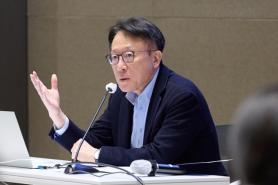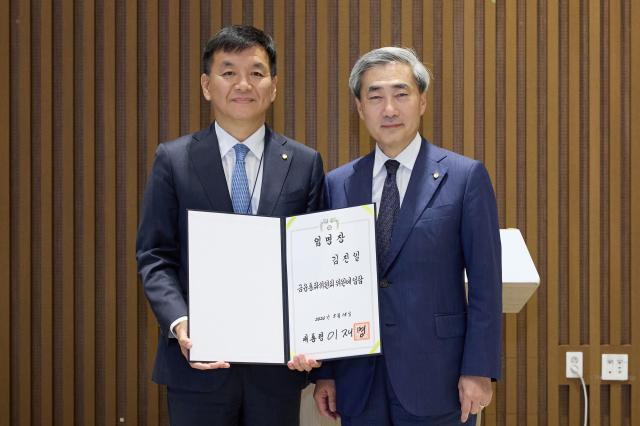
SEOUL, May 15 (AJP) - Kim Jin-ill, a former professor at Korea University, held his inauguration ceremony on Friday, to succeed Shin Sung-hwan, who retired from the Bank of Korea’s (BOK) Monetary Policy Board earlier this week.
Kim is expected to strengthen the BOK’s hawkish stance with his focus on the traditional role of a central bank.
Kim held a private inauguration ceremony at the BOK on Friday afternoon. This comes just four days after the Korea Federation of Banks (KFB) recommended him as a board member following Shin’s departure. Kim’s term officially began this Tuesday, immediately after Shin’s retirement, in accordance with the Bank of Korea Act.
The right to nominate the five board members, excluding the BOK governor and senior deputy governor, lies with the BOK governor, the Minister of Economy and Finance, the Financial Services Commission chairman, the chairman of the Korea Chamber of Commerce and Industry, and the chairman of the KFB. Since Shin was appointed upon the KFB’s recommendation, the vacancy was filled by the same body.
In contrast to Shin, who was known for his strong dovish tendencies—issuing seven dissenting opinions, five of which favored rate cuts—Kim is an expert who emphasizes the traditional roles of a central bank. He is recognized as a "U.S. expert," having conducted research as an invited economist at the U.S. Federal Reserve from 1996 to 1998 and from 2003 to 2010.
Given that this appointment comes under the leadership of Governor Shin Hyun-song, a traditional financial stability advocate who succeeded former Governor Rhee Chang-yong, the central bank is expected to place more weight on monetary policy itself moving forward.
Notably, Kim views himself as a relative hawk compared to other board members.
In an interview with a media outlet shortly after his nomination, Kim stated that if he were to place a dot on the BOK’s dot plot, it would be "half a click (0.125 percent)" above the average or median. He did not hide his intention to prioritize financial stability, aligning with Governor Shin’s past stance of suggesting preemptive rate hikes during the 2008 financial crisis.
In his inauguration speech on Friday, Kim opened by stating that "inflationary concerns have intensified due to high oil prices caused by the war in the Middle East" and mentioned exchange rate risks stemming from capital outflows. He clearly signaled that he would prioritize price stability.
The increasing likelihood that the U.S. Federal Reserve will not cut interest rates is another burden.
While Fed Chair-designate Kevin Warsh, often called a "hawkish dove" for advocating simultaneous balance sheet reduction and rate cuts, is set to begin his term soon, the timing of any cut has become uncertain. U.S. consumer prices rose 3.8 percent in April, the highest in about three years since May 2023. Some presidents of major regional Federal Reserve Banks, including Chicago and Boston, have even suggested rate hikes, forcing the BOK to prepare accordingly.
However, Kim drew a line against the possibility of a radical rate hike, citing the 2,000 trillion won ($1.36 trillion) in household debt and the steady rise in apartment prices.
Under the leadership of former Governor Rhee, the BOK had frozen the benchmark interest rate at 2.5 percent for seven consecutive sessions until April 10, following its last cut in May last year, to account for households' debt repayment capacity. Kim has not ruled out the possibility of aligning with this cautious approach.
Copyright ⓒ Aju Press All rights reserved.