

Journalist

Kim Yeon-jae
duswogmlwo77@ajupress.com
-
 Red flags rise as leveraged stock investment hits record highs in Korea SEOUL, January 12 (AJP) - As an AI-driven frenzy continues to power record rallies in Seoul and on Wall Street, leveraged stock investment in South Korea has surged to historic highs, amplifying financial vulnerabilities in an economy where household debt already exceeds gross domestic product. The benchmark KOSPI continued to rewrite records this week, climbing 0.84% to 4,624.79 - less than a week after breaking through 4,500. The index has rallied almost uninterrupted since mid-December, rising from below 4,000 on Dec. 18. The roughly 16 percent gain over that period extends a broader rally of about 75 percent since the start of 2025. If last year’s rally was driven primarily by SK hynix, this year’s momentum has been led by Samsung Electronics. The stock has set successive record highs, briefly topping the 140,000-won level during morning trading. The blistering equity surge — unfolding against a backdrop of sluggish economic indicators — is fueling concern rather than relief among policymakers and market watchers. According to data from the Korea Financial Investment Association (KOFIA), margin trading balances reached a record 28 trillion won ($19.2 billion) as of Jan. 8, marking a more than 30 percent increase from a year earlier. Margin debt, which allows investors to borrow against existing holdings to amplify returns, has accelerated sharply over the past three years. Growth stood near 10 percent in 2023, rose to about 20 percent in 2024 following the U.S. Federal Reserve’s aggressive rate cuts, and has surged further this year amid abundant global liquidity. Risk appetite has been especially concentrated in blue-chip stocks. Samsung Electronics alone accounted for nearly 2 trillion won in margin debt as of early January. Analysts warn that such “borrowed-money” investment is highly vulnerable to external shocks — most notably a potential further rate hike by the Bank of Japan (BOJ). BOJ Governor Kazuo Ueda signaled a continued hawkish stance at a New Year’s press conference on Jan. 5, indicating that the central bank would raise policy rates gradually from the current 0.75 percent as real interest rates remain deeply negative. The BOJ’s policy meeting on Jan. 23, followed closely by the U.S. Federal Open Market Committee (FOMC) meeting, is expected to serve as a key test for the direction of the yen-carry trade. While Japan’s December rate hike was largely priced in, analysts caution that an additional move could push the yen beyond key psychological thresholds against the dollar. “The ‘Black Monday’ crash in August 2024, when the Korean market plunged nearly 9 percent, was triggered the moment the yen hit 162 per dollar,” said Cho Yong-gu, a researcher at Shinyoung Securities. “Investors should closely monitor the yen-dollar exchange rate as the Fed weighs whether to hold or cut rates.” Kwon Ah-min, a researcher at NH Investment & Securities, echoed the warning, noting that given the severe damage caused by the unwinding of yen-carry trades two years ago, market participants must watch closely where global capital flows once the yen begins to strengthen. During the previous unwinding episode on Aug. 5, 2024, South Korean stocks suffered an 8.77 percent plunge, triggering widespread margin calls and heavy losses among retail investors. Samsung Electronics fell more than 10 percent, while SK hynix slid over 9 percent. With leverage now at even higher levels, a similar shock could pose systemic risks to the broader economy. Rising debt yields are adding further strain to South Korea’s households, whose total debt surpassed a record 1,800 trillion won as of the third quarter last year. Data submitted by the Bank of Korea to the National Assembly show that average debt per borrower is approaching 100 million won, underscoring the fragility of private-sector balance sheets. Global investment banks are also raising cautionary flags. Goldman Sachs warned in a late-December report that a BOJ rate hike on Jan. 23 could become a “tipping point” for the yen-carry trade. Morgan Stanley said that if Japan’s real interest rates turn positive, a large-scale repatriation of capital to Japan could trigger a global market sell-off. Identifying early warning signals will be critical in the current environment. “When the yen strengthens by more than 1 percent in a single day, or when bond yields and credit default swap premiums spike beyond normal ranges, it should be seen as a sign that yen-carry unwinding has begun,” said Kim Young-ik, a former professor at Sogang University. 2026-01-12 16:48:10
 -
 BOK likely to sit tight on rates through H1 amid FX and housing volatility SEOUL, January 09 (AJP) - The Bank of Korea is widely expected to keep its benchmark interest rate unchanged in the early months of 2026, as policy room remains constrained by persistent currency weakness, elevated housing prices and uncertainty over the durability of growth driven by an unprecedented chip boom. The central bank will hold its first rate-setting meeting of the year on Jan. 15, launching its annual cycle of eight policy reviews. Since reducing the number of monetary policy meetings from 12 to eight in 2017, the BOK has adopted longer intervals to allow for more comprehensive assessments of economic conditions. The benchmark rate has been on hold since May 2025, when the BOK cut it to 2.50 percent. Any additional easing would risk widening the interest-rate gap with the U.S. federal funds rate, currently in the 3.5–3.75 percent range. A wider differential typically puts downward pressure on the won as capital flows toward higher-yielding dollar assets. The policy calculus has grown more complex following the Bank of Japan’s recent move away from its long-standing zero-interest-rate stance, a shift that could further accelerate capital outflows from South Korea. The BOK’s maneuvering room is constrained both externally and internally. Domestically, the monetary policy board has historically favored caution during the final months of a governor’s term. Rhee Chang-yong’s four-year term ends in April, and it remains unclear whether he will be reappointed. Household debt remains another major limiting factor. As of the third quarter of 2025, household liabilities stood at 1,968 trillion won ($1.35 trillion), with more than 1,000 trillion won tied to real estate through mortgages and jeonse loans — a unique local system in which tenants provide large lump-sum deposits. A rate hike under these conditions could sharply strain debt-servicing capacity and risk destabilizing the property market. Against this backdrop, expectations for a hold are overwhelming. A survey conducted by Aju Business Daily on Thursday showed all 12 bond and macroeconomic strategists polled at major brokerages forecasting that the BOK will keep rates unchanged in January. While views diverged on the timing of any subsequent move, respondents broadly agreed that the status quo would persist at least through the first half of the year. “With corporations reporting robust earnings, there is little immediate pressure for further rate cuts, while it is also unclear whether a hike would meaningfully stabilize either housing prices or the exchange rate,” said Park Sang-hyun, a researcher at iM Securities. Cho Yong-gu of Shinyoung Securities echoed that view, noting that although growth momentum has remained resilient since November, volatility in the won and persistent overheating in the Seoul metropolitan housing market argue for policy caution. Analysts say future decisions will hinge largely on upcoming growth data. “If strong growth momentum carries through the second quarter, rates could remain on hold or even edge higher toward year-end,” said Woo Hye-young of LS Securities. “But signs of a slowdown in the second half would revive the case for renewed easing.” The housing market remains a critical wildcard. “Home prices, particularly in the metropolitan area, are likely to continue rising this year,” said Paik Yoon-min of Kyobo Securities, adding that a clear cooling of property prices would be a prerequisite for any shift in monetary stance. For now, neither the currency nor real estate shows signs of stabilizing. The won stood at 1,458 per dollar as of 3:30 p.m. Friday, down 5 won on the day. Despite foreign-exchange authorities having spent more than $2.6 billion in reserves on market intervention, the impact has been limited. Seoul apartment prices, meanwhile, climbed 8.71 percent in 2025. With household lending at commercial banks continuing to rise in early January, upward pressure on asset prices appears far from easing. 2026-01-09 17:13:57
 -
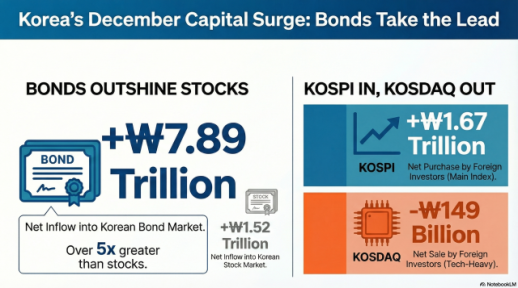 Foreign investors' appetite for South Korean stocks recovers SEOUL, Jan. 9 (AJP) - Foreign investors returned to the South Korean stock market, net purchasing over 9 trillion won in December alone, according to data released by the Financial Supervisory Service (FSS) on Friday. Foreigners snapped up 1.52 trillion Korean won (US$1 billion) in stocks and 7.89 trillion won in bonds, marking a decisive return after a brief retreat in November last year. The appetite was concentrated on the KOSPI, with net purchases totaling 1.67 trillion won, even as the tech-heavy KOSDAQ saw a modest net outflow of 149 billion won. The renewed interest lifted the total value of foreign-held stocks to 1,326.8 trillion won by the end of the year, up 134 trillion won from the previous month. Foreign holdings now account for 30.8 percent of the total market capitalization of the South Korean stock market. European investors led the buying spree with a net 1.6 trillion won, followed by North American and Asian investors at 400 billion won and 300 billion won, respectively. By country, France and the U.K. were the most aggressive buyers, with net purchases of 1 trillion won and 800 billion won. Conversely, Singapore and the Cayman Islands offloaded 900 billion won and 600 billion won. The U.S. remains the largest stakeholder, holding 546 trillion won worth of stocks or 41.2 percent of all foreign-owned shares. European investors follow with 417 trillion won, while Asian and Middle Eastern holdings stand at 182.4 trillion won and 22.9 trillion won. The bond market also saw a robust influx of capital with foreign investors purchasing a net 17.53 trillion won. Even after 9.64 trillion won in matured holdings, net investment amounted to 7.89 trillion won. This pushed total foreign bond holdings to 328.5 trillion won, up 6.9 trillion won from November, accounting for 11.9 percent of all outstanding listed debt. European investors led foreign bond inflows with 2.5 trillion won, followed by the Americas at 1.7 trillion won and Asia at 1.1 trillion won. In terms of total holdings, Asian investors maintain the largest share at 135.9 trillion won, followed by European holders at 120.6 trillion won. Most of the investment went into government bonds and Monetary Stabilization Bonds (MSBs), which saw net purchases of 3.7 trillion won and 1.9 trillion won, respectively. As of the end of last year, foreign investors held 297.1 trillion won in government bonds and 31.4 trillion won in other bonds. 2026-01-09 09:38:15
 -
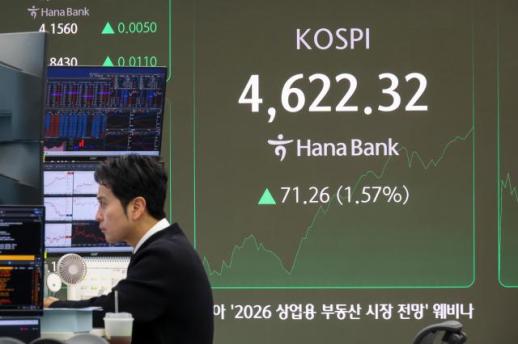 Tax may be one reason Koreans prefer overseas ETFs over home-based ones SEOUL, January 08 (AJP) - Authorities have blamed overseas securities investment for the stubborn weakness of the Korean won and have rolled out incentives to encourage capital to return home. But for many individual investors, tax treatment remains a decisive reason to stick with foreign exchange-traded funds (ETFs). An investor who generates 30 million won ($20,691) in profits from Korea-listed ETFs within a pension account would take home about 19.1 million won after tax. That implies an effective tax rate of roughly 35 percent. By contrast, profits from overseas-listed ETFs are subject to a flat 22 percent capital gains tax on excess earnings, allowing the same investor to retain around 24 million won. The arithmetic alone tilts preferences toward overseas ETFs. How Korea’s ETF tax system works South Korea’s ETF taxation rests on two pillars: dividend income tax and global income tax. Investment profits of up to 20 million won are subject only to dividend income tax. Once gains exceed that threshold, the excess is classified as “other income” and added to earned income, triggering progressive global income tax rates. For higher earners, this can push the marginal tax rate as high as 49.5 percent. As a result, a 30 million won gain can translate into a 35 percent tax burden, significantly eroding net returns. A widening global gap The disparity becomes more pronounced in international comparison. For the same 30 million won gain, investors in Japan or China would retain about 24 million won. In the United States, the most popular destination for Korean investors, long-term capital gains are taxed at 15 percent, leaving investors with more than 25 million won. In Taiwan and Singapore, capital gains from ETFs are largely untaxed beyond transaction fees, allowing investors to keep nearly the full amount. Capital outflows accelerate Against this backdrop, the shift toward foreign securities has intensified. According to a press release from the Bank of Korea last December, South Korean residents invested $99.85 billion in foreign stocks and bonds between January and September last year — more than three times the $29.65 billion foreign investors put into Korean securities over the same period. The ETF market mirrors this trend. Based on data from ETFGI and the Korea Exchange, capital inflows from Korea into overseas ETFs reached an estimated 150–160 trillion won last year, more than double the 77.5 trillion won that flowed into domestically listed ETFs. While Korean ETFs still lead in total assets under management, the gap is narrowing rapidly. “Too much capital from individual investors is flowing overseas,” BOK Governor Rhee Chang-yong said at a press conference following a Monetary Policy Board meeting in November, stressing the need to induce net inflows to help stabilize the exchange rate. Policy friction, structural problem In response, authorities began requiring investors in overseas-listed ETFs to complete a mandatory one-hour educational session starting last December — a move widely interpreted as an attempt to slow capital outflows by raising procedural hurdles. Market participants argue, however, that such measures fail to address the root cause. The Korea Capital Market Institute noted that disparities in ETF taxation and regulation have created structural incentives for high-net-worth investors to favor overseas products. The institute has called for tax neutrality between domestically listed overseas ETFs and overseas-listed ETFs. “We are seeing a phenomenon where Koreans ‘direct-purchase’ Korean ETFs through foreign markets,” said Lim Tae-hyuk, head of ETF management at Samsung Securities. “Eliminating double taxation would bring domestic investors back to the home market.” Kim Jung-hyun, head of ETF business at Shinhan Asset Management, echoed the view, calling for separate taxation of dividend income for domestic ETFs held in individual retirement pensions. “For the long-term growth of Korea’s capital market,” he said, “structural tax reform is no longer optional.” 2026-01-08 17:49:15
 -
 Naver's sovereign AI plan questioned over use of China's open-source technology SEOUL, Jan. 8 (AJP) - Naver’s push to develop a so-called “sovereign AI” model has come under scrutiny after disclosures that its government-backed foundation model incorporated components from Alibaba’s open-source Qwen system, raising questions about South Korea’s technological independence and its ambition to build advanced artificial intelligence from scratch. Industry sources said on Thursday that Naver Cloud’s HyperCLOVA X Seed 32B Sync model used a vision encoder from Alibaba’s Qwen. Vision encoders convert visual data into numerical representations that allow AI systems to process images and other non-text inputs. Naver Cloud defended the decision, saying the integration was a strategic choice aimed at ensuring compatibility with the global AI ecosystem and improving overall performance. The revelation, however, has challenged the domestic industry narrative that South Korea’s sovereign AI initiatives are fully homegrown. Several industry officials said reliance on global open-source models was a pragmatic response to tight deadlines and limited resources under government-led projects. “Given the compressed timelines and performance requirements, developers had little choice but to rely on proven open-source tools to deliver functioning multimodal AI,” one industry official said, declining to be named. Chinese open-source models have gained traction globally by offering open-weight architectures that allow developers to modify and optimize systems freely. In contrast, leading U.S. models such as OpenAI’s ChatGPT and Google’s Gemini operate largely as closed systems. Data from developer platform OpenRouter and venture capital firm Andreessen Horowitz show that usage of Chinese-developed open-source models rose sharply, from 1.2 percent in late 2024 to about 30 percent by August last year. Even U.S.-based companies such as Nvidia and Perplexity, as well as Stanford University, have reportedly used Alibaba’s Qwen for specific applications. At the same time, the performance gap between Chinese and Western models is narrowing. Stanford University’s Human-Centered AI institute said in its AI Index 2025 report that the U.S. lead in benchmarks such as Massive Multitask Language Understanding shrank from double digits in late 2023 to between 0.3 and 3.7 percentage points by the end of 2024. Research firm Epoch AI estimated that leading Chinese models now trail top Western systems by an average of about three months. “China is strengthening its position in the open-source AI ecosystem through large-scale state support and regulatory easing,” another industry official said. “Firms developing sovereign models may need selective collaboration to remain competitive.” Performance data has also tempered expectations. In December, a Sogang University research team tested five government-backed AI models using university entrance exam-style questions, including South Korea’s CSAT mathematics section. While startup Upstage scored 58 points, other domestic models recorded results in the 20-point range. By contrast, leading global systems such as GPT-5.1 and DeepSeek V3.2 scored above 70, highlighting the gap that remains despite state-backed efforts. 2026-01-08 17:31:42
 -
 China's export curbs on Japan risk collateral damage to Korean chipmakers SEOUL, January 07 (AJP) - South Korean technology producers that rely on both China and Japan for critical raw and intermediate inputs may find themselves caught in the crossfire of rising U.S.–Japan tensions, after Beijing imposed sweeping export restrictions on more than 1,000 so-called “dual-use” items bound for Japan. China announced a blanket ban on the export of dual-use goods to Japan while hosting South Korean President Lee Jae Myung for a state visit and summit with Chinese President Xi Jinping. Although framed as a measure to prevent “military use,” the restrictions include seven types of heavy rare-earth elements (HREEs) and permanent magnets essential to advanced manufacturing, making it one of Beijing’s most aggressive trade actions against Tokyo to date. The impact, however, is unlikely to stop at Japan. Because South Korea depends heavily on Japanese intermediate goods for its core semiconductor and battery industries, disruptions along the China–Japan supply chain could ripple quickly into Korea. Heavy rare earths at the choke point At the center of the issue are heavy rare-earth elements, often described as the “vitamins of the high-tech industry.” Compared with light rare earths, HREEs offer stronger magnetic properties, higher heat resistance and superior performance in optical signal processing — making them indispensable for semiconductors, electric vehicles and defense-related technologies. China holds a near-monopoly over these materials, accounting for more than 60 percent of global HREE mining output and refining about 95 percent of all rare earths produced worldwide. It also controls over 90 percent of global permanent magnet production. This concentration raises particular risks for South Korea’s export-driven tech sector, especially semiconductors and electric vehicles. Korean chipmakers remain more than 90 percent dependent on Japanese-made extreme ultraviolet (EUV) lithography equipment, supplied by firms such as Tokyo Electron. The production of this equipment is virtually impossible without yttrium (Y), a key heavy rare earth now caught up in China’s export controls. The electric vehicle sector faces similar exposure. Korean EV manufacturers rely heavily on Japanese-made power integrated circuits that regulate energy flow from batteries to motors. Producing these components requires stable supplies of gallium (Ga), germanium (Ge) and graphite (C) — materials over which China maintains tight control across the global supply chain. Caution amid uncertainty Despite the mounting concerns, some experts warn that excessive alarm may be premature, as details of the export ban remain unclear. “While the term ‘comprehensive ban’ sounds severe, the absence of a finalized item list suggests this could still be a low-level maneuver,” said Park Han-jin, a special professor at Hankuk University of Foreign Studies and a former China head at KOTRA. An official notice, he noted, would normally specify the legal authority, exact items covered and enforcement rules. So far, the announcement from China’s Ministry of Commerce has remained broad and procedural, in contrast to Beijing’s 2023 restrictions on germanium and gallium, which were authorized directly by Xi through a presidential decree. An official at South Korea’s Ministry of Trade, Industry and Energy, speaking on condition of anonymity, also said it was too early to assess the direct impact on Korean firms. Still, the warning lights are flashing. “At this stage, it appears to be a pressure tactic aimed at discouraging Japan from deeper involvement in the Taiwan issue,” Park said. “But if rare earths are fully included in the ban, the shock could hit Korea’s core exporters hard.” 2026-01-07 17:27:02
 -
 Retail traders bet on US markets as KOSPI rally continues SEOUL, Jan. 7 (AJP) - While the KOSPI continues its record-breaking rally on Wednesday, breaching the 4,600-level for the first time in history, the unwavering appetite of South Korean retail investors for U.S. equities remains a dominant market force. According to data from Koscom ETF CHECK, the most net-purchased ETFs by retail investors over the past week were the TIGER US S&P 500 and KODEX US S&P 500. Individual traders poured nearly 350 billion Korean won (US$241.7 million) into these two funds, with net purchases of 225.9 billion won and 121 billion won, respectively. The preference for Wall Street extended to tech-heavy indices, as retail investors also snatched up 96.0 billion won of KODEX US Nasdaq 100 and 77.6 billion won of TIGER US Nasdaq 100, signaling a persistent bias toward U.S. growth stocks. This exodus of capital into overseas markets is a long-standing trend rather than a fleeting phenomenon. Between January and October last year, South Koreans invested a net $117.1 billion in overseas securities — comprising $89.9 billion in equities and $27.2 billion in bonds. October alone recorded a record $17.3 billion outflow. Data from the Bank of Korea further underscores this imbalance; while domestic investment in foreign securities jumped by $17.27 billion, foreign investment in South Korean equities grew by a mere $5.2 billion, highlighting a stark divergence in market confidence. Ironically, the most popular domestic equity ETF among retail investors was the KODEX 200 Futures Inverse 2X, known colloquially as the "Gop-bus" - which tracks twice the inverse of the KOSPI 200's daily performance. Retail traders bet 116.4 billion won on a market downturn, despite the ETF plunging 15.93 percent over the past week as the index continued to climb - suggesting that a significant segment of the retail market expects an imminent correction following the recent streak of record highs. Institutional investors, in contrast, are doubling down on the domestic rally. Over the past week, institutions focused their buying on the KODEX Leverage and KODEX KOSDAQ 150 Leverage, with net purchases of 85.8 billion won and 79.8 billion won, respectively. These leverage products provide twice the daily return of their underlying indices, reflecting institutional confidence that the domestic bull market still has room to run despite the height of the current valuation. Brokerages are fueling this optimism by aggressively raising their year-end targets. Yuanta Securities recently hiked its 2026 KOSPI forecast range to 4,200–5,200 points from 3,800–4,600, while Kiwoom Securities raised its band to 3,900–5,200 points. On Tuesday, Korea Investment & Securities significantly upgraded its KOSPI target to 5,650 from 4,600, citing the high probability of further upward revisions in operating profit forecasts for semiconductor giants. However, the narrow breadth of the rally remains a point of skepticism for individual investors. The surge in the KOSPI is almost entirely dependent on a few mega-cap stocks like Samsung Electronics and SK hynix. The combined market capitalization of these two firms has reached 1,374.8 trillion won, accounting for a staggering 36.6 percent of the total KOSPI value as of Wednesday. Historical data also serves as a cautionary tale; while the KOSPI saw explosive growth during the "Three Lows" boom of 1987–1988 and the short-term recovery after the 1997 Asian financial crisis, these rallies were often followed by stagnant or sharply declining markets, such as the 50.92 percent crash in 2000 following the IT bubble. Analysts suggest that the anxiety over domestic volatility is driving the demand for global asset allocation toward U.S. markets. Even among experts, measuring appropriate valuations for the KOSPI has become a challenge due to its rapid ascent. "It is historically unprecedented for the KOSPI to lead global markets with such a dominant growth rate," said an analyst at a major brokerage, on condition of anonymity, adding that market sentiment is likely to remain volatile for the time being, although the ceiling for the index remains high. 2026-01-07 17:23:29
 -
 Seoul's all-out defense of the won takes heavy toll on FX reserves Dec SEOUL, January 06 (AJP) - South Korea’s foreign-exchange reserves fell by nearly $3 billion in December, marking the largest monthly decline among major reserve-holding economies and underscoring the cost of aggressive market intervention to defend the won. According to data released Tuesday by the Bank of Korea, the country’s FX reserves stood at $428.05 billion at end-December 2025, down $2.6 billion from the previous month. While the headline figure remains substantial, the contraction represents the second-steepest December decline on record, surpassed only by the nearly $4 billion plunge during the 1997 Asian financial crisis, when South Korea sought an IMF bailout. The drawdown is notable not only for its size but also for its timing. December is typically a month when global financial institutions build up foreign-currency buffers to meet capital-adequacy requirements under Bank for International Settlements Basel III rules, which recommend a common equity Tier 1 ratio of at least 10.5 percent, including a 2.5-percentage-point capital conservation buffer introduced after the 2008 global financial crisis. In recent years, South Korea followed that seasonal pattern. FX reserves increased in December 2023 and 2024, and even during periods of acute stress the year-end drawdowns were modest. During the 2022 “Legoland” municipal debt default, which rattled domestic credit markets, December reserves fell by just $140 million. At the height of the 2008 global financial crisis, the December decline was limited to about $600 million. An outlier among major reserve holders The divergence between Seoul and its peers was stark. China, the world’s largest reserve holder, added roughly $30 billion to its reserves in December. Japan, ranked second, increased its holdings by around $120 billion, while India added $45 billion, the second-largest increase after Japan. Even Russia, in war-related hemorrhage and sweeping sanctions, recorded a net increase of about $1.5 billion in reserves. The comparison suggests that Korea drew down reserves more aggressively than economies grappling with far more severe external shocks. Other countries did post declines, but for fundamentally different reasons. Switzerland saw a roughly $5 billion drop, largely reflecting valuation effects from a stronger Swiss franc and a weaker U.S. dollar, rather than active intervention. Saudi Arabia’s estimated $15 billion decline reflects deliberate spending to finance large-scale projects such as the Neom giga-city. Korea’s case stands apart. The reserve loss was driven primarily by direct and sustained intervention in the currency market to curb the won’s slide amid renewed dollar strength following the U.S. military operation in Venezuela. Market stability remains a key concern for regulators. As of September, South Korean banks posted a total capital ratio of 15.87 percent, according to the Financial Supervisory Service, a level that appears comfortable on paper. However, during its annual consultation in November, the International Monetary Fund urged Seoul to maintain even higher buffers, citing rapidly rising household debt—now estimated at 2,000 trillion won (about $1.4 trillion)—which is growing faster than in most advanced economies. If government intervention continues, analysts warn that FX reserves could remain under pressure through the end of January. The broader impact on the private financial system may become clearer in March, when the FSS releases updated capital-adequacy data for banks. “Measures to address exchange-rate volatility led to the decrease in reserves,” the Bank of Korea said in its statement. A central-bank official, speaking on condition of anonymity, said the private and institutional sectors are expected to maintain precautionary measures until the exchange rate stabilizes, but declined to comment on how deeply the interventions may be affecting banks’ capital positions. 2026-01-06 17:32:29
 -
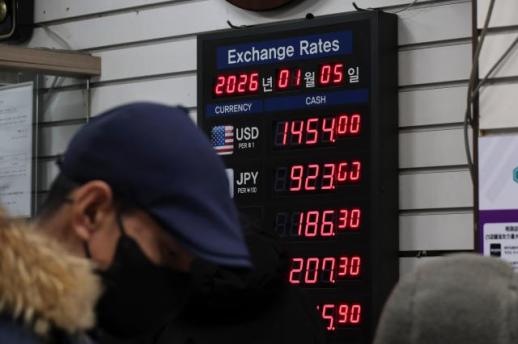 Korea's FX reserves recede by near $3 billion Dec amid won defense efforts FX rates displayed at a currency exchange shop in Seoul’s Myeong-dong on Jan. 5, 2026. AJP You Na-hyun SEOUL, January 06 (AJP) -South Korea’s foreign exchange reserves fell by $2.6 billion in December from the previous month — the first decline in seven months — signaling stepped-up dollar-selling intervention to shore up the won, which had hovered near crisis-era lows. According to a report released Tuesday by the Bank of Korea, the country’s foreign exchange reserves stood at $428.05 billion at the end of December, down from $430.66 billion a month earlier. The reserves had dropped to $404.6 billion at the end of May, the lowest level in nearly five years, after the dollar surged to the 1,480-won range in April amid a tariff barrage from the new Trump administration. They then recovered steadily, topping $430 billion for the first time in three years and three months in November. That milestone proved short-lived, however, as the dollar revisited the 1,480-won range late in the year. Authorities encouraged the National Pension Service and other institutional investors to hedge their dollar exposure to stabilize the won as it edged closer to the psychologically sensitive 1,490-per-dollar level, while mobilizing a range of incentives to prompt the sale of dollar assets. A Bank of Korea official attributed part of the earlier increase in reserves to quarter-end effects, including a rise in foreign-currency deposits at financial institutions and valuation gains from converting non-dollar assets into U.S. dollars. At the same time, measures aimed at curbing foreign-exchange market volatility weighed on the total. These included smoothing operations in both the spot and forward markets, as well as hedging activity by the pension fund, the official said. By asset class, securities — such as government and corporate bonds — fell by $8.22 billion to $371.12 billion, suggesting the divestment of foreign-currency-denominated papers to secure ammunition for won-stabilization efforts. Deposits, by contrast, increased by $5.44 billion to $31.87 billion. Holdings of the International Monetary Fund’s special drawing rights rose $150 million to $15.89 billion, while gold holdings were unchanged at $4.79 billion, as they are recorded at purchase price rather than market value. As of the end of November, South Korea’s foreign exchange reserves ranked ninth globally at $430.7 billion. China topped the list with $3.3464 trillion, followed by Japan ($1.3594 trillion), Switzerland ($1.0588 trillion), Russia ($734.6 billion), India ($687.9 billion), Taiwan ($599.8 billion), Germany ($552.3 billion) and Saudi Arabia ($463.7 billion). The dollar has returned toward the 1,450-won level after all-out year-end stabilization efforts from authorities upon a renewed flight to safe-haven assets following the Venezuela crisis. 2026-01-06 07:44:34
 -
 Asian markets surge to record highs as CES week kicks off SEOUL, January 05 (AJP) - Asian equity markets rallied in a synchronized surge on Monday as investor focus shifted to major technology players ahead of the Consumer Electronics Show (CES) 2026 in Las Vegas. Benchmarks in Seoul and Taipei led the advance, with both markets scaling fresh record highs. South Korea’s benchmark KOSPI jumped 3.43 percent to close at 4,457.52, marking its sharpest daily gain this year and pushing the index to the doorstep of the 4,500 level after surpassing its previous all-time high. Foreign investors drove the rally with net purchases of 2.17 trillion won (about $1.5 billion), while retail and institutional investors booked profits, selling 1.5 trillion won and 703 billion won, respectively. Despite a firmer U.S. dollar amid geopolitical tensions — including a U.S. military operation in Venezuela — the won–dollar exchange rate held nearly flat at 1,446.8 as of 5 p.m. The stability was widely attributed to heavy foreign inflows into Korean tech stocks and continued vigilance by foreign-exchange authorities. Tech leads the charge Blue-chip technology names powered the rally. Samsung Electronics, a flagship CES participant, surged 7.47 percent to a record 138,100 won. Sentiment was buoyed by upbeat brokerage views, with Sangsangin Investment & Securities lifting its 2026 target price to 150,000 won. At CES, Samsung is set to unveil its “Affectionate Intelligence” concept for integrated home appliances. SK hynix, the global leader in high-bandwidth memory (HBM), rose 2.81 percent to a new peak of 696,000 won as it prepares to highlight its role as a “full-stack memory provider.” Optimism spilled over to supply-chain plays, with Hanmi Semiconductor surging 15.8 percent in regular trading before leaping another 23 percent to 178,000 won in after-hours Nextrade (NXT) trading. Energy, utilities and refiners rally Energy and utility stocks also logged outsized gains. Doosan Enerbility soared 10.64 percent to 83,200 won, tracking last week’s rally in U.S. small modular reactor (SMR) names. Korea Electric Power Corporation climbed 7.2 percent to 49,850 won. Manufacturers tied to transformers and high-voltage equipment advanced sharply, with Iljin Electric up 7.23 percent, HD Hyundai Electric gaining 6 percent, and Hyosung Heavy Industries rising 3.7 percent. Refiners joined the rally on expectations of improving margins and reduced Middle East dependence as Washington signaled a push to boost oil production in Venezuela. S-Oil gained 5.35 percent, while SK Innovation added 2.8 percent. Hyundai Motor Company and LG Energy Solution rose 2 percent and 2.9 percent, respectively, as both companies look to showcase new initiatives at CES. The tech-heavy KOSDAQ advanced a more modest 1.26 percent to 957.50, led by aerospace names. Innospace jumped 14.7 percent to 15,570 won, rebounding from earlier launch setbacks, while Nara Space Technology surged 10.1 percent to 31,050 won. Regional markets ride the CES wave Japan’s Nikkei 225 rallied 2.97 percent to 51,832.80, fueled by a broad semiconductor upswing. Chip-testing specialist Advantest climbed 7.84 percent to 21,175 yen, while Tokyo Electron, Disco and Ibiden gained between 6 percent and 8 percent. Toyota Motor Corporation added 1.28 percent. Taiwan’s TAIEX rose 2.57 percent to 30,105.54, extending gains ahead of CES. TSMC jumped 5.36 percent to a record 1,670 Taiwan dollars, cementing its position as the world’s sixth-largest company by market capitalization. MediaTek and Foxconn rose 3.74 percent and 1.08 percent, respectively. On the mainland, China’s Shanghai Composite gained 1.38 percent and the Shenzhen Component climbed 2.24 percent as CES-driven tech optimism lifted sentiment. Hong Kong’s Hang Seng Index, however, ended flat at 26,326.84, with lingering geopolitical uncertainty prompting a more cautious stance among some foreign investors. 2026-01-05 17:25:57