
Journalist

Jeong Hae-hun
ewigjung@ajunews.com
-
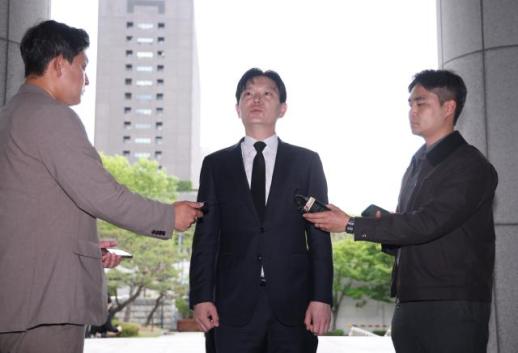 Park Sang-yong Seeks Opportunity to Clarify Allegations Amid Disciplinary Review Park Sang-yong, a deputy chief prosecutor at the Incheon District Prosecutors' Office, is under investigation for allegedly coercing testimony by providing salmon and alcohol during the North Korean remittance investigation involving Ssangbangwool. He has requested an opportunity to clarify the allegations and indicated he would file a lawsuit depending on the outcome of the disciplinary review.According to legal sources, the Supreme Prosecutors' Office held a meeting of its inspection committee on the afternoon of May 11 to deliberate on the disciplinary action against Park.Speaking to reporters around 1:50 PM outside the Supreme Prosecutors' Office, Park stated, "I have not been informed at all about what the allegations are or how many there are against me. I believe that even if there are grounds for disciplinary action, it should not be carried out based on a predetermined conclusion without giving me any procedural rights or opportunities to clarify my position."He added, "If there were proper procedures in place, I would not have to stand before the media or wait indefinitely in the office. I would like to have the opportunity to clarify my case to the external committee members as if I were knocking on the door of a grievance office."Furthermore, Park noted, "After the Supreme Prosecutors' Office's inspection committee, the matter will go to the Ministry of Justice, which also has its own inspection committee, and I understand that the final disciplinary decision will be made by the disciplinary committee. If a disciplinary action is ultimately imposed and I cannot accept it, I plan to file a lawsuit for cancellation."Park is accused of providing salmon and alcohol to suspects, including former Gyeonggi Province Peace Vice Governor Lee Hwa-young and former Ssangbangwool Chairman Kim Sung-tae, while investigating the North Korean remittance case.The task force at the Seoul High Prosecutors' Office, which is investigating the allegations, reported to the Supreme Prosecutors' Office on May 17, 2023, after confirming that such gatherings had taken place.The second comprehensive special investigation team, led by Special Prosecutor Kwon Chang-young, which is investigating remaining allegations following the three major special investigations (Kim Geon-hee, insurrection, and deceased Marines), received the North Korean remittance case from the Seoul High Prosecutors' Office task force last month and is currently conducting an investigation into what has been termed the "Presidential Office's interference in the Suwon District Prosecutors' Office investigation."* This article has been translated by AI. 2026-05-12 03:59:59
 -
 Supreme Court Rules Desk-Tipping Not Assault Without Physical Threat The Supreme Court has ruled that tipping over a desk does not constitute assault if it does not pose a physical threat to the victim.On May 10, the Supreme Court's first division, led by Justice Ma Yong-joo, overturned a lower court's ruling that imposed a fine of 300,000 won on an individual identified as A, and sent the case back to the Uijeongbu District Court.A was charged with assault after tipping over a desk during a verbal altercation with B in a residents' meeting room of an apartment complex in Goyang, Gyeonggi Province, in May 2021.Both the first and second trials found A guilty and imposed the fine, stating that “fragments of the overturned desk flew toward the victim, and the sudden act startled and threatened the victim and others present.”However, the Supreme Court found that the lower court had misunderstood the legal principles regarding the establishment of assault, accepting A's appeal.The court stated, “The evidence presented by the prosecution, including the fact that fragments of the desk flew toward the victim as a secondary result of A's actions, is insufficient to conclude that A assaulted the victim or had the intent to do so.”It further explained, “Considering that the desk was tipped over in a direction blocked by another desk, and that the victim was standing approximately at the 10 o'clock position relative to A, it does not appear that A's actions posed a physical threat to the victim. Simply startling or frightening the victim does not qualify as 'assault.'”The court also referenced previous rulings, stating, “Assault under criminal law is intended to protect the integrity of a person's body, not to safeguard against psychological distress. Therefore, in cases where there is no physical contact with the victim, one must carefully assess whether the exertion of force against a person constitutes assault.”The court emphasized the need to consider various factors, including the physical orientation of the act, the degree of illegality against the victim's body, the spatial proximity between the actor and the victim, the intent and purpose of the act, the nature and method of the act, the circumstances at the time, and the presence and extent of any pain inflicted on the victim.* This article has been translated by AI. 2026-05-11 02:49:54
 -
 Commission Resumes Investigation of Pro-Japanese Assets After 16 Years The Pro-Japanese Asset Investigation Committee has been reestablished to review and decide on matters related to pro-Japanese assets. The new law provides a legal basis for recovering proceeds from the sale of these assets and for rewarding whistleblowers who report pro-Japanese properties.On May 7, the Justice Ministry announced that the Pro-Japanese Asset Confiscation Law passed the National Assembly. This law will take effect six months after its promulgation.The committee will resume its activities after 16 years. The first committee, active from July 2006 to July 2010, successfully recovered approximately 237.3 billion won in pro-Japanese assets before concluding its work.The new law not only reinstates the committee but also clarifies the legal framework for recovering proceeds from sold pro-Japanese assets and introduces reward provisions to encourage reporting.Once the committee resumes its work, recovered assets will primarily support funds for independence activists and their families, contributing to their financial stability and commemorative projects.In related developments, the Justice Ministry confirmed that descendants of pro-Japanese collaborator Im Seon-jun sold eight plots of land in Cheonsong-dong, Yeoju, between 1993 and 2000. On January 14, the ministry filed a lawsuit seeking the return of approximately 53 million won from the descendants.On April 22, the Seoul Western District Court ruled in favor of the state, marking the first successful case following a Supreme Court ruling that deemed claims of expiration by descendants of pro-Japanese collaborators as an abuse of rights.The Justice Ministry has also filed lawsuits for the return of properties belonging to descendants of other collaborators, including 31 plots in Ho-won-dong valued at about 7.8 billion won, 12 plots in Ilsan-dong valued at approximately 2.5 billion won, and two plots in Inchang-dong valued at around 3 billion won. These cases are currently in the first trial stage.Justice Minister Jeong Seong-ho stated, "The enactment of this law represents a national commitment to fully address pro-Japanese collaboration, aiming to recover unjustly accumulated assets and restore historical justice."* This article has been translated by AI. 2026-05-07 23:12:15
 -
 South Korea’s top court says arrest of suspect who voluntarily appeared was unlawful South Korea’s Supreme Court has ruled that police unlawfully executed an arrest warrant by taking a suspect into custody after he voluntarily appeared at a police station, saying the grounds and necessity for arrest were not met. According to the legal community on Wednesday, the Supreme Court’s First Division (Justice Ma Yong-ju presiding) upheld an appeals court ruling that sentenced a man identified only as A to 18 months in prison, a 10 million won ($7,300) fine and 17.6 million won in forfeiture for violating the Act on the Punishment of Acts of Arranging Sexual Traffic (arranging prostitution). Prosecutors said A rented four units in an officetel in Uijeongbu, north of Seoul, from August 2020 to January 2021, hired female workers and arranged paid sex for male customers who came after seeing online advertisements. Lower courts imposed the same sentence and rejected A’s claim that police executed the arrest warrant illegally. The Supreme Court said the request for and issuance of the arrest warrant were lawful, but the arrest carried out under the warrant was illegal. A prosecutor at the Uijeongbu District Prosecutors Office sought the warrant on Jan. 22, 2021, at the request of an officer with the Gyeonggi Nambu Provincial Police Agency, and a judge at the Uijeongbu District Court issued it on Jan. 25, the court said. Police searched and seized A’s bank account on Jan. 26 and the officetel he rented on Feb. 4. Just before the officetel search, police contacted A for the first time to ask whether he would participate in the warrant execution process, but he declined, saying he was in Jeonju, North Jeolla Province, among other reasons. Police later repeatedly demanded that A appear, calling his mobile phone. A responded that it was difficult because he was out of town and that he would appear after consulting a lawyer, then agreed to come in voluntarily at 3 p.m. on Feb. 19. When he arrived at the police station at that time, police executed the warrant and arrested him. The court said the conclusion that the grounds and necessity for arrest were satisfied was “markedly lacking in rationality” under common experience. It noted that A arrived exactly at the agreed time at the guidance desk at the main gate and was asking where the relevant department was located, showing no special behavior suggesting a risk of destroying evidence or fleeing. The court added that, aside from the fact that a warrant had been issued, it was difficult to find circumstances supporting the reasons and need for arrest at the time of execution. It also said the “suspect arrest report” prepared immediately after the arrest listed only the circumstances of A’s voluntary appearance and his prior criminal record, without explaining why the warrant had to be executed or the basis for concluding there was a risk of evidence destruction or flight. Still, the Supreme Court dismissed A’s appeal, saying the lower court did not commit an error that affected the verdict by misunderstanding legal principles on the warrant’s execution and alleged illegality in the investigation and trial procedures. The court said interrogation records prepared by investigators and A’s written statements made while he was detained following the unlawful arrest could not be used as evidence of guilt. However, it said the remaining evidence cited in the first- and second-instance rulings, excluding A’s statements, was sufficient to find the criminal facts proven beyond a reasonable doubt. * This article has been translated by AI. 2026-05-07 14:47:22
 -
 South Korea finds 84 violations in monthlong inspection of seasonal migrant workers’ housing, rights Government inspections of farms and fishing households employing foreign seasonal workers found 84 violations over one month, including substandard housing and alleged rights abuses, the Justice Ministry said Thursday. The ministry said it inspected 849 workplaces in 15 cities and counties and interviewed 2,035 seasonal workers from April 1 to 30. It found 84 violations at 61 workplaces across eight cities and counties. Investigators from the Korea Immigration Service are conducting a three-month nationwide review through June 30 covering 3,445 workplaces in 27 cities and counties and 7,997 seasonal workers. The inspections focus on overall working and living conditions, including suspected involvement of illegal brokers, unpaid wages, contract violations and whether adequate housing is provided. In the interim results released Thursday, the ministry cited 34 cases involving inadequate housing, including 16 cases of providing container housing and 18 cases of missing fire-prevention equipment such as extinguishers. It also reported 25 labor contract violations, including failure to pay the minimum wage or overtime, failure to guarantee days off, and wage arrears. Another 25 cases involved alleged human rights abuses, including restricting phone use and verbal abuse. By region, Goryeong County in North Gyeongsang Province recorded the most violations with 29 cases, followed by Uiryeong County in South Gyeongsang (10). Changnyeong County in South Gyeongsang and Nonsan and Yesan in South Chungcheong each had six, Miryang in South Gyeongsang had two, and Gochang in North Jeolla and Damyang in South Jeolla had one each. The immigration policy bureau said it has demanded corrective action from workplaces and local governments where violations were found. Depending on the severity, it plans to impose penalty points and restrict the assignment of seasonal workers. For alleged rights abuses, the Migrant Rights Protection Task Force will begin detailed investigations and, if confirmed, start relief procedures through the Foreigners’ Human Rights Protection and Rights Promotion Council, the ministry said. If broker involvement is suspected, the ministry said it will immediately launch targeted investigations and seek punishment, including referring illegal brokers to prosecutors. A revised Immigration Control Act banning and penalizing broker activity took effect Jan. 23; violations are punishable by up to three years in prison or a fine of up to 30 million won. Justice Minister Jeong Seong-ho said, “Human rights violations against seasonal workers cannot be tolerated under any circumstances.” He said the ministry will strengthen on-site inspections through June 30 to ensure meaningful protection and, after the inspection period ends, improve the system so the 1345 immigration hotline can more actively receive reports through multilingual counselors. * This article has been translated by AI. 2026-05-07 11:13:59
 -
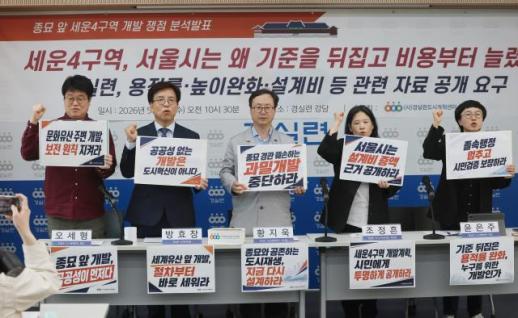 Civic Group Urges Seoul to Disclose Why It Raised Height Limits for Sewoon 4 Redevelopment The Citizens' Coalition for Economic Justice on Tuesday urged the Seoul city government to disclose how and why it changed height standards for the redevelopment of Sewoon District Zone 4, near Jongmyo Shrine in Jongno-gu. The group said it filed a freedom-of-information request seeking internal review materials, reports, alternative-plan reviews and approval documents that would show the basis for raising height limits along Jongno and the Cheonggyecheon stream in Zone 4. It also filed an information request with the Seoul Housing & Communities Corp., known as SH Corp., seeking the reasons for an increase in design fees and the basis for calculating the total design cost. According to documents including the "Sewoon 4 project implementation approval application" provided to the group by the office of Seoul Metropolitan Council member Lim Jong-guk, the redevelopment height was raised compared with the previously set building plan: along Jongno, from 54.3 meters to 98.7 meters; along Cheonggyecheon, from 71.8 meters to 144.9 meters. Citing a full redesign, the design fee was increased by 16.748 billion won, bringing the total to 52.083 billion won. The group said the project had been pursued under height-management principles meant to protect the historic and cultural landscape near Jongmyo. It said a recent draft change to the district's redevelopment promotion plan loosened that system, raising concerns that principles for protecting views, scenery and cultural heritage near the shrine could be weakened. It said the draft explains the height relaxation by citing measures such as securing open green space and providing more publicly accessible space than required, adding that the issue is not only how much taller buildings would be. The key question, it said, is what administrative judgments and procedures led to changes in long-standing management principles and whether preservation of the historic and cultural environment was sufficiently reviewed. The group also said the design-fee increase tied to the height change is a key indicator of the financial burden of the plan revision, suggesting the decision could lead to substantial additional costs. It called for separate review not only on heritage preservation and landscape management but also on cost efficiency and accountability in project execution. The group said the Seoul city government and SH Corp. should transparently explain to the public the grounds for the height relaxation, the process behind the plan change, the reasons for the design-fee increase, public contributions and measures to protect tenants. If they delay disclosure and avoid a responsible explanation, it said, suspicions of preferential treatment and public distrust will only grow. On March 25, the group said the Sewoon 4 case accepted the risk of damaging the landscape near a World Heritage site by raising the floor-area ratio, creating a structure that allowed about 551.6 billion won in additional development gains. It urged authorities to immediately halt administrative procedures related to the high-rise, high-density plan near Jongmyo and to fully disclose how the floor-area ratio and height limits were relaxed and how public contributions were calculated. A Seoul city document titled "Overview and progress by zone in the Sewoon District" shows that among the district's 34 zones, the floor-area ratio for 11 completed zones ranges from 660% to 940%, while seven zones under way were raised to 1,000% to 1,550%. An analysis of development gains from the floor-area ratio increase in Sewoon 4 put the figure at 551.57 billion won. * This article has been translated by AI. 2026-05-06 18:12:17
 -
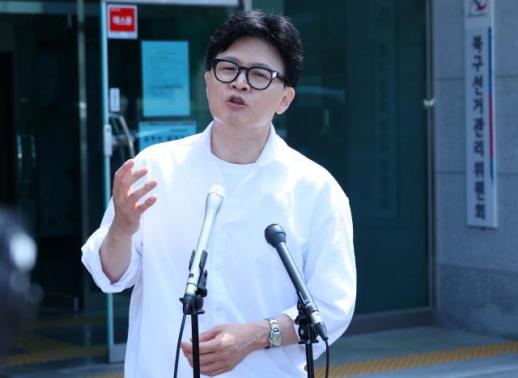 Special Prosecutor Bars Han Dong-hoon From Leaving South Korea in Probe of Alleged North Korea Remittance Case Manipulation A second comprehensive special prosecutor team led by Special Prosecutor Kwon Chang-young has barred Han Dong-hoon, former leader of the People Power Party, from leaving the country after he was accused in connection with allegations that an investigation into remittances to North Korea was manipulated. The team said on the 6th that it imposed a travel ban on Han. A special prosecutor official said the restriction followed the filing of a complaint naming Han as an accused party in a case alleging presidential office interference in a Suwon District Prosecutors Office investigation. According to the Justice Ministry’s Korea Immigration Service, Han has been under a travel ban from the 13th of last month through the 12th of this month due to the ongoing investigation. Han disclosed the travel ban on Facebook and said, “Last year, the Chae Sang-byeong special prosecutor imposed a travel ban on me for an absurd reason and then closed the case without even questioning me. This special prosecutor is repeating the same excessive move.” He added, “The Democratic Party couldn’t even call me as a witness for a parliamentary probe aimed at canceling Lee Jae-myung’s indictment, yet the party and political special prosecutors keep putting on a show. Again, I say, ‘Go ahead and try.’ But there must be no election interference.” Earlier, the civic group Judicial Justice Action filed a complaint with the special prosecutor team on the 7th of last month against seven people, including Han, former President Yoon Suk Yeol, former Prosecutor General Lee Won-seok, former Suwon District Prosecutors Office chief Hong Seung-wook, former second deputy chief prosecutor Kim Young-il, former Criminal Division 6 chief Kim Young-nam, and prosecutor Park Sang-yong. The group alleged abuse of authority and obstruction of rights, and inducing perjury, among other charges. The group said the complaint was based on claims that a “typical fabricated investigation aimed at eliminating a political rival” was carried out to tie Democratic Party leader Lee Jae-myung — described as a leading presidential contender who lost the 20th presidential election by 0.7 percentage points — to the case. The special prosecutor team received the Ssangbangwool remittances-to-North-Korea case from a human rights inspection task force at the Seoul High Prosecutors Office in early last month. It has since pursued the probe under the name “alleged presidential office interference in the Suwon District Prosecutors Office investigation.”* This article has been translated by AI. 2026-05-05 17:34:34
 -
 Korean court orders matchmaking client to pay marriage fee and penalty despite quitting A Seoul court has ruled that a matchmaking service member must pay a contracted marriage “success fee” even after quitting over alleged personal data exposure. The court also said the member owed a penalty for failing to notify the company of the marriage. According to legal officials on May 5, Judge Bang Chang-hyeon of the Seoul Central District Court, sitting alone in Civil Division 83, ordered B to pay matchmaking company A a success fee of 11.88 million won and a penalty of 35.64 million won, for a total of 47.52 million won, in a lawsuit seeking payment under the contract. B signed a membership contract on Sept. 14, 2022, to receive five introductions over one year and to pay 11.88 million won within two weeks once a marriage was confirmed. The contract also said the fee was due even if the marriage resulted from meetings after the contract period or after the five introductions, and that failure to report a marriage would trigger payment of three times the success fee. B met C, a member of an A affiliate, in January 2023 and married in June that year, but did not inform A. A then sued for the success fee and the penalty. B argued the contract had been mutually terminated by agreement in May 2023, but the court rejected the claim. The judge said it was acknowledged that B’s father protested what he said was disclosure of B’s personal information and, acting as B’s representative, expressed an intent to withdraw, and that A said it would process the withdrawal. However, the court said there was no evidence to treat that as a legal mutual termination of the contract. The court found B had made an ordinary “membership withdrawal,” but said that did not eliminate the duty to pay the success fee. It cited the one-year service period, the time it typically takes for a couple to marry after first meeting, and B’s agreement at signing to pay even if the marriage occurred after the contract period. On the penalty, the court treated the clause as a contractual punitive provision and said B owed it because the success fee was not paid. The judge said the success fee functioned as a deferred payment for services and that the company needed a way to indirectly enforce payment, especially because it would be difficult to learn of a member’s marriage without notification. The court also dismissed B’s claims that A unlawfully leaked personal information and that, contrary to the financial information provided at signup, A supplied false or exaggerated details about salary and assets, leading to serious conflict with C’s family during the formal meeting between families. The judge said there was no evidence to support those assertions. The court said it was recognized that in June 2019 B completed a personality test on A’s website and agreed to the collection and use of personal information, including arranging meetings with affiliate members. It added that A provided information about B’s salary and assets based on what B entered at signup. Even if B’s claims were true, the court said, A did not provide B’s information to unrelated parties or profit-seeking companies, but to C’s side, a potential marriage partner. The judge added that the marriage was not broken off due to the information provided and that because B and C ultimately married, B could not belatedly raise alleged data exposure or false or exaggerated information to resist A’s claims. * This article has been translated by AI. 2026-05-05 15:31:25
 -
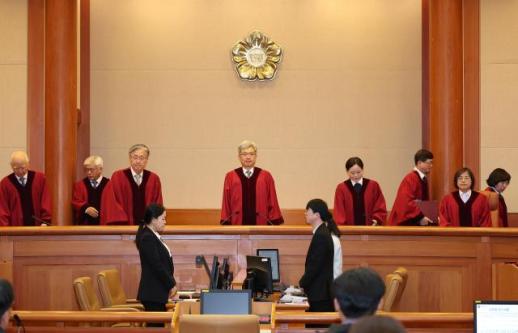 South Korea court upholds limits on Chinese characters in children’s registered names South Korea’s Constitutional Court has ruled that a provision limiting the Chinese characters that can be used when registering a child’s name at birth does not violate the Constitution. According to the legal community on Saturday, the court upheld the provision in Article 44(3) of the Family Relations Registration Act by a 5-4 vote, rejecting a constitutional complaint challenging the phrase “commonly used Chinese characters.” The petitioner, identified only as A, reported the birth of a daughter using the character “婡” (read as “rae,” meaning “pretty”) in the child’s name. But the official handling the filing recorded the name in the family register only in Hangul, saying the character was not included among “commonly used Chinese characters” under a Supreme Court rule issued pursuant to Article 44(3). A argued the provision infringed the right to choose a child’s name. Article 44(3) provides that a child’s name must be written in Hangul or in commonly used Chinese characters, and that the scope of such characters is set by Supreme Court rules. The court said there was no need to overturn its July 2016 precedent, which found a substantively similar provision constitutional and not in violation of the principle against excessive restrictions. The court said a child’s registered name is the basis for forming social relationships and should be recorded using characters that members of society can actually read and use. It also cited the vast number of Chinese characters and the unclear boundaries of their use, saying the range of “commonly used” characters must be defined in advance to register Chinese-character names in the computerized family-registration system. It noted that the Supreme Court has periodically expanded the list of Chinese characters permitted for personal names through rule revisions. Since the earlier precedent, the list has been revised three more times, increasing by more than 1,000 characters to 9,389, the court said. The court also said remedies exist, including registering newly added characters through a name-change process or a supplemental birth-registration procedure. Even if a noncommonly used character cannot be entered in official records, parents may still use their preferred character privately, it said, concluding the restriction on naming freedom is not severe. Justices Jeong Jeong-mi, Kim Bok-hyeong, Ma Eun-hyeok and Oh Young-jun dissented, saying the provision violates the principle against excessive restrictions and infringes the freedom to choose a child’s name. They said the abstract possibility that the list may be revised in the future does not resolve the current infringement, and that ordinary people cannot reasonably predict which characters will be deemed “commonly used” and selected for the approved list. A court official said the 5-4 decision was based on the view that the trend toward expanding the approved list and changes in the share of Chinese-character use do not weaken the need for limits, and that use of nonapproved characters remains allowed in the private sphere. * This article has been translated by AI. 2026-05-03 16:42:15
 -
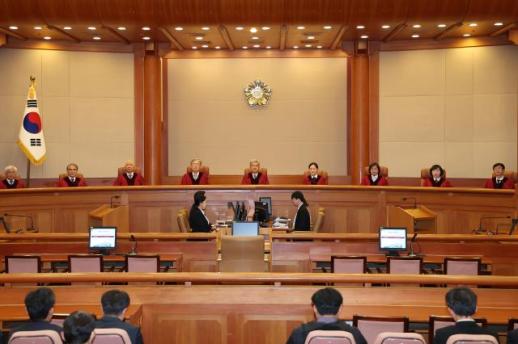 South Korea court rules mandatory patent attorney bar membership unconstitutional A provision requiring all patent attorneys to join the Korean Patent Attorneys Association violates the Constitution, South Korea’s Constitutional Court ruled Tuesday. In a constitutional complaint challenging Article 11 of the Patent Attorney Act, the court issued a ruling of “constitutional nonconformity” by a vote of 4-3-2, with four justices supporting nonconformity, three finding the provision unconstitutional and two upholding it. A ruling of constitutional nonconformity recognizes unconstitutionality but keeps the law temporarily in force to avoid disruption. The court ordered the provision to remain applicable until the National Assembly revises it, setting a deadline of Oct. 31, 2027. Six patent attorneys, including a person identified as A, were disciplined with reprimands in November 2018 by the head of the Korean Intellectual Property Office, cited for not joining the association. They sued to overturn the discipline and sought a court referral for constitutional review of the part of Article 11 covering “patent attorneys registered under Article 5(1),” but the request was denied. They then filed the constitutional complaint in January 2020. Article 5(1) requires a person qualified as a patent attorney to register with the head of the intellectual property office before starting practice. Article 11 requires those registered under Article 5(1) to join the association. The association has argued that allowing lawyers to automatically obtain patent attorney qualifications undermines professionalism and has pushed legislation to abolish the system, but it has not succeeded due to opposition from the Korean Bar Association. Conflict between the professions has continued, including the creation of a separate Korean Patent Lawyers Association by lawyer-patent attorneys who did not want to join. Justices Kim Sang-hwan, Kim Hyeong-du, Jeong Hyeong-sik and Oh Yeong-jun said the provision violates the principle against excessive restrictions and “infringes the freedom of association and occupational freedom of lawyer-patent attorneys.” They said disputes between patent attorneys and lawyers have also produced internal conflict within the association between nonlawyer patent attorneys and lawyer-patent attorneys, with the association acting to represent the interests of nonlawyer patent attorneys. In that context, they said, forcing lawyer-patent attorneys to join “excessively restricts” their freedoms. They added that striking the provision down immediately would remove the legal basis for mandatory membership and could make it difficult for the association to continue operating, explaining the decision to issue a nonconformity ruling. Justices Kim Bok-hyeong, Cho Han-chang and Ma Eun-hyeok said the legislative purpose — strengthening public-interest work through a single association and promoting development of the industrial property rights system and related industries — is significant. But they said the private harm is greater because patent attorneys have no choice but to join one association. Justices Jeong Jeong-mi and Jeong Gye-seon dissented, saying the disadvantages to patent attorneys are not greater than the public interest in improving patent attorneys’ competence and ethics and ultimately promoting development of the industrial property rights system and related industries. * This article has been translated by AI. 2026-04-29 18:19:34