
Journalist

Shin Ji-a
fromjia@ajunews.com
-
 Doosan Bobcat Q1 2026 Operating Profit Rises 3.5% to 207 Billion Won Doosan Bobcat said in a regulatory filing on the 28th that it posted first-quarter 2026 revenue of 2.2473 trillion won and operating profit of 207 billion won. Revenue rose 7.1% from a year earlier and operating profit increased 3.5%. Net profit climbed 15.9% to 131.4 billion won, helped by lower financial costs. In dollar terms, revenue and operating profit increased 6.2% and 2.6%, respectively, maintaining an overall growth trend. By region, Europe, the Middle East and Africa grew 18% on a recovery in demand for compact equipment, leading results. North America rose 3% as forklift sales rebounded. Asia, Latin America and Oceania increased 4% on higher sales in South America, China and India. By product, compact equipment revenue rose 7%, and industrial vehicles grew 4% on expanded sales in North America. Portable power revenue fell 18% due to delays in a key customer’s sales schedule. Doosan Bobcat said it is maintaining an annual minimum dividend of 1,600 won per share and a quarterly dividend policy under its corporate value enhancement plan. Its board on the 28th set the first-quarter dividend at 400 won per share.* This article has been translated by AI. 2026-04-28 16:54:18
 -
 Hanwha Solutions posts 92.6 billion won Q1 operating profit, up 205.5% on year Hanwha Solutions said it improved results despite growing external uncertainty, posting profits across all business units. The company said Monday it posted a consolidated operating profit of 92.6 billion won ($?) for the first quarter of 2026, up 205.5% from a year earlier. It marked a return to profitability after three quarters, following the second quarter of 2025. Revenue rose 25.4% to 3.882 trillion won. By division, the renewable energy business posted revenue of 2.1109 trillion won and operating profit of 62.2 billion won. Even in the seasonally slow first quarter, revenue rose 32.0% from a year earlier, topping 2 trillion won. The company said last year’s U.S.-bound cell customs-clearance delays were fully resolved late in the year, normalizing operations at its U.S. plant and accelerating EPC project work, which lifted module sales volumes. It also cited higher module selling prices as regulations tightened on shipments routed through Southeast Asia. The chemicals business reported revenue of 1.3401 trillion won and operating profit of 34.1 billion won. Revenue increased 24.8% from a year earlier, and the unit returned to the black for the first time in about 2 1/2 years, since the third quarter of 2023. The company said external factors, including supply-and-demand shifts and price increases tied to issues in the Middle East, played a role, but structural improvements drove the turnaround. It cited exiting unprofitable businesses, streamlining production lines, ongoing efficiency gains and a profitability-focused strategy. It said its overseas PVC business and W&C business also contributed through lower power costs and a higher share of high-margin products. The advanced materials business posted revenue of 285.6 billion won and operating profit of 12.2 billion won. Revenue rose 4.3% from a year earlier and operating profit turned positive. The company said its solar materials business benefited from improved cost structure and expanded U.S. sales, while its lightweight composite materials business saw revenue and profitability improve on higher export volumes and a weaker won. Park Seung-deok, head of Hanwha Solutions’ Qcells division, and Nam Jeong-woon, head of its chemicals division, said they expect results to improve steadily through year-end. They said profitability in renewable energy is expected to strengthen as the Cartersville plant’s cell line begins mass production in the third quarter. They added that the chemicals business will seek to secure key raw materials in advance despite concerns about global oversupply and will continue structural reforms to sustain profitability.* This article has been translated by AI. 2026-04-28 14:31:38
 -
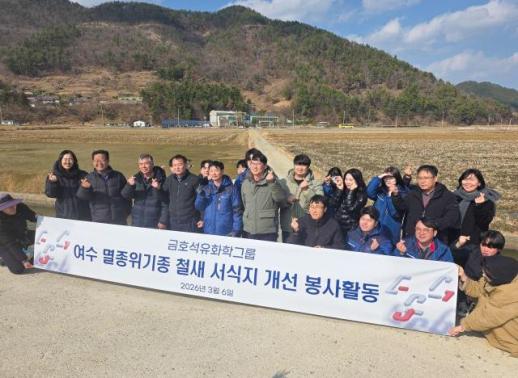 Kumho Petrochemical to Restore Migratory Bird Habitat in Yeosu Wetland Project Kumho Petrochemical Group said it is launching a habitat restoration project in Yeosu, South Jeolla Province, aimed at protecting biodiversity and supporting climate response efforts. The group said April 28 it will begin a project to improve habitat for endangered migratory birds. Five affiliates will participate: Kumho Petrochemical, Kumho P&B Chemicals, Kumho Mitsui Chemicals, Kumho Polychem and Kumho T&L. Working with Thanks Carbon, the group will invest a total of 260 million won over the next three years to create wetlands by flooding farmland near the Gasari Eco Park. The area will expand in phases, from about 1,200 pyeong in the first year to 2,400 pyeong in the second and 3,400 pyeong in the third. The Yeosu area, near the Suncheon Bay wetland, has served as a key stopover and wintering site for migratory birds. The group said industrialization and development have reduced farmland and worsened habitat conditions. Its plan is to restore winter habitat by creating flooded rice paddies on farmland during the off-season. Flooded paddies can support a range of species and are also known for storing carbon in soil, the group said. It plans to monitor bird numbers and environmental changes using unmanned sensor cameras and to develop management strategies based on the data. Local farmers will take part as operators. The group said nearby farms are supplying feed such as rice seed and sweet potatoes once a week during winter. In March, Kumho Petrochemical employees joined on-site activities, it said. Baek Jong-hoon, CEO of Kumho Petrochemical, said, “Preserving Yeosu’s ecological value and protecting biodiversity is a responsibility for a company that has grown with the local community.” He added, “We will continue sincere efforts to deepen our ESG management.” Separately, the company said employees raised 210 plants of the Jeju native species ‘pachoil-yeop,’ a Class II endangered wild plant, for nine months and planted them near their natural habitat at the Kumho Jeju Resort. 2026-04-28 14:15:18
 -
 Korean Power-Equipment Makers Pause in Q1, but Backlogs Hit Records on AI Data Center Demand AI data centers are driving a surge in electricity demand, and South Korea’s power-equipment makers posted strong year-over-year growth in the first quarter even as results cooled from the prior quarter. Industry officials said April 27 that Hyosung Heavy Industries, LS Electric, HD Hyundai Electric and Iljin Electric generally expanded sharply from a year earlier but saw some quarter-on-quarter easing. They cited a base effect from record fourth-quarter results and the seasonal first-quarter slowdown. Hyosung Heavy Industries reported first-quarter operating profit of 152.3 billion won, up 48.8% from a year earlier but down from the previous quarter as some revenue recognition was delayed during the off-season. The company secured about 4 trillion won in new orders for the quarter, and sales of ultra-high-voltage transformers are rising quickly, led by North America. Hyosung Heavy Industries’ share price recently topped 3 million won, and it traded above 4 million won intraday that day. The company has maintained that it is not reviewing a stock split. LS Electric posted first-quarter operating profit of 126.6 billion won, up 45% from a year earlier and a quarterly record, though slightly below 129.7 billion won in the prior quarter. With distribution-equipment orders for Amazon Web Services data centers being reflected in results, demand is spreading beyond ultra-high-voltage transformers into distribution. The company is also diversifying products from AC-focused equipment to DC power equipment. HD Hyundai Electric, which was set to report earnings April 28, was expected to show a similar pattern. FnGuide estimated first-quarter operating profit at about 270 billion won, up from a year earlier but slightly down from the previous quarter, reflecting the seasonal slowdown and some delayed revenue recognition for North American projects. Iljin Electric was also expected to extend its growth streak. First-quarter operating profit was forecast at about 50.8 billion won, up 49.2% from a year earlier, supported by expansion at its second plant in Hongseong, a higher share of higher-priced transformers for North America, and revenue recognition from long-term order backlogs. The four companies have already secured at least three years of work, with backlogs at record levels. Hyosung Heavy Industries’ heavy-industry division had an order backlog of about 15 trillion won. LS Electric’s backlog stood at 5.6425 trillion won at the end of the first quarter, up 13% from the prior quarter. HD Hyundai Electric had about 9.4 trillion won, and Iljin Electric about 2.39 trillion won. “The quarter-on-quarter decline in sales largely reflects the seasonal first-quarter slowdown and the fact that recently won orders have not yet been recognized as revenue,” an industry official said. “The boom in power equipment is expected to continue for the next four to five years, and backlogs are sufficient.”* This article has been translated by AI. 2026-04-27 18:15:49
 -
 HD Construction Equipment Q1 2026 Operating Profit Jumps 88.3% to 190.7 Billion Won HD Construction Equipment said in a regulatory filing on the 27th that it posted first-quarter 2026 revenue of 2.3049 trillion won and operating profit of 190.7 billion won. Revenue rose 22.1% from a year earlier and operating profit climbed 88.3%. The company attributed the revenue gain to a broad recovery in global demand for construction equipment and faster growth in industrial and defense engine sales. Operating profit also increased sharply as profitability improved in the construction equipment business and the engine unit delivered steady earnings. The results come after HD Hyundai Construction Equipment and HD Hyundai Infracore launched an integrated company on Jan. 1, with the firm saying “one-team” synergies have begun to show as the market rebounds. HD Construction Equipment said its eight-region sales structure helped it respond quickly in the market with the Hyundai and Develon brands. It also cited companywide coordination across production, sales, purchasing and research and development to strengthen cost competitiveness. The company said integrated assembly and delivery centers in Europe and North America cut delivery times by 30% and reduced costs by 20%, while its China manufacturing base was consolidated from a dual Jiangsu-Yantai setup into Yantai to improve efficiency. By business, construction equipment revenue rose 26.9% to 1.9275 trillion won. Operating profit was 148.6 billion won, for an operating margin of 7.7%. The engine business posted revenue of 336.1 billion won, up 10% on higher industrial engine sales and steady growth in defense engine revenue. Operating profit increased 8% to 47.3 billion won, and the operating margin was 14.1%. An HD Construction Equipment official said the company will continue to expand construction equipment sales while diversifying profit sources, including engines and the aftermarket business.* This article has been translated by AI. 2026-04-27 16:17:15
 -
 Hanwha Ocean posts 441.1 billion won Q1 operating profit, up 78% from prior quarter Hanwha Ocean extended its earnings rebound on a high-margin business mix led by LNG carriers. The company said Sunday that on a consolidated basis it posted first-quarter 2026 revenue of 3.2099 trillion won and operating profit of 441.1 billion won. Revenue fell 3% from the previous quarter and 2% from a year earlier. Operating profit rose 78% from the prior quarter and 71% from a year earlier. Revenue edged down as fewer operating days weighed on output, but the commercial ship division drove growth on higher-priced projects and a larger share of LNG carriers. The naval ship division kept revenue steady, centered on submarine and surface-ship construction, while the energy plant division declined temporarily as projects ended. Profitability improved as the company maintained a high-margin LNG carrier mix and saw clearer gains in other ship types. It also cited benefits from a weaker won, cost cuts, productivity improvements and the impact of some early deliveries. In the first quarter, Hanwha Ocean booked orders totaling $2.45 billion, including four LNG carriers, seven very large crude carriers and one wind turbine installation vessel. A company official said profitability gains should continue as revenue recognition accelerates for high-priced commercial ship projects, adding that Hanwha Ocean will strengthen competitiveness based on its design and construction experience and systems integration capabilities.* This article has been translated by AI. 2026-04-27 14:51:15
 -
 HD Hyundai Heavy Signs Deal to Build Sweden’s Icebreaking Vessel, a First for a Korean Yard HD Hyundai Heavy Industries said Sunday it has held a contract-signing ceremony for an overseas icebreaking vessel order, marking the first such deal won by a South Korean shipyard and moving the project into full implementation. The company said it signed the shipbuilding contract with the Swedish Maritime Administration on Friday local time at the National Maritime Museum in Stockholm. CEO Joo Won-ho and Swedish Maritime Administration Director General Erik Eklund attended the event and discussed the significance of the agreement and ways to cooperate going forward, the company said. HD Hyundai Heavy previously disclosed it had secured an order for one icebreaking vessel worth $348.9 million (about 514.8 billion won). The ship is expected to be delivered in 2029 and will have icebreaking capability rated at Polar Class 4. The company said the contract is seen as a step into the global icebreaker market and a foundation for expanding into Arctic-route vessels such as LNG carriers and bulk carriers equipped with icebreaking functions.* This article has been translated by AI. 2026-04-27 10:21:19
 -
 HJ Shipbuilding Wins Order for Two 10,100-TEU Container Ships HJ Shipbuilding said Sunday it has won orders worth a combined 357.2 billion won for two 10,100-TEU container ships. The ships are based on the company’s in-house 7,700- to 9,000-TEU eco-friendly container ship design and were engineered to the largest specifications that can be built in the dock at its Yeongdo shipyard in Busan. The company said the high-efficiency design expands cargo space on deck and in the holds, while applying an optimized layout aimed at improving process efficiency and safety. HJ Shipbuilding previously won its first order for a container ship of 10,000 TEU or more at the Yeongdo shipyard in February. With the latest deal, it has secured four ships of the same design. The company said building identical ships in sequence is expected to boost efficiency across design, procurement and production, improving productivity and profitability. It added that shipowners can also benefit from more efficient operations and maintenance. To meet International Maritime Organization environmental rules, the ships will be built with exhaust gas cleaning systems, known as scrubbers, and an alternative maritime power system for shore power supply. HJ Shipbuilding said it has also completed development of an LNG dual-fuel propulsion model based on the same design to meet future demand for cleaner fuels. Chief Executive Yoo Sang-cheol said the company has laid the groundwork to build four large container ships of 10,000 TEU or more in succession at the Yeongdo shipyard. He said it will strengthen competitiveness through selective, profitability-focused orders and high-quality, on-time delivery.* This article has been translated by AI. 2026-04-27 10:15:05
 -
 Chey Tae-won to Present South Korea’s AI Growth Strategy at National Assembly Seminar Chey Tae-won, chairman of the Korea Chamber of Commerce and Industry, will visit the National Assembly to lay out a national growth strategy for the AI era. The Korea Chamber of Commerce and Industry said Monday that the National Assembly Korea-China Parliamentary Union will hold its first policy seminar of 2026 at 8 a.m. Tuesday in the first small conference room of the National Assembly Members’ Office Building. The seminar will be held under the theme, “South Korea’s growth strategy amid the U.S.-China AI technology rivalry.” Chey is scheduled to deliver a special lecture offering a global business perspective on how the South Korean economy should respond. The event is set to begin with opening remarks by Kim Tae-nyeon and a commemorative photo session, followed by Chey’s lecture and a question-and-answer session with attending lawmakers. Organizers said about 40 lawmakers from both the ruling and opposition parties are expected to attend, including Kim Seong-won, senior vice chairman, and Reps. Lee Jae-jung, Min Byeong-deok, Jeong Il-young, Lim O-kyeong, Heo Seong-moo, Cho Bae-sook, Na Kyung-won, Shin Seong-beom and Cha Gyu-geun. Rep. Kim has led policy agendas focused on strengthening national industrial competitiveness and securing future growth engines, and has continued related discussions through an economic policy study group within the Assembly. Organizers said the seminar was arranged as part of that effort to flesh out a national strategy centered on AI and semiconductors. The Korea-China Parliamentary Union is a bipartisan parliamentary diplomacy platform with 145 lawmakers from both parties, and it continues policy discussions across areas including the economy, diplomacy and advanced industries.* This article has been translated by AI. 2026-04-27 10:13:36
 -
 South Korea Steelmakers Hold Up in Q1 as Hyundai Steel Returns to Profit Hyundai Steel returned to profit this year, but the rebound was limited by higher raw-material costs and currency headwinds. Dongkuk Steel Group improved profitability on stronger exports. In a regulatory filing Thursday, Hyundai Steel said first-quarter consolidated revenue rose to 5.7397 trillion won ($5.7397 trillion won) and operating profit totaled 15.7 billion won. It swung from an operating loss of 19.0 billion won a year earlier. Operating profit, however, fell 63.7% from the previous quarter, missing market expectations. The company cited higher coking coal prices and a heavier exchange-rate burden, while product prices faced downward pressure. In a conference call, Hyundai Steel said price normalization is under way as low-priced imports are pushed out and steelmakers reflect higher costs in prices. It said construction demand is unlikely to improve much in the first half, but demand should be maintained at a certain level through large projects by Samsung Electronics and SK hynix. Hyundai Steel said the impact from the war in the Middle East is limited. It said annual export volume to the region is about 140,000 tons, accounting for less than 1% of total sales. While higher oil prices weigh on profitability, it said it is working to defend margins, including shifting long-distance logistics to shorter routes to cut shipping costs. The company said rebuilding demand would emerge from six months after the war ends, adding it would respond jointly with South Korean construction firms if such demand materializes. Dongkuk Steel said in a preliminary earnings release that first-quarter revenue was 857.2 billion won and operating profit was 21.4 billion won, up 403.8% from a year earlier. After posting operating profit of 59.4 billion won last year amid weak steel demand, the company said it has shown a recovery trend starting in the first quarter. Dongkuk Steel said the improvement reflected its strategy to expand global exports. It said higher export volumes led to increased production and sales of long steel products, and it plans to adjust the share of export sales flexibly in response to changes in domestic demand this year. Dongkuk CM, an affiliate of Dongkuk Steel Group, also improved results on higher selling prices and cost controls, returning to profit from the previous quarter. First-quarter operating profit was 11.2 billion won, down 25.9% from a year earlier, but it reversed an operating loss of 3.8 billion won in the prior quarter. External conditions for the steel industry remain challenging, including a slowdown in construction. Still, the industry is watching for higher import prices as the government tightens anti-dumping investigations and for a possible demand pickup as the seasonal peak approaches. With structural oversupply and a delayed demand recovery, the pace of improvement is expected to be gradual. An industry official said some of the rise in raw-material costs has been reflected in selling prices, supporting results, but energy costs and uncertainty in downstream demand remain high. The official said it will take time for a full-fledged improvement in profitability.* This article has been translated by AI. 2026-04-24 16:22:09