

Journalist

Kim Hanho
hanho21@ajunews.com
-
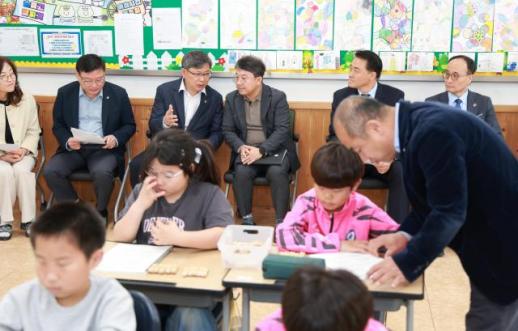 Acting Jeonbuk Education Superintendent Visits Basic Skills Lead School in Namwon Yoo Jeong-gi, acting superintendent of education for Jeonbuk Special Self-Governing Province, visited Namwon Elementary School on the 21st to review how the province’s “basic skills lead school” program is being carried out in classrooms. The Jeonbuk Office of Education said it expanded the number of basic skills lead schools to 369 this year — about half of all schools — from 99 last year, aiming to prevent learning gaps early and reduce disparities in education. Namwon Elementary, now in its fourth year as a lead school, has built a classroom culture designed to keep all students engaged through a “one classroom, two teachers” model in which a specialist teacher and the homeroom teacher co-teach lessons. The school reported that after three years of operating as a lead school, achievement among students needing learning support improved significantly, including in math. After observing a third-grade co-taught class, Yoo held a meeting with Principal Ahn Jung-man and teachers to hear requests from the field, including the stable placement of specialist teachers and support for running lead schools. “The Namwon Elementary co-teaching model is an excellent example of how classroom-centered accountability in education can be put into practice at schools,” Yoo said. He added that the office would provide administrative and financial support so no student is left behind in learning, including expanding lead schools to 60% of all schools next year. Senior officials hold integrity policy forum, focus on upgrading Jeonbuk-style model The Jeonbuk Special Self-Governing Province Office of Education held a “senior officials integrity policy forum” on the 20th at its headquarters, with Yoo and about 50 executives attending, including heads of education support offices from 14 cities and counties. The office said the forum was held to seek strategies to improve integrity by analyzing areas vulnerable to corruption, based on results from an integrity-level assessment conducted in February. Participants discussed ways to ensure fairness on issues that can hurt public trust, including illegal donations tied to school sports teams and suspected collusion in construction and contracting. They also discussed factors that can undermine internal confidence, such as unfair personnel decisions, authoritarian abuse of power, and distrust in reporting systems. The forum presented action steps to raise integrity, including establishing an everyday culture of integrity, building cooperative networks by corruption-vulnerable area, and expanding a joint integrity governance framework involving the public and private sectors and labor. The office said senior officials’ leadership by example and building a field-centered system for implementation were emphasized as key tasks. It said it plans to use the forum as a starting point to further develop a Jeonbuk-style integrity model for clean education administration.* This article has been translated by AI. 2026-04-21 16:22:19
 -
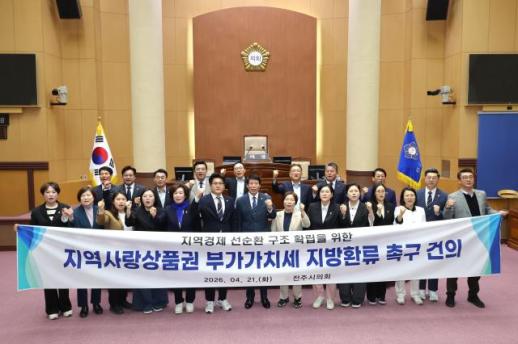 Jeonju City Council urges VAT revenue from local gift certificates be returned to municipalities Jeonju City Council in North Jeolla Province urged the government to return to local governments a portion of the value-added tax generated by the issuance and use of local gift certificates, saying it would strengthen the financial independence of municipalities. The council adopted a resolution at the second plenary session of its 429th extraordinary meeting on the 21st. The measure, proposed by council member Kim Se-hyeok (proportional representative), called for a system to return VAT tied to local gift certificates to the municipalities where the spending occurs. Kim said local gift certificates have become “a key tool” for boosting small merchants’ sales and supporting local economies, but that “structural imbalances and fairness issues between regions” have been raised. He said local governments shoulder significant costs, including subsidies for discounted sales and operating expenses, while VAT generated by certificate use “is fully allocated as a national tax.” He also said the way financial support is distributed — based on issuance volume and population — creates equity problems by favoring some municipalities with higher fiscal capacity. In the resolution, the council called for: △a制度 to return a set share of VAT generated by local gift certificate use to the relevant municipality; △reasonable, fair return standards that reflect local fiscal conditions; and △comprehensive policies to expand fiscal decentralization. Call to streamline procedures for installing traffic safety facilities The council also said it adopted a separate resolution at the same session, proposed by council member Kim Dong-heon (Samcheon 1·2·3, Hyoja 1-dong), seeking improvements to procedures for installing traffic safety facilities and related equipment. Kim said current law requires local governments to obtain a review each time from a police station’s traffic safety deliberation committee before installing such facilities. He said even simple, low-impact installations requested through public complaints are delayed by review schedules, and that largely paperwork-based procedures do not adequately reflect conditions on the ground. He said cutting unnecessary administrative steps and shifting to a practical, field-centered system is urgent to resolve complaints faster and improve the efficiency of budget execution. Key proposals include: △revising relevant laws and enforcement rules to simplify reviews, ease bottlenecks and expand local autonomy; and △creating a fast-track system for areas requiring rapid safety measures. The council said the adopted resolutions will be sent to the Cheong Wa Dae, the Prime Minister’s Office, the Ministry of the Interior and Safety, the National Police Agency, and the National Assembly’s Public Administration and Security Committee.* This article has been translated by AI. 2026-04-21 15:12:48
 -
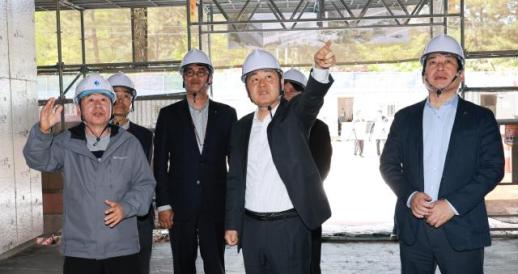 Jeonbuk Gov. Kim Kwan-young inspects Jeongeup biotech sites, children's 'Miracle Playground' Kim Kwan-young, governor of Jeonbuk Special Self-Governing Province, visited Jeongeup on the 21st to inspect advanced bio industry sites and a children’s play facility known as the “Miracle Playground,” the province said. The trip was aimed at reviewing on-the-ground preparations for workforce training and technology commercialization support in advanced bio, a sector where Jeonbuk says it has a competitive edge, and at checking local living conditions for children. Kim first toured the Pharmaceutical Industry Future Workforce Training Center at the Jeongeup Advanced Science Industrial Complex. He received a briefing on construction and future operations and then checked the site. The project, running through 2026, is designed to build a demand-tailored training base for key pharmaceutical manufacturing specialists. Education and hands-on training facilities equipped with GMP-grade process equipment are being built. The center aims to train about 1,200 people a year, including students, job seekers and workers. “The core of competitiveness in the pharmaceutical and bio industries ultimately comes down to people,” Kim said, calling for thorough preparations for operations and stronger training programs to produce job-ready talent. Kim then visited the Jeonbuk Advanced Bio Research Division of the Korea Institute of Toxicology to hear an update on the “Jeonbuk Advanced Bio Boost-Up Platform Construction Project.” He also held a meeting with heads of government-funded research institutes, including the Korea Institute of Toxicology, the Jeonbuk branch of the Korea Research Institute of Bioscience and Biotechnology, and the Advanced Radiation Technology Institute of the Korea Atomic Energy Research Institute. The boost-up platform project, set for 2025-2027, focuses on technology commercialization using foundational technologies, integrated nonclinical testing support, stage-by-stage support for advanced bio companies, and assistance with investment attraction and global expansion. Multiple government-funded institutes are participating, the province said. Kim later inspected the Miracle Playground built in the Naejangsan cultural tourism area, reviewing operations and safety management. The playground was designed to reflect children’s needs by age and includes seven themed areas: an infant zone, a spiderweb zone, a maple tree zone, a sand zone, an ecological pond zone, an alleyway zone and a forest play zone. The facility is intended to let children enjoy creative play and hands-on activities in a nature-friendly setting, the province said. “It is very meaningful that a space where children can safely run and build creativity has taken root in the community,” Kim said, pledging continued provincial attention to child-friendly environments and related policies. Namwon and Gimje selected for social solidarity economy innovation model program Jeonbuk Special Self-Governing Province said on the 21st that Namwon and Gimje were selected in a Ministry of the Interior and Safety competition for the “2026 Social Solidarity Economy Innovation Model Discovery and Expansion Project,” securing a total budget of 20 billion won, including 10 billion won in national funding. The ministry is launching the program this year with 8.5 billion won to encourage social solidarity economy organizations to work with local companies and groups to address community problems and build a sustainable economic ecosystem, the province said. Namwon was chosen in the “local circular economy” category for its “Wolmae Stay” project, while Gimje was selected in the “regional revitalization leading” category for its “Jjaemmaero Dadaitseon” project, the province said. Namwon’s Wolmae Stay will use idle space to build a Namwon-style complex hub for longer stays and self-reliance. The city plans to run programs for retirees from the Seoul metropolitan area to attract a “living population,” while involving vulnerable groups, including young people preparing for independent living, as facility staff to support both housing and self-reliance. Gimje’s Jjaemmaero Dadaitseon aims to link an old downtown commercial district with surrounding rural areas through a shared-growth, circular model. Centered on an area where traditional markets and historical and cultural sites coexist, the city plans to operate a night market, cultural and arts programs, and pop-up events in vacant stores to build a self-sustaining local ecosystem where young sellers and local merchants can grow together. Support may continue for up to three years, depending on annual evaluations, the province said. It expects the program to help counter population decline risks and boost the local economy.* This article has been translated by AI. 2026-04-21 11:39:14