

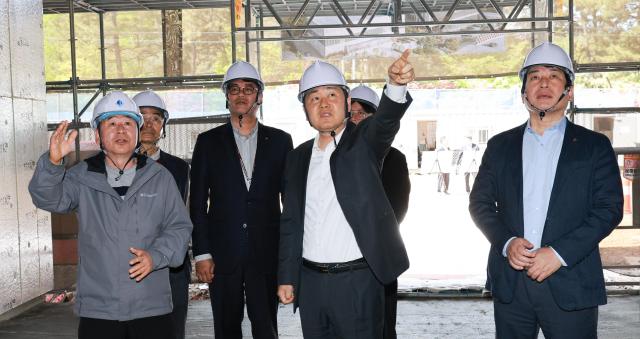
The trip was aimed at reviewing on-the-ground preparations for workforce training and technology commercialization support in advanced bio, a sector where Jeonbuk says it has a competitive edge, and at checking local living conditions for children.
Kim first toured the Pharmaceutical Industry Future Workforce Training Center at the Jeongeup Advanced Science Industrial Complex. He received a briefing on construction and future operations and then checked the site.
The project, running through 2026, is designed to build a demand-tailored training base for key pharmaceutical manufacturing specialists. Education and hands-on training facilities equipped with GMP-grade process equipment are being built. The center aims to train about 1,200 people a year, including students, job seekers and workers.
“The core of competitiveness in the pharmaceutical and bio industries ultimately comes down to people,” Kim said, calling for thorough preparations for operations and stronger training programs to produce job-ready talent.
Kim then visited the Jeonbuk Advanced Bio Research Division of the Korea Institute of Toxicology to hear an update on the “Jeonbuk Advanced Bio Boost-Up Platform Construction Project.” He also held a meeting with heads of government-funded research institutes, including the Korea Institute of Toxicology, the Jeonbuk branch of the Korea Research Institute of Bioscience and Biotechnology, and the Advanced Radiation Technology Institute of the Korea Atomic Energy Research Institute.
The boost-up platform project, set for 2025-2027, focuses on technology commercialization using foundational technologies, integrated nonclinical testing support, stage-by-stage support for advanced bio companies, and assistance with investment attraction and global expansion. Multiple government-funded institutes are participating, the province said.
Kim later inspected the Miracle Playground built in the Naejangsan cultural tourism area, reviewing operations and safety management.
The playground was designed to reflect children’s needs by age and includes seven themed areas: an infant zone, a spiderweb zone, a maple tree zone, a sand zone, an ecological pond zone, an alleyway zone and a forest play zone. The facility is intended to let children enjoy creative play and hands-on activities in a nature-friendly setting, the province said.
“It is very meaningful that a space where children can safely run and build creativity has taken root in the community,” Kim said, pledging continued provincial attention to child-friendly environments and related policies.
Namwon and Gimje selected for social solidarity economy innovation model program
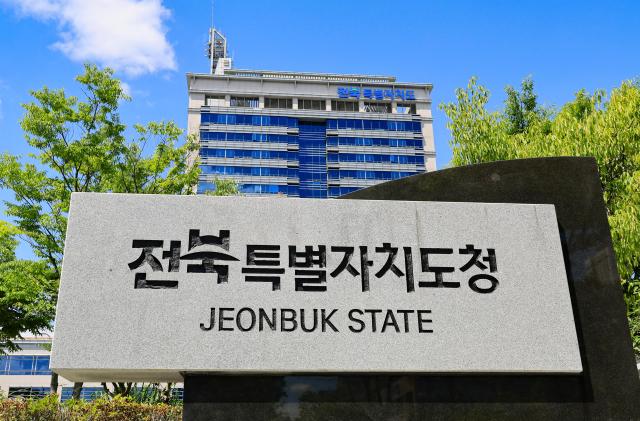
The ministry is launching the program this year with 8.5 billion won to encourage social solidarity economy organizations to work with local companies and groups to address community problems and build a sustainable economic ecosystem, the province said.
Namwon was chosen in the “local circular economy” category for its “Wolmae Stay” project, while Gimje was selected in the “regional revitalization leading” category for its “Jjaemmaero Dadaitseon” project, the province said.
Namwon’s Wolmae Stay will use idle space to build a Namwon-style complex hub for longer stays and self-reliance. The city plans to run programs for retirees from the Seoul metropolitan area to attract a “living population,” while involving vulnerable groups, including young people preparing for independent living, as facility staff to support both housing and self-reliance.
Gimje’s Jjaemmaero Dadaitseon aims to link an old downtown commercial district with surrounding rural areas through a shared-growth, circular model. Centered on an area where traditional markets and historical and cultural sites coexist, the city plans to operate a night market, cultural and arts programs, and pop-up events in vacant stores to build a self-sustaining local ecosystem where young sellers and local merchants can grow together.
Support may continue for up to three years, depending on annual evaluations, the province said. It expects the program to help counter population decline risks and boost the local economy.
* This article has been translated by AI.
Copyright ⓒ Aju Press All rights reserved.