

SEOUL, April 21 (AJP) - Artificial intelligence generated nearly 29 percent of new Python scripts in the United States by early 2025. That metric triggered a silent panic across enterprise software sectors, marking the onset of what industry insiders call the SaaS (software-as-a-service)-pocalypse. Software is no longer just a functional tool waiting for a human click. Machine intelligence is actively moving to absorb complete cognitive workflows, seizing the power of judgment from human operators and fundamentally transferring authority.
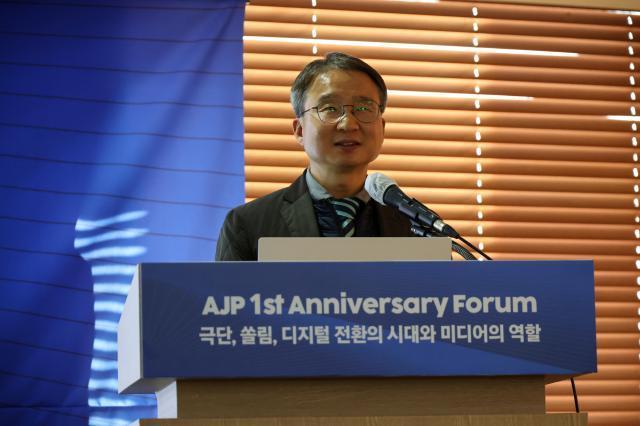
Park Han-woo, a media and digital business professor at Yeungnam University in South Korea, argues that the global economy is entirely unprepared for this structural disruption. In his latest book, "Digital Assets and Trust Operating Systems in the Era of AI," published on Tuesday, the author outlines how generative algorithms are evolving from passive assistants into autonomous agents capable of making financial and governance decisions on behalf of humans.
"Judgment is power," the professor told AJP, noting that delegating these decisions to AI poses severe risks if left unchecked by robust institutional frameworks.
"AI can create information, but it cannot take responsibility," the academic added. "The usefulness of a tool is determined by humans. To a thief, a knife can be a weapon to threaten people, but to a chef, a knife is necessary equipment to make delicious food. Delegate, but verify. AI is fast. But it can be wrong."
Data as a mirror of social fracture
The delegation of authority to machines frequently exposes deep-seated societal flaws. In his book, he highlighted a specific incident where an image-generating algorithm was prompted to draw a street sock seller and a corporate stockbroker. The resulting image depicted the sock vendor as an overweight Black man and the stockbroker as a well-groomed, physically fit White man holding an elegant bag.
Algorithms learn from historical data sets inherently laced with human prejudice. An unchecked AI will inevitably reproduce and amplify past inequalities, ultimately reinforcing social disparities rather than eliminating them.
"AI is a mirror. It reflects us," the author said.
To prevent these biases from manifesting into automated discriminatory actions, the scholar insists that human intervention remains mandatory. He proposes a multi-layered approach: refining data to correct prejudice before training, enforcing transparent judgment processes that explain how a conclusion was reached, and demanding human oversight for critical decisions.
"Content is overflowing, and trust is lacking," he noted, referring to the infinite generation of long-tail media. "Content verification comes from structure."
The algorithmic challenge to sovereignty
To formalize this oversight structure, the Yeungnam University academic advocates for the implementation of an AI-enhanced Decentralized Autonomous Organization, or AIDAO. This theoretical model combines the flexible, probabilistic reasoning of AI with the immutable, cryptographic execution of blockchain technology.
"To explain AIDAO in one sentence: An organization operated together by AI and humans, or a decentralized autonomous organization where AI can be the CEO," the professor said.
In an AIDAO, an agent might propose a strategy, such as shifting 20 percent of a portfolio during volatile market conditions. That proposal is not executed instantly. Instead, it must pass through smart contracts, specifically Ethereum protocols like ERC-8004 for identity verification and ERC-8001 for execution consensus, and require human approval.
"The reason this is important is because it separates judgment, execution, and responsibility," the scholar said.
Washington and other Western powers are already grappling with the implications of algorithmic governance. Seoul must also pivot toward shared global architectures rather than relying on isolated corporate platforms. The ultimate safeguard against the SaaS-pocalypse is a Trust Operating System that demands verifiable proof over blind faith.
"AI calculates based on rules," he said, emphasizing, "AI generates based on probabilities. AI infers based on data. But humans are incomplete beings accompanied by mistakes. An AI with errors is discarded. However, even if imperfect, humans are chosen. Because humans are noble beings in and of themselves."
While algorithms excel at optimizing workflows, the author maintains that humanity will retain its monopoly on meaning and purpose. "AI is good at 'how,' but it cannot do 'why,'" the academic said. "AI gives answers. But humans ask questions."
That philosophical boundary forms the foundation of his proposed trust operating system. As algorithms steadily absorb the functional tasks of daily commerce and governance, the defining challenge of the AI era is no longer technological capability, but the architectural design of trust. The authority to build that architecture, the scholar argues, must remain firmly in human hands.
While theoretical frameworks like AIDAO are still being debated in academic and financial circles, initial regulatory steps are already materializing. The South Korean government mandated the use of watermarks on AI-generated content starting in January this year.
Copyright ⓒ Aju Press All rights reserved.
