

Journalist

Han Ji-hyun
hanji@ajunews.com
-
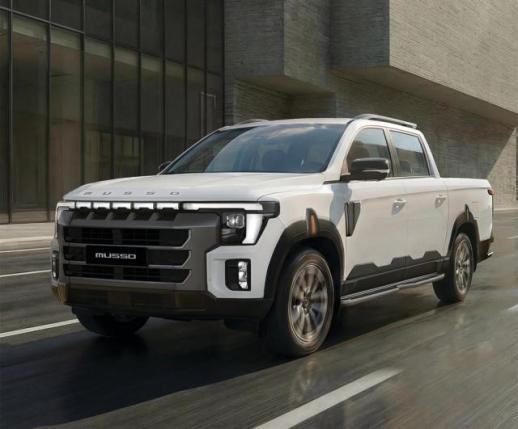 KGM April Sales Rise 6.5% on Strong Exports, Led by Musso KG Mobility, or KGM, said Monday its April sales totaled 9,512 vehicles, up 6.5% from a year earlier, as exports climbed. Domestic sales fell 4.6% to 3,382 vehicles, while exports rose 13.8% to 6,130. KGM said Musso export sales increased, pushing monthly exports above 6,000 for the first time in four months since December, when exports reached 7,000 vehicles. Cumulative sales through April rose 4.7% from the same period a year earlier. By model, the Musso, which began its global market launch last month, sold 1,336 vehicles, and the Torres EVX sold 1,830, helping drive the increase. KGM said it is stepping up efforts to expand volumes by building on export momentum and strengthening its response in the domestic market. On April 28 and 29, KGM invited overseas dealers and reporters from 31 countries to Turkiye, its largest export market, for the Musso global launch and test-drive events. In Germany, it held a launch and test-drive event for the Actyon Hybrid in early April. In March, KGM Chairman Kwak Jae-sun met with its Vietnam KD partner, Kim Long Motors, to inspect production sites and discuss detailed cooperation plans. In South Korea, KGM said it is conducting marketing activities to strengthen brand communication and expand customer engagement, including hosting “KGM Tuning Festival Season 2” and serving as an official sponsor of the “2026 UCI MTB World Series.” A KGM official said exports are recovering and that April sales rose 6.5% from a year earlier, with cumulative sales up 4.7%. The official said the Musso has been well received in South Korea and at last month’s global launch events, and KGM plans to expand rollouts by country and deepen cooperation with local dealers to further increase sales.* This article has been translated by AI. 2026-05-04 15:51:17
 -
 Hyundai, Kia U.S. April Sales Dip on Tariff-Driven Early Buying; Hybrids Hit Record Hyundai Motor and Kia reported slightly lower U.S. sales in April, which the companies attributed to earlier buying tied to tariff concerns. Even as overall volume slipped, hybrid-electric vehicle (HEV) sales rose to a record on strong demand for fuel-efficient models amid high oil prices. Hyundai Motor and Kia said their combined U.S. sales in April totaled 159,216 vehicles, down 2.1% from a year earlier. Hyundai sold 86,513 vehicles, down 1.5%, while Kia sold 72,703, down 2.8%. Premium brand Genesis posted 6,356 sales, up 0.8%. HEV sales climbed to an all-time high of 41,239 vehicles despite the overall decline. A Hyundai Motor and Kia official said sales eased because purchases had been pulled forward after last year's debate over U.S. auto tariffs. The official said the companies still outperformed the broader U.S. market on the strength of HEVs, sedans and electric vehicles (EVs). At Hyundai, Sonata HEV sales jumped 170% to 4,520, and Elantra HEV sales rose 55.3% to 2,399. Kia continued to see strength in SUVs led by the redesigned Telluride and in HEV models. Telluride sales totaled 12,557, and Seltos sales rose 31.7% to 5,335. Sportage HEV sales increased 65.2% to 7,446, and EV9 sales surged 481.5% to 1,349. At Genesis, GV70 sales rose 7.7% to 2,837 and G70 sales increased 23.4% to 991, helping lift the brand's overall results. With uncertainty persisting, including the war in the Middle East, Hyundai Motor and Kia said demand for eco-friendly vehicles increased. Their combined eco-friendly vehicle sales in April rose 47.6% from a year earlier to 48,425, accounting for 30.3% of total sales. HEV sales rose 57.8% to 41,239, with Hyundai up 47.7% to 21,713 and Kia up 70% to 19,526. EV sales totaled 7,186, up 7.7%. Hyundai's EV sales fell 8.4% to 4,779, while Kia's rose 65% to 2,407. Global automakers also posted declines in April amid broader uncertainty. Toyota Group sales fell 4.6% to 222,378, while Subaru (-5.9%), Mazda (-17.3%) and Honda (-0.2%) also reported lower sales.* This article has been translated by AI. 2026-05-04 10:48:24
 -
 Korea’s Imported Car Market Splits Between Ultra-Luxury and Budget Models Korea’s imported-car market is increasingly splitting between ultra-expensive models and bargain-priced vehicles, with fewer buyers in the middle. The same pattern is emerging in the fast-growing electric-vehicle segment, where attention is focused on high-performance EVs priced above 100 million won and entry-level models using LFP batteries that maximize government subsidies. According to the Korea Automobile Importers & Distributors Association on May 3, sales of imported cars priced at 100 million won or more totaled 17,375 in the first quarter, up 13.3% from 15,795 a year earlier. By price band, vehicles priced from 100 million won to under 150 million won jumped 22.7% to 9,258. Sales of models priced at 150 million won or more edged down 1.2% to 8,088 from 8,184. Among imported cars priced above 100 million won, BMW led with 6,540 vehicles sold, followed by Mercedes-Benz with 4,687 and Porsche with 2,105. Among brands classified as “luxury cars,” Bentley sold 99 vehicles in the first quarter, up 98% from 50 a year earlier. Land Rover sales rose 10.1% to 1,141 from 1,036, and Rolls-Royce increased 13.2% to 43 from 38. Budget-focused brands also gained ground. China’s BYD sold 2,252 vehicles in the first quarter, accounting for 84% of imported-car sales priced under 40 million won. With BYD’s surge, total sales in that under-40-million-won segment reached 2,038, up 581.6% from 299 a year earlier. The split is also evident in EVs. Sales of imported EVs priced at 100 million won or more rose 72.3% to 2,872 in the first quarter. At the same time, sales of mass-market EVs priced at 50 million won or less totaled 17,938, about 60% of the overall imported EV market of 31,498, driving growth. By contrast, sales in the 50 million to 70 million won range—often seen as the market’s average price band—rose 13.9% to 20,575. That increase lagged the overall imported-car growth rate of 35.5%. The disappearance of midrange demand is being attributed to widening gaps in household wealth. With some assets such as real estate and stocks rising sharply, higher-income consumers have gained purchasing power, while many households facing high prices and high interest rates are focusing more strictly on value, the association said. The trend has been reinforced as EV brands such as Tesla reduce midpriced offerings and emphasize a two-track approach centered on higher-margin luxury models and lower-priced vehicles. An industry official said the value segment is expanding as lower-priced EVs gain traction, while buyers seeking clear differentiation are moving into the ultra-premium market, reshaping demand toward the extremes. “Brands with an unclear position will find it increasingly difficult to survive,” the official said. The official added that as polarization by price is expected to become more pronounced, imported-car brands should refine strategies to meet layered consumer demand. 2026-05-03 17:33:16
 -
 Hyundai Motor Group wins 7 US News awards for 2026 hybrids and EVs Hyundai Motor Group said it captured more than one-third of the awards in a major U.S. media outlet’s hybrid and electric vehicle rankings, underscoring its competitiveness in North America’s electrified-vehicle market. The group said it aims to build on that quality reputation as it posts record sales in the region. The automaker said Saturday that it won seven of 19 categories in U.S. News & World Report’s “2026 Best Hybrid and Electric Cars Awards.” U.S. News evaluated 138 vehicles across 19 categories, judging overall quality, fuel economy and driving range based on EPA figures, safety and reliability, the company said. Hyundai and Kia each won three categories, the most among global auto brands, the group said. Genesis won one category. Hyundai’s Ioniq 5 was named best compact electric SUV, and the Tucson Hybrid was named best compact hybrid SUV. Both models won for a third straight year in their categories, the company said. The Ioniq 9 was selected as best midsize electric SUV. Kia’s Niro was named best subcompact hybrid SUV, and the Sportage plug-in hybrid was selected as best compact plug-in hybrid SUV. The Telluride Hybrid won best midsize hybrid SUV, the group said. Genesis’ GV60 was named best compact luxury electric SUV, making the list for the first time, it said. A Hyundai-Kia official said the results show “clear evidence” that models based on the E-GMP dedicated EV platform and the group’s hybrid lineup are being recognized for top-tier value in North America. The official said the companies will continue introducing vehicles aimed at meeting a range of customer lifestyles and leading the global electrification market. Hyundai Motor Group said it is seeking to strengthen its lead in North America’s electrified market as U.S. sales of Hyundai and Kia hybrids and EVs continue to rise. Hyundai Motor America said Hyundai’s April hybrid sales rose 52% from a year earlier, the best monthly result on record. Kia said its April hybrid sales jumped 97%, while total sales of its EV models rose 71%, both the best April results on record. For Hyundai, April sales of the Sonata Hybrid surged 171%, and the Elantra Hybrid rose 55%, it said. The Santa Fe Hybrid also set a new April retail sales record, pointing to growing SUV-focused hybrid demand. Kia said April sales of the Sportage Hybrid and Sorento Hybrid increased 112% and 34%, respectively. Over the same period, sales of the large electric SUV EV9 jumped 481%, it said.* This article has been translated by AI. 2026-05-03 10:28:07
 -
 BMW M Sets 14th Straight Global Sales Record, Leads Korea’s Premium High-Performance Segment BMW’s high-performance brand BMW M set a global sales record for the 14th consecutive year, industry officials said. The brand also held onto the top spot in South Korea’s premium high-performance market, extending its position as a technology leader. According to the industry on Tuesday, BMW M sold 213,457 vehicles worldwide last year, up 3% from a year earlier. BMW M accounted for a record 9.8% of BMW’s total sales last year. BMW M’s best-selling model was the BMW X3 M50. Among M high-performance models, the BMW M2 and M3 posted their highest-ever sales totals last year, with 71,500 units sold. BMW Korea sold 5,541 BMW M models last year, ranking No. 1 for the second straight year in domestic premium high-performance vehicle sales. The BMW M340i sedan led the lineup with 613 units, followed by the M850i xDrive Gran Coupe (572), M2 (436), X7 M60i (349) and XM (315). BMW M remained No. 1 in the first quarter, selling 1,334 vehicles, up 7% from the same period a year earlier. A BMW Korea official said the company would “further solidify leadership in the premium high-performance market by strengthening the value of the BMW M brand.”* This article has been translated by AI. 2026-04-29 18:06:27
 -
 Hyundai Motor shifts robotics lab under AVP unit, steps up Nvidia physical AI push Hyundai Motor Group is reshuffling its organization to strengthen its competitiveness in physical artificial intelligence, while accelerating efforts to build a physical AI alliance with Nvidia. According to industry sources on April 29, Hyundai Motor will move its Robotics Lab — currently under the R&D division focused on vehicle hardware development — to the Advanced Vehicle Platform (AVP) division, which oversees future mobility technologies. The Robotics Lab will be led by Park Min-woo, president and head of the AVP division. Park joined Hyundai Motor Group in January after building experience at Nvidia and Tesla in autonomous driving, AI models, computer vision, sensor fusion and machine learning. A Hyundai Motor official said the change is intended to strengthen synergy among robotics, autonomous driving and AI technologies and to improve cross-organization collaboration efficiency. Analysts said the reshuffle signals Hyundai’s push to shift more decisively toward physical AI. They said a leadership change was needed to commercialize products developed by the Robotics Lab, including the industrial robot “X-ble Shoulder” and the small mobility platform “MobED.” Hyun Dong-jin, an executive director who has overseen Robotics Lab development for the past 12 years, is reported to be stepping down. Separately, the day before, Hyundai Motor Group Executive Chairman Chung Euisun met with Madison Huang, senior director of Omniverse and robotics product marketing at Nvidia and the eldest daughter of Nvidia CEO Jensen Huang. They discussed ways to strengthen a next-generation physical AI partnership spanning semiconductors, mobility and robot platforms. Hyundai and Nvidia have recently expanded their technology alliance from software-defined vehicles to humanoid robots, in what the industry views as a strategic move to secure an early lead in physical AI standards. Hyundai is adopting Nvidia’s DRIVE Hyperion platform to build an integrated autonomous driving architecture that can scale from Level 2 and above advanced driver-assistance systems to Level 4 robotaxis. Affiliate Boston Dynamics has installed Nvidia’s robotics AI computing platform, Jetson Thor, on its humanoid robot Atlas. The companies are also developing a robotics foundation model aimed at enabling robots to understand and follow human language and actions without programming. In the meeting, Huang was also reported to have explored a practical cooperation model combining Nvidia’s Omniverse robot simulation platform with Hyundai’s robot hardware.* This article has been translated by AI. 2026-04-29 18:05:08
 -
 Hanwha Aerospace Unveils Plan to Develop Korea’s ‘Meteor’-Class Missile Engine to Boost KF-21 Exports Hanwha Aerospace said it is laying groundwork to export Korean-made air-launched weapons by developing a homegrown counterpart to the propulsion technology used in Europe’s Meteor long-range air-to-air missile. The company said it aims to reduce heavy reliance on overseas suppliers in air-weapon technologies, strengthen South Korea’s self-reliant defense capabilities and improve export competitiveness for domestically developed fighters such as the KF-21. Hanwha Aerospace on April 29 held its “Hanwha Tech Academy 2026” event at Hanwha Building in Jung-gu, Seoul, and disclosed key capabilities tied to localizing air-launched weapons. The company highlighted development status and plans centered on a ducted-ramjet propulsion system, a core technology for advanced air weapons. A ducted ramjet generates thrust by burning solid fuel using air taken in during flight. Because it does not carry a separate oxidizer, it can load more fuel, extending range and enabling rapid acceleration and sustained high speed, the company said. The technology is widely reported to be used in MBDA’s Meteor missile. Meteor is described as flying at up to Mach 4 and intercepting aircraft beyond about 200 kilometers. Hanwha Aerospace said the importance of long-range air weapons has grown as integrated air defense networks have drawn greater attention in conflicts such as the Russia-Ukraine war and fighting in the Middle East, increasing demand for precision strikes from outside an adversary’s engagement range. Industry officials expect export competitiveness to improve if domestically developed air weapons are integrated on Korean fighters such as the KF-21 and sold as a package. Hanwha Aerospace said it has conducted research since 2005 with the Agency for Defense Development on key ducted-ramjet technologies, including propellants, gas generators and combustors. Based on that work, it plans to complete localization by 2033 under a government-led air-weapon program and begin mass production in 2036. Cho Jeong-tae, propulsion development team leader in Hanwha Aerospace’s PGM business division, said the company has built localization capabilities for key components including a nozzleless booster, gas generator and rocket propellants through 20 years of research with the defense research agency. “Especially, the oxidizer, which is core to missile propulsion, can be produced in Korea only by Hanwha,” Cho said. “As we also have the country’s largest propellant and propulsion-system manufacturing facilities, we will strengthen export competitiveness in the global fighter market through package technology development.” Hanwha Aerospace also introduced advanced artillery-shell technologies aimed at improving accuracy for 155mm rounds used by the K9 self-propelled howitzer. Precision-guided shells are described as intelligent munitions that can strike key enemy facilities accurately with fewer rounds. The company said the shells incorporate a combined navigation unit using GPS and an inertial navigation system, along with guidance and control equipment and tail fins. While conventional self-propelled artillery is optimized for area fire using large volumes of rounds, pairing it with precision-guided shells can enable point strikes similar to missiles, the company said. Hanwha Aerospace also presented a trajectory-correction fuze that uses GPS to adjust a shell’s flight path and improve accuracy. The company said the technology can address declining accuracy at longer ranges and can be used by replacing the fuze on existing ammunition. Both the precision-guided shell and the trajectory-correction fuze include advanced anti-jamming functions developed with domestic technology to counter enemy electronic interference, the company said. If localization of the advanced shell technologies succeeds, the company said it would allow rapid responses to changes in military requirements and could enable additional ammunition exports to countries that have adopted the K9. A Hanwha Aerospace official said the company will “actively participate in localizing advanced defense technologies based on cooperation with the government and partner companies,” contributing to self-reliant defense and expanded exports of South Korea’s defense industry.* This article has been translated by AI. 2026-04-29 14:37:37
 -
 KAI, Bell Textron sign MOU on South Korea’s next-generation high-speed utility helicopter Korea Aerospace Industries, or KAI, said April 29 it signed a memorandum of understanding with U.S. aircraft maker Bell Textron on April 27 (local time) to jointly develop a solution for South Korea’s next-generation high-speed medium utility helicopter, known as HSMUH. The signing ceremony was held at Bell Textron’s headquarters in Fort Worth, Texas. Attendees included Cho Jeong-il, head of KAI’s rotorcraft business division, and Jeff Schloesser, senior vice president for strategic business at Bell Textron, the company said. KAI said the agreement is aimed at a joint response to South Korea’s HSMUH program, aligned with U.S. government priorities and policy, based on the MV-75 being developed by Bell Textron in cooperation with the U.S. Army as a next-generation vertical lift aircraft. The MV-75 was officially selected for the U.S. Army’s Future Long-Range Assault Aircraft, or FLRAA, program and is now in system development at Bell Textron. Bell Textron announced on April 15 (local time) that the aircraft’s official name will be “Cheyenne II.” The companies said their partnership reflects a shared vision for a next-generation vertical lift aircraft based on the MV-75, with major improvements in speed, range and maneuverability to deliver top-tier tiltrotor performance. They said they will also review solutions that use a Modular Open Systems Approach, or MOSA, to enable rapid and cost-effective upgrades to weapon systems, and will explore broader industrial cooperation opportunities as the project is further defined. “This cooperation will be an opportunity to make a major leap in the South Korean military’s next-generation aviation operational capabilities,” Cho said. He said KAI will combine its proven system development capabilities with Bell Textron’s advanced technology to help the military secure a flexible and powerful weapon system able to respond quickly to a rapidly changing battlefield. Schloesser said the MV-75 is “a platform that showcases the essence of next-generation vertical lift technology.” He said South Korea’s HSMUH program will be an important opportunity to expand those capabilities into the global market and strengthen interoperability between the United States and its allies.* This article has been translated by AI. 2026-04-29 09:11:10
 -
 Hyundai Motor Group, University of London SOAS Share Research on Africa Mobility Industry Hyundai Motor Group said it held a briefing on April 28 at its headquarters in Seoul to share Africa-related research results with the Centre for Sustainable Structural Transformation, or CSST, under SOAS University of London. SOAS is one of the 17 colleges that make up the University of London and specializes in Asian and African studies. CSST, established under SOAS in 2024, has been studying long-term industrial policy and practical tasks for Africa’s sustainable growth under the leadership of economist Ha-Joon Chang. Hyundai Motor Group said it supported CSST’s launch and backed research on supply chains, renewable energy, mineral resources and infrastructure development, which it described as key elements of sustainable growth in Africa. The group said the work is intended to deepen its understanding of the region and explore opportunities to enter or expand businesses in areas including mobility, energy, resources and construction. The briefing, held under the theme “Global competitiveness and business growth potential of Africa’s mobility industry,” shared findings from research conducted over the past two years. Attendees included CSST co-directors Chang and Antonio Andreoni, as well as participants from SOAS, the University of Manchester, Seoul National University, Yonsei University, and officials from South Africa’s government and public institutions. Hyundai Motor Group participants included Sung Kim, president in charge of strategic planning; Shin Yong-seok, head of the HMG Management Research Institute; and Kim Dong-wook, vice president of the Strategic Planning Office. Sessions covered energy transition and green hydrogen, critical minerals and infrastructure development, global supply chain restructuring, Africa business models, and industrial policy and development finance. Participants reviewed Africa’s growth potential and challenges through presentations and discussions. “Hyundai Motor Group believes the next stage for global sustainable growth is the Global South, especially Africa,” Sung Kim said, calling the research “a practical starting point” for building a long-term partnership with the region. He added that South Korea’s experience of growing through challenges could offer meaningful implications as African countries design their own development paths. Chang said the core of “sustainable structural transformation” is aligning government policy and corporate strategy with social and environmental goals. Africa’s transformation, he said, requires cooperation in which governments, companies, public institutions and local communities share responsibility under a common vision. Hyundai Motor Group said it will continue to explore mid- to long-term research and cooperation with domestic and overseas institutions linked to Africa’s mobility industry. A Hyundai Motor Group official said the event provided a venue for companies and academia to share insights and discuss practical solutions during Africa’s industrial transformation, adding that the group will seek business opportunities based on a deeper understanding of the region’s market and industrial environment. * This article has been translated by AI. 2026-04-29 08:57:20
 -
 Hyundai Glovis Adds ‘Glovis Leader,’ World’s Largest Car Carrier, to Fleet Hyundai Glovis has introduced what it called the world’s largest pure car and truck carrier, aiming to strengthen its position in the global finished-vehicle ocean transport market. The company said 29일 it will deploy the 10,800-vehicle PCTC, the Glovis Leader, for finished-vehicle shipping. A naming ceremony was held 28일 at the GSI shipyard in Guangzhou, China, attended by Hyundai Glovis CEO Lee Kyoo-bok and other officials. The vessel is 230 meters long and 40 meters wide, with a weight of 102,590 tons. It has 14 cargo decks, with total loading space roughly equivalent to 28 soccer fields. Based on compact cars, it can carry up to 10,800 vehicles. Hyundai Glovis said it is the first global car carrier operator to introduce a PCTC with capacity exceeding 10,000 vehicles, and that the ship is currently the largest PCTC in the world. The ship is equipped with a liquefied natural gas dual-fuel propulsion engine and can use shore power facilities, known as AMP, which the company said will help it respond to tightening environmental rules such as the European Union’s carbon emissions trading system. AMP supplies electricity from land to a ship while it is docked. Without it, vessels typically run onboard generators using bunker C fuel to power equipment such as refrigeration, emitting sulfur oxides, nitrogen oxides and fine dust. Using shore power can sharply reduce those emissions. Hyundai Glovis said the PCTC will be rotated across global routes. Hyundai Glovis said it plans to expand its operating PCTC fleet to 128 vessels by 2030, including the newly introduced ship. It also aims to increase the number of finished vehicles it transports by sea to 5 million a year by 2030, from 3.4 million, and to handle more than about 20% of global finished-vehicle ocean cargo volume. The company has also stepped up efforts to secure cargo from non-affiliated customers. Last year, it signed ocean transport contracts with multiple automakers in Europe, North America and China. With China’s vehicle exports rising, non-affiliate revenue has increased to about 53%, surpassing affiliate revenue, it said. Industry officials said Hyundai Glovis’ continued addition of PCTCs could help ease a global shortage of car-carrier capacity. In recent years, a surge in vehicle export volumes from the Far East has prolonged the capacity shortage. Geopolitical risks around the Middle East and the Red Sea have also pushed many PCTCs onto longer detours, extending transit times and worsening the shortage. A Hyundai Glovis official said the company will continue to strengthen its competitiveness in finished-vehicle ocean transport and provide stable supply-chain services to global shippers.* This article has been translated by AI. 2026-04-29 08:48:28