

Journalist

Jinkyu, Myung
hisunny20@ajunews.com
-
 SK Telecom Recovers 500 Billion Won Operating Profit; LG Uplus Continues Growth Amid Hacking Concerns The three major telecom companies in South Korea—SK Telecom, KT, and LG Uplus—released their Q1 2026 results, with SK Telecom recovering to an operating profit of 500 billion won, moving past the fallout from last year's USIM hacking incident. LG Uplus was the only company to report increases in both revenue and operating profit, demonstrating stable growth. According to SK Telecom, its consolidated revenue for Q1 reached 4.39 trillion won, with an operating profit of 537.6 billion won. Although revenue decreased by 1.4% and operating profit by 5.3% compared to the previous year, the recovery of operating profit above 500 billion won raised expectations for improved performance in the second half of the year. The wireless segment reported a 3% decline in revenue to 2.58 trillion won. However, the proportion of 5G subscribers grew to 81% of total handset subscribers, maintaining a market share of 45.7%. In the wired segment, revenue increased by 2.2% year-over-year to 295.4 billion won, driven by a rise in high-speed internet subscribers and an increase in gigabit internet users. Conversely, revenue from paid broadcasting fell by 1.3% to 471.9 billion won, and enterprise revenue decreased by 1.7% to 274.7 billion won. LG Uplus reported growth in both revenue and operating profit for Q1, with consolidated revenue of 3.80 trillion won, up 1.5%, and operating profit of 272.3 billion won, up 6.6% year-over-year. The mobile segment's total revenue reached 1.65 trillion won, a 3.2% increase from the previous year, attributed to an increase in subscriber lines and enhanced competitiveness in core telecom operations. The total mobile subscriber lines grew by 6.4% year-over-year to approximately 39.03 million. Mobile network operator (MNO) lines increased by 7.1% to about 21.97 million, while mobile virtual network operator (MVNO) lines rose by 4.7% to about 8.96 million. Revenue from the smart form segment, which includes IPTV and internet services, rose by 4.1% year-over-year to 656.3 billion won. IPTV revenue increased by 1.5% to 335.1 billion won, while internet revenue grew by 7.9% to 320 billion won. Both companies' performance was bolstered by their AI businesses. SK Telecom's AI revenue nearly doubled compared to its sluggish telecom segment, with AIDC revenue soaring by 89.3% year-over-year to 131.4 billion won, driven by increased data center utilization and GPU as a Service (GPUaaS) sales. LG Uplus also experienced growth in its AIDC business, with revenue increasing by 31% year-over-year to 114.4 billion won. An Hyung-kyun, head of the Enterprise AI Business Group, stated during the Q1 earnings call that the revenue from contracts secured last year is now being reflected, and he expects continued high growth. He added that the company plans to strategically expand its business in line with market conditions while reliably executing existing projects. KT is set to announce its Q1 results on the 12th. Analysts predict KT's consolidated revenue for the quarter will be around 6.8 trillion to 6.9 trillion won, with operating profit expected between 480 billion and 520 billion won. The market anticipates that the impact of last year's femtocell hacking incident, increased security investments, customer compensation policies, and one-time gains from real estate sales will affect its performance.* This article has been translated by AI. 2026-05-08 07:21:26
 -
 LG HelloVision Reports 1st Quarter Operating Profit of 5.1 Billion Won, Down 28.4% Year-on-Year LG HelloVision reported declines in both revenue and operating profit for the first quarter of this year, impacted by a stagnant pay TV market and a reduction in its educational smart device business. However, the company achieved a return to profitability compared to the previous quarter due to the resolution of one-time costs related to voluntary retirements. In a preliminary earnings report released on May 7, LG HelloVision announced consolidated revenue of 255.4 billion won, operating profit of 5.1 billion won, and net profit of 3 billion won for the first quarter. Revenue fell by 18.5% and operating profit decreased by 28.4% compared to the same period last year. The revenue decline reflects the contraction in the educational smart device sector and a slowdown in the pay TV industry. Adjustments to the portfolio as part of a focused strategy in regional businesses also contributed to the drop. Operating profit improved by 13 billion won from the previous quarter, marking a return to profitability. This was largely due to the elimination of one-time costs associated with voluntary retirements recorded in the fourth quarter of last year. By business segment, broadcasting revenue was 120.2 billion won, internet revenue was 33.8 billion won, and mobile virtual network operator (MVNO) revenue was 36.8 billion won. The rental business generated 40.9 billion won, while regional businesses, including media and B2B transactions, accounted for 22.5 billion won. Broadcasting and MVNO revenues fell by 2.1% and 5.4%, respectively, year-on-year. The broadcasting segment saw slight declines due to reduced video-on-demand (VOD) sales, although targeted products like technology-neutral offerings and student-specific plans helped maintain subscriber competitiveness. The MVNO segment faced revenue drops due to intensified competition among telecom companies offering low-cost plans. Conversely, the rental segment experienced a 27.2% increase in revenue to 40.9 billion won, driven by rising demand for popular products among younger consumers, such as robot vacuums and LG's StandbyME. Regional businesses recorded a revenue decline of 45.3% to 22.5 billion won due to portfolio adjustments. Kim Young-jun, CFO and CRO of LG HelloVision, stated, "Despite stagnation in the pay TV market, we focused on operational efficiency and business stabilization. We aim to secure a sustainable growth foundation through improved profitability and solid operations." Last year, LG HelloVision reported consolidated revenue of 1.2657 trillion won and operating profit of 18.7 billion won, marking increases of 5.8% and 39.0%, respectively. However, in the fourth quarter, the company recorded revenue of 299.5 billion won and an operating loss of 7.9 billion won, attributed to one-time costs related to voluntary retirements.* This article has been translated by AI. 2026-05-07 21:58:50
 -
 SK Telecom Shifts Focus to High-Value Subscribers to Regain Market Share SK Telecom (SKT) announced its strategy to focus on acquiring high-value subscribers to recover market share. On May 7, Baek Byung-chan, head of SKT's Mobile Network Operations, stated during a first-quarter earnings conference call, "We will avoid the wasteful competition of simply increasing subscriber numbers and instead concentrate on securing high-LTV subscribers to balance profitability and market share." He added that the company plans to enhance its sales channel competitiveness and implement new target segmentation to drive natural market share growth. According to SKT, the company started the year with approximately 980,000 fewer subscribers compared to the previous year but recorded a net gain of 208,000 subscribers in the first quarter. SKT also expressed its commitment to improving annual performance. Chief Financial Officer Park Jong-seok noted, "We are seeing a recovery in customer trust and a transition to net subscriber growth in the telecommunications sector," emphasizing the use of artificial intelligence (AI) to enhance efficiency and reduce costs in internal operations, including call centers. He stated that expanding the AI Data Center (AIDC) business would help elevate annual performance beyond previous levels. In the first quarter, SKT reported consolidated revenue of 4.3923 trillion won and operating profit of 537.6 billion won, marking a 1.4% decrease in revenue and a 5.3% decline in operating profit compared to the same period last year.* This article has been translated by AI. 2026-05-07 21:53:43
 -
 Tving Posts 19.2 Billion Won Q1 Operating Loss, Narrowing Deficit by 6.5 Billion Won Online video service Tving posted an operating loss of 19.2 billion won in the first quarter, narrowing its deficit and raising expectations for improved profitability after extending its content amortization period. CJ ENM said on May 7 during its 2026 first-quarter earnings conference call that Tving recorded a 19.2 billion won operating loss for the quarter. That compared with a 25.7 billion won operating loss a year earlier, reducing the loss by 6.5 billion won. A CJ ENM official said the company changed Tving’s amortization method for content rights from two years to four years. The official said the previous system was designed around broadcast-centered distribution cycles, but the shift to an OTT-driven market led the company to adjust content useful lives to better reflect reality. The official added that the change was made to align with amortization practices used by global OTT operators. CJ ENM said it will expand content investment this year centered on Studio Dragon while also improving cost efficiency by managing production costs per episode. A company official said domestic new-content investment had been somewhat stagnant, but investment will increase this year led by Studio Dragon. The official said CJ ENM plans to systematically manage per-episode production costs to limit the overall pace of cost increases. On a supply gap involving Fifth Season, CJ ENM said it was temporary. The company said it is discussing series supply with multiple platforms, and that Fifth Season posted first-quarter revenue of 233.6 billion won and an operating loss of 2.9 billion won, with the loss improving by 14.5 billion won from a year earlier. CJ ENM also reported on a consolidated basis first-quarter 2026 revenue of 1.3297 trillion won and operating profit of 1.5 billion won. That was up 16.8% and 107.2%, respectively, from a year earlier. Revenue in the entertainment division rose 22.6% to 951.1 billion won. The division remained in the red with an operating loss of 19.0 billion won, though the loss narrowed by 7.2 billion won from a year earlier. The commerce division extended revenue growth but saw weaker profitability. First-quarter revenue rose 4.5% to 378.5 billion won, while operating profit fell 7.6% to 23.9 billion won.* This article has been translated by AI. 2026-05-07 15:51:20
 -
 CJ ENM Q1 Operating Profit Rises 107% to 1.5 Billion Won on Film, Drama Rebound CJ ENM said growth at streaming platform TVING and stronger overseas content sales lifted first-quarter revenue in 2026, though profitability was mixed as the TV advertising market weakened and music investment increased. The company said May 7 that, on a consolidated basis, it posted first-quarter revenue of 13.297 trillion won and operating profit of 1.5 billion won. That was up 16.8% and 107.2%, respectively, from a year earlier. The entertainment division reported revenue of 9.511 trillion won, up 22.6%. It remained in the red with an operating loss of 19.0 billion won, but the loss narrowed by 7.2 billion won from a year earlier. The media platform division posted revenue of 3.268 trillion won, up 11.6% on TVING’s growth, but recorded an operating loss of 21.2 billion won as TV advertising revenue fell amid an economic slowdown. Results improved sharply in film and drama. Revenue rose 44.8% to 4.573 trillion won, and operating profit was 8.0 billion won, swinging to a profit. CJ ENM attributed the gains to expanded supply of global series including “American Classic,” “The Good Daughter” and “East of Eden,” which it said improved both sales and profitability. The music division posted revenue of 1.670 trillion won, down 0.1%. It recorded an operating loss of 5.8 billion won, citing fewer large events by label artists including at Lapone Entertainment and increased infrastructure investment for Mnet Plus. The commerce division extended revenue growth but saw weaker profitability. Revenue rose 4.5% to 3.785 trillion won, while operating profit fell 7.6% to 23.9 billion won. CJ ENM said it expanded intellectual property-based content commerce and strengthened short-form social media marketing to boost mobile competitiveness. It said mobile live commerce transaction volume jumped 137% from a year earlier, while app downloads and monthly active users each rose 11.8% on increased mobile investment. Subsidiary Studio Dragon reported first-quarter revenue of 155.3 billion won, up 16%, and operating profit of 6.4 billion won, up 50.1%. The company said broader TV scheduling, including terrestrial channels, and increased supply of global OTT originals supported growth. CJ ENM said it plans from the second quarter to focus on strengthening local platform partnerships and building a base for overseas co-productions; boosting integrated advertising competitiveness around anchor IP; expanding its artist lineup and improving concert-based earnings; and widening its commerce IP universe while strengthening premium product competitiveness. A CJ ENM official said, “We continued top-line growth in the first quarter on steady increases in TVING subscribers and advertising revenue and strong overseas content sales,” adding, “In the second quarter, we will focus on restoring profitability by improving business fundamentals by division and strengthening platform competitiveness.”* This article has been translated by AI. 2026-05-07 14:32:16
 -
 LG Uplus Q1 Operating Profit Rises 6.6% to 272.3 Billion Won on Subscriber Growth LG Uplus said revenue and operating profit rose in the first quarter, helped by subscriber growth and gains in its corporate infrastructure business. On May 7, the company reported first-quarter 2026 consolidated revenue of 3.8037 trillion won, up 1.5% from a year earlier. Service revenue rose 3.3% to 3.0370 trillion won, while handset revenue fell 5.2% to 766.9 billion won. Operating profit increased 6.6% to 272.3 billion won. Mobile revenue climbed 3.2% to 1.6526 trillion won on higher subscriber lines and stronger core telecom competitiveness. Mobile service revenue, excluding interconnection revenue, rose 3.7% to 1.5878 trillion won. Total mobile subscriber lines grew 6.4% from a year earlier to about 30.931 million, with a net increase of 220,000 lines during the quarter. MNO lines rose 7.1% to about 21.967 million, and MVNO lines increased 4.7% to about 8.964 million. 5G handset subscribers rose 11.0% to 9.473 million, lifting 5G penetration among handset subscribers to 84.2%. MNO service ARPU, excluding IoT and MVNO lines, edged up 0.3% to 35,646 won. Smart home revenue, which includes IPTV and internet, increased 4.1% to 656.3 billion won, supported by growth in gigabit internet subscribers. Internet revenue rose 7.9% to 320.0 billion won, and internet subscribers posted a net gain of 62,000 in the quarter to 5.64 million, up 4.5% from a year earlier. IPTV revenue increased 1.5% to 335.1 billion won, and IPTV subscribers rose 2.8% to 5.767 million. Corporate infrastructure revenue grew 6.3% to 435.6 billion won. AIDC revenue jumped 31.0% to 114.4 billion won on expanded colocation and DBO sales. Solution revenue slipped 0.8% to 117.9 billion won, and corporate line revenue fell 0.1% to 203.3 billion won. Voice revenue rose 1.1% to 84.5 billion won. Internet phone revenue fell 1.1% to 40.9 billion won, while corporate and international voice revenue increased 3.2% to 43.6 billion won. "LG Uplus aims to build a stable profit structure by making stronger profitability in its core telecom business a key task and systematically securing competitiveness in its AX business," said CFO and CRO Yeo Myeong-hee. "We will consistently pursue this strategic direction to accelerate mid- to long-term growth and continue to enhance corporate value," she said. LG Uplus said it will not pay a first-quarter dividend. The company said it will maintain its current dividend policy of paying twice a year, with interim and year-end dividends, instead of quarterly dividends. 2026-05-07 10:27:07
 -
 SK Telecom Posts 5.376 Trillion Won Q1 Operating Profit as AI Data Center Sales Surge SK Telecom (SKT) said it showed signs of recovery in the first quarter after the fallout from a hacking incident last year. Revenue and operating profit edged down from a year earlier, but sales from its AI data center business nearly doubled, and the company maintained net additions in 5G subscribers, keeping a 45.7% market share. SKT said Thursday that on a consolidated basis it posted first-quarter 2026 revenue of 4.3923 trillion won and operating profit of 537.6 billion won. Revenue fell 1.4% from a year earlier and operating profit slipped 5.3%, but the company returned to operating profit in the 500 billion won range, boosting expectations for the second half. Wireless revenue declined 3% to 2.5813 trillion won. Still, 5G continued to expand as a share of handset subscribers, reaching 81%. Net additions of 5G subscribers continued, and SKT’s 5G market share held steady at 45.7%. Marketing expenses rose 7.1% from a year earlier to 740.8 billion won, but fell 3.0% from the previous quarter. In the wireline business, revenue from fixed-line communications rose 2.2% to 295.4 billion won, supported by net additions in high-speed internet subscribers and a higher share of gigabit internet users. High-speed internet subscribers increased to 7.311 million. Pay-TV revenue fell 1.3% to 471.9 billion won, and enterprise revenue slipped 1.7% to 274.7 billion won. IPTV subscribers totaled 6.75 million. Against softer telecom results, the AI business helped drive the recovery. AIDC revenue rose 89.3% from a year earlier to 131.4 billion won, helped by higher utilization at new data centers and expanding sales of graphics processing unit as a service, or GPUaaS. AI business-to-business and business-to-consumer revenue fell 10.3% to 45.0 billion won, reflecting weaker cloud revenue. SKT said it expects demand for AI infrastructure to surge, led by global big tech companies, and plans to strengthen competitiveness across the AI data center value chain while continuing to expand its infrastructure footprint. The company also said it will step up shareholder returns and has resumed dividends that had been suspended. The first-quarter dividend is 830 won per share. Chief Financial Officer Park Jong-seok said the first quarter was “a meaningful period” in which the company delivered results aligned with its goals for the year, including strengthening core competitiveness around customer value and restoring profitability through a streamlined AI business. “We will continue focusing on improving performance through sustained results,” he said. 2026-05-07 09:53:15
 -
 KT Overhauls Security Systems to Rebuild Customer Trust KT said Thursday it will push a sweeping overhaul of its companywide information security system, centered on a newly formed Information Security Office, as it works to restore customer trust. The company said it will shift to an always-on prevention and proactive response posture through an integrated governance structure led by its chief information security officer and chief privacy officer. KT said it will also upgrade customer protection and complaint-handling systems through its previously launched “Customer Protection 365” task force. The Information Security Office will coordinate with the task force to quickly review and respond to concerns involving customer personal data and to raise protection standards across technology, organization and processes. To strengthen outside expertise and objectivity, KT said it will form an external advisory committee and build a security ecosystem linked to the security industry and academia. KT said it will run a companywide consultative body to manage security risks across IT, network and service operations, and will revamp its end-to-end incident response process to enable faster, more consistent action. The company said it will bolster security management to keep pace with advances in artificial intelligence, including using AI agents for penetration testing. It also plans to enhance integrated security monitoring to improve threat detection and blocking, and to tighten controls across tangible and intangible assets such as in-home devices, outdoor base stations and software. KT said it will also reorganize its privacy protection framework, refining internal controls under the CPO and strengthening reporting to the board to raise compliance standards. Lee Sang-woon, KT’s CISO and an executive director, said, “Centered on the Information Security Office, we will build a trust-based foundation that can safely protect customers’ daily lives and data, and establish a security system that supports our transition into an AX platform company.” The measures follow a hacking incident involving an illegal small base station, or femtocell, that occurred in September last year. The cyberattack using the illegal femtocell exposed subscriber identification information for more than 20,000 users and caused more than 200 million won in unauthorized small-amount payment losses, the company said. In December last year, KT said it would invest more than 1 trillion won in information security over the next five years to restore customer trust and overhaul its protection systems. It also said it would raise annual information security spending from about 125 billion won to about 200 billion won starting in 2026, focusing on AI-based security technology and infrastructure upgrades. 2026-05-07 09:27:05
 -
 Anthropic to Visit South Korea Next Week for AI Safety Talks With Science Minister Anthropic is set to meet with the South Korean government to discuss artificial intelligence safety and security issues, including its AI model “Mythos.” Industry sources said May 6 that Michael Sellitto, Anthropic’s head of global policy, will visit South Korea next week and plans to meet with Bae Kyung-hoon, deputy prime minister and minister of science and ICT. A ministry official said, “We are coordinating a meeting next week between Deputy Prime Minister Bae and Anthropic.” Sellitto is an AI policy and security specialist who previously served as cyber policy director at the U.S. White House National Security Council. At Anthropic, he oversees global policy and external relations. Mythos is expected to be a key topic. The model highlights AI-based cybersecurity and vulnerability detection capabilities. Anthropic on April 7 officially unveiled the Claude-based model, previously known by the codename “Capybara,” under the name Mythos. The company said that during seven weeks of testing, Mythos autonomously found more than 2,000 previously undisclosed software vulnerabilities, or zero-days, across major operating systems and browser environments. In Mozilla’s Firefox browser, it identified 271 vulnerabilities. Of those, it was reported to have generated exploit code for 181. Bae previously met with Anthropic CEO Dario Amodei in February at the “2026 India AI Impact Summit” held in India. * This article has been translated by AI. 2026-05-06 17:42:14
 -
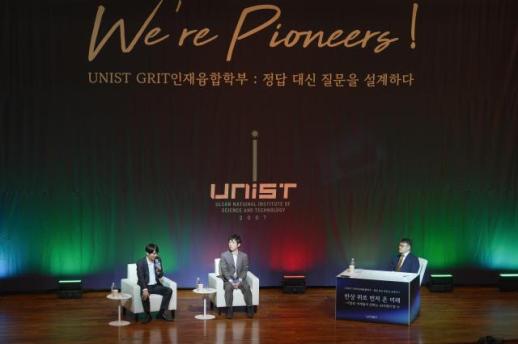 UNIST to Launch GRIT Interdisciplinary Program in 2027 to Train Question-Driven Talent Ulsan National Institute of Science and Technology, or UNIST, said it will launch a new undergraduate division, the GRIT Interdisciplinary Program, in 2027, aiming to help students design their own majors and academic paths. The school said the program is meant to move beyond department-centered education in an era when artificial intelligence can quickly produce answers, and instead strengthen students’ ability to form questions and map out lines of inquiry. UNIST said on May 6 it will separately admit about 10 freshmen a year starting in 2027 through a dedicated GRIT admissions track. The program will be built around project-based inquiry education. Students will combine foundational and research-oriented courses to create individualized curricula, then complete both personal projects and team-based interdisciplinary projects. Each student will be assigned a dedicated faculty mentor for one-on-one guidance throughout their studies and research. Kim Cheol-min, head of the GRIT Interdisciplinary Program, said the school is preparing an approach in which “one persistent question a student asks can become a major explored over four years, and a record of failure and trying again becomes a personal portfolio.” In the AI era, he said, it is important not only to find answers quickly but also to endure uncertainty and “design questions” in areas without clear answers. UNIST said it will also differentiate evaluation. The program will use a P/NR (Pass/No Record) system to reduce the burden of failure and encourage ambitious inquiry. Graduates will receive either a bachelor’s degree in interdisciplinary science or interdisciplinary engineering. The major title designed by the student will be officially listed on the academic transcript. UNIST introduced the GRIT program’s education philosophy to students and residents during “UNIST Open Stage 1,” held May 6 at the main auditorium of its administration building. Lee Sedol, a UNIST special professor, referred to his experience teaching a board game design course and interacting with students. “If you make rules, set criteria for choices, and think about why you make those judgments, your experience with baduk naturally connects to other fields,” he said. Lee Chang-ho, described as a baduk titleholder, echoed the program’s emphasis on student-driven inquiry, saying that a student’s persistent question can become a four-year field of study and that a record of failure and renewed attempts can become a personal portfolio. He also said that in the AI era, the attitude of designing questions matters. UNIST President Park Jong-rae said universities should be places that build students’ capacity to create their own questions, endure failure and find solutions on their own. He said the event, using baduk as a symbolic medium, showed that uniquely human perseverance, creativity and judgment are key conditions for future talent. UNIST said it plans to continue introducing the GRIT Interdisciplinary Program to residents and students through a range of events. Later this month, it said, a screening and artist talk are scheduled with media artist Kim A-young, a UNIST special professor. * This article has been translated by AI. 2026-05-06 16:07:27