
Journalist

Na Seon-hye
hisunny20@ajunews.com
-
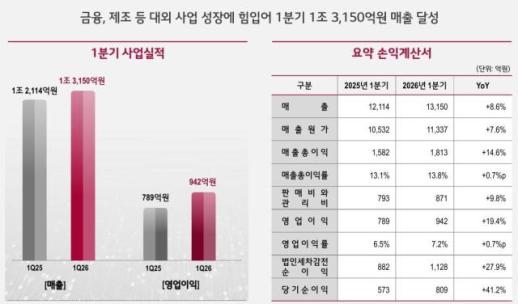 LG CNS Q1 Operating Profit Rises 19.4% to 94.2 Billion Won LG CNS said Thursday it posted broad first-quarter growth across its businesses, helped by expanding AI and cloud operations. The company said rising demand for AI transformation, along with growth in external projects, lifted both profitability and sales. LG CNS reported first-quarter revenue of 1.315 trillion won and operating profit of 94.2 billion won. Revenue rose 8.6% from a year earlier and operating profit increased 19.4%. Revenue from its AI and cloud business, a key growth driver, climbed 6.7% to 765.4 billion won, accounting for about 58% of total sales. The company said it expanded its AI transformation portfolio across industries including the public and defense sectors, finance, manufacturing, pharmaceuticals and biotech, shipbuilding and defense manufacturing. It also said it is expanding external business by providing agentic AI-based multi-agent services and has secured what it described as the largest number of AI transformation implementation cases in South Korea. LG CNS said it is also strengthening global partnerships, expanding cooperation beyond the three major global cloud providers to include OpenAI and Palantir as it targets the enterprise AI transformation market. It began supplying ChatGPT Enterprise in February and has secured about 10 corporate customers. With Palantir, it said dedicated teams are working together to identify high value-added AI transformation projects. In cloud, the company said it is boosting competitiveness through its data center design, build and operate (DBO) business. It said it won orders worth about 1 trillion won for the Samsong data center, reaffirming its position as a domestic DBO provider. It also introduced a modular AI data center that can be built within six months as it expands its infrastructure business. Revenue from its smart engineering business rose 10.4% to 227.8 billion won. The company said its smart logistics business grew on projects to build automated centers in beauty, food, fashion and defense manufacturing, and that it secured global references through its AI-based logistics optimization solution, “Mobile Shuttle.” Its smart factory business also maintained growth as projects won in defense manufacturing, shipbuilding, semiconductors and pharmaceuticals translated into revenue, the company said. It said its lightweight smart factory solution is spreading into new industries including food, medical, electronics and consumer goods, and that its agentic AI-based battery testing facility has received a positive market response. Revenue from digital business services increased 11.9% to 321.9 billion won. The company said performance was driven by next-generation system projects for major financial firms including NH NongHyup Bank, Mirae Asset Life Insurance and Shinhan Investment Corp. Looking ahead, LG CNS said it plans to expand into physical AI. It said it will pursue robot commercialization through a “full-stack RX (Robot Transformation)” service combining an industry-specific robot foundation model, hardware and a platform. It also said it has secured a broader robot lineup, including humanoids, through steps such as investing in U.S. robotics company Dexmate. The company is also expanding overseas business. It said it won an order in August last year for a hyperscale AI data center project in Jakarta worth about 100 billion won and is pushing to complete it by the end of 2026. The project is being carried out through “LG Sinar Mas,” a joint venture established with Indonesia’s Sinar Mas Group. LG CNS said it is stepping up efforts in Japan and the United States centered on enterprise solutions such as “PerfecTwin,” and is expanding its financial digital transformation business mainly across the Asia-Pacific region. 2026-04-30 10:48:19
 -
 South Korea Launches Broad AI Strategy to Upgrade Data, Manufacturing and Government South Korea’s Ministry of Science and ICT is moving ahead with a comprehensive strategy to respond to a sweeping shift driven by artificial intelligence, spanning data 확보, research and development, industrial deployment and global expansion. The government plans to invest more than 60 trillion won in national strategic technologies over the next five years and accelerate its push to become one of the world’s “top three AI powers” by expanding AI-based innovation across manufacturing, public administration and public safety, among other areas. Bae Kyung-hoon, deputy prime minister and minister of science and ICT, chaired the eighth meeting of ministers for science and technology relations at the Government Complex Seoul on Wednesday and discussed seven agenda items, including a draft plan titled “Data Policy Directions in the Era of the AI Transformation.” “AI is having a real impact on solving difficult scientific challenges and on people’s daily lives,” Bae said, adding that the government would expand global cooperation to advance AI-driven science and technology innovation, strengthen the ecosystem and promote responsible use. The meeting reviewed policy directions to energize the data ecosystem, a plan to support “manufacturing AX” based on tacit knowledge to bolster industrial competitiveness, and a rollout plan to expand an AI-based public work platform known as “OnAI.” In manufacturing, the government plans to turn skilled workers’ experience and know-how into data and apply it to AI models and robots. Through a 2026 supplementary budget, it will support building process-by-process datasets totaling 48 billion won and use them to expand manufacturing AI and robotics solutions. In government administration, the OnAI work-management platform will be expanded to about 40 central government ministries. With mobile services enabling access to work networks and collaboration regardless of location, the government expects more efficient decision-making in the public sector. The government also plans to strengthen drug interdiction capabilities using advanced technology, applying detection tools at airports, seaports and other sites and building cooperation among relevant ministries and research institutions to shift toward prevention-focused responses. Investment in national strategic technologies will also be increased, with more than 60 trillion won over five years to concentrate support on key R&D projects and speed results through designated specialized research institutes and expanded corporate support. The government will also step up AI-driven innovation in materials research. By 2030, it plans to develop AI models for materials, build autonomous experimentation centers and upgrade data infrastructure, aiming to shorten research timelines while developing new materials. A global expansion strategy will proceed in parallel. Existing overseas IT support centers will be converted into KAIN (Korea AI Innovation Network) to provide region-specific support in North America, Asia and the Middle East, among other areas, and help domestic AI companies expand overseas. The government said the strategy is intended to build an AI ecosystem that combines data, technology and talent and to secure global competitiveness.* This article has been translated by AI. 2026-04-30 10:08:48
 -
 LG’s EXAONE AI to Power Korea’s Safety Report System, Pilot Service Due This Year LG AI Research is accelerating the use of artificial intelligence in public safety services. LG AI Research said April 30 that it has completed the first phase of development of an “AI Safety Report System” based on its EXAONE model, in cooperation with the Korea Electronics Technology Institute (KETI), and will launch a pilot service within the year. The system is designed to analyze more than 39,000 safety reports filed each day and automate the full workflow — from intake to screening and classification, transfer to the responsible department, and sending a reply. The current Safety Report System uses some keyword-based automatic classification, but accuracy can drop when reports include typos or unclear wording. Reports with photos or videos are handled by staff who review the material and then route it to the relevant agency. LG AI Research said its vision-language model, EXAONE 4.5, addresses those limits by understanding and reasoning over visual information such as photos and videos to improve screening and classification. KETI plans to use the refined report text generated by EXAONE to further break down key categories, shorten transfer times for high-urgency cases and reduce administrative workload. For example, if a user uploads a photo of a clogged storm drain, EXAONE analyzes the image and automatically generates the report text. If the case is classified as high priority — such as a flood risk during the rainy season — it can be sent directly to the response department without intermediate steps, enabling faster action. The two organizations said that as more safety-report data accumulates, they expect to analyze patterns by time, region, type and frequency, and use the results to help develop policies that respond proactively to emerging safety risks. “Through cooperation with LG, we will be able to reduce the administrative burden and operating costs of public services and strengthen citizen safety,” KETI President Shin Hee-dong said. “We will create a model case of AI transformation that people can feel.” Lim Woo-hyung, co-head of LG AI Research, said, “By using EXAONE, we will improve both the speed and quality of safety administration and contribute to improving people’s quality of life.” Separately, LG AI Research said it is also developing “K-EXAONE” and is participating in the Ministry of Science and ICT’s “Independent AI Foundation Model (Dokpamo)” project. It said K-EXAONE earned the top technology score in the first evaluation and ranked first in contributions within the open-source ecosystem. 2026-04-30 10:04:40
 -
 YouTube launches AI-powered search feature for Premium users in the U.S. YouTube is rolling out a generative artificial intelligence search feature, accelerating its shift toward becoming a broader search platform and reshaping how users find information on the service. According to industry sources on the 29th, YouTube introduced an AI search tool called “Ask YouTube” for Premium subscribers ages 18 and older in the United States. The feature combines text and video in its results. When users type detailed questions — such as about travel itineraries or recipes — the AI first summarizes key points in text, then presents related videos and specific segments as clips in a step-by-step format. Unlike the previous approach of listing videos that match keywords, the tool puts an answer first and uses video to support it. That allows users to find needed information without scanning long videos. The move comes as information-seeking habits shift. According to CJ MezzoMedia’s “2026 Target Report,” released the same day, social media accounted for the largest share of information channels among people in their 20s. Among women, social media usage reached 62%. The share of information exposure through video channels was 44% for men and 41% for women, similar to or higher than portal-site search at 33% for men and 42% for women. YouTube’s influence is also evident in search behavior. Among people in their 20s, the share using YouTube to look up information was 47% for men and 39% for women. For men, YouTube ranked as a major channel after Naver at 52% and Google at 51%. Online video has become a central way people consume information. In internet activities among those in their 20s, “watching online video” was the top category at 67% for women and 52% for men. Average daily viewing time was about 1 hour and 50 minutes. Short-form video use reached 98%, and YouTube Shorts use was in the 80% range, the report said. Experts said the strategy reflects Google’s push to strengthen its position in search while maximizing the value of video content. Choi Byeong-ho, a research professor at Korea University’s Artificial Intelligence Research Institute, said the impact could be significant as learning, hobbies and even political activity increasingly center on YouTube. He said the shift could go beyond text-based search to enable video-driven connections such as extracting specific scenes, searching by people or style, and analyzing time-and-place context. He added that combining search AI with generative AI features could further increase users’ dependence on the platform.* This article has been translated by AI. 2026-04-30 00:04:39
 -
 IBS Identifies Collagen Barrier Mechanism in Stroke, Proposes Drug Candidate South Korea’s Institute for Basic Science said it has identified what it called a root mechanism of brain damage in stroke and outlined a potential treatment approach, showing that blocking a “hydrogen peroxide–collagen production pathway” could suppress neuronal death. The research team led by IBS Center Director Lee Changjoon, working with Eulji University, said on April 28 that it found a mechanism in which rising hydrogen peroxide during stroke activates astrocytes, and type I collagen produced in the process triggers the death of nerve cells. Astrocytes typically help protect the brain and, during stroke, are known to form a glial barrier around damaged tissue to limit the spread of lesions. The team said it confirmed that this barrier can instead contribute to neuronal death, challenging the prevailing view. Based on the mechanism, the researchers developed a drug candidate, KDS12025, designed to both remove hydrogen peroxide and inhibit collagen production. In a mouse stroke model, the team said, the drug sharply reduced glial barrier formation and neuronal death, and impaired motor function returned to normal levels within a week. The team also reported effects even when the drug was given two days after onset, suggesting the possibility of extending the “golden time” window often cited as a limitation in stroke treatment. Similar results were reported in a primate model. Three days after KDS12025 was administered, lesion size decreased, and within a week, function returned in a hand that had been paralyzed, the researchers said. In a fruit-grasping test, the treated group succeeded in all 10 attempts, while the untreated group struggled because of motor impairment. The team said the primate findings support the potential for clinical application because of primates’ biological similarity to humans. Lee Boyoung, an IBS research fellow, said the team identified at the molecular level a collagen-synthesis mechanism in astrocytes driven by reactive oxygen species. “It will provide an important clue not only for stroke but also for research on degenerative brain diseases such as dementia and Parkinson’s disease,” Lee said. Yoo Seungjun, a professor at Eulji University, said that demonstrating efficacy in a primate model could help speed the transition to clinical stages. Lee Changjoon said the team succeeded in identifying a root cause and proposing a treatment strategy through a “one-stop research system” integrating basic research, drug development and preclinical work. The findings were published online April 28 in the international journal Cell Metabolism.* This article has been translated by AI. 2026-04-29 18:25:30
 -
 Broadcast Media and Communications Commission Conditionally Renews 17 Radio Licenses; Allows Commercial Ads on tbs Traffic FM South Korea’s Broadcast Media and Communications Commission voted to grant conditional renewals to radio stations that fell short of the required score in license reviews, while also easing some rules to support management turnarounds. At its fifth plenary meeting of 2026, held April 29 at the Government Complex in Gwacheon, the commission approved three-year conditional renewals for 17 stations operated by three entities: 14 stations run by the Korean Broadcasting System, two stations run by MBC Gyeongnam Co., and Seoul’s media foundation tbs Traffic FM. The stations had scored below 650 points in earlier renewal evaluations, triggering a hearing process. The commission held hearings on April 22 to review causes of deficiencies and improvement plans before making the final decision. As renewal conditions, the commission ordered operator-specific corrective tasks, including expanded production and investment to strengthen public responsibility and local service, and steps to secure public interest functions. It said failure to meet the conditions could lead to cancellation of the renewals. For KBS’ 14 stations, the commission required tailored improvement plans for each station, including increased production and investment. For MBC Gyeongnam’s Jinju and Changwon Second FM stations, it required improvement plans and performance reports covering broadcast evaluations, disaster broadcasting, and production and investment. tbs Traffic FM was required to carry out a management normalization plan, improve its internal review system to strengthen fairness in broadcasting, and ensure transparency in the operation of donations. The commission also decided to allow commercial advertising on tbs Traffic FM, citing worsened finances since tbs was removed from Seoul’s list of funded institutions in 2024 and the need to diversify revenue raised during the hearing process. It said it could reconsider the advertising allowance if management conditions change, including any expansion of public support, to prevent harm to public interest and independence. Commission Chairman Kim Jong-cheol said the decision aimed to strengthen broadcasters’ public responsibilities while allowing flexibility to respond to changes in the business environment. He said the commission will continue to check compliance and take strict action under relevant laws if conditions are not met.* This article has been translated by AI. 2026-04-29 18:15:37
 -
 Science Ministry Checks Deployment of Homegrown AI Chips as Commercial Use Expands South Korea’s Ministry of Science and ICT has begun on-site checks at major AI companies as it moves to speed adoption of Korean-made neural processing units, or NPUs. The ministry said it visited SK Telecom’s Incheon data center and LG AI Research on the 29th to review how domestic AI semiconductors are being used in real services and to hear feedback from companies. The visit was arranged to assess the rollout of Korean-made NPUs. At SK Telecom’s Incheon data center, Lee Do-gyu, director general for ICT Policy at the ministry, toured the site with Park Byeong-gwan, head of SKT’s core platform, and Park Seong-hyeon, CEO of Rebellions. Servers installed there use Rebellions’ data center NPUs, ATOM and ATOM MAX. Park said SKT is applying servers based on ATOM and ATOM MAX to A.Dot’s phone-call summary service and to X Caliber, a companion-animal video diagnostic support service. He said the company plans to keep expanding commercial services based on ATOM MAX. SKT said A.Dot’s call-summary service, built on its in-house large language model A.Dot X (A.X), handles up to 50 million API calls a day. At LG AI Research, the ministry was briefed on AI service development that combines the institute’s in-house large language model EXAONE with FuriosaAI’s NPU, Renegade (RNGD). Renegade is a Korean-made AI chip that uses high-bandwidth memory, or HBM, and is designed to deliver the data-processing performance needed to run large AI models. The ministry described it as a case of building an “AI full stack” by pairing a domestic LLM with a domestic semiconductor. Lee said the ministry confirmed on the ground that Korean-made AI semiconductors are being applied to real services. He said the government will continue policy support so AI chips that have entered full-scale mass production can spread quickly in the market.* This article has been translated by AI. 2026-04-29 16:37:43
 -
 Korea’s ICT R&D Spending Jumps 13.8% to 64.6 Trillion Won, Driven by Private Sector Korean information and communications technology (ICT) companies sharply increased research and development spending last year, led by semiconductors and artificial intelligence, government data showed. The gains, however, were concentrated in private funding while government and public support remained flat. According to the “2024 ICT Corporate R&D Statistics” released Tuesday by the Ministry of Science and ICT and the Institute for Information & Communications Technology Planning & Evaluation (IITP), ICT R&D investment in 2024 totaled 64.6 trillion won, up 13.8% (7.8 trillion won) from a year earlier. It was the largest increase in six years and accounted for 60.6% of total industrial R&D spending of 106.7 trillion won. Private and foreign funding reached 62.4 trillion won, or 96.6% of the total, driving the rise. Government and public funding totaled 2.2 trillion won, or 3.4%, showing little change. By sector, ICT and broadcasting equipment makers—centered on semiconductors—spent 59.5 trillion won, or 92.1% of the total. Software development and production companies invested 4.2 trillion won, or 6.4%. By company size, large firms invested 53.5 trillion won, up 16.3% from the previous year, leading overall growth. Small and midsize companies spent 2.5 trillion won, up 11.9%, while venture companies posted a 0.3% decline in growth rate. By research stage, 45.2 trillion won (70%) went to development research, followed by applied research at 10.9 trillion won (16.8%) and basic research at 8.5 trillion won (13.2%). Basic research rose 19%, outpacing applied research growth of 16.1%. ICT R&D staffing also increased. The sector employed 225,900 R&D workers, up 5,200 (2.4%) from a year earlier, representing 48.0% of total industrial R&D personnel. Equipment makers accounted for 161,000 workers (71.2%), while software development and production employed 57,000 (25.1%). The ministry said the software field generates relatively high employment compared with investment levels. The share of advanced-degree researchers continued to rise. Master’s and doctoral researchers totaled 71,000 (33.2%), narrowing the gap with bachelor’s degree holders at 133,000 (62.2%). Female researchers numbered 36,000 (17.1%), continuing a steady increase since 2020. Park Tae-wan, director general for ICT Industry Policy at the ministry, said, “It is a meaningful result that private-sector-led ICT R&D investment expanded despite domestic and external uncertainties.” He added, “We will reflect this in future investment planning and budget allocation to strengthen synergy between the government and the private sector.”* This article has been translated by AI. 2026-04-29 12:04:19
 -
 South Korea Expands Research Funding Flexibility, Eases R&D Rules The Ministry of Science and ICT said it is moving to significantly expand researchers’ discretion in using grant funds and to streamline what it called unnecessary administrative rules, aiming to let scientists focus more on research and less on paperwork. The ministry said a revision to the enforcement decree of the National Research and Development Innovation Act was approved at a Cabinet meeting on the 28th. The revision is a follow-up to the “R&D ecosystem innovation plan to lead the future through science and technology” announced in November 2025, which called for easing administrative regulations and improving conditions for researchers. To broaden flexibility for individual researchers, the decree creates a new direct-cost budget category called “research innovation expenses.” Under the new category, researchers may spend funds more freely — without subdividing items — for costs needed to carry out projects, including research materials, business travel and meeting expenses. The ministry said the category may be used up to 10% of direct costs, capped at 50 million won, and documentation requirements will be minimized to reduce administrative burdens. The system will apply to selected programs starting in June 2026 and will be fully implemented in 2027. The ministry also said it will shift how institutions use indirect costs to a “negative regulation” approach. Previously, indirect costs could be spent only on listed items; under the change, institutions may broadly spend on research-related costs except for items explicitly prohibited. The ministry said this will allow more flexible responses to new needs such as fees for artificial intelligence services. This change will take effect immediately upon promulgation. The decree does not fully liberalize indirect-cost spending. It specifies certain items as prohibited to maintain minimum controls. Commonly barred uses include payments a university-industry cooperation foundation makes to a university without consideration for carrying out an R&D project; costs such as damages and penalties; and expenses unrelated to research. For personnel support funds, prohibited items include additional pay for researchers or support staff already receiving salaries, as well as scholarships such as merit-based graduate awards or teaching assistant scholarships. For research support funds, prohibited items include costs that function as rewards for winning R&D contracts, as well as construction and building remodeling expenses. The ministry said it also revised smaller rules that had caused inconvenience in the field. It abolished a requirement for prior approval before using meeting expenses, and it will simplify supporting documents required for spending on research materials. Park In-gyu, head of the ministry’s Science and Technology Innovation Office, said, “We are continuously improving the system so researchers can focus on research without administrative burdens,” adding, “We will actively identify regulations that hinder research immersion and continue additional improvements.” * This article has been translated by AI. 2026-04-28 15:17:04
 -
 USTR Steps Up Pressure on South Korea Over Network Fees, Data Access and AI Concerns The Office of the U.S. Trade Representative has publicly criticized South Korea’s network usage fee policy, raising pressure in digital trade. Industry officials and experts in South Korea warn the dispute could expand beyond telecom policy into demands for broader data access, a key resource in the AI era. According to the industry on April 28, the USTR posted on X on April 27 (local time) that “no country in the world imposes network usage fees for traffic transmission by its internet service providers (ISPs). Korea is the only exception.” The post escalated what had previously been raised mainly in reports, framing South Korea’s policy as a major non-tariff trade barrier. The issue emerged in earnest in the 2023 National Trade Estimate (NTE) report. In 2024, it broadened into wider digital regulation and became a trade issue, and in 2025 it was cited as a core non-tariff barrier. In 2026, the USTR has widened its focus further, also raising concerns that U.S. cloud service providers (CSPs) were excluded from AI infrastructure projects. The United States argues the policy imposes discriminatory costs on foreign companies and restricts market access. South Korea’s telecom industry counters that the structure is unfair because global platforms that generate massive traffic do not share the cost of network investment. Ahn Jeong-sang, an adjunct professor of communication at Chung-Ang University, said network usage fees reflect a basic cost-sharing principle given rising data use and potential network overload. He said a system in which big tech “effectively uses networks for free” and then uses its financial strength to expand dominance in AI technology could weigh on the growth of South Korea’s AI industry. Some also caution that trade pressure could lead to demands for broader data opening. Because data is central to AI model training and industrial competitiveness, expanded access could weaken the competitive edge of domestic companies, they say. Bong Kang-ho, a researcher at the Software Policy & Research Institute, said sharing data with big tech can improve connectivity with global services. But he warned that opening data could weaken domestic AI firms’ competitive advantage based on proprietary data and reduce differentiating factors in South Korea’s AI industry. The European Union previously considered introducing network usage fees but effectively withdrew the idea after concluding it was not feasible. Still, disputes over cost-sharing between telecom companies and big tech have continued. In January, the EU moved to pursue a system under the “Digital Networks Act (DNA)” in which regulators would mediate. Experts said South Korea needs an institutional response, not just a policy debate. Kim Yong-hee, a professor of business administration at Sun Moon University, said South Korea was not sufficiently prepared for the era of global services and has struggled to respond effectively to USTR pressure. He said the National Assembly should hear from stakeholders and elevate practical improvement measures as an agenda item. Ahn said a phased approach is needed: prioritize voluntary negotiations between companies, but apply limited regulation only if no agreement is reached within a set period or if one side refuses unilaterally. 2026-04-28 14:48:06