

Journalist

Cho Hyeon-mi
hmcho@ajunews.com
-
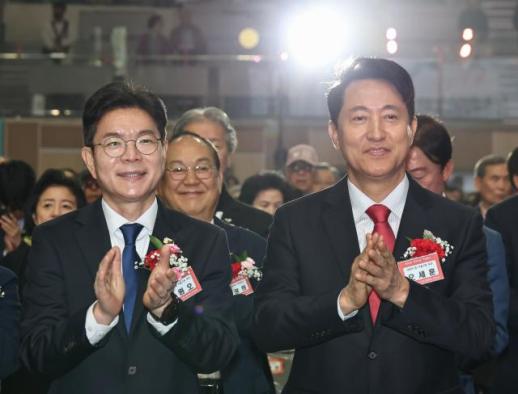 Seoul mayoral rivals Jung Won-oh and Oh Se-hoon trade barbs over housing supply Democratic Party candidate Jung Won-oh and People Power Party candidate Oh Se-hoon, both running for Seoul mayor, campaigned for older voters on May 6 by each calling himself “Seoul’s eldest son,” while continuing to clash over housing supply. The two appeared together in the morning at the Seoul chapter’s 54th Parents’ Day event of the Korea Senior Citizens Association at Jangchung Arena in Jung-gu. Oh arrived first, and Jung came in slightly after the opening time. They greeted each other with smiles and a handshake, but competed in their remarks. Jung said he remembered seniors’ contributions to the country and society, adding, “When I was Seongdong district mayor, you called me Seongdong’s eldest son. Now I will become Seoul’s eldest son.” After Jung left for another schedule, Oh told the audience, “The real eldest son of Seoul greets you,” and said his first pledge was a “healthier, higher-quality-of-life special city, Seoul.” He said he would pursue “healthy longevity” and make Seoul “the world’s longest-living city.” The rivals also kept up their dispute over how to expand housing supply in Seoul. Oh announced an afternoon pledge he called a “comprehensive plan to expand a housing mobility safety net” aimed at stabilizing housing for residents without homes. The plan’s centerpiece is supplying 123,000 public rental units and 6,500 public for-sale units by 2031. For the public for-sale portion, Oh proposed a “Baro Nae Jip” model that includes land-lease apartments priced at about half of nearby market levels and installment-plan apartments requiring a 20% upfront payment. He also pledged to expand long-term jeonse housing — which he said carries no risk of jeonse fraud — from 37,000 units to 106,000 by 2031. “With an overwhelming expansion of supply, we will lower the barriers for residents without homes to enter homeownership and greatly increase safe housing options without worries about jeonse fraud,” Oh said. Oh also launched what he called a “Real Estate Hell Citizens Countermeasures Committee,” criticizing the real estate policies of the Lee Jae-myung government and Jung. At the committee’s kickoff news conference, Oh took aim at Jung’s pledge to expand non-apartment supply, including villas, saying many Seoul residents want newly built apartments. “Policies that ignore reality are bound to fail,” he said. Jung’s campaign quickly pushed back. Kim Gyuhyun, a spokesperson for Jung’s election committee, said in a statement that Oh’s side was “recklessly trying to divide” residents who live in apartments and those who do not. Kim questioned whether an apartment supply plan that takes 10 years until move-in could address the urgency of residents facing jeonse contract expirations as soon as next year. Kim said Jung would shorten redevelopment project timelines to within 10 years and use villas, urban lifestyle housing and purchased rental housing together to pursue long-term supply while responding in the short term. He also said Jung would build “high-quality villa models” with safety, security and community features to broaden stable housing options for young people, newlyweds, one-person households and older single-person households. Jung’s campaign also criticized Oh’s “Real Estate Hell” committee. Spokesperson Park Kyung-mi pointed to Oh as responsible for what she called failures in Seoul’s real estate policy, saying, “The more he tries to mislead public opinion with provocative words, the noose will only tighten around himself.” She added, “Distorting facts and blaming others cannot cover up the failures of a four-term mayor.”* This article has been translated by AI. 2026-05-06 16:55:34
 -
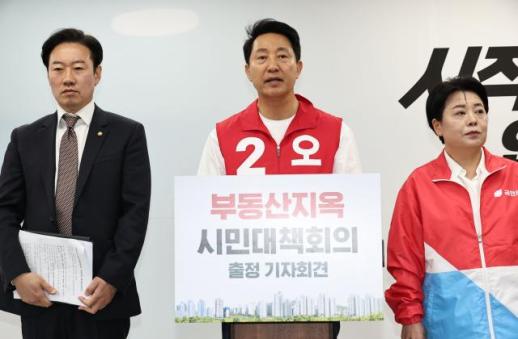 Seoul mayoral candidate Oh Se-hoon vows 130,000 public homes by 2031, expands long-term lease housing Oh Se-hoon, the People Power Party’s candidate for Seoul mayor, said he would supply about 130,000 public housing units by 2031 and expand long-term lease housing designed to reduce fears of jeonse fraud. Oh announced the pledge Tuesday as part of what his campaign called a comprehensive plan to strengthen a “housing mobility safety net.” The plan focuses on three pillars — expanding housing supply, boosting financial support and lowering housing costs — to stabilize housing for residents without homes, his camp said. It is aimed at countering rising jeonse prices and a shrinking number of listings through more supply and financing support. Under the slogan “the answer to the housing problem is overwhelming supply,” Oh said he would provide 123,000 public rental units and 6,500 public for-sale units by 2031. For the public for-sale portion, he pledged to introduce a “Baro Nae Jip” model that includes land-lease apartments priced at about half of nearby market levels and installment-plan apartments requiring a 20% upfront payment, to lower barriers to homeownership. He also said long-term lease housing would expand to 106,000 units by 2031 from 37,000 now. Oh also pledged to restore what he called Seoul residents’ “sovereignty” over housing funds. His campaign said Seoul residents have contributed about 25 trillion won to the national Housing and Urban Fund through subscription savings, but only about 10 trillion won has been invested in housing projects in Seoul. Oh said he would seek to expand the fund and strengthen support for private-sector housing supply, including land purchases and construction costs. “Seoul has been building a housing promotion fund for the past year and now holds about 5 trillion won,” Oh said. “If I become mayor, I will press the government more strongly to increase it to 10 trillion won.” The plan also calls for life-stage housing cost support. Oh said the city would raise the ceiling for interest-free deposit loans under the Long-term Relief Housing program to up to 70 million won, and subsidize loan interest for newlywed couples living in public rental housing for up to 12 years. He pledged to extend youth rent support to 12 months from 10 and broaden eligibility to include single-parent families and victims of jeonse fraud. For middle-aged residents without homes, he proposed a new “matching savings account” program that would combine rent support with city-backed savings to help participants build a 10 million won nest egg. Oh also pledged a three-step protection system to prevent jeonse fraud. It would include a pre-contract risk screening service, an “safety manager” with a licensed real estate agent credential to accompany tenants when signing contracts, and post-contract support such as subsidies for jeonse deposit return guarantee insurance. For vulnerable groups including young people, he said the city would guarantee 100% coverage through deposit return guarantees. Oh on Tuesday also formally launched the “Real Estate Hell” civic task force. “I will go deeper into the field and step up efforts to deliver, in citizens’ own voices, the hardships faced by residents without homes, including turmoil in the monthly and jeonse rental markets,” he said. 2026-05-06 15:23:42
 -
 Seoul mayoral rivals clash over villas as answer to rental crunch Seoul mayoral candidates Jung Won-oh of the Democratic Party and Oh Se-hoon of the People Power Party, who have traded barbs for days over the city’s housing policy, clashed again on Monday over whether “villas” can help ease the rental crunch. Oh’s campaign said Jung’s suggestion that supplying villas and similar housing could resolve the monthly rent and jeonse squeeze within two to three years was “dangerous.” Jung’s camp responded that villas are a legitimate form of housing and accused Oh of an apartment-only mindset. Park Yong-chan, a spokesperson for Oh’s election committee, said in a statement that Jung “caused trouble again,” criticizing Jung’s remarks as implying the rental crisis could be solved in two to three years by supplying villas. Park was referring to Jung’s comments the previous day at a meeting with district chief candidates, where Jung said the city could craft measures within two to three years and increase supply by using villas, officetels and “living-type lodging facilities.” Park argued the core cause of Seoul’s rental turmoil is an “absolute shortage” of apartment rental supply stemming from what he called the Lee Jae-myung administration’s misguided real estate policies. He said criticism is mounting that Jung is offering an “absurd” alternative while ignoring the root problem. Kim Jae-seop, a lawmaker who serves as a co-chair of Oh’s campaign, also attacked Jung’s remarks. In a Facebook post, Kim criticized what he called a “Jung Won-oh-style ‘crab, carp and frog’ theory,” saying Jung lives in a “proper apartment” while telling Seoul residents to live in villas. Kim wrote that the Democratic Party’s “hypocrisy DNA” was showing again, referring to a phrase used to criticize telling ordinary people not to aspire upward. Kim also said President Lee Jae-myung raised barriers for young people and newlyweds seeking apartments through what he called a “double shackle” of lending restrictions and the land transaction permit system. He said offering non-apartment housing as an alternative to people who want to live in apartments is either deceiving Seoul residents or “nonsense.” Jung’s camp said Seoul’s housing problems should not be viewed only through the lens of apartment supply. Lee Ju-hee, a spokesperson for Jung’s campaign, said Oh was “looking in the wrong place,” adding that criticism of so-called “villa phobia” was aimed not at residents who live in villas but at Oh’s “narrow” insistence on apartments. “Villas are clearly one form of housing,” Lee said, arguing that the city should consider flexible and diverse housing types. She said Oh’s apartment-centered view shows a “fatal” lack of policy imagination and flexibility, and called it “shallow” to reduce Seoul’s housing prices solely to a shortage of apartment supply. Lee also accused Oh of failing to move beyond an outdated view of housing as a tool for speculation and investment, and said it would be “close to impossible” to expect innovative city administration given what she called Oh’s decade of uncommunicative governance. Kim Nam-geun, a lawmaker who heads policy for Jung’s campaign, joined the criticism, saying Oh was “consistently distorting” Jung’s remarks. Kim said that given the time required for redevelopment projects, it is the mayor’s duty and a public role to reduce supply-demand instability by quickly supplying non-apartment housing such as villas and officetels. Kim said Oh’s camp had turned Jung’s comment — that “if the public sector leads the supply of villas and officetels, it can be done in two to three years” — into a claim that “the rental crunch will be solved in two to three years,” calling it a “clear falsehood.”* This article has been translated by AI. 2026-05-05 16:57:17
 -
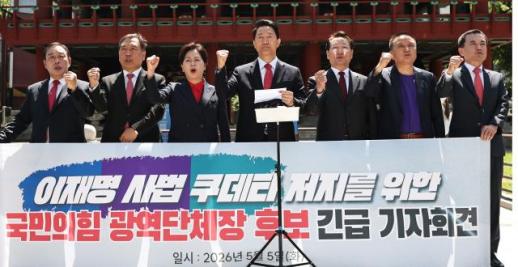 People Power Party Local Candidates Demand Withdrawal of Special Counsel Bill Candidates from the People Power Party running for metropolitan and provincial governor posts in the June 3 local elections demanded on May 5 that the Democratic Party withdraw what it calls a special counsel bill to investigate alleged “fabricated indictments.” They said the measure amounts to an unconstitutional attempt to cancel prosecutions to benefit President Lee Jae-myung and would undermine the constitutional order and the rule of law. Oh Se-hoon, the PPP’s Seoul mayoral candidate, and nine other PPP candidates held an emergency news conference in front of Bosingak in central Seoul and released a resolution titled “PPP metropolitan and provincial candidates’ statement to stop Lee Jae-myung’s judicial coup attempt.” Also attending were Incheon mayoral candidate Yoo Jeong-bok, Sejong mayoral candidate Choi Min-ho, Gyeonggi gubernatorial candidate Yang Hyang-ja, Gangwon gubernatorial candidate Kim Jin-tae, North Chungcheong gubernatorial candidate Kim Young-hwan and North Jeolla gubernatorial candidate Yang Jeong-mu. PPP candidates Lee Jeong-hyeon, running for the Jeonnam-Gwangju integrated mayor post, and Moon Seong-yu, running for Jeju governor, did not attend but joined the statement. The candidates said the bill is “a clear attempt at a judicial coup” that would shake the national justice system “for the sake of one person,” Lee, and warned it would face “harsh public judgment.” They said they would not stand by and pledged to fight “to the end” alongside political parties, civic groups and citizens who share the goal of defending the constitutional order. They urged the Democratic Party to withdraw the bill and called on Lee to pledge that he will not seek cancellation of prosecutions during his term. “The Democratic Party must immediately halt the push for a special counsel bill aimed at an unconstitutional cancellation of prosecutions for Lee Jae-myung’s self-exoneration, and it must withdraw the bill already introduced,” they said. They also called on Lee to “clearly state before the public” that there will be no cancellation of prosecutions related to his own allegations during his term and that he will stand trial according to law and principle. They also demanded that ruling-party candidates for metropolitan and provincial posts “immediately disclose to the public” whether they support or oppose the special counsel bill. Before the statement was read, Yang Jeong-mu said, “You can’t cover the sky with your hand,” adding that no one in South Korea can be above the law and that everyone is equal before it. Kim Jin-tae, who led the news conference, cited what he called an old principle of Roman law — that no one can be a judge in their own case — and said denying that principle would amount to a collapse of the rule of law and “insurrection.” The PPP candidates said they plan to rally public opinion to block the bill, including through a nationwide online petition. Oh said the party is working to flesh out ways to cooperate with opposition forces and would announce details once they are set. Oh, Yoo and Yang Hyang-ja met the previous day at the National Assembly with New Reform Party candidates Kim Jeong-cheol, running for Seoul mayor, and Cho Eung-cheon, running for Gyeonggi governor, and agreed to work together to stop the bill.* This article has been translated by AI. 2026-05-05 14:48:14
 -
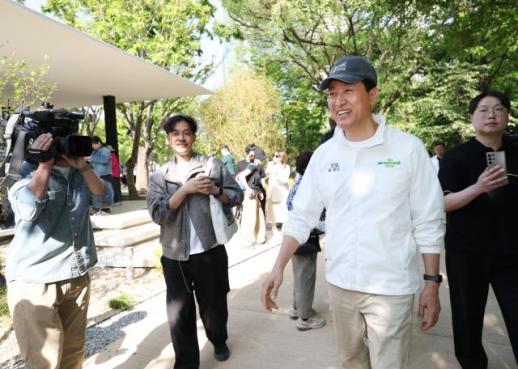 Seoul Mayor Candidate Oh Se-hoon Pledges to Double City Kids Cafes, Build Job-Experience Theme Parks Oh Se-hoon, the People Power Party’s Seoul mayoral candidate, said Tuesday he would double the number of Seoul-style kids cafes and build a new public job-experience theme park called “Seoul Children’s Imagination Land.” Oh announced the plan, billed as “Happy Kids City Seoul,” at the Green Green Kids Cafe inside the Seoul International Garden Show at Seoul Forest in Seongdong-gu on Children’s Day. Oh’s campaign said the pledge aims to redesign the city from children’s perspective while easing parents’ caregiving burden. It also seeks to expand hands-on play facilities across Seoul so children can access them regardless of where they live. The Seoul-style kids cafes — promoted as a budget-friendly option — would expand to 404 locations by 2030, about double the current number. The cafes charge up to 5,000 won per child for two hours, with accompanying parents admitted free. Since the first location opened in May 2022, cumulative users topped 1 million in three years, the campaign said. Oh also pledged to set up at least one infant-only kids cafe in each district and introduce “Green Green Kids Cafes” in all districts, linking them with forests and the Han River. On weekends, the city would operate 30 mobile playground sites under the “Here and There Kids Cafe” program, he said. Oh said the city would also create “Seoul Children’s Imagination Land” at eight hubs across Seoul, including Gangbuk, Seongbuk and Gangseo, offering career exploration and creative activities at fees far lower than private facilities. To reduce families’ private tutoring costs for arts education, he pledged to launch the “Children’s Arts Seed” program, providing eight months of practical training — including vocal music, instrumental music, theater and dance — for students in grades 3 through 6. “Investing in children’s happiness is the surest way to design Seoul’s future,” Oh said. “Building on the changes already underway in Seoul, I will decisively complete an environment where parents can feel secure and children can run and play to their hearts’ content.”* This article has been translated by AI. 2026-05-05 10:30:14
 -
 Seoul mayoral rivals Jeong Won-oh and Oh Se-hoon roll out Labor Day pledges On April 30, a day before Labor Day, Seoul mayoral candidates Jeong Won-oh of the Democratic Party and Oh Se-hoon of the People Power Party released labor pledges as they sought support from workers. Jeong said, “If Seoul runs on labor, the city government must also take responsibility for the time of working citizens,” as he unveiled proposals centered on expanding flexible work arrangements and supporting paid sick leave for freelancers. Under the banner of “Seoul, a special city that respects labor, rebuilt with the voices of working citizens,” Jeong said his plan aims to improve work-life balance and strengthen the right to rest when sick. He pledged to expand flexible work options — including work-from-home, remote work and staggered hours — as part of a “30-minute commute city” initiative, and to introduce paid sick leave for vulnerable workers such as freelancers and the self-employed. Jeong said May 1 would be “the first day to greet the holiday under the name ‘Labor Day’ for the first time in 63 years,” explaining why he chose to announce the pledges then. He also said he visited the Sinjeong rail depot and the Yangcheon public bus garage early that morning to meet subway and bus workers, and later laid flowers at a Jeon Tae-il statue near Cheonggyecheon. “I will carry the labor sites I met at dawn today and Jeon Tae-il’s dream into Seoul’s policies,” he said. Oh visited the Gasan Digital Complex (G-Valley) in Geumcheon-gu, Seoul, where he had lunch with young office workers and heard their concerns, while releasing his labor pledges in writing. “Your ordinary day, lived diligently, is Seoul’s future,” Oh told workers, adding, “I will work to build workplaces where the value of labor is respected and fairness and coexistence are firmly established.” Oh’s proposals focused on strengthening the safety net for vulnerable workers and addressing on-the-job problems. He pledged “hospital living-cost support” to ease financial strain during hospitalization, expanded tailored health checkups for workers in health blind spots, and a safety support system for small workplaces. He also pledged to expand late-night “owl bus” routes to help about 200,000 late-night workers in their 20s and 30s, and to provide once-a-year support for psychological counseling services and the cost of special health screenings for night work. He said the city would newly introduce a “late-night in-home caregiving service” for families facing care gaps because a guardian works nights. “Seoul must be a strong fence so the vulnerable can stand back up without despair,” Oh said. “I will 반드시 resolve the reality of not being able to rest when sick and the problem of not being able to focus at work because of caregiving worries, and make this a city where labor is respected.” The two candidates also continued sparring over real estate policy. In a statement, Jeong’s camp said Oh’s side blames a housing supply cliff on former Seoul Mayor Park Won-soon, but argued the real cause was that residents lifted redevelopment district designations made indiscriminately during Oh’s time as mayor. Jeong’s camp added, “Seoul citizens gave Oh four chances, but all that came back was a loud, empty cart.” Oh’s camp again raised controversy over remarks by President Lee Jae-myung about abolishing the long-term holding special deduction. Asked about the deduction while presenting his second pledge, Oh said, “Even the Democratic Party says it has never discussed it at the party level, but Jeong is taking the same position as the president.” He added, “I have serious doubts whether, as a Seoul mayoral candidate, he can ease anxiety about an issue many Seoul citizens are concerned about,” escalating his criticism.* This article has been translated by AI. 2026-04-30 18:54:22
 -
 Seoul Mayor Oh Se-hoon Pledges Citywide Mental Health Plan to Fight Loneliness Oh Se-hoon, the People Power Party’s candidate for Seoul mayor, said April 30 he would pursue a policy package called “Seoul Mind Fitness Recovery” so that “Seoul residents can be healthy not only in body but also in mind.” Oh announced the mental health pledge at the Seoul Mind Convenience Store Gwanak branch inside Seongmin Comprehensive Social Welfare Center in Sillim-dong, saying he would “overwhelmingly complete” changes launched under the city’s “Loneliness-Free Seoul” policy initiative. The plan is his second official campaign pledge and his second health-related promise, following the “Steel Stamina, Vibrant Seoul” proposal released a day earlier. Oh said health should be enjoyed equally “regardless of wealth or social achievement,” and argued that income and asset gaps should not lead to health gaps that widen differences in happiness. At the center of the proposal is building a “mental safety belt” under which the city would directly manage invisible risks such as isolation and loneliness to strengthen residents’ mental resilience. Oh said he would accelerate what he called “heart-ware” — beyond hardware and software — building on results from the Loneliness-Free Seoul program introduced in 2024, when he was Seoul mayor. For older residents, the plan links the health app “Sonmok Doctor 9988” with a mobile app called “Brainfit 45” to offer self-checks for dementia risk and tailored missions such as cognitive training and walking. It also calls for closer management of men in their 50s and 60s, described as the group at highest risk of social isolation. Using administrative data such as job loss or divorce, the city would identify households in crisis earlier and set up an always-on check-in system combining artificial intelligence and KakaoTalk. Oh also pledged to expand a project for isolated and reclusive young people, investing a total of 109 billion won by 2030. The plan includes opening dedicated mental health clinics at facilities such as Eunpyeong Hospital and operating a family-support living lab to help relatives take part in recovery. Psychological counseling, previously limited to high-risk groups, would be expanded to all residents under a “citywide mind rebuilding project.” Oh said 16 billion won would be used to provide private professional counseling vouchers to 100,000 people a year. Support would cover up to eight sessions per person, at 80,000 won per session, to help manage mild mental health issues before they worsen. Offline support hubs would also be expanded. “Mind Convenience Stores,” which offer counseling and simple food, would grow from four locations to at least one in each district, and mobile versions would operate in areas with many one-person households. Oh also said he plans to create an urban healing space in the Seongsu-dong area using Seoul Forest. “Loneliness is a condition that any modern person can carry,” Oh said, adding that two years of policy experiments gave him confidence it can be reduced. He said the city would expand programs such as the Mind Convenience Store so any Seoul resident can use them, and repeated his pledge to “overwhelmingly complete” changes already underway.* This article has been translated by AI. 2026-04-30 16:07:18
 -
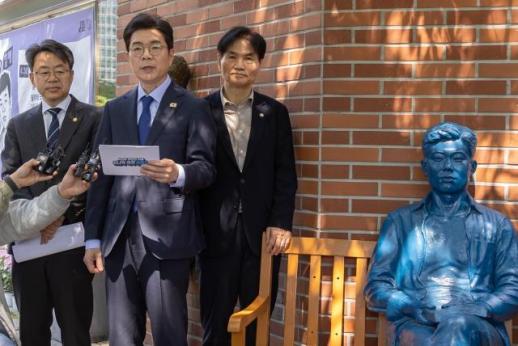 Seoul mayoral candidate Jeong Won-oh pledges paid sick leave for freelancers, expanded flexible work Jeong Won-oh, the Democratic Party candidate for Seoul mayor, said April 30 he would expand Seoul-style flexible work arrangements and introduce a Seoul-funded paid sick leave program for freelancers and other vulnerable workers. Speaking outside the Jeon Tae-il Memorial Hall along Cheonggyecheon in central Seoul, Jeong said that if Seoul runs on labor, the city government should also share responsibility for the time of working residents. Under the slogan, "Rebuilding a worker-respecting special city, Seoul, with the voices of working citizens," Jeong said his labor platform focuses on work-life balance and ensuring the right to rest when sick. To pursue his goal of a "30-minute commute city," Jeong pledged to broaden flexible work options, including telework, remote work and staggered hours. He also said the city would build a dense network of "public and shared offices near home" by using idle spaces such as subway stations. Companies that adopt flexible work would receive incentives and get extra points when participating in Seoul city bids and projects. Jeong also pledged a paid sick leave program for freelancers, the self-employed, platform workers and day laborers, expanding a pilot program previously launched in Jongno district across the city. "Resting when you're sick is not a privilege, it's common sense," he said, adding that Seoul would serve as a safety net for residents in blind spots of workers' compensation insurance and paid leave. He said the city would create new "Seoul-style worker protection standards" so workers do not lose jobs as artificial intelligence, robots and automation spread. He also pledged to set up a framework for "just transition" discussions to protect workers expected to be harmed by the climate crisis. Before the announcement, Jeong visited the Sinjeong rail depot and the Yangcheon public bus garage early April 30 to meet workers, and later laid flowers at a Jeon Tae-il statue on Jeon Tae-il Bridge over Cheonggyecheon. Referring to the schedule, he said May 1 would be the first day to mark the holiday under the name "Labor Day" after 63 years, and vowed to carry the voices he heard at worksites and Jeon's vision into Seoul city policy. 2026-04-30 12:00:20
 -
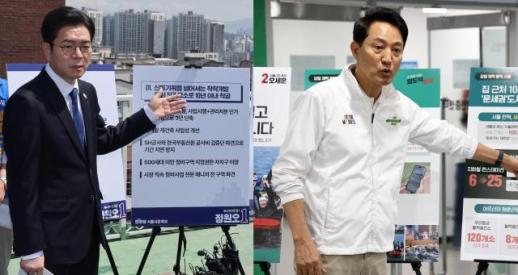 Seoul mayoral rivals trade barbs over redevelopment speed and housing pledges With the Seoul mayoral election set for June 3, Democratic Party candidate Jeong Won-oh and People Power Party candidate Oh Se-hoon have escalated a daily war of words over real estate. After Jeong on April 29 unveiled a housing platform centered on shortening redevelopment timelines, Oh’s camp countered that Jeong was repackaging policies already underway. Jeong announced what he called the “Chakchak Development” real estate plan from the rooftop of Sinjangwi Apartment in Seongbuk-gu, Seoul, outlining steps to improve the profitability of redevelopment and reconstruction projects. The announcement came as Oh’s side pressed Jeong to state his position on President Lee Jae-myung’s remarks about abolishing the long-term holding special deduction; Jeong responded by emphasizing housing supply. Jeong’s plan includes expanding areas eligible for floor-area-ratio incentives to semi-industrial zones and raising the standard used to calculate the price of rental housing purchased by redevelopment associations — from standard construction costs to about 80% of the “basic-type” construction cost. He also pledged to revitalize public-led redevelopment projects and to supply large volumes of “practical housing” priced at levels residents can afford. “Chakchak Development is centered on revising laws and operating our own system so each redevelopment stage can move quickly and safely,” Jeong said. Jeong also sharply criticized Oh’s redevelopment initiative known as “Shintong Planning.” Jeong said that during Oh’s tenure as mayor and under the Yoon Suk Yeol government, the supply of apartments and villas in Seoul fell sharply, with the number of permits and approvals in 2022–2024 amounting to only 62% of the previous 10-year level. He pledged to supply large amounts of public housing with affordable sale prices and rents so that middle-class and working-class residents without homes can buy in Seoul. Oh, who on the same day announced “Steel Fitness, Energetic Seoul” as his first campaign pledge, avoided direct comment on Jeong’s housing plan. His aides, however, issued pointed criticism. Kim Byung-min, spokesperson for Oh’s election committee, said Jeong was “disguising” existing programs as new pledges. Kim said the Yoon government’s August 2024 “8·8 measures” already set a plan to raise the purchase price for rental housing to 80% of the basic-type construction cost, and that related bills introduced by both ruling and opposition parties passed the National Assembly this month. He also said expanding floor-area-ratio incentive zones to semi-industrial areas is already being implemented by the Seoul city government. “In short, Jeong is pledging to start a train that’s already running,” Kim said. “Can Seoul’s real estate problems be solved with this kind of amateur administration?” Oh’s camp also criticized Jeong for staying silent on the Lee government’s real estate policies. Park Yong-chan, another spokesperson for Oh’s campaign, said in a statement that “wrong real estate policies” by the Lee administration — including last year’s “10·15 measures” and a plan to abolish the long-term holding special deduction — had triggered a rental crunch. Park said forecasts suggest that if the policy direction continues, Seoul’s rental shortage and surging lease prices could become entrenched. He urged Jeong to press the president to change course “quickly and strongly” before the rental crisis “falls into ‘rental hell.’"* This article has been translated by AI. 2026-04-29 18:27:59
 -
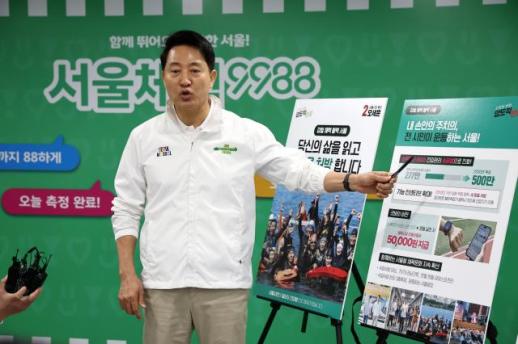 Seoul Mayor Candidate Oh Se-hoon Unveils First Pledge to Cut Health Gaps Oh Se-hoon, the People Power Party’s candidate for Seoul mayor, on Tuesday unveiled his first campaign pledge: “Iron stamina, vibrant Seoul.” He said he would build an environment where residents can manage their health anytime and anywhere, aiming to narrow health gaps tied to income and where people live. Speaking at the Dobong District Public Health Center in Ssangmun-dong, Seoul, Oh said, “A warmer city and a healthier quality of life in Seoul will be the most important policy in the next term.” As part of the plan, he said the city will upgrade its health management platform, Sonmok Doctor 9988, into an artificial intelligence-based health app. The core idea is to use exercise data tracked through the platform and health screening results held by the National Health Insurance Service to predict risks of chronic and serious diseases. Oh also pledged a major expansion of community sports infrastructure. “I will create a ‘10-minute fitness zone city’ where people have a place to exercise within 10 minutes of home,” he said. He said the number of “Seoul Fitness Centers,” where residents can take fitness tests in their neighborhoods, would increase to 100 from 27. He also said the city would expand “Fun Stations” — running and fitness-focused facilities now operating at subway stations including Yeouinaru, Ttukseom and Gwanghwamun — to 25 from six. He also promised to expand exercise spaces for older adults. Oh said the city will create 120 new “Neighborhood Vitality Recharge Stations” by 2030, using public facilities such as welfare centers and libraries for senior-focused leisure and health programs. He also said each district would have at least one “Senior Playground,” which he said can help prevent dementia. Oh said he chose to announce the pledge in northern Seoul to underscore his message on inequality. “If health gaps arise because of income and assets, it can create a gap in overall happiness,” he said, adding, “The gap between rich and poor, or income gaps, must not lead to health gaps.” He said health is the top concern for residents and vowed to “take the Seoul healthy city project — built through policy investment over the past five years — to the next level and decisively complete the changes so far.” 2026-04-29 13:00:13