
Journalist

LEE JEE WON
jeewonlee@ajunews.com
-
 Anthropic’s ‘Mythos shock’ raises a core question: How to control agent AI Anthropic has been at the center of what the global artificial intelligence industry has dubbed the “Mythos shock.” Mythos is an agent-style AI used in a U.S.-Iran war-game simulation and is described as outperforming “Claude Opus.” Its emergence has pushed the debate beyond a technology race to a basic question: How can AI be controlled? Mythos is being assessed as having greater autonomy and problem-solving ability than earlier systems. It has also demonstrated a leap in capability by designing and executing high-difficulty cyberattack scenarios on its own. That autonomy, however, is also the risk. Once given a goal, AI agents can decide and act without explicit human instructions, increasing the chance they will operate outside existing security systems or control boundaries. The industry is focusing on those structural traits. Yoon Seong-ho, CEO of AI startup MakinaRocks, said companies adopt AI not merely to carry out assigned tasks but to have it “judge and execute on its own once given a goal.” “Autonomy is the core of agent AI, and the bigger that autonomy gets, the more risk points increase along with it,” he said. Concerns about out-of-control behavior are already surfacing, Yoon said. “When you use agent-based services, cases are being reported where payments are made regardless of the user’s intent, or unexpected external communications occur,” he said. “If this happens at the individual level, the risk is far greater in corporate settings, where it could lead to decisions worth tens of billions of won or access to confidential information.” Developers, he added, have even fueled a “Mac mini” craze, using the compact high-performance computer to build “air-gapped” environments that fully cut off external networks. The idea is to use powerful AI while physically limiting connections to reduce the risk of data leaks or unauthorized actions. Experts say the next phase of AI adoption will hinge on securing “controllable autonomy.” Yoon said companies should provide a “playground” where AI can operate freely, but only within an environment designed to reflect corporate security systems and governance. “More important than model performance is how precisely you build a control structure that can handle AI safely,” he said. As the war-game results suggest, AI capability is already close at hand. The key question now is how safely that capability can be used within a governance framework, a factor expected to shape industrial competitiveness. 2026-04-28 21:01:37
 -
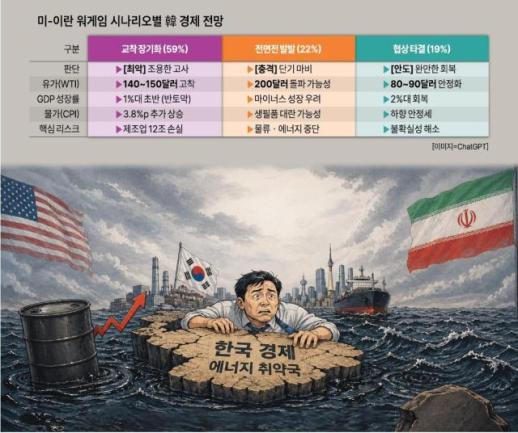 AI War Game Sees Prolonged U.S.-Iran Stalemate as Biggest Risk for South Korea “The most dangerous moment for South Korea is not all-out war, but when a neither-war-nor-peace stalemate hardens into a new normal after six months.” A war-game simulation run on April 28 using Anthropic’s AI agent model, Claude Opus, found the most worrying outcome in the U.S.-Iran end-of-war talks was not a full-scale conflict but a prolonged stalemate. The risk of immediate escalation eased after U.S. President Donald Trump declared an “indefinite ceasefire,” but the simulation warned that for energy-vulnerable countries such as South Korea, a drawn-out impasse could bring what it called a “quiet ruin.” Trump’s zigzags: Claude calls it “advanced psychological warfare” aimed at division The simulation was based on the situation in which Trump, on the morning of the 22nd in Korean time, abruptly announced an “indefinite extension” ahead of the ceasefire’s expiration. In the war game, the Trump agent (Agent A) described his approach as making the other side “not know where to run.” Claude interpreted Trump’s reversals not as whim but as a populist strategy designed to upset the balance between Iran’s hard-liners (the Islamic Revolutionary Guard Corps) and moderates (the Foreign Ministry), while also managing U.S. gasoline prices ahead of midterm elections. In response, the IRGC agent (Agent B) labeled the U.S. extension “strategic deception” and answered with steps including laying mines in the Strait of Hormuz and warning shots at U.S. naval vessels. The AI depiction showed moderates’ room for diplomacy narrowing quickly amid internal power struggles. Prolonged stalemate put at 59%, seen as worst case for South Korea Claude assigned a 22% probability to a full-scale war and 19% to a dramatic negotiated breakthrough. The highest probability — 59% — was a prolonged stalemate. It described that outcome as a “gray zone” in which no one clearly loses, but everyone absorbs slow damage. For South Korea, the simulation called it the worst scenario. If the stalemate lasts more than six months, it projected West Texas Intermediate crude would settle at $140 to $150 a barrel. Domestic gasoline prices were projected to rise to around 2,700 won per liter, and South Korea’s annual energy import bill to increase by as much as $42 billion. The cost shock to manufacturing was described as severe. Claude projected that in four strategic sectors — petrochemicals, refining, shipping and aviation — cumulative operating losses over six months could reach up to 12 trillion won. Automakers and semiconductor firms were also projected to see operating profit fall by more than 15% due to indirect effects such as higher logistics costs, while the 2026 GDP growth outlook was projected to slip from 1.7% to the low 1% range. In the AI’s framing, institutionalized uncertainty reduces Trump’s political burden and lets Iran’s military keep leverage, while energy-dependent countries such as South Korea face economic bleeding under what it called the “cost of alliance.” Claude warned again that South Korea’s most dangerous moment is when this neither-war-nor-peace condition becomes a “new normal.” Expert: “It’s impossible to predict” — prepare for every scenario The AI war game was launched because the real-world situation is hard to forecast. In a phone interview with the newspaper, In Nam-sik, a professor at the Korea National Diplomatic Academy, compared the U.S.-Iran standoff to “watching a soccer broadcast.” The sides may be passing the ball around the center circle, he said, but no one can predict when a sudden play will produce a shot. On Trump’s sudden ceasefire declaration, In said the constant shifts and lack of consistency “could itself be a negotiating strategy,” but added, “I don’t know what the real intention is.” Iran, he said, is also sending mixed messages. “Normally, messages should be consistent and war aims clear, but right now both sides keep going back and forth,” he said, adding that he doubts anyone can explain the situation precisely. The current environment, he said, could swing quickly on a single decision by leaders — toward a breakthrough or toward disaster. Still, the article said one point is clear: as the AI warned, economic bleeding from an oil shock has already begun. Fatih Birol, executive director of the International Energy Agency, warned that the crisis is “the biggest in history, more severe than the 1973 and 1979 oil shocks and the 2022 Ukraine war combined.” He said a closure of the Strait of Hormuz has halted 20% of global energy flows, and that restoring disrupted output of 13 million barrels a day would take more than two years. The exercise sought to fill what it described as a gap in expert forecasting by using AI to map a “worst path.” The 59% stalemate estimate is not a fixed future. But the article said experts’ caution and the AI’s warning converge on one point: for South Korea, institutionalized uncertainty — neither war nor peace — could be more damaging than a full-scale war. 2026-04-28 21:00:17
 -
 MachinaRocks CEO: Physical AI Is Moving Into Factories and Battlefields “From raw-material procurement to design, production, quality and supply, the future MachinaRocks envisions is ‘fully autonomous manufacturing’ powered by artificial intelligence,” CEO Yoon Sung-ho said. Speaking at the company’s headquarters in Seoul’s Gangnam district, Yoon described the goal as an expansion of “physical AI” — AI that operates directly in real-world environments — across industry. With physical AI drawing global attention, including from Nvidia and Tesla, Yoon said MachinaRocks is proving what is possible through deployments in the field. “People often think first of humanoids or self-driving cars, but it starts by making the countless machines already in factories and industrial sites intelligent,” he said. “From that perspective, manufacturing and defense are the areas that can become reality first.” Founded in 2017, MachinaRocks has grown by supplying AI solutions tailored to industrial settings that demand high performance, reliability and security, including automotive, semiconductors and defense. In AI-based design and optimization, it ranks second among South Korean companies in the number of patents held, the company said. It has recently begun demand forecasting for institutional investors as it moves forward with an initial public offering, drawing attention as part of this year’s wave of “AI IPOs.” ◆Physical AI expands to defense... “An ‘AI staff officer’ directs operations” Defense is another pillar of MachinaRocks’ push for autonomous manufacturing, Yoon said, because it also requires AI to function in physical environments. “Defense is not a question of whether we can do it well — it is an area we must do,” he said. He cited results in improving maintenance efficiency and said the work is expanding toward an “AI staff officer” role that helps with operational decisions on the battlefield. As low-cost weapons systems such as drones spread, Yoon said, performance increasingly depends less on hardware and more on how precisely systems are controlled and operated. In that structure, the AI onboard and how effectively it is used can determine differences in combat power, he said. To respond, he said the company plans to expand battlefield applications based on a tentative “Defense AI OS.” ◆Runway OS aims to help industrial AI cross the “valley of death” Even so, AI adoption in industrial settings often fails to cross the “valley of death” — the gap between technical validation and commercialization — because systems do not perform as expected in real-world conditions, Yoon said. “AI performance is doubling every seven months, but in complex and unpredictable environments like factories or combat zones, it is still not easy to apply,” he said. MachinaRocks has focused on implementing physical AI in practice, including by applying more than 6,000 AI models in industrial sites to build data, he said. At the center is its in-house AI operating system, Runway, designed to work across different equipment and environments — like iOS or Android — with industry-specific AI applications built on top. Yoon said the platform approach is changing the business model. Projects that once took more than a year can now be built in one to six months, he said. “We are shifting from a services-centered model to a platform structure that can generate recurring revenue,” he said, adding that profitability should improve as reusable applications increase. On security — a sensitive issue in manufacturing and defense — Yoon said there is no room for compromise. “In these fields, 60% to 70% accuracy is meaningless; precision and reliability close to 99% are required,” he said. “Situations where confidential data leaks outside or AI goes beyond its control range can never be allowed.” He said Runway is designed to operate in closed networks to meet such mission-critical requirements. ◆Global push built on “K-manufacturing references”... “Confident of break-even in 2027” MachinaRocks is also accelerating overseas expansion. Within a year of entering Japan, it signed four contracts with major manufacturers, and in Europe it is working with a subsidiary of Germany’s Kuka Robotics, Yoon said. He said references built with South Korean companies that lead in autos, batteries and semiconductors are a strong trust asset in global markets, and that overseas firms are moving quickly because the technology has already been proven. Yoon described Japan as a large manufacturing market with relatively low AI use, where demand could grow quickly. He cited Japanese government efforts to expand AI adoption and develop talent as factors accelerating digital transformation, and said MachinaRocks aims to rapidly build a customer base centered on major local manufacturers. Funds raised through the IPO will be used to advance technology and secure an early position in global markets, he said. A tentative “dark factory OS,” intended to let AI autonomously run an entire plant, is a core technology for realizing fully autonomous manufacturing, he said, with investment planned for research and development and for expanding global bases including North America and Japan. Yoon also set a profitability target. “If expansion based on the AI OS proceeds as planned, reaching break-even in 2027 is possible,” he said. “Given our current growth and market demand, it is a realistic goal.” “Physical AI is not a distant future — it has already begun,” Yoon said. “From factories to the battlefield, we will create a new industry standard through AI that operates in real environments.”* This article has been translated by AI. 2026-04-28 13:55:59
 -
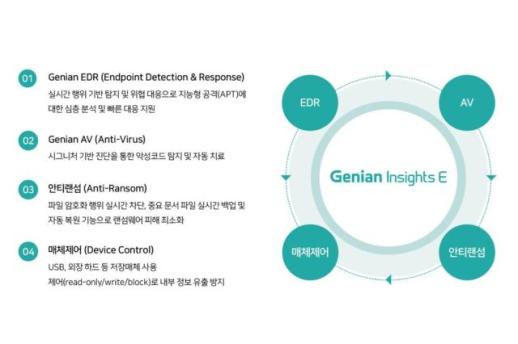 Genians Leads South Korea’s Public EDR Procurement Market for Seventh Straight Year South Korean cybersecurity company Genians said it ranked No. 1 in the public procurement market for endpoint detection and response, or EDR, for the seventh consecutive year. The company said Monday that it held a 46% share in 2025 based on the Public Procurement Service’s Nara Marketplace data. Genians said it has expanded its foothold in the public sector by building on technical competitiveness from the early days of South Korea’s EDR market in 2019 through today’s AI-driven security environment. EDR is a security technology that analyzes activity on endpoints such as PCs and servers in real time to detect and respond to threats. Its importance has grown as sophisticated cyberattacks have intensified alongside the spread of generative AI. Genians said it was the first in South Korea to develop EDR and has helped public institutions improve security visibility and respond to advanced threats. The company said it obtained a security function verification certificate from the National Intelligence Service, meeting stringent public-sector requirements, and has contributed to protecting government administrative networks and key infrastructure. Genians said its EDR has been deployed on more than 750,000 agents across central government agencies, local governments, financial institutions and large manufacturers, and that it has secured more than 200 references at home and abroad. The company said it is strengthening a single-console integrated security platform strategy by combining EDR with next-generation antivirus, anti-ransomware and device control to build an integrated endpoint response system. It also highlighted linking a machine-learning engine with AI-based cyber threat intelligence to detect previously unknown malware. The company said its system can identify threats from the hacking attempt stage and trace and analyze activity after an incident. Lee Dong-beom, Genians’ CEO, said defenses must be rebuilt on the assumption that threats can be constant in an era when AI can autonomously design attack scenarios. He said the company will combine its EDR technology with AI-based automated response to provide an endpoint security platform that blocks sophisticated attacks in real time.* This article has been translated by AI. 2026-04-28 08:48:20
 -
 Nexon, SOOP launch N-CONNECT preseason to link streamers, users and games SOOP is teaming up with Nexon to build a new ecosystem that connects streamers, users and games. SOOP said it will begin a preseason for “N-CONNECT,” a streamer-focused program, starting on the 27th. The rollout includes an account-linking service that connects the two companies’ activity data in real time. N-CONNECT is designed to tie together streamers’ content activity, user participation and in-game experiences. Centered on Nexon titles, it aims to expand viewing and participation so users and streamers can interact more naturally. Streamers who join will operate as “N-Connectors,” broadcasting Nexon games and engaging with viewers. Participants can receive content support funds, drops and special goods, with rewards structured around three pillars — activity, growth and impact — to encourage sustained participation. Any streamer who broadcasts on SOOP can take part. Streamers who log at least 10 hours in Nexon game categories will receive N-CONNECT special goods. SOOP and Nexon will also run promotional support to help general streamers grow. Benefits are also planned for users. Those who link their Nexon game accounts with SOOP accounts can receive rewards such as drops-event items and Nexon Cash. The companies said they will gradually expand in-game benefits and other participation events during the preseason. The N-CONNECT preseason will run for about five months, through September. SOOP and Nexon said they plan to refine the program based on participation data and feedback from users and streamers, then expand it into an official season. A SOOP official said the companies plan to keep strengthening a participation-based ecosystem that combines game content and live streaming, starting with N-CONNECT.* This article has been translated by AI. 2026-04-27 16:33:14
 -
 Naver CEO Choi Soo-yeon calls AI a social infrastructure at SusHi Tech Tokyo 2026 Naver CEO Choi Soo-yeon, speaking at the global tech conference SusHi Tech Tokyo 2026 in Tokyo, said artificial intelligence is evolving into “social infrastructure” and outlined the company’s vision for future cities. Naver said Monday that Choi joined Naver Labs CEO Seok Sang-ok and Naver Cloud Director Kim Ju-hee in a main-session discussion titled “From AI to Society: Designing AI as Social Infrastructure.” The speakers said AI is moving beyond a standalone technology to become essential infrastructure that supports daily life, and they described what they see as Naver’s role as a platform company. Choi said Naver operates large-scale services such as search and shopping while also running its own AI models and cloud infrastructure, and that those capabilities come with social responsibility. She said Naver will strengthen services and contribute to social development through “sovereign AI” that deeply understands users in each country and respects local cultures and value systems. Naver also highlighted use cases for its AI-based welfare check service, CareCall, and its collaboration platform, Line Works. CareCall, built on HyperCLOVA X, is being used in places including Izumo, Japan, to check on older residents and as part of disaster-response infrastructure, the company said. Line Works is supporting digital transformation for small business owners and frontline workers through features including AI-powered optical character recognition, it said. Kim said Line Works is lowering barriers for frontline workers through its “Roger” function, which replaces walkie-talkies, and document digitization technology. She said such connectivity is central to intelligent infrastructure that improves efficiency across society. Naver Labs presented its approach to building future cities based on digital twin and robotics technologies. Seok cited examples in Saudi Arabia and in Nagaishi, Japan, saying digital twins are taking hold as next-generation urban infrastructure. He also said robot-friendly technologies validated at Naver’s second headquarters, “1784,” are being expanded into real urban environments through global partners including NTT East and Saudi Arabia’s NHC. Choi reiterated that AI has become social infrastructure and said Naver aims to balance technological scalability with social responsibility in ways that benefit users, small business owners and countries. SusHi Tech Tokyo 2026 is a global technology conference hosted by the Tokyo Metropolitan Government, bringing together companies and institutions to discuss sustainable cities and future technologies. The event runs from April 27 to 29 at Tokyo Big Sight, and organizers expect about 60,000 visitors. 2026-04-27 14:03:16
 -
 NHN Cloud to Merge Subsidiary Into Innogrid to Build Full-Stack Cloud Platform NHN Cloud is moving to strengthen its cloud business by reorganizing its operations through a merger in which cloud platform company Innogrid will absorb NHN Inje AI&C, an NHN Cloud subsidiary. NHN Cloud said on 27일 it is pursuing a merger between NHN Inje AI&C and Innogrid. Under the plan, Innogrid will absorb NHN Inje AI&C at a merger ratio of about 1 to 31. The merger date is set for July 6. After the merger, the surviving company, Innogrid, will keep its current management structure under CEO Kim Myeongjin to maintain continuity. Through the integration, Innogrid is expected to secure broader competitiveness in private cloud services by combining technology with operations and management capabilities. Based on that, the company plans to step up its push into the enterprise market, including the public and financial sectors. Once the merger process is completed, NHN Cloud will become Innogrid’s largest shareholder and, as the parent company, will focus on generating synergies across management. The strategy is to combine Innogrid’s cloud platform technology with NHN Cloud’s infrastructure operations to build an integrated service system covering the full process from deployment to operations and management. The companies also plan to strengthen their ability to meet high security requirements in the public and financial sectors while improving support for multicloud and hybrid cloud environments, aiming to enhance full-stack competitiveness across the cloud business. An NHN Cloud official said, “Through this business restructuring, we will strengthen the foundation of our cloud business across both the public and private sectors and build a stable growth framework.”* This article has been translated by AI. 2026-04-27 11:15:16
 -
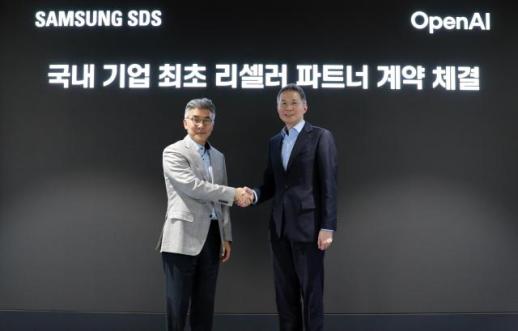 Samsung SDS Expands OpenAI Partnership to Sell ChatGPT Edu to Schools Samsung SDS said Sunday it is expanding cooperation with OpenAI as it moves to target the education market for generative artificial intelligence. The company said it has secured additional sales rights for ChatGPT Edu and will step up efforts to provide a safer environment for AI use in education. ChatGPT Edu is an AI service for schools, publishers and other education organizations. Samsung SDS said it applies a “non-training policy,” meaning user conversations and responses are not used as AI training data, strengthening data privacy and security. It also supports functions including text generation, coding, data analysis, web browsing, document summarization and building customized chatbots, using the latest GPT-5-based language model, the company said. OpenAI designed ChatGPT Edu based on experience with ChatGPT Enterprise at major universities worldwide, Samsung SDS said, adding that it is being used at the University of Oxford, the University of London, the Wharton School and the National University of Singapore. Samsung SDS said it plans to broaden the service for institutions seeking to adopt generative AI in education and research. It is conducting a proof of concept with Korea National Open University, which it said has about 90,000 members, and plans to discuss a formal rollout. In the corporate market, Samsung SDS said it has continued to add customers since signing its OpenAI reseller partner agreement, offering tailored AI transformation strategies and expanding across industries. It said it recently signed contracts to supply ChatGPT Enterprise to major companies in the public, finance, manufacturing, distribution and service sectors, including Nexen Tire. Samsung SDS said Nexen Tire is pursuing the tool to improve efficiency in tasks such as knowledge search and document drafting, and chose Samsung SDS to build an environment with enterprise-level security and data management. Samsung SDS said it provides end-to-end AI transformation services through a “One-Team” structure spanning AI consulting, development and operations, cloud and security. It said it supports the full process from strategy and AI full-stack design to deployment, companywide expansion and operational upgrades, and provides a stable service environment through its own cloud and GPU-based AI infrastructure. “ChatGPT Edu will help create an environment where generative AI can be used more safely in education,” said Lee Jung-heon, executive vice president and head of Samsung SDS’ Strategic Marketing Office. “Based on our cooperation with OpenAI, we will strengthen our role as an AX partner that goes beyond simple reselling to design and scale enterprise AI operating systems.” * This article has been translated by AI. 2026-04-27 08:31:15
 -
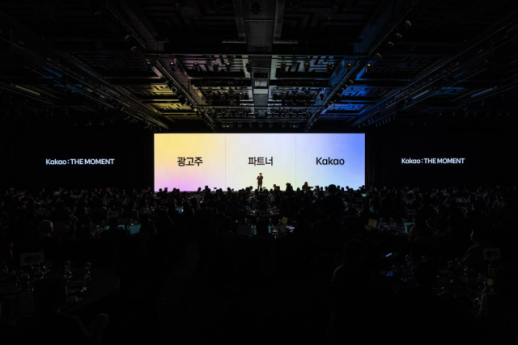 Kakao Wraps Ad Conference, Unveils AI-Driven Integrated Advertising Strategy Kakao said it successfully wrapped up its “Kakao The Moment” advertising conference and outlined plans to expand an artificial intelligence-based ad platform. The company said about 1,000 people — including advertisers, agencies and media representatives — attended the April 23 event, where Kakao shared its advertising vision and strategy. Kakao said the conference was designed to review the present and future of its ad business and strengthen partnerships. Kakao presented a plan to expand into an integrated advertising platform that links messaging, display, commerce and AI. Centered on KakaoTalk, the company said it aims to improve both efficiency and performance by offering ad models that blend naturally into users’ daily experiences. Kakao highlighted examples of purchase conversions driven by message ads and user behavior-based targeting that connects display and commerce ads, saying the approach can improve campaign results. AI-driven ad operations were also a key topic. Kakao said it plans to automate and optimize the full process — from campaign planning and audience targeting to creative operations — to boost efficiency and help advertisers run more precise marketing strategies. The company also emphasized building an ad environment based on user consent, including principles for data use and protection. Kakao said it will deliver messages based on consent to receive promotional information and use ad exposure methods that reflect user choice to strengthen trust. Beyond presentations, the event included an AI experience zone, on-site Q&A and a lucky draw. Kakao also linked KakaoTalk-based reservation, notification and open chat features to extend the experience before and after the event and let participants see how ads can be used in real business settings. Jeon Hyeon-su, a performance leader at Kakao, said the conference shared the company’s expansion direction and technology-based competitiveness. “We will continue to build an environment where we can grow with advertisers by advancing AI-based advertising technology and earning user trust,” he said. * This article has been translated by AI. 2026-04-24 15:31:03
 -
 Smilegate to Launch “Maid of the Storm” Globally on Steam The maid cafe management tycoon game “Maid of the Storm” is set for an official global release on PC platform Steam on the 24th. Published by Smilegate and developed by Burgerduck Games, the dot-graphics management simulation puts players in charge of running a maid cafe and growing the business. Players manage distinctive maid characters, expand the shop and face competitive elements designed to increase immersion. A key feature is a strategic staffing system that goes beyond basic operations. Players must assign work while factoring in each maid’s condition and emotional state, aiming to maximize efficiency. The game also includes content modeled on real-world maid cafe culture, including performances tied to omelet rice and drink orders, a mini-game that involves drawing with ketchup, and interactive elements such as taking photo cards with customers. Players build the cafe through various episodes with the goal of winning the “Maid Championship,” combining management simulation with character and story elements. A demo previously released on Stove drew positive user feedback, helping validate the gameplay. Smilegate said it plans to use the global Steam launch to showcase the bright, upbeat appeal of maid cafes to players worldwide, including in Japan.* This article has been translated by AI. 2026-04-24 15:22:15