

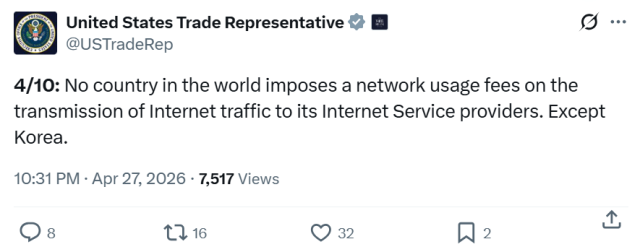
The rhetoric from Washington reached a new peak this week. In a blunt post on X, the Office of the U.S. Trade Representative (USTR) labeled South Korea’s mooted network fee policy as one of the "Craziest Foreign Trade Barriers Facing American Exporters."
The USTR’s 2026 National Trade Estimate Report, released March 31, categorized the issue as a significant service trade barrier. "No country in the world imposes network usage fees on the transmission of internet traffic... Except Korea," the agency wrote, grouping the fees with other "digital concerns" like platform regulation and location-data export restrictions.
Local giants SK Telecom, KT, and LG Uplus argue that foreign "Big Tech" firms like YouTube and Netflix are free-riders. They claim these platforms profit from South Korea’s world-class infrastructure without contributing to its maintenance.
"It is unfair that Korean companies are being discriminated against," says Choi Min-hee, chair of the National Assembly’s Science and ICT Committee.
Google, Meta, and Netflix argue that users already pay for internet access. Charging content providers for the same data constitutes "double billing" and violates net neutrality—the principle that ISPs should not discriminate against traffic based on volume or type.
While South Korea has not yet passed a direct statutory fee, the National Assembly has seen a flurry of bills since 2021 aimed at mandating these payments.
Kim Jeong-won, a former senior digital policy official, notes that while no law exists yet, "Korea is one of the countries closest to legislating such measures." This "closeness" has triggered the USTR’s preemptive strike, as the U.S. fears these fees would benefit Korean competitors and further entrench the local telecom oligopoly.
While South Korean experts like Choi Won-mog of Ewha Womans University point out that Europe, Brazil, and India have debated similar "fair contribution" models, the global tide seems to be turning against the fees:
The EU recently confirmed it would not adopt mandatory network fees, and Brazil dropped its network fee approach in 2024.This leaves South Korea increasingly isolated in its pursuit of a legislative solution.
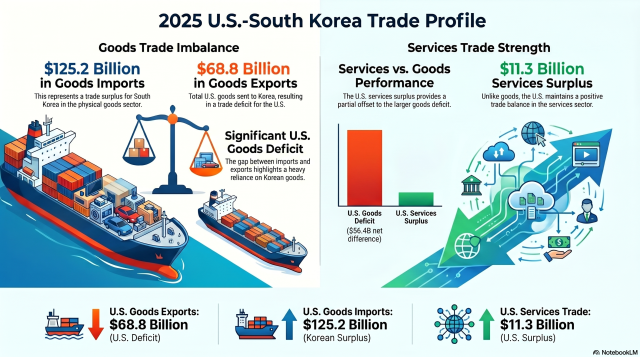
The timing of the USTR’s pressure is not accidental. The network fee dispute is being folded into a broader trade narrative involving Section 301 investigations and the Trump administration’s focus on the trade deficit.
The 2023 resolution of the legal battle between SK Broadband and Netflix—which ended in a "strategic partnership" rather than a court-mandated fee—may offer a blueprint for the future.
"A practical solution would be to resolve this issue through agreements between the companies involved," suggests Kim Jeong-won. However, as the rhetoric from both capitals sharpens, the "invisible walls" of the internet may become the next major hurdle in the K-U.S. alliance.
Copyright ⓒ Aju Press All rights reserved.
