

Journalist

Yoo Joonha
joonhayoo94@ajunews.com
-
 Seoul and Tokyo equities fall, Asian currencies and debt tumble on inflation fears SEOUL, May 20 (AJP) - Seoul and Tokyo bourses extended losses in a broad Asian retreat as investors moved past AI euphoria toward a reality check on the economic toll of prolonged Gulf conflicts and renewed inflation fears. The benchmark KOSPI fell 0.86 percent to close at 7,208.95 after swinging between an intraday high of 7,324.52 and a low of 7,053.84. Foreign investors sold a net 2.9293 trillion won ($1.94 billion) worth of shares, while retail and institutional investors bought 1.7106 trillion won and 1.1053 trillion won, respectively. Large-cap technology shares showed mixed performances. Shares of Samsung Electronics edged up 0.18 percent to 276,000 won even after government-mediated wage talks with its labor union collapsed ahead of a planned general strike Thursday. The Central Labor Relations Commission officially declared its second mediation attempt unsuccessful Wednesday morning after the two sides failed to narrow differences over compensation for workers in loss-making semiconductor units, including System LSI and foundry operations. The union confirmed it would proceed with the strike as planned. President Lee Jae Myung appeared to indirectly criticize the union during a Cabinet meeting Wednesday, saying labor rights were not granted “to enforce the interests of a few through collective force.” The government has previously signaled it could invoke emergency arbitration powers should the strike materially disrupt the national economy. SK hynix closed flat at 1,745,000 won. Shipbuilding shares outperformed the broader market, buoyed by expectations that rising data center-related electricity demand would boost orders for power engines and related infrastructure. HD Hyundai Heavy Industries surged 6.35 percent to 636,000 won. Elsewhere on the KOSPI, losses were widespread. Mirae Asset Securities fell 6.63 percent to 62,000 won, while LG Electronics dropped 5.58 percent to 181,000 won. POSCO Holdings declined 5.33 percent to 417,000 won, while Korea Electric Power slid 5.49 percent to 37,000 won. Doosan Enerbility lost 4.43 percent to 101,300 won, while Doosan Robotics fell 4.6 percent to 95,500 won after a second large block sale of PRS-linked shares worth about 537.6 billion won. Naver retreated 3.33 percent to 191,500 won. The tech-heavy KOSDAQ dropped 2.61 percent to close at 1,056.07 after moving between an intraday high of 1,081.04 and a low of 1,038.23. Foreign investors bought a net 194.2 billion won worth of KOSDAQ shares, while retail and institutional investors sold 57.7 billion won and 130.7 billion won, respectively. High-valuation growth shares came under renewed pressure as rising global bond yields reduced investor appetite for risk assets. AI robotics, secondary-battery and biotech shares led the decline, with robotics-related names extending recent losses amid broader weakness in AI-linked sectors. Among KOSDAQ heavyweights, Alteogen fell 1.91 percent to 359,500 won, while Ecopro dropped 2.38 percent to 118,700 won. Ecopro BM slipped 3.12 percent to 176,700 won, while HLB declined 3.84 percent to 47,600 won. Samchundang Pharm plunged 5.06 percent to 347,000 won, while ABL Bio and Kolon TissueGene each lost 5.1 percent. The Korean won strengthened slightly, with the dollar trading at 1,506.30 won, down 0.1 percent from the previous session. Asian markets also closed broadly lower. Japan’s Nikkei 225 fell 1.23 percent to 59,804.41, while China’s Shanghai Composite slipped 0.18 percent to 4,162.18. The selloff was driven by a sharp rise in long-term U.S. Treasury yields, with the 30-year yield briefly topping 5.18 percent, its highest level since 2007. The Japanese government bonds hit levels not seen in nearly three decades. 2026-05-20 17:29:42
 -
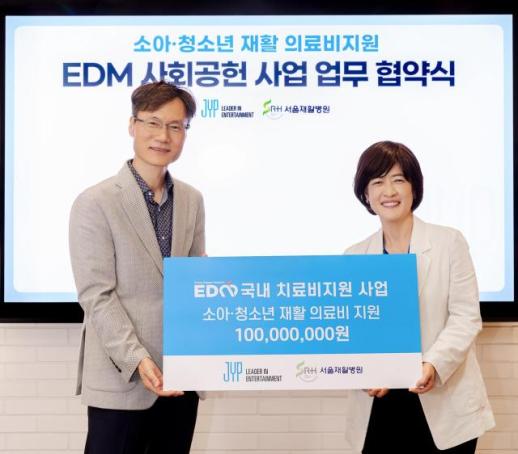 JYP Entertainment donates 100 mln won for children's rehabilitation treatment SEOUL, May 20 (AJP) - JYP Entertainment has signed a social contribution agreement with Seoul Rehabilitation Hospital and donated 100 million won to support rehabilitation treatment for children and young people with disabilities, the company said Monday. JYP Entertainment and Seoul Rehabilitation Hospital signed the agreement Monday at JYP Center in Seongnae-dong, Gangdong District, Seoul. Seoul Rehabilitation Hospital is a public children's rehabilitation hospital in the Seoul metropolitan area. The donation will be used to help patients aged 24 or younger cover rehabilitation treatment costs and purchase assistive devices. Byun Sang-bong, chief financial officer (CFO) and vice president of JYP Entertainment, said the company decided to partner with the hospital to extend its support beyond surgeries and medical treatment to rehabilitation care. "We hope this will help further develop the pediatric and adolescent rehabilitation system that Seoul Rehabilitation Hospital has built and allow its impact to reach broader communities," Byun said. Lee Ji-sun, director of Seoul Rehabilitation Hospital, said the funds will be used to provide practical support for patients and families in need of rehabilitation treatment and assistive devices. The donation is part of JYP's corporate social responsibility program EDM, short for "Every Dream Matters." Launched in 2020, the EDM medical expense support project has helped children in need of surgery and treatment. From 2020 to 2025, JYP donated a total of 7.92 billion won ($5.25 million) through the program, supporting medical expenses for 4,101 children across 10 countries, including South Korea. JYP Entertainment said it will continue EDM-related social contribution projects in 2026, including medical expense support, volunteer programs and its Love Earth environmental initiative. 2026-05-20 15:31:42
 -
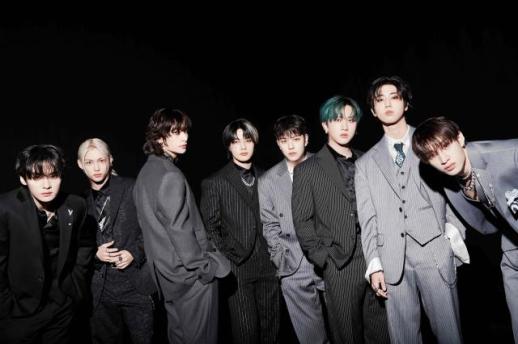 Stray Kids notch 20th music video with 100 million YouTube views SEOUL, May 20 (AJP) - K-pop boy group Stray Kids’ music video for “Walkin On Water” has surpassed 100 million views on YouTube, becoming the group’s 20th music video to reach the milestone, JYP Entertainment said Wednesday. The music video crossed the 100 million mark Tuesday afternoon. “Walkin On Water” is the title track of “合 (HOP),” a SKZHOP HIPTAPE project released by Stray Kids on Dec. 13, 2024. The video features large-scale choreography and visuals set against traditional and modern backdrops. Stray Kids now has 20 music videos with more than 100 million views on YouTube, the most among fourth-generation K-pop boy groups, according to JYP Entertainment. Previous titles to reach the mark include “God’s Menu,” “Back Door,” “MIROH,” “Hellevator,” “MANIAC,” “S-Class,” “LALALALA,” “Chk Chk Boom” and “MEGAVERSE,” among others. “合 (HOP)” became Stray Kids’ sixth consecutive album to top the Billboard 200, the main U.S. albums chart. “Walkin On Water” uses the image of walking on water and navigating rough waves as a metaphor for the group’s confidence on stage. Stray Kids is set to headline The Governors Ball Music Festival in New York on June 6 and Rock in Rio in Brazil on Sept. 11. 2026-05-20 15:31:26
 -
 LIGHTSUM's Nayoung releases cover of YOASOBI's 'Yoru ni Kakeru' SEOUL, May 20 (AJP) - Nayoung of K-pop girl group LIGHTSUM has released a cover video of Japanese duo YOASOBI's "Yoru ni Kakeru," according to a press release from Cube Entertainment. The video, uploaded to LIGHTSUM's official social media channels on Tuesday, features Nayoung performing the song at nighttime locations in Seoul, including Namsan and Hangang Bridge. The cover had drawn more than 22,000 views and 1,300 likes within about 14 hours of its release as of Tuesday evening. Nayoung is a member of LIGHTSUM, a six-member girl group that debuted under Cube Entertainment in June 2021. The group comprise of — Sangah, Chowon, Nayoung, Hina, Juhyeon and Yujeong — has promoted itself as a performance-driven girl group, building an image around bright energy, sharp choreography and youthful concepts. "Yoru ni Kakeru" is the debut single of YOASOBI, a Japanese duo consisting of composer Ayase and vocalist Ikura. The song, based on Mayo Hoshino's short story "Thanatos no Yuwaku," topped Billboard Japan's 2020 year-end Hot 100 chart and has surpassed 700 million streams on Spotify. 2026-05-20 14:36:19
 -
 aespa to open 'LEMONADE' pop-ups in Seoul, LA, New York and Shenzhen SEOUL, May 20 (AJP) - K-pop girl group aespa will open a series of pop-up events in Seoul and major overseas cities to celebrate the release of its second full-length album “LEMONADE,” SM Entertainment said Monday. The album is scheduled for release at 1 p.m. on May 29 on major streaming platforms and as a physical album. The pop-up campaign, titled “aespa WEEK - MAKE IT LEMONADE,” will run from May 29 to June 7 across Yeouido and Banpo in Seoul. In the capital city, events will be held at IFC Mall in Yeouido, the Moonlight Rainbow Fountain at Banpo Hangang Park and Yeouido Hangang Park. The sites will offer merchandise, photo booths, name sticker events, media wall installations and other album-related experiences. SM Entertainment said pop-ups will also open in Los Angeles, New York and Shenzhen, China, alongside the Seoul events. Additional events are planned in Bangkok, Tokyo, Taipei and other major cities. The campaign follows aespa’s prerelease single “WDA (Whole Different Animal) (Feat. G-DRAGON),” released ahead of the full album. aespa debuted in 2020 with “Black Mamba” and is known for its AI avatar and metaverse-themed concept, as well as hits including “Next Level,” “Savage,” “Spicy” and “Drama.” 2026-05-20 14:11:08
 -
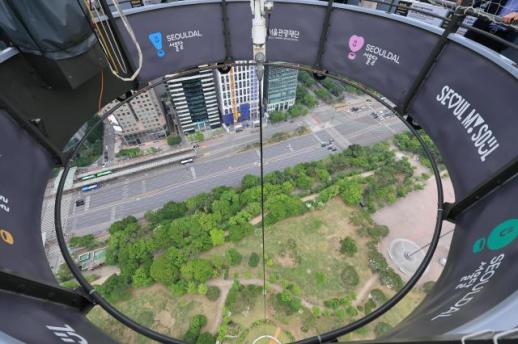 Rides to see and feel Seoul by water and sky SEOUL, May 19 (AJP) - The Han River has always cut Seoul in two. Rising from the Taebaek Mountains and emptying into the Yellow Sea, it served for millennia as Korea's commercial artery — grain barges, merchant boats, wartime supply lines threading through the heart of the peninsula. Then the expressways came, the subway came, and the river was quietly pensioned off into a parkland backdrop while the roads above filled up and stayed that way. Anyone who has sat on the Olympic-daero at 8 a.m. watching the minutes tick by knows exactly how that arrangement has worked out. Last September, Seoul decided the river had been idle long enough. The Hangang Bus — Seoul's new water transit service — connects seven docks stretching from Jamsil in the east to Magok in the west, running hybrid-electric vessels along a route that doubles, depending entirely on your disposition, as either a commute or a sightseeing cruise. The full end-to-end journey runs about 75 minutes; an express service linking Magok, Yeouido and Jamsil cuts that to around 54. The adult fare is 3,000 won — teenagers pay 1,800 won, children 1,100 won — and the service integrates with Seoul's T-money transit system and Climate Card, meaning you can transfer from the subway and barely notice the seam. Getting here wasn't entirely smooth sailing. The project was announced in late 2023, a joint operating company was incorporated in mid-2024, and most of 2025 was spent in trial runs and regulatory preparation before commercial operations finally began on September 18. Since then, more than 270,000 passengers have climbed aboard — enough to suggest that Seoul was, in fact, ready for this. On a Tuesday morning at Jamsil Dock, the floating terminal had the low-key energy of a platform unsure whether it was transit or tourism and had decided, sensibly, not to choose. Passengers stood with paper tickets and transit cards. Some looked out toward the water. The boat arrived at 9:45 with no particular fanfare, and by 10 a.m. it had slipped away from the dock without a horn or a whiff of diesel — just the city, suddenly visible on both sides at once. That, it turns out, is the whole trick. From the middle of the Han, Seoul reorganizes itself. The south bank presents its polished face: gleaming high-rises, newly built riverside towers, the architectural confidence of a city that has decided it likes what it's become. The north bank is quieter — older residential areas, large apartment complexes sitting less showily along the water. Most Seoulites see the river from one shore. From the Hangang Bus, you're the center line. The bridges overhead become landmarks rather than obstacles; the gaps between them, brief windows of open sky. The boat itself is closer to a commuter ferry than a leisure cruise. Seats are arranged in rows, a small snack counter divides the fore and aft sections, and an electronic display up front shows current location, weather, temperature and fine dust levels. Life jackets and emergency equipment line the floating gangway. It is, in other words, properly set up — neither a tourist novelty rigged for Instagram nor a purely functional workhorse. Somewhere usefully in between. Passing under Banpo Bridge, a sign read "7.75m." The concrete span filled the view for a long moment. The boat passed beneath with the unhurried confidence of something that does this every few hours and has stopped thinking about it. On board, the mood divided neatly between pragmatists and romantics. Lee Nu-rim, a 21-year-old soldier on leave, was using the service as an actual commute. He'd spotted it through a social media advertisement and realized his route home happened to match the Apgujeong-to-Yeouido leg. "It felt like I could enjoy the Han River and get home at the same time," he said. He probably wouldn't take it every day, he admitted — partly because not all vessels have the upper deck seen in promotional materials, and seats fill quickly — but the fact of it clearly pleased him. Foreign visitors skipped the ambiguity entirely and called it what it looked like. Kei, 32, from the UK, said it was "lovely" to travel by river through a new city — visitors usually move through streets and landmarks, he noted, and rarely get time to slow down and take the water in. Anna, 29, from Mexico, was quietly amazed by the price. "In my country, something like this would cost much more," she said, which is almost certainly true of most countries. Cristtel, 45, also from Mexico, put the whole proposition most cleanly: "People are used to moving fast now, so maybe it is not for everyone's daily commute. But if you are not in a rush and want to enjoy the scenery, this is exactly right." She could have written the brochure. Seoul Tourism could do worse than to hire her. By the time Yeouido came into view — the golden 63 Building catching the morning light and throwing it in long streaks across the water, doing what old landmarks do when they want you to remember them — the 70-minute ride had accomplished something Seoul's subway system, for all its legendary frequency and coverage, structurally cannot: it had slowed the city down. At nearby Yeouido Park, another novel ride in Seoul was waiting. Between KBS and the financial district, a giant white sphere stood over the grass. The words “SEOUL MY SOUL” and a smiling face were printed on its surface. From a distance, it looked like a piece of city branding. Up close, it resembled a childhood amusement park ride enlarged to an almost unreal scale. This was SEOULDAL, a tethered helium balloon that rises up to 130 meters above Yeouido. The official materials describe it as a 22-meter-wide full-moon-shaped gas balloon. Each ride takes about 15 minutes from boarding to landing, with a maximum capacity of 20 passengers depending on weather conditions. The adult fare is 25,000 won. Before boarding, staff explained the safety rules. The balloon cannot operate in poor weather or strong winds. That explanation felt abstract on the ground. It became much more concrete once the door closed. The passenger platform was shaped like a doughnut, open to views on all sides. That meant the ground was visible almost everywhere. For anyone afraid of heights, the design was not entirely comforting. As the balloon began to rise, the sound of heavy metal cables and machinery replaced the noise of the park below. The safety briefing that had sounded reassuring minutes earlier suddenly disappeared from memory. The plan to calmly film the view from above also faded quickly as sweaty hands gripped the railing. About five minutes later, the operator announced that the balloon had reached its highest point and that passengers could move around to enjoy the view. Only then did the city become visible again. The National Assembly building, the bridges over the Han River and the cars moving along Yeouido’s roads all looked unexpectedly small. Buildings that dominate the skyline from the ground appeared like miniatures. The river stretched out below, and the city, usually too close and too busy to take in, briefly became something that could be seen from a distance. For foreign tourists, Seoul Dal has already become searchable as a destination. Seoul Tourism Organization materials say foreign passengers account for about 44 percent of Seoul Dal riders. Milita, 34, and Carsten, 31, from Germany, had found the balloon through a travel app KLOOK, where it appeared as a recommended place to visit. They had arrived in Korea just one day earlier and were beginning a two-and-a-half-week trip that would take them from Seoul to Jeju, Busan and back to Seoul. The two had ridden hot air balloons before, but said this was their first time on a tethered helium balloon. They were looking forward to “seeing the city buildings from above,” they said. Seoul runs fast. It has always run fast. The transfers, the countdowns, the twelve-lane arterials — the entire urban rhythm is calibrated to velocity. The Hangang Bus and SEOULDAL offer very different experiences. One moves slowly across the river. The other lifts passengers vertically into the sky. But both change the usual angle from which people see Seoul. But the Han was never really about speed. For most of its history it moved goods and people at the pace the current allowed, and the city arranged itself around that. The expressways changed the equation. The Hangang Bus, in its modest, 3,000-won way, is suggesting it might be time to revisit the terms. The city is often experienced at speed — through subway transfers, road traffic, office towers and crowded sidewalks. On the river, that speed slows down. In the sky, the city briefly becomes small enough to observe. Travel Tip The Hangang Bus operates across seven docks from Magok to Jamsil, with stops at Mangwon, Yeouido, Apgujeong, Oksu and Ttukseom. Adult fare 3,000 won; youth 1,800 won; children 1,100 won. T-money transfers and Climate Card accepted. From March 2026, eastern (Jamsil–Yeouido) and western (Magok–Yeouido) routes operate as separate services — check timetables at the Hangang Bus website before boarding. 2026-05-19 21:29:52
 -
 KOSPI tumbles 3.3% as chip-cycle peak fears trigger foreign selloff SEOUL, May 19 (AJP) - South Korean benchmark KOSPI tumbled 3.3 percent Tuesday as foreign investors offloaded shares amid growing concerns that the global memory-chip cycle is nearing its peak. Foreign investors drove the decline on the main bourse, selling 5.34 trillion won ($3.55 billion) worth of shares to outweigh combined purchases by retail and institutional investors. The selloff heavily impacted semiconductor and artificial intelligence-related stocks following an overnight slump in U.S. tech shares. The index ended at 7,271.70, dropping from an intraday high of 7,446.57 to a low of 7,141.91. Large-cap semiconductor stocks dragged the market lower, with industry leader Samsung Electronics falling 2.0 percent to 275,500 won and SK hynix dropping 5.2 percent to 1,745,000 won. Automakers and technology-related shares suffered steep losses alongside chipmakers. Hyundai Motor plunged 8.9 percent to 604,000 won, LG Electronics tumbled 11.7 percent to 191,700 won, and Hanmi Semiconductor lost 9.2 percent to 288,000 won. Mirae Asset Securities also declined 5.8 percent to 66,400 won. Moving against the broader market trend, Korea Electric Power Corp. rose 4.0 percent to 39,150 won. The gain followed expectations that the government will accelerate a high-voltage direct current transmission project on the west coast to expand renewable-energy capacity and strengthen grid stability. LG Innotek climbed 4.3 percent to 793,000 won after NH Investment & Securities raised its target price from 700,000 won to 1 million won. The brokerage cited spillover effects from package substrate shortages and stronger-than-expected benefits from camera specification upgrades for major clients. The tech-heavy KOSDAQ index fell 2.4 percent to close at 1,084.10, pressured by a selloff in growth stocks. Retail investors bought 107.1 billion won on the junior board, while foreign and institutional investors sold 12.3 billion won and 55.8 billion won, respectively. KOSDAQ-listed Doosan Robotics sank 15.1 percent to 100,100 won, and Taihan Fiber Optics fell 6.7 percent to 21,550 won. Conversely, I-ROBOTICS jumped 7.4 percent to 4,295 won after reporting a return to profitability with a first-quarter net profit of 450 million won, driven by stronger overseas orders and a 20.1 percent rise in sales. The decline in Seoul followed a mixed session on Wall Street, where the Dow Jones Industrial Average rose 0.3 percent to 49,686.12, while the Nasdaq Composite fell 0.5 percent to 26,090.73. Across Asia, Japan's Nikkei 225 fell 0.6 percent, while China's Shanghai Composite rose 0.5 percent and Hong Kong's Hang Seng Index gained 0.4 percent. Oil prices retreated from recent highs as West Texas Intermediate crude fell 1.3 percent to $103 a barrel and Brent crude declined 2.1 percent to $109.80. The pullback occurred after U.S. President Donald Trump said he had paused a planned military strike on Iran at the request of Gulf allies, prompting hopes for renewed negotiations. The South Korean won weakened against the U.S. dollar. The local currency closed at 1,506.10 won per dollar, down 1.0 percent from the previous session. 2026-05-19 16:09:44
 -
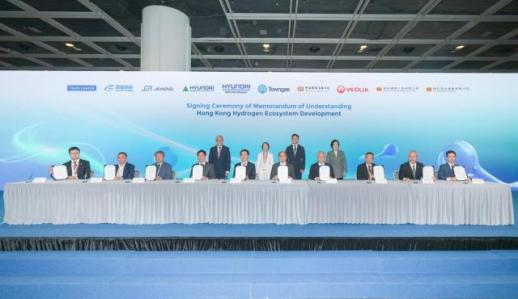 Hyundai Motor Group signs multilateral MOU to build hydrogen ecosystem in Hong Kong SEOUL, May 18 (AJP) - Hyundai Motor Group said Monday it has signed a multilateral memorandum of understanding with nine other companies to create a hydrogen ecosystem in Hong Kong, positioning the city as a gateway for the group's broader push into the Asia-Pacific hydrogen market. Hyundai Motor and Hyundai Engineering & Construction signed the agreement during the International Hydrogen Development Symposium 2026 at the Hong Kong Convention and Exhibition Centre. The agreement involves 10 companies, including South Korean firms Hyundai Motor, Hyundai Engineering & Construction and JING, as well as Hong Kong, Chinese and international partners including Towngas, Veolia, China Certification & Inspection Group, Guofu Hydrogen Energy, Templewater, Chun Wo Construction and Chun Wo Bus. Under the agreement, the companies will work to develop waste-to-hydrogen facilities that produce low-carbon hydrogen from landfill gas, build liquid hydrogen refueling stations and introduce hydrogen-powered mobility services. Liquid hydrogen refueling stations can store more hydrogen per unit volume than gaseous hydrogen stations, making them better suited for areas with limited available land. Hyundai Motor Group said the project is designed to support Hong Kong’s energy transition by creating a local hydrogen value chain that connects production, charging and mobility use. Hong Kong has limited land available for renewable energy production and relies heavily on imported energy. According to the city’s Census and Statistics Department, its dependence on imported primary energy stood at about 98.7 percent last year. The project comes as the Hong Kong government, which redefined its hydrogen roadmap in 2024, has been supporting hydrogen commercial vehicles and refueling infrastructure through the New Energy Transport Fund. Hyundai Motor will oversee the broader hydrogen ecosystem project, including hydrogen production, refueling infrastructure and the supply of hydrogen mobility. Hyundai Engineering & Construction will design and build waste-to-hydrogen facilities optimized for Hong Kong’s hot and humid climate. Hyundai Motor Group has been expanding its hydrogen business in South Korea and overseas. The group has built biogas-based clean hydrogen production facilities in Cheongju and Paju and began applying a similar waste-to-hydrogen model in Indonesia last year. In 2023, it established HTWO Guangzhou, its first overseas hydrogen fuel cell system production base, as part of efforts to expand in the Greater China market. Shin Seung-kyu, executive vice president in charge of energy and hydrogen policy at Hyundai Motor Group, said the agreement was signed to support Hong Kong’s hydrogen policy and build a local hydrogen ecosystem based on the group’s hydrogen business capabilities and experience. He said Hyundai Motor Group will continue to expand cooperation and business opportunities across the Asia-Pacific hydrogen market, starting with Hong Kong. 2026-05-18 18:00:10
 -
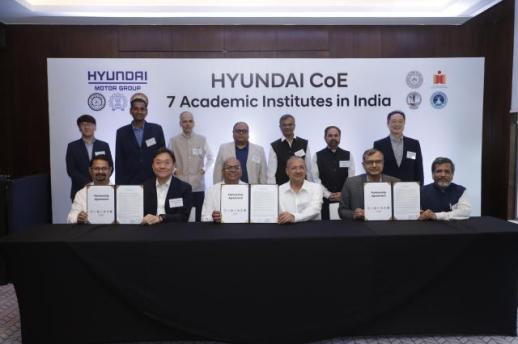 Hyundai Motor, Kia expand EV research network with Indian universities SEOUL, May 18 (AJP) - South Korean automakers Hyundai Motor and Kia have expanded their joint research network with leading Indian universities to strengthen core technologies in electric vehicle batteries and electrification, the companies said Monday. Four universities — IIT Hyderabad, IIT Kanpur, Visvesvaraya National Institute of Technology Nagpur and Tezpur University — signed agreements to participate in the network under the Hyundai Center of Excellence for future mobility technology. Hyundai Motor and Kia launched the center on April 23, 2025, with IIT Madras, IIT Delhi and IIT Bombay as part of efforts to strengthen industry-academia research cooperation in India. With the latest additions, the network now includes seven universities across India. They will work on 39 joint research projects covering batteries, electrification, advanced materials and AI-based vehicle-to-grid platforms. Hyundai Motor and Kia said the expanded network will focus on battery designs tailored to local market conditions, electrification performance technologies and talent development in future mobility. Kim Chang-hwan, executive vice president in charge of electrification energy solutions at Hyundai Motor and Kia, said the agreement represents “a shared promise for the future,” adding that Hyundai Motor Group and Indian academia will continue cooperation in future mobility technologies. The expansion comes as Hyundai Motor and Kia strengthen their presence in India, where the companies posted record first-quarter sales and recently signed an agreement with TVS Motor Company to develop India-focused electric three-wheelers. 2026-05-18 17:53:50
 -
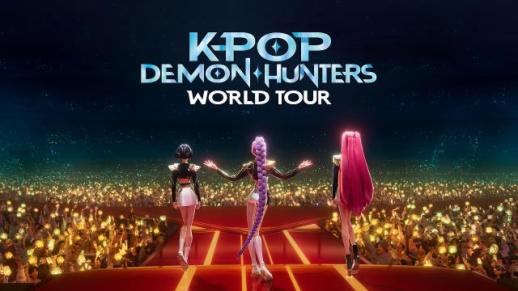 Netflix, AEG Presents announce plans for 'K-Pop Demon Hunters' concert tour SEOUL, May 18 (AJP) - Streaming giant Netflix and live entertainment company AEG Presents announced on May 15 that they plan to develop a global concert tour based on the animated film "KPop Demon Hunters," though no performers, tour dates or cities have been announced. The two companies said the project would draw on the film's music and fictional K-pop universe to create a live stage experience for audiences worldwide. Neither company disclosed the format of the performances — whether concerts, a theatrical production or a hybrid live production — nor a projected launch timeline. "KPop Demon Hunters," directed by Maggie Kang and Chris Appelhans and produced by Sony Pictures Animation in partnership with Netflix, follows HUNTR/X, a fictional K-pop girl group whose members secretly battle supernatural forces while maintaining their image as stadium-filling pop stars. The film and its soundtrack have also gained attention during the awards season. Its song "Golden" won Best Song Written for Visual Media at the Grammy Awards, Best Original Song at both the Golden Globes and the Academy Awards, while the film took Best Animated Feature at both ceremonies. AEG Presents, one of the world's largest live entertainment companies, has previously promoted tours for major K-pop acts including BLACKPINK, ATEEZ, LE SSERAFIM and TOMORROW X TOGETHER, among others. The announcement comes as the film's soundtrack has become one of the year's biggest music releases, expanding the property's reach beyond streaming. 2026-05-18 17:53:06