
Journalist

Yoo Joonha
joonhayoo94@ajupress.com
-
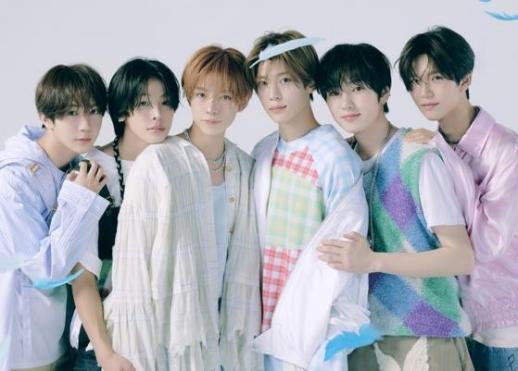 NCT WISH to release first studio album 'Ode to Love' on April 20 SEOUL, April 02 (AJP) -K-pop boy band "NCT WISH" will release its first studio album "Ode to Love" on April 20, marking a key milestone for the rookie act as it continues to build its presence in the global market, its agency SM Entertainment said Thursday. NCT WISH, a six-member boy group consisting of Sion, Riku, Yushi, Jaehee, Ryo and Sakuya, debuted in 2023 under SM Entertainment. The group has been recognized for its refreshing, youth-driven concept and performance-focused identity, with tracks such as "Wish," "Songbird," and "Steady." The group kicked off its comeback rollout by unveiling a schedule video titled “WISH Upon A Dream” at midnight through its official social media channels. The video features illustrated visuals reflecting the group’s signature kitsch and playful aesthetic, alongside a timeline of upcoming promotional content. According to the agency, teaser materials will begin rolling out on April 6, including concept images, a promotional website titled "Ode Diary," a music video for the track "Sticky," and teaser content for the title track, "Ode to Love." The 10-track album is set for release at 6 p.m. (0900 GMT) on April 20 across major music platforms, with a physical version also scheduled for the same day. Pre-orders are currently available through online and offline music retailers. 2026-04-02 15:20:55
 -
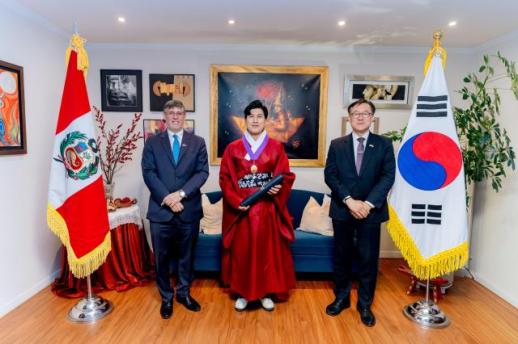 Peru honors Samuel Chung for contributions to Korea–Peru ties SEOUL, April 02 (AJP) - The Peruvian government has awarded Samuel Chung, president of the Korea Culture Association, the Order of Merit at the Comendador level in recognition of his contributions to strengthening ties between South Korea and Peru. The decoration was presented Wednesday by Peruvian Ambassador to Korea H.E. Paul Duclos at his residence in Seoul, on behalf of the president of Peru. The award coincided with the inaugural “Korea–Peru Friendship Day,” established by the Peruvian Congress in 2025 to commemorate diplomatic relations between the two countries, first forged on April 1, 1963. Chung has long been engaged in promoting cultural exchanges between Korea and Peru, working closely with the Peruvian Embassy in Seoul on a range of bilateral programs. His activities have included events linked to the 2024 APEC summit in Peru and celebrations marking the 60th anniversary of diplomatic ties, including a reception for the Peruvian naval training ship B.A.P. Unión. Ambassador Duclos praised Chung’s sustained efforts, saying he has “served as a bridge between the two countries over many years,” helping to boost interest in Korean culture among younger generations in Peru. Choi Joon-ho, director-general for Latin American affairs at South Korea’s foreign ministry, also congratulated Chung, expressing hope that bilateral cooperation would continue to expand. “This honor does not belong to me alone, but to everyone who has worked to promote cultural diplomacy between Korea and Peru,” Chung said. “I will continue to support exchanges that deepen mutual understanding.” Established in 1950, the Order of Merit is awarded to individuals — civilian or military, domestic or foreign — who have made distinguished contributions to the nation or demonstrated excellence in fields such as the arts, science, industry and commerce. 2026-04-02 15:20:47
 -
 Korea leads broad Asian fall on disappointment at Trump address SEOUL, April 02 (AJP) - Asian stocks fell Thursday, led by energy-dependent South Korea, as U.S. President Donald Trump’s much-hyped address failed to deliver clarity on reopening the Strait of Hormuz, leaving markets with more uncertainty than relief. Trump, speaking in a nationally televised address at 10 a.m. Korea time, said the conflict could continue for “two to three more weeks,” while offering no clear commitment to restoring access to the key shipping route. The remarks, coupled with continued military rhetoric, reinforced concerns over prolonged disruption to global energy supply. The benchmark KOSPI dropped 3.96 percent to 5,261.78 as of 11:20 a.m., sharply reversing from the previous day’s rally as sentiment turned risk-off. Institutional investors provided limited support, purchasing a net 341.8 billion won ($226 million), while retail and foreign investors sold 303.8 billion won and 159.0 billion won, respectively, signaling a broad pullback. Large-cap stocks declined across the board. Samsung Electronics fell 4.8 percent to 180,600 won, while SK hynix dropped 4.3 percent to 855,000 won. Hyundai Motor lost 3.9 percent to 469,000 won, and Kia slipped 1.2 percent to 153,400 won. LG Energy Solution edged down 0.3 percent. In contrast, defense and aerospace-related shares advanced, reflecting heightened geopolitical tensions and renewed interest in strategic industries. Hanwha Aerospace rose 6.9 percent to 1,425,000 won, supported by expectations of increased defense demand and strengthening momentum in the space sector. The gains were further underpinned by optimism over NASA’s Artemis II lunar mission and reports that SpaceX has confidentially filed for an initial public offering, reinforcing long-term growth expectations in aerospace. The KOSDAQ also fell, declining 3.3 percent to 1,079.8, with losses accelerating shortly after the start of Trump’s address at 10:02 a.m. Selling pressure on the secondary board was led by institutions and foreign investors, which offloaded 182.2 billion won and 73.6 billion won, respectively, while retail investors bought 290.6 billion won, indicating a divergence in risk appetite. The Korean won also erased most of the previous day’s gains, weakening to 1,520 per dollar as foreign outflows persisted. Oil prices surged, with Brent crude rising 4.7 percent to $105.8 per barrel and West Texas Intermediate gaining 3.9 percent to $104.1, underscoring persistent supply concerns tied to disruptions in the Strait of Hormuz. Across Asia, major indices also traded lower. Japan’s Nikkei 225 fell 1.3 percent, Hong Kong’s Hang Seng Index declined 0.8 percent, and China’s Shanghai Composite edged down 0.1 percent, reflecting a broader shift toward risk aversion. 2026-04-02 11:35:10
 -
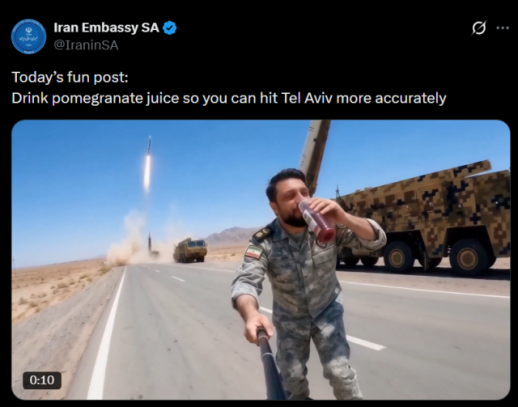 April Fools' jokes turn serious as U.S., Iran trade memes alongside war SEOUL, April 01 (AJP) -The joke on this year’s April Fools’ Day was no joke for the United States and Iran, as they wage a parallel war of memes and parodies online alongside the real conflict. What was once confined to humor and internet culture is increasingly emerging as a tool of influence, signaling a shift in how states communicate and compete in times of conflict. A meme circulating on X on April 1 depicted U.S. President Donald Trump in a cartoonish, childlike form, dressed in a stylized outfit and playing with toy aircraft and submarines inside a mock White House setting. Framed as a jab at his handling of the war, the post drew around 76,000 views, 1,900 likes and more than 800 reposts within hours. Another widely shared post, uploaded by an Iranian embassy-affiliated account, showed an AI-generated figure skateboarding past military vehicles while casually drinking pomegranate juice as missiles launched in the background. Captioned, “Drink pomegranate juice so you can hit Tel Aviv more accurately,” the content amassed more than 2.8 million views, 51,000 likes and 7,600 shares. Analysts say such content reflects the “gamification” of conflict, particularly in digital environments where visual simplicity and emotional resonance drive engagement. The examples align with a broader pattern seen in recent exchanges among Iran, the United States and Israel, where messaging increasingly incorporates satire, pop culture references and rhetorical mimicry — blurring the line between propaganda and entertainment. Iranian officials have echoed phrases associated with Trump, including his well-known “You’re fired” remark, while adopting his communication style to dismiss criticism as “fake news.” References to films and gaming imagery have similarly been used to frame opposing narratives in a more derisive light, suggesting a deliberate effort to communicate through culturally recognizable formats rather than conventional political language. Unlike past conflicts, where psychological operations were largely conducted through radio broadcasts, printed leaflets and tightly controlled media narratives, the rise of digital platforms has shifted influence from centralized messaging to decentralized, rapidly replicating content. “Short-form videos can now be generated within minutes and distributed automatically,” said Billy Choi, a collaboration professor at Korea University’s Human-Inspired AI Research Institute. Choi noted that large volumes of content can be produced with minimal human intervention and said algorithms further amplify this process by repeatedly surfacing similar content based on user behavior. This combination of automation and algorithmic amplification allows for what analysts describe as volume-driven dissemination, where repeated exposure becomes a more effective mechanism of influence than factual accuracy. Military analysts interpret the trend as part of an evolving information warfare landscape. “Mobilizing all available platforms to influence public sentiment is becoming a central feature of modern conflict,” said Choi Ki-il, a professor in Sangji University’s Department of Military Studies. Such tactics reflect a long-standing strategic principle. “Winning without fighting has long been considered the highest form of strategy, and these developments can be seen as its extension in the digital domain,” he said. As digital platforms continue to evolve, analysts expect such forms of communication to become more sophisticated, further blurring the boundary between satire, influence and strategy. 2026-04-01 17:44:39
 -
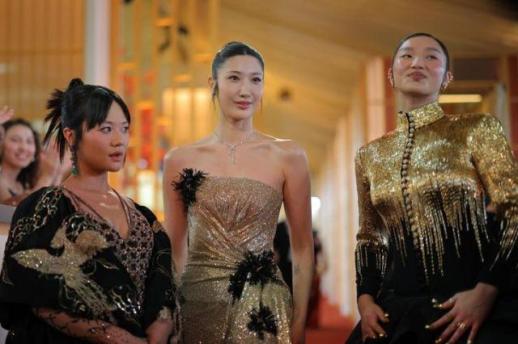 Grand homecoming for award-winning K-pop Demon Hunters team SEOUL, April 01 (AJP) - Singer-songwriter EJAE still lives in the surreal “Golden” moment of the Oscars night she stole by winning Best Original Song for the Netflix animation K-pop Demon Hunters and performing the famously high-pitched “up, up, up” at the 98th Academy Awards. “I used to be teased in the United States, but standing on the Oscars stage and seeing the audience wave light sticks, I felt a deep sense of pride,” she said, her voice breaking as she received a warm welcome back home. EJAE joined fellow Oscar winners at a joint press conference at CGV Yongsan I’Park Mall in Seoul, alongside key figures behind the film, including co-directors Maggie Kang and Chris Appelhans, and producers from The Black Label’s IDO — Lee You-han, Kwak Jung-gyu and Nam Hee-dong. The event marked the film’s recent triumph at the 98th Academy Awards, where it secured both Best Animated Feature and Best Original Song — a rare double win that underscores the growing global influence of Korean content. Singer also recalled the emotional buildup to her performance, saying she became overwhelmed during rehearsals. “I cried a lot during rehearsal,” she said, adding that incorporating traditional Korean elements such as pansori and gugak made the performance especially meaningful. That emotional intensity carried onto the stage, where the performance drew strong reactions — including Hollywood actors seen waving light sticks, a signature element of K-pop fandom. Co-director Appelhans said Korean cultural identity would remain central to the sequel. “The Koreanness is the soul of the film,” he said, adding that the next installment will continue to draw on Korean cultural elements while expanding the story beyond the first film. The event highlighted a broader shift, as distinctly Korean cultural elements are increasingly being translated into content with global appeal rather than remaining confined to local narratives. Participants also pointed to the role of audiences in the film’s success, noting that global fans were instrumental in discovering and amplifying the film. While specific details of the sequel were not disclosed, Kang said the team aims to deliver a larger-scale project building on the success of the original. Released in June 2025, K-pop Demon Hunters follows a fictional K-pop girl group battling supernatural forces, blending music, fantasy and Korean mythology. The film has since garnered major international accolades, including the Golden Globes and the Grammys, culminating in its Oscar wins last month. 2026-04-01 16:15:52
 -
 Seoul leads Asian bourse rally on war endgame hopes SEOUL, April 01 (AJP) - Asian markets surged Wednesday, with Seoul leading gains as investors moved on bargain-hunting opportunities amid signs the Middle East conflict may be winding down. U.S. President Donald Trump is due to hold a press conference later Wednesday after signaling a possible withdrawal of U.S. forces from Iran within “two to three weeks.” Overnight, the Dow Jones Industrial Average rose 2.5 percent, while the S&P 500 and Nasdaq Composite gained 2.9 percent and 3.8 percent, respectively. The CBOE Volatility Index (VIX) plunged 17.5 percent to 25.25, signaling a sharp easing in market anxiety. The U.S. dollar sharply retreated to 1,507.3 won after hovering above 1,530 won in the previous session. Oil prices remained elevated, with Brent crude rising 1.7 percent to $105.7 per barrel and West Texas Intermediate gaining 1.5 percent to $102.9, as supply concerns persisted despite improving risk sentiment. In Seoul, the benchmark KOSPI surged 6.2 percent to 5,370.7 in early trade, reclaiming the 5,300 level. The rally triggered a buy-side sidecar at 9:07 a.m., temporarily halting program buy orders after futures jumped more than 5 percent. The gains were driven by hopes of easing geopolitical tensions, which lifted risk appetite and spurred institutional buying in large-cap stocks. Institutional investors led the rally, buying 1.05 trillion won ($697 million) worth of shares, while retail and foreign investors sold 1.00 trillion won and 135.8 billion won, respectively. Large-cap stocks advanced broadly. In semiconductors, Samsung Electronics surged 8.5 percent to 181,400 won, while SK hynix climbed 8.4 percent to 875,000 won. Automakers also gained, with Hyundai Motor rising 7.4 percent to 478,500 won. Industrial and defense-related shares outperformed, with Doosan Enerbility rising 6.8 percent to 98,000 won, SK Ocean Plant jumping 10.8 percent to 29,750 won, and Hanwha Systems surging 14.5 percent to 130,600 won. Hyundai Engineering & Construction gained 9.6 percent to 155,700 won. The KOSDAQ also rallied, rising 5.0 percent to 1,105.7 as of 10:30 a.m. Institutional and foreign investors supported the gains, purchasing 145.9 billion won and 150.5 billion won, respectively, while retail investors sold 304.3 billion won. Improved risk sentiment fueled buying in high-beta and thematic stocks. Biotech shares advanced, with Alteogen rising 4 percent to 355,000 won, while battery-related stock EcoPro BM gained 3.6 percent to 199,300 won. Robotics-related shares outperformed, as Rainbow Robotics jumped 7.3 percent to 559,000 won. Elsewhere in Asia, Japan’s Nikkei 225 climbed 3.6 percent, Hong Kong’s Hang Seng Index gained 2.2 percent, and China’s Shanghai Composite rose 1.2 percent, reflecting improved risk appetite. 2026-04-01 11:37:42
 -
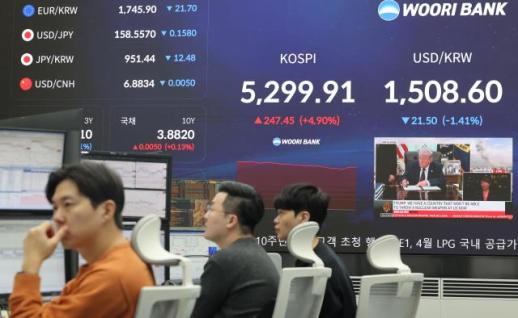 Korean stocks and won roar back on Gulf endgame hopes SEOUL, April 01 (AJP) - The first buy-side sidecar in 10 trading sessions was triggered on the Seoul bourse at the open Wednesday, as the market surged nearly 5 percent with institutions returning in force on expectations the war may be winding down following overnight comments by U.S. President Donald Trump. The benchmark KOSPI rose 4.9 percent to reclaim the 5,300 mark, while the KOSDAQ gained 4.6 percent to move above 1,100. The U.S. dollar also fell back below the 1,510 won level after spiking above 1,530 won in the previous session. Investment sentiment improved for the first time in many days after Trump said U.S. operations against Iran could be “wrapped up” within two to three weeks. He also suggested that a formal agreement may not be necessary to end the conflict and that the United States could “leave Iran very soon,” remarks that markets interpreted as signaling potential de-escalation. The comments come amid mixed signals on diplomacy. While Trump said negotiations are underway, Iran has denied direct talks, though it confirmed indirect exchanges through intermediaries. The sharp rally followed strong gains on Wall Street overnight. The S&P 500 rose 2.91 percent to 6,528.51, while the tech-heavy Nasdaq Composite jumped 3.83 percent to 21,590.63. The Dow Jones Industrial Average advanced 2.49 percent to 46,341.33. Gainers on the KOSPI overwhelmed losers 818 to 84, with bellwethers Samsung Electronics and SK hynix soaring nearly 7 percent. 2026-04-01 09:33:26
 -
 April squeeze forces K-pop acts to fight to spotlight SEOUL, April 01 (AJP) - April may prove a cruel month for some K-pop acts, as a crowded comeback calendar squeezes much of the first half’s release schedule into a single month. At least 27 acts are set to return in April, ranging from major-label groups and established stars to rookies and soloists. What was supposed to be a strategy to avoid head-on clashes with mega events — including BTS’s return and major political and sporting fixtures — has instead produced an intense bottleneck. The lineup begins with Tomorrow X Together on April 13, marking the group’s first release since renewing their contracts. NCT WISH follows on April 20, while ILLIT is scheduled to return on April 30. LE SSERAFIM is set for a comeback just six months after its previous release, with TWS and others also joining the packed slate. Solo releases are piling up alongside group returns. Much of the congestion stems from delays earlier in the year. First-quarter releases were pushed back to avoid high-profile events, including the Winter Olympics in Italy from Feb. 6 to 22 and BTS’s March 20 release of its fifth studio album, followed by a large-scale performance in downtown Seoul the next day. The months ahead offer little relief. Local elections are scheduled for June 4, and the World Cup will follow, creating further pressure on agencies trying to secure attention before public focus shifts elsewhere. “When major national or global events take place, attention and spending are redirected there first,” pop culture critic Kim Sung-soo said. “Entertainment becomes secondary.” That has left only a narrow window between BTS’s return and the coming wave of headline-grabbing events. In trying to avoid competition, the industry has instead concentrated it. “When resources, time, money and attention are pulled toward larger events, other forms of consumption are pushed back,” Kim said. “That is when release schedules begin to cluster.” The April lineup now spans the full spectrum of the market, with top-tier groups, solo acts and newcomers all crowding into the same stretch in a fight for visibility. 2026-04-01 08:13:04
 -
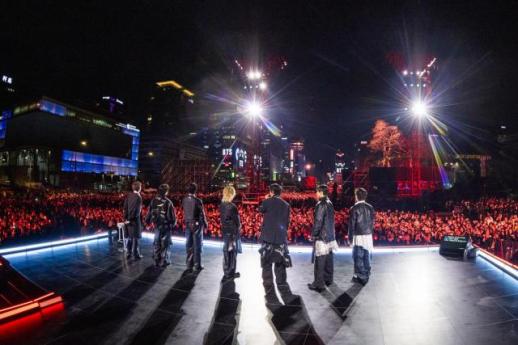 BTS' 'Swim' hits No. 1 on Billboard's top 100 song chart SEOUL, March 31 (AJP) - BTS has topped the Billboard Hot 100, the weekly top 100 song chart compiled by the prominent American music and entertainment magazine, on Monday (local time) with the band's new song "Swim," released on March 20. While BTS reached its seventh No. 1 on Billboard's most popular song chart, the seven-member band also dominated other global rankings across major Billboard charts. According to Billboard, "Swim" debuted at No. 1 on the Hot 100, driven by a combined performance of streaming, radio airplay and digital sales in the United States. The latest result places BTS among the top five groups with the most Hot 100 No. 1 hits in history, trailing legendary bands such as The Beatles, The Supremes, Bee Gees and The Rolling Stones. The track’s debut extends BTS’ Hot 100 leadership streak that began with “Dynamite” in 2020, followed by successive chart-toppers including "Savage Love (Laxed – Siren Beat)," "Life Goes On," "Butter," "Permission to Dance" and "My Universe." The group’s latest achievement comes in tandem with strong album performance. The band's new album "Arirang" entered at No. 1 on the Billboard 200, the weekly top 200 albums chart, completing a simultaneous sweep of Billboard’s two primary charts. This achievement is widely regarded as a key indicator of both consumption scale and market impact in the U.S. music industry. Beyond the U.S., BTS delivered an unprecedented showing on global charts. "Swim" debuted at No. 1 on both the Billboard Global 200, the weekly top 200 global song chart, and the Billboard Global Excl. U.S., the weekly popular song chart based on digital sales and streamings, becoming the group’s eighth leader on each ranking and extending its own record for the most No. 1 songs on the charts. Tracks from BTS' album "Arirang" occupied the entire top nine positions on the Global 200, matching the record set by American pop-singer Taylor Swift, while BTS became the first act to monopolize the top 10 and top 13 on the Global Excl. U.S. chart. The concentration of entries underscores the scale of coordinated global streaming and purchasing activity following the album’s release. "Swim" led the performance with 108.8 million streams and 221,000 units sold worldwide in the tracking week ending March 26, according to data compiled by Luminate. Eight additional tracks from the album followed in sequence on the Global 200, each surpassing 40 million streams, reflecting unusually high depth of consumption across the full album rather than a single-track concentration. The official Hot 100 chart is set for release Tuesday, with market attention focused on how many additional tracks from “Arirang” will enter the ranking, potentially extending BTS’ multi-chart dominance further. 2026-03-31 08:55:07
 -
 BABYMONSTER to drop third mini album 'CHOOM' on May 4 SEOUL, March 30 (AJP) - K-pop girl band BABYMONSTER will release its third mini album "CHOOM" next month, marking its latest comeback as the group continues to expand its global presence, said the seven-member group's agency on Monday. BABYMONSTER, a hip-hop-based pop-dance group under South Korea's entertainment powerhouse YG Entertainment, is a multinational band launched in 2024, seven years after BLACKPINK. BABYMONSTER consists of seven members — Ruka, Pharita, Asa, Ahyeon, Rami, Rora and Chiquita — from South Korea, Thailand, and Japan, attracting fans from around the world. The agency unveiled a teaser poster titled BABYMONSTER 3rd mini album CHOOM on its official blog on March 29, confirming that the upcoming album will be released at 6 p.m. (0900 GMT) on May 4. Ahead of the comeback, the group will hold a weeklong fan event, “MONSTIEZ DAY,” from Monday to Saturday at "The Same" stores, popular among K-pop fans for its idol-related merchandise, located in Seoul's hipster districts including Hapjeong, Myeongdong, and Insadong. The fan event will feature interactive programs and offer special gifts prepared by the members. 2026-03-30 17:53:04