
Journalist

Yoo Joonha
joonhayoo94@ajupress.com
-
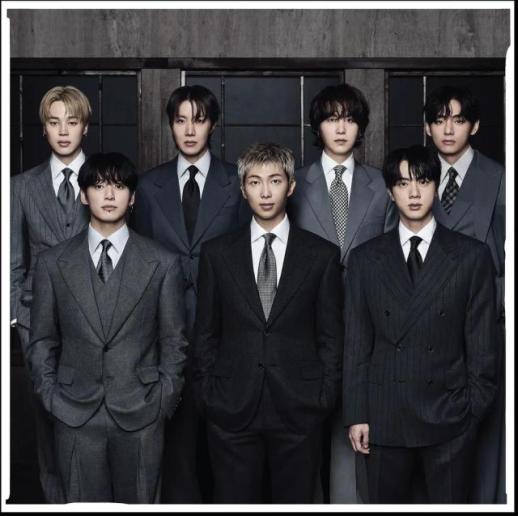 BTS Live D-1: From waiting to Arirang, from Gwanghwamun to the world SEOUL, March 20 (AJP) -They are officially back as seven, with the drop of the fifth BTS full-member album ARIRANG on Friday. That simple fact is the emotional center of this comeback — bigger than chart numbers, bigger than spectacle, even bigger than the stage rising in central Seoul. After three years and nine months without a full-group album, BTS has returned with ARIRANG, carrying something both intimate and immense: the joy of reunion and the weight of time. The members said it plainly. They had prepared carefully because ARMY had waited so long. They felt excited, nervous and above all deeply moved. More than anything, they said, they were grateful simply to be able to do something together again as seven. Before it is an event, this comeback is a reunion. Yet BTS is not returning by repeating what came before. The fifth full-length album, ARIRANG, opens what the group calls “BTS 2.0” — a new chapter shaped as much by growth as by reunion. The title track “SWIM” captures that direction. Jimin described it as a message about continuing forward: there is pressure, there are doubts, but there is no stopping. It is not a return to shore. It is movement through water. That sense of motion runs through the album. The members said they focused on expanding genre, sound and vocal expression, even stepping into unfamiliar territory. Some tracks push rougher or more experimental textures, while others deliberately strip things back. Still, the guiding question remained simple, as SUGA put it: what is most like us? That question may explain the title. Arirang is one of the most resonant words in Korean culture — a song, a feeling, a shared memory of endurance and passage. For BTS, it becomes a bridge between identity and reinvention. Each member described “BTS 2.0” differently — a new beginning, growth, a new direction — but RM brought it into focus as balance: half is the meaning of being seven again, and half is the need to move forward. That balance also explains why they chose Gwanghwamun. Most artists would return in a stadium. BTS chose Gwanghwamun Square, the symbolic heart of Seoul. Framed by Gyeongbokgung Palace, it is a place where history, public life and national identity meet. That choice turns the comeback into more than a concert. It becomes a national narrative moment — where K-pop, cultural symbolism and public emotion converge. The space itself becomes part of the performance. Even before the music begins, the setting carries meaning. The decision to make the show free adds another layer. This is not a closed, ticketed return. It is open, in a public square. That changes the emotional contract. It makes the comeback feel communal rather than exclusive — less like a product launch, more like a gathering. For a group built on its connection with ARMY, the symbolism is clear: the first step back is outward. And yet the moment is not limited to Seoul. The Gwanghwamun performance will be livestreamed globally, allowing fans across the world to share the same moment. That duality — local and global, intimate and vast — has always defined BTS. Their rise was not a single explosion, but a steady accumulation. From their 2013 debut through years of gradual growth, from early tours to global chart dominance, BTS built momentum step by step. Even at their largest scale, they retained something direct — a closeness with fans that did not disappear as the stage expanded. That is why this reunion carries such weight. During the hiatus, each member pursued solo work, but the group itself never faded. If anything, the time apart clarified what BTS is: seven distinct artists whose meaning is strongest together. Jungkook recalled the process of listening to more than 100 demo tracks as a group — sometimes hearing each other’s work for the first time — as one of the most memorable parts of making the album. Jin said the members have grown closer. The atmosphere — the jokes, the laughter — remains unchanged. BTS 2.0, then, is not a break from who they were. It is a continuation, with more depth. The Gwanghwamun stage is also a beginning. It opens into a global tour and the so-called “BTSnomics 2.0,” where the group’s impact extends beyond concerts into platforms, digital content and a wider cultural economy. 2026-03-20 11:55:19
 -
 Asian stocks broadly retreat more than 2%, USD/KRW breaches 1,500 SEOUL, March 19 (AJP) - Korean stocks tumbled Thursday, tracking a broad selloff across Asia, while the won broke past the key 1,500 level against the dollar as surging oil prices and escalating Middle East tensions triggered heavy foreign outflows. The benchmark KOSPI fell 2.7 percent to close at 5,763.22, after briefly touching an intraday low of 5,738.95. The Korean won weakened to 1,500.6 per dollar at the close, breaching the psychological 1,500 threshold as risk-off sentiment intensified and capital outflows accelerated. Foreign investors led the selloff, dumping 1.87 trillion won ($1.25 billion) worth of shares on the KOSPI, while institutions sold an additional 665.9 billion won. Retail investors bought 2.41 trillion won, absorbing the bulk of the selling. The divergence in flows reflected a classic risk-off pattern, with offshore capital exiting aggressively as currency volatility spiked. Technology heavyweights bore the brunt of the decline. Samsung Electronics fell 3.8 percent to 200,500 won, while SK hynix dropped 4.1 percent to 1,013,000 won, tracking weakness in global semiconductor shares. NAVER and Kakao declined 2.7 percent and 2.9 percent, respectively. Cyclical sectors also came under pressure. Hyundai Motor fell 3.3 percent and LG Energy Solution slipped 3.3 percent, as rising oil prices and rate concerns weighed on growth-sensitive stocks. Hybe dropped 3.5 percent to 354,500 won ahead of BTS’s comeback, as broader market risk aversion overshadowed event-driven optimism. The tech-heavy KOSDAQ fell 1.79 percent to 1,143.48. Foreign investors sold 202.6 billion won on the KOSDAQ, while institutions offloaded 262.3 billion won. Retail investors bought 502.1 billion won, mirroring the KOSPI pattern. Losses were broad-based across sectors, with electronics, securities and industrials leading declines as tightening financial conditions and geopolitical risks dampened investor appetite. In contrast, select energy-linked plays rallied. SK Eternix surged 26.1 percent, extending its monthly gain to nearly 95 percent, as investors rotated into renewable energy stocks as a hedge against rising crude prices. Samsung Electro-Mechanics rose 3.34 percent. Construction stocks also outperformed, with Daewoo Engineering & Construction gaining 8.7 percent on expectations of overseas infrastructure and nuclear power projects. Overnight on Wall Street, major indexes fell, with the Dow Jones Industrial Average down 1.6 percent, the S&P 500 losing 1.4 percent and the Nasdaq declining 1.5 percent. The Philadelphia Semiconductor Index slipped 0.5 percent, while Nvidia and ASML fell 0.8 percent and 2.5 percent, respectively. Oil remained the central driver of sentiment. Brent crude surged 6.5 percent to $114.4 per barrel, while West Texas Intermediate rose to $97.3, heightening inflation concerns and reinforcing fears of prolonged supply disruptions tied to attacks on Middle Eastern energy infrastructure. Market volatility spiked, with the VIX jumping 13.8 percent to 25.5, signaling elevated investor anxiety. Across Asia, markets broadly declined under the weight of energy shocks and tightening financial conditions. Japan’s Nikkei 225 plunged 3.4 percent as investors unwound positions ahead of the Vernal Equinox Day holiday. Hong Kong’s Hang Seng fell 2 percent, while China’s Shanghai Composite dropped 1.4 percent. 2026-03-19 17:40:21
 -
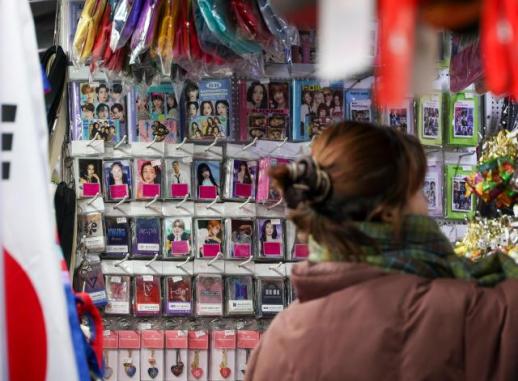 BTS Live D-2: Unofficial BTS goods surge in Seoul challenging brand control SEOUL, March 19 (AJP) - As official BTS merchandise becomes ever more expensive and ever harder to obtain ahead of the group’s comeback concert Saturday, a parallel market is emerging in Seoul and beginning to challenge the limits of brand control. In the city’s popular tourist Myeongdong and Insadong districts, unofficial BTS-themed goods have moved beyond the margins and into plain sight. Street vendors and small retailers openly display banners, printed T-shirts, photo cards, keychains and accessories. Tables stacked with BTS purple-themed items line narrow streets, while racks of printed apparel spill out onto sidewalks, blurring the boundary between formal retail space and street-level commerce. In one shop in Insadong, BTS-logo eco bags were selling for 25,000 won ($17), while metal badges were priced at 10,000 won, offering a snapshot of how unofficial goods are being priced on the ground. The contrast with official distribution is stark. Licensed goods remain limited, often require online access, and are subject to timed releases. For visitors arriving just days before the concert, the unofficial merchandise represents the only practical option. "I don’t mind buying unofficial goods," said Jeniffer Dayton, a 25-year-old visitor from Florida. For such fans, the distinction between approved and unapproved is secondary to participation itself. The ability to take part in a shared moment that is unfolding across the city counts for more. "What matters is our love for BTS,” she said. “These items are more practical, I can actually use them in my daily life, like a lanyard for my keys, unlike some official goods that I mostly keep at home." This shift is beginning to reshape the balance between brand management and on-the-ground consumption. Official merchandise carries legitimacy and scarcity, but the unofficial market operates on speed, proximity and volume, factors that become decisive in a time-sensitive, event-driven setting. "If you look at resale markets like eBay, official light sticks easily goes for over $100," said Sarah Zhong, a 31-year-old visitor from Guangzhou currently living in Washington. "Getting one for under $50 feels like a bargain but it’s usually really hard to get your hands on one." At the same time, the divide remains meaningful within parts of the core fan base, where authenticity continues to carry symbolic weight and ownership of official goods is tied to identity and loyalty. "I still prefer official goods because they feel more authentic," she said. "But if I see something I really like, especially something related to V, I might still buy it." A vendor, who asked not to be named, denied that she made the products. She said she is supplied by manufacturers and does not know if the products are licensed or not. She declined to provide further details. The fragmented supply chain reflects the speed at which the market has scaled up, with goods flowing into tourist-heavy districts in response to surging demand. The result is not simply a coexistence of two markets, but a structural tension. As Seoul transforms into a city-scale stage for BTS, the gap between controlled branding and uncontrolled demand is becoming increasingly visible, raising questions about how much of the fan experience can, or should, be managed. 2026-03-19 17:18:23
 -
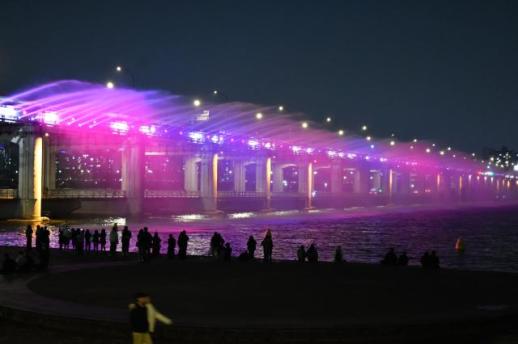 BTS Live D-2 : Latest from Gwanghwamun - beyond and across Seoul SEOUL, March 19 (AJP) - Seoul’s transformation ahead of BTS’s comeback is no longer confined to barricades and traffic controls. It is now unfolding as a citywide visual and behavioral shift one that is already drawing crowds into the experience before the performance begins. At Gwanghwamun Gate, visitors dressed in traditional hanbok gathered in large numbers, taking photos against the historic backdrop, an early sign that the area is already functioning as a cultural staging ground rather than a conventional tourist site. Along the Han River, bridges have been illuminated with sweeping arcs of purple and red water jets, turning ordinary infrastructure into a synchronized light and water display. Groups of people gathered along the riverbanks late into the evening, many pausing to watch and film the scene, suggesting that the buildup to the concert has effectively begun outside the main venue. Compared with just a few days ago, the pace of change has visibly accelerated across multiple parts of the city. The change is equally visible at street level. In central Seoul, storefronts are beginning to adopt BTS-themed visuals, with large purple banners reading “WELCOME BTS ♥ ARMY” stretching across building facades above convenience stores and cafes. The installations, while informal, signal how businesses are actively aligning themselves with the event, transforming everyday commercial spaces into extensions of the concert environment. In Namdaemun Market, large-scale banners congratulating BTS stretched across narrow commercial streets, demonstrating how even traditional marketplaces are actively incorporating the event into their daily operations This spread of visual identity marks a shift from earlier preparations, which focused heavily on security and crowd control. While police barriers and controlled pedestrian routes remain in place, they are now accompanied by a parallel layer of symbolic and commercial participation. Physical preparations are accelerating on site. Large-scale stage structures, lighting rigs and LED frames are now visibly assembled, with crews working throughout the day, indicating that the transformation is not only symbolic but structurally underway. At the same time, some concerns have emerged over the use of color in the broader promotional campaign. While purple remains the group’s signature color, red has also been used in certain visual elements a choice that has drawn cautious reactions in Korea, where red is strongly associated with conservative political parties. Some observers have warned that even unintended overlaps in visual symbolism could invite political interpretations in a highly polarized environment. Crowd behavior is also beginning to change. At public spaces near the venue, including stepped seating areas along the river, people were already gathering in clusters, sitting, waiting and checking their phones — a pattern more typical of pre-event staging than casual foot traffic. The scene suggests that the audience is starting to assemble well ahead of the scheduled performance. Fans have also begun to signal their presence visually. Some were already seen holding official light sticks near the venue, rehearsing the collective gestures that typically define BTS concerts. Together, these developments point to a broader transformation: the event is no longer anchored to a single stage at Gwanghwamun Square. Instead, it is expanding outward, absorbing surrounding districts into a loosely connected, city-scale experience. Lighting equipment and barricade systems have also been deployed around key heritage sites, reflecting the scale of technical integration required to turn the historic district into a live performance environment. The expansion is also becoming visible beyond Seoul itself, as surging arrivals at Incheon International Airport signal a sharp buildup of inbound visitors, with crowded terminals offering an early indication of the scale of movement toward the capital. With only two days remaining until the concert, Seoul is not just preparing for BTS, it is beginning to perform. 2026-03-19 09:21:21
 -
 Chip rally drives KOSPI higher as Samsung, SK hynix top 40% of market cap SEOUL, March 18 (AJP) - South Korean stocks roared higher on Wednesday, powered by chip heavyweights, as easing oil prices and renewed momentum in AI-linked semiconductors lifted investor sentiment. The benchmark KOSPI jumped 5.04 percent to close at 5,925.03, reclaiming the 5,900 level after opening at 5,767.10 and extending gains throughout the session. A buy-side sidecar was triggered in afternoon trading as futures rose more than 5 percent, underscoring the strength of the rally. Foreign and institutional investors led the advance, purchasing a combined 3.9 trillion won ($2.9 billion) worth of shares. Foreigners bought 880 billion won, while institutions added 3.1 trillion won. Retail investors, by contrast, were net sellers of 3.87 trillion won. The divergence in flows pointed to a clear rotation into large-cap, AI-linked semiconductor stocks, with institutional and foreign capital moving aggressively into index heavyweights while retail investors took profits. Technology shares led gains, supported by both near-term and structural drivers. Samsung Electronics rose 7.5 percent to 208,500 won, while SK hynix surged 8.9 percent to 1,056,000 won. Optimism around Micron Technology’s upcoming earnings boosted sentiment across memory stocks, while continued momentum from Nvidia’s AI ecosystem reinforced demand for next-generation high-bandwidth memory (HBM). Improved shareholder return expectations also lent support, with Samsung signaling stronger competitiveness and a commitment to enhancing shareholder value at its recent annual general meeting. The rally pushed the combined market capitalization of Samsung Electronics and SK hynix to 1,986 trillion won ($1.4 trillion), accounting for 40.6 percent of the KOSPI — the first time their combined weight has exceeded the 40 percent threshold. Samsung alone made up roughly a quarter of the market, with SK hynix contributing about 15 percent, highlighting the concentration of gains in semiconductor heavyweights. Autos and industrials also advanced, with Hyundai Motor rising 4.4 percent to 545,000 won and Kia gaining 4.7 percent to 175,100 won, suggesting a modest broadening of the rally beyond chips. The tech-heavy KOSDAQ rose 2.4 percent to 1,164.4. Foreign investors bought 491.7 billion won, while institutions and retail investors sold 27.5 billion won and 392.7 billion won, respectively. Still, the contrasting flows underscored that buying interest remained concentrated in large-cap names rather than spreading evenly across smaller growth stocks. Elsewhere in Asia, Japan’s Nikkei 225 climbed 2.9 percent, Hong Kong’s Hang Seng rose 0.5 percent and China’s Shanghai Composite gained 0.3 percent. Oil prices eased, with Brent crude falling 1.5 percent to $101.85 per barrel and West Texas Intermediate declining 2.9 percent to $93.45. In currency trading, the Korean won hovered around 1,488 per dollar ahead of the Federal Reserve’s policy decision. 2026-03-18 17:49:53
 -
 BTS Live D-3 : BTSnomics 2.0 estimated to top $2 billion SEOUL, March 18 (AJP) -Even before the album drop, BTS’s comeback after a nearly four-year hiatus is shaping up to be a billion-dollar blockbuster. Starting with a truly national-scale open-air performance on Saturday — expected to shut down traffic and deploy a presidential-level security presence — analysts forecast more than 3 trillion won ($2.2 billion) in economic impact from their year-long comeback agenda. Moreover, their return has accelerated the transition from event-driven revenue for K-Pop performers to a platform-based model, analysts say. “This comeback is not just a return to activity, but an event that expands the monetization structure of the K-pop industry,” said Kim Yoo-hyuk, an analyst at IBK Investment & Securities, in a report released March 17. The report projects 2.9 trillion won in direct revenue from album sales, global tours, and merchandise. The estimate assumes 6 million albums sold and 6 million concert attendees, with an average ticket price of 300,000 won and average merchandise spending of 140,000 won per fan. Including tourism-related spending, the total economic impact will exceed 3 trillion won, the report said. If global demand that cannot be absorbed by offline concerts shifts online, revenue estimates could rise further, it said. Early demand indicators already point to strong momentum for the fifth full-length album “Arirang.” The record surpassed 4.06 million pre-orders within a week of pre-sales beginning, according to distributor YG Plus, exceeding the previous record of 3.42 million set by “Map of the Soul: 7” in 2020. The scale of the upcoming BTS world tour further underscores the economic impact. The “Arirang” tour is scheduled to feature 82 performances across 34 cities, positioning it as one of the largest ever mounted by a K-pop act. Demand has surged across major markets. Performances in North America and Europe sold out rapidly following ticket releases, with online queues reportedly reaching hundreds of thousands of users. Secondary market prices have also spiked, with some U.S. resale tickets trading as high as $5,700. The surge is extending beyond ticket sales into broader consumption. Travel demand linked to tour locations has risen sharply, with flight and accommodation searches increasing significantly ahead of major shows, highlighting the group’s capacity to drive cross-border economic activity. Select performances are to be streamed globally, a model that effectively transforms concerts from location-bound events into scalable digital products. Online concerts have already emerged as a key revenue driver, with BTS’ virtual performances in 2020 and 2021 drawing about 2.92 million viewers and generating $15.26 million in revenue. The scale of the economic spillover has drawn comparisons to “Swift-nomics,” a term used to describe the surge in local economic activity generated by Taylor Swift’s global tour. Swift’s Eras Tour was estimated to produce roughly $10 billion in economic impact across 51 cities, setting a benchmark for how large-scale tours can stimulate local economies. Analysts note that the BTS model differs in structure. While traditional tours primarily generate localized economic effects, BTS is increasingly combining offline performances with digital distribution and fan-platform monetization, allowing demand to scale beyond the actual venues. It is also possible the comeback will serve as a catalyst for broader industry transformation. In a report released in December, Samsung Securities said the revenue model for the BTS agency HYBE is shifting toward fan platforms and digital content. The BTS return is expected to accelerate that transition. “As fan-platform revenue expands, HYBE’s earnings structure is being reshaped toward recurring revenue streams,” the report said. At the center of this transition is Weverse, HYBE’s global fan platform, which has been expanding its user base and increasing paid subscription and digital service revenue. HYBE maintained its multi-trillion-won annual revenue during the group’s hiatus by expanding a multi-label strategy and platform business. BTS remains the key driver of the company’s revenue growth and margin expansion. The shift toward platform-based monetization is also influencing valuation. HYBE is currently trading at a forward price-to-earnings ratio of around 35 times, with analysts still seeing upside potential as recurring revenue streams expand. Beyond music, BTS’ intellectual property continues to extend into industries including fashion, gaming, and food. Analysts increasingly refer to this evolution as “BTSnomics 2.0,” defined by monetizing global audiences through platforms rather than one-off events. “In the past, BTSnomics 1.0 was about expanding the market through fandom growth,” Kim Yoo-hyuk of IBK Investment & Securities said in his report. “Now it has evolved into a structure that generates recurring revenue through platforms.” Risks such as revenue concentration around a single act and uncertainties in global regulatory environments remain, analysts note. Still, the comeback is likely a defining moment marking the transition from a hit-driven entertainment model to a scalable platform economy. 2026-03-18 17:07:14
 -
 BTS Live D-3 - Latest from Gwanghwamun SEOUL, March 18 (AJP) - Across the Gwanghwamun district, signs of tightening control are becoming visible in real time. Police barricades are being extended along sidewalks and major intersections, carving out narrow pedestrian corridors and restricting lateral movement between streets. Access points to nearby subway stations are being prepared for selective closure, while public bike docks and lockers around the area have already been suspended or sealed off. Security perimeters are also expanding outward from the square. Metal fencing now lines key roads and building frontages, creating buffer zones designed to absorb crowd pressure before it reaches the main venue. Mobile police units and monitoring vehicles have been positioned at strategic points, indicating a shift toward active, real-time crowd management. Together, these measures are gradually transforming not just the square, but the surrounding urban grid into a controlled environment, where movement is increasingly guided, filtered and contained ahead of the event. With three days remaining until BTS’s live comeback performance, Gwanghwamun Square is rapidly transforming into a tightly controlled event zone, as new layers of infrastructure and security measures take shape by the hour. Rows of temporary modular units believed to be portable restrooms and staff facilities have been installed across sections of the square, while extensive metal fencing now carves the area into clearly defined pedestrian corridors. Despite steady rain, pedestrians were seen navigating the newly arranged routes under umbrellas, offering an early preview of how movement will be managed as crowds swell later this week. As night fell, the transformation became even more apparent. The main stage structure lit up against the backdrop of Gwanghwamun Gate, suggesting that preparations are moving beyond construction toward technical testing. Beyond the square itself, nearby businesses are also adjusting to the expected influx of visitors. Cafes in central Seoul have begun introducing themed menus and streamlining operations with kiosks and reusable cup systems to handle increased demand. The changes reflect how preparations for the event are extending beyond the venue into the broader urban environment. On the policy side, authorities have raised the terrorism alert level in central Seoul ahead of the event, citing risks associated with large-scale crowd gatherings amid heightened global security uncertainties. The alert level in parts of Jongno and Jung districts will be elevated from “attention” to “caution” from midnight on Thursday through Saturday, under a four-tier system ranging from attention to serious. Police estimate that up to 260,000 people could converge on the area, prompting heightened surveillance and expanded safety measures. Authorities have also moved to restrict planned demonstrations near the square, warning that overlapping gatherings could pose risks of crowd crush and other safety incidents. Several groups have since relocated or scaled back their events as police tighten control over the area. Authorities have also moved to restrict planned demonstrations near the square, warning that overlapping gatherings could pose risks of crowd crush and other safety incidents. Officials have also requested cooperation from organizers to voluntarily adjust or relocate events during the concert period. Several groups have since relocated or scaled back their events as police tighten control over the area. On the ground, those measures are already materializing not as policy statements, but as barriers, routes and controlled spaces that are steadily reshaping how the public moves through the city center. 2026-03-18 16:13:46
 -
 KOSPI outperforms on Nvidia-driven momentum despite oil jitters SEOUL, March (AJP) — South Korean equities outperformed regional peers on the back of AI-driven buying, brushing aside rising oil prices that weighed on broader Asian markets. Seoul’s main bourse drew strength from its exposure to Nvidia’s supply chain, as momentum from the U.S. chipmaker’s GTC 2026 conference continued to support investor positioning in artificial intelligence-related stocks. Brent crude rose 3 percent to $103.23 a barrel, while West Texas Intermediate gained 3.6 percent to $96.80, bringing energy risks back into focus as tensions around the Strait of Hormuz intensified. Across Asia, the divergence was clear. Japan’s Nikkei 225 fell 0.2 percent and China’s Shanghai Composite dropped 0.9 percent, while Hong Kong’s Hang Seng Index edged up 0.2 percent. The benchmark KOSPI rose 1.63 percent to 5,640.48, supported primarily by strong institutional buying that offset selling by foreign and retail investors. Institutions bought a net 733.8 billion won ($492 million), effectively driving the market higher, while foreigners and individuals sold 173.8 billion won and 575.2 billion won, respectively — highlighting fragile underlying sentiment despite the headline gains. Technology and AI-linked stocks led the advance. Samsung Electronics rose 2.8 percent, while SK hynix briefly reclaimed the 1 million won level before paring gains. SK Square added 4.5 percent, reflecting continued positioning in AI infrastructure and platform exposure. Both Samsung Electronics and SK hynix took part in Nvidia’s event as key suppliers of next-generation HBM4 chips. Gains extended to autos and battery makers, with Hyundai Motor rising 3.2 percent and LG Energy Solution adding 4 percent. Platform and biotech shares also moved higher. NAVER climbed 2.8 percent, while Samsung Biologics rose 1.2 percent and Celltrion gained 3 percent. In contrast, defense and energy-related names lagged despite ongoing geopolitical tensions. Hanwha Aerospace fell 5.4 percent and Doosan Enerbility slipped 1.2 percent. The index, however, gave up much of its intraday gains after rising nearly 3 percent earlier in the session, as higher oil prices and late-session profit-taking weighed on sentiment. The tech-heavy KOSDAQ underperformed, slipping 0.12 percent to 1,136.94 after surrendering earlier gains. Foreign and institutional investors led the decline, selling a combined 94.6 billion won, while retail investors stepped in with net purchases of 140.1 billion won. The reversal underscored weakening momentum in smaller-cap and growth-oriented stocks, in contrast to the relative resilience of large-cap AI-linked names on the KOSPI. In currency markets, the Korean won held near 1,490 per dollar, supported by a modest pullback in the U.S. currency. 2026-03-17 17:46:18
 -
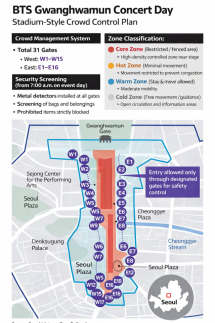 BTS Live D-4 : Transit tip for the concert big day SEOUL, March 17 (AJP) - An estimated 260,000 people are expected to flood central Seoul Saturday for the BTS comeback concert, turning the historic Gwanghwamun district into a vast open-air theater. Authorities estimate that while 22,000 ticketholders will be seated near the main stage, the larger crowds packing the city’s main boulevard and surrounding streets will effectively transform much of downtown into a pedestrian-saturated festival zone. In anticipation of the large numbers of international fans, Seoul is rolling out new measures to improve transit access. Starting Tuesday, overseas-issued credit and debit cards will be accepted at subway ticket machines across 273 stations, allowing visitors to purchase single-use tickets and short-term transit passes without cash. To accommodate the surge, major roads around Gwanghwamun Square will be gradually shut down. Sections of the Sejong-daero boulevard will be closed from Friday evening, with additional restrictions extending through Saturday and into early Sunday as crowds disperse. Public transportation will also be reconfigured. To ease congestion, 62 bus routes, including city, regional and airport lines, will be diverted away from the area, while nearby subway stations such as Gwanghwamun, City Hall and Gyeongbokgung may temporarily skip stops or restrict access during peak hours. Bike-sharing services will also be scaled back, with 58 public rental stations near the venue suspended in stages ahead of the event. “The concert is exciting, but the scale of traffic controls feels excessive, especially for people who still need to commute or work over the weekend,” said Kim Jun-hwan, a 30-year-old office worker in Seoul. Safety measures will also be in force. Fifteen temporary medical stations will be installed between Gwanghwamun Square to Sungnyemun Gate. Mobile intensive care units and on-site medical teams will also be deployed nearby. Information for non-Korean speaking visitors remains a concern. “The subway system is great, but I haven’t really seen much information about the transit pass or event logistics,” said Sarah Shaun, a 28-year-old BTS fan from the United States. “I’m excited for the concert, but with road closures and subway disruptions, we’re still figuring out how to get to the venue,” her husband Ethan added. “BTS concerts are always intense, so I think even a crowd of 260,000 can be manageable,” Sarah said. 2026-03-17 17:32:54
 -
 BTS Live D-4 - Latest from Gwanghwamun SEOUL, March 17 (AJP) - With BTS’s comeback performance four days away, large-scale stage installation is underway at Gwanghwamun Square, where equipment and structures are being assembled across multiple sections of the site. Heavy machinery and staging crews were seen operating near the main installation area, while nearby sidewalks and elevated vantage points filled with onlookers photographing and recording the preparations. Some visitors were observed using professional cameras and mobile devices to document the setup process as anticipation builds ahead of the event. Moreover, crowds have begun gathering at vantage points overlooking Gwanghwamun Square, where the stage is currently being installed. At the rooftop of the National Museum of Korean Contemporary History, which offers a clear view of the site, people were seen taking photos and recording videos as preparations for the concert continued. Crowds are gathering around Gwanghwamun Square to photograph and document the comeback story from stage construction phase, with some livestreaming preparations using DSLRs and action cameras. Rooftop vantage points overlooking the venue are filling up as fans treat the event as a once-in-a-lifetime moment. The influx is also being felt across nearby commercial districts. Currency exchange operators in Myeong-dong report a noticeable uptick in Japanese and Taiwanese tourists over the past week, while restaurants and takeaway chains are preparing for what some describe as an “unimaginable” surge in demand. Seoul city officials have launched a multilingual live information page covering transport changes, safety rules and venue logistics, signaling a full-scale readiness effort as the concert approaches. 2026-03-17 15:18:37